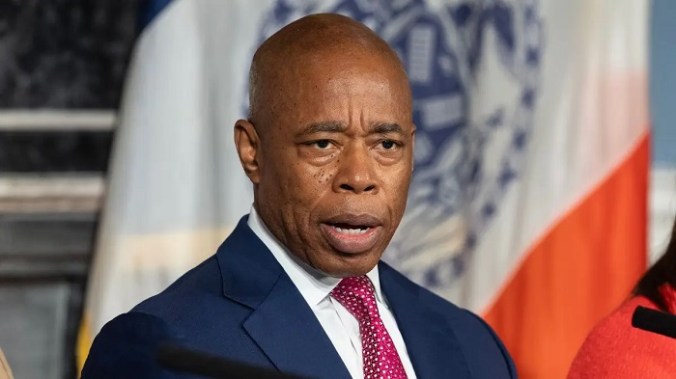
PIX11’s Dan Mannarino interviewed New York City Mayor Eric Adams this week and at the end asked a Barbara Walters-ish question. “Mr. Mayor, we’ve come to the end of what was a very eventful 2023. So, when you look at the totality of the year, if you had to describe it in one word, what would that word be? And tell me why.”
Adams answered, “’New York.’ This is a place where every day you wake up, you could experience everything from a plane crashing into our Trade Center, to a person who’s celebrating a new business being open. This is a very, very complicated city. And that’s why it’s the greatest city on the globe.”
Republicans, conservatives, the social media mobs and even some on the Left “pounced.” “Eric Adams gives the worst answer any politician has ever given to a softball question,” MSNBC contributor (and you know what THAT means) Tim Miller tweeted. echoing the reactions of many Adams critics. (Adams is also being mocked this week for joking that he will occasionally “look at myself, and I give myself the finger.”)
Refreshing as it is to see a Democrat getting the Donald Trump treatment for an off-hand remark that critics deliberately interpret as negatively impossible, Adams doesn’t deserve the brickbats for the 9/11 gaffe. It’s obvious what he meant, isn’t it? Searching for contrasting extremes that illustrate what an exciting and unpredictable place his city is, his mind jumped to the most shocking of all Big Apple events, putting him in instant peril. It reminded me of a scene in “Bang the Drum Slowly,” when the baseball team’s manager (played by one of my favorite character actors, Vincent Gardenia) is trying to give an inspirational speech to his players, who have just learned that their back-up catcher (Robert DeNiro) is dying. He’s determined not to mention that metaphorical elephant in the locker room, but the first words out of the manager’s mouth are “When I die..” Gardenia’s eyes roll in disgust with himself as soon as he hears what he said—the perfect expression of someone thinking, “I can’t believe that I did that!” But it’s like trying not to think of a hippopotamus.
Anyone who speaks often in public and spontaneously is going to have these moments. I speak unscripted for a living, and I think I’m good at it, but now and then the words I hear coming out of my mouth are horrifying. Talk show hosts, reporters, politicians, stand-up comics, teachers—this is an occupational hazard. Most of the social media-dwellers attacking Adams have never given a pubic speech or an unscripted public statement in their lives.
What Adams was trying to say was that his single word description of 2023 from his perspective was “New York” (that’s two words, by the way) because you never know what’s going to happen, and have to be ready for anything. Sure, he would have been safer breaking into a verse of the theme from “New York, New York,” but he didn’t, and once he committed to the “good vs bad” approach, he was stuck. (If he had chosen the Jets losing their starting quarterback on the first play of the season instead of 9/11, he would have been attacked by Jets fans.)
Mayor Adams has had a rocky year to be sure, but as failing Democratic big city mayors go, he’s been lapped in incompetence by the mayors of D.C., Chicago and Boston, among others. He deserves a break.