Slaves, Whales, Humphrey the Hippo, and Captive Animal Ethics

The beginning of the end for this barbaric practice began with the publication of "Uncle Shamu's Cabin"...

Whether or not it is excessively cruel to killer whales to keep them at Sea World and train them to do tricks is an interesting ethical issue that turns on utilitarian principles: are whales as a species better served by the public learning to appreciate them through close contact in zoos than by having them be accessible only in the wild, and does this result justify keeping some whales in captivity, performing like seals? Good question. What isn’t a good question is posed by People for the Ethical Treatment of Animal’s lawsuit against Sea World, suggesting that it violates the Thirteenth Amendment to keep performing whales, because the practice constitutes slavery.

It’s a stupid question. It’s a silly question. It’s an offensive question, equating aquatic mammals with African-Americans. Continue reading

My 15 Hollywood Cures For A Paterno-Penn State-Sandusky Hangover, Part 2

Part 1 listed the first seven of my 15 cinematic remedies for Penn State-inspired ethics ennui. Part 2 includes the final eight. Please don’t take the order too seriously; I could have shuffled the whole batch. I also tried to include as many genres as possible. When it comes to ethics, good lists can be compiled using all Westerns, all sports movies, all war movies, courtroom drama or science fiction. Here we go…

8Spartacus (196o)

The raw history is inspiring enough: an escaped gladiator led an army of slaves to multiple victories over the Roman legions in one of the greatest underdog triumphs ever recorded. Stanley Kubrick’s sword-and-sandal classic has many inspiring sequences, none more so than the moment when Spartacus’s defeated army chooses death rather than to allow him to identify himself to their Roman captors (“I am Spartacus!”)

Ethical issues highlighted: Liberty, slavery, sacrifice, trust, politics, courage, determination, the duty to resist abusive power, revolution, love, loyalty.

Favorite quote: “When a free man dies, he loses the pleasure of life. A slave loses his pain. Death is the only freedom a slave knows. That’s why he’s not afraid of it. That’s why we’ll win.” [Spartacus (Kirk Douglas)] Continue reading

Affronts to Animal Dignity

"Boy, will you look at those idiots watching this? Where is their sense of dignity?"

The Washington Post recently published a photo of an oddball attraction at a minor league baseball game in Harrisburg, PA. A capuchin monkey, garbed in jockey attire, was riding a border collie—really, really stupid, though “really stupid” is the frequent standard of minor league baseball promotions generally. This means that when a club executive suggests, “Hey, howzabout we have some monkeys riding on dogs, like in little saddles?” and the response from the management team is, “That’s really stupid, Ed,” he’ll say, “Great! Then it’s a go!”

I found the picture rather grotesque, but it never occurred to me that the gimmick was unethical. Oh, I assumed that PETA would find it unethical, but PETA believes it’s unethical that animals aren’t allowed to vote.  Several indignant readers wrote to the Post, however, protesting that the photo was “offensive” because it celebrated unethical conduct, the conduct being, apparently,“insulting the natural identity of these animals.” “Monkeys riding boarder collies is just wrong,” wrote one of the outraged. Continue reading

5 Things PETA Doesn’t Understand About Ethics

Stay classy, PETA.

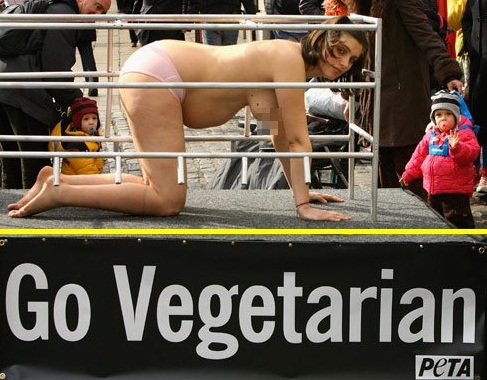
PETA—People for the Ethical Treatment of Animals— has announced that it is starting a porn website to attract attention to the plight of animals. Over on his Business Ethics Blog, Chris McDonald asks whether this means that PETA has “jumped the shark.” More so than offering Octomom money to put a billboard on her lawn advocating spaying pets so they won’t have litters like hers? More so than complaining that Punxsutawney Phil, the groundhog of Groundhog Day fame, should be replaced by a robot? I don’t think so. Besides, jumping a shark would be cruel to the shark.

The tunnel-visioned organization, well on its way to becoming a joke to the detriment of its abused animal constituency, has registered the domain name peta.xxx and plans to launch a pornography website in December that “draws attention to the plight of animals.” How will it do that, you ask? By using images of naked women performing  sex acts on men to attract viewers, and then making the audience observe graphic videos of animal abuse for the privilege of watching the graphic sex. “We try to use absolutely every outlet to stick up for animals,” says PETA spokesperson Lindsay Rajt, who adds that the organization wouldn’t use its “flashier tactics if we didn’t know they worked.”

Let’s put that right at the top of this list, entitled “5 Things PETA Doesn’t Understand About Ethics.” Continue reading

Calvin College, Forfeiting Its Right To Exist

As further proof of evolution, the chimp is behaving exactly like his distant relatives, the adminsitrators of Calvin College

I don’t know what the exact point is that marks where a religious school’s departure from legitimate adherence to its core beliefs metastasizes into a nuisance to society and civilization by affirmatively encouraging life-crippling ignorance. I do know, however, that Michigan’s  Calvin College has passed that point.

Two religion professors at Calvin wrote scholarly papers suggesting that new discoveries in genetics and evolution raised questions about the literal reading of Genesis that could no longer be brushed aside. Neither professor questioned the existence of God or the role of their church, but they argued that the findings of rigorous, modern science may require a theological re-examination of literalist Biblical teachings. Readers of The Banner, the publication of the Christian Reformed Church in North America, promptly blew a Biblical gasket:

“To protect the church and college from false teachers and contrary orthodox beliefs it would be right to let these guys go,” said one commenter. “Clearly, professors who deny the scriptures as interpreted by our creeds and who have broken the promise they made when they signed the Form of Subscription should be fired,” said another. From yet another: “Why is it that so many Christians and academics in Christian colleges seem more concerned about keeping in step with what the world teaches than they are about what God’s Word teaches? Are we ashamed of God’s Word in the face of the beliefs of our worldly peers?”

Calvin investigated the two professors, and as a consequence one of them, John Schneider, resigned the tenured position he had held for 25 years, as part of a settlement with the college. Continue reading

Cats, Kids, and Caretakers’ Betrayals

Perhaps most enraging of all unethical conduct are blatant breaches of trust by a person who has accepted the significant responsibility of protecting and caring for a life in need, whether it is a child, an aged parent, someone who is sick or disabled, or an animal companion. It is  frightening to realize that so many weak and needy lives must rely for their survival on people devoid of basic ethical instincts and common sense. Yet every day, thousands upon thousands of caregivers betray that desperate trust, with only a small percentage of the resulting tragedies making the news. Here are three that ruined my morning:

How many children locked in a car?

In Missouri, police rescued ten children—that’s 10, X, T-E-N, 5 times 2—- whose mother had  locked them in her car, in the afternoon sun, for at least two hours outside a local bar, while she and a male companion patronized the establishment.  Mackisha B. Johnson and Christopher M. Jones were arrested outside the Alibi Lounge on Thursday and charged with misdemeanor child endangerment. The temperature outside was 99 degrees with a heat index of 101, police said.

I would rate such an incident as having signature significance,* proving beyond any reasonable doubt that Johnson is an unfit mother and that to leave any of the children in her care for another second is tantamount to aiding and abetting child abuse. Never mind though; motherhood advocates will be caterwauling that the children are better off with their biological parent, even though she tried to broil them while she was getting smashed with a boyfriend primed to father #11. Continue reading

An Appropriate Limit on the First Amendment Right To Be A Total Jerk

"Pardon? I'm not sure I understood that last remark."

If you peruse the various debates on Ethics Alarms, you will note that every time someone writes or says something cruel, dishonest or uncivil that appropriately brings down criticism or worse on the miscreant’s noggin, he and his defenders  will argue that the First Amendment should render them immune from the consequences of their words. This is not what the First Amendment is about, however. It is about the government not being able to punish them for what they say, with some exceptions. Even then, it is possible to be so inarticulate in your jerkish expression that your utterances are beyond even that constitutional protection.

For example, when you bark like a dog.

Or to be more accurate, when you set out to tease and annoy a police dog by barking. Mason, Ohio has an  ordinance making it a crime to “willfully and maliciously taunt, torment, [or] tease … any dog used by the Police Department in the performance of the functions or duties of such Department.” That’s exactly what Mason Police Officer Brad Walker found a drunken Ryan Stephens doing to Timber, a K-9 German Shepard behind a screen in his police cruiser. Continue reading

Murder House Ethics and the Validity of Feelings

We last visited the issue of the ethical selling of murder houses in February, when  the Jon Benet Ramsey house went on sale. I opined that even though Colorado doesn’t have a legal requirement that a seller must reveal the history of the house as long as it has no structural implications, there is an ethical obligation to let prospective buyers know about house-related events that might cause them to reconsider their decision to buy it:

“The truth is still this: there is something about the $2,300,000 house that makes it undesirable to a lot of prospects, and that means that even if the law doesn’t require the seller to tell interested house-hunters the story of the little dead girl in the basement, fairness and the Golden Rule do.”

The debate over this issue was unexpectedly intense. Ethics Alarms’ resident rational humanist “tgt” objected strenuously, writing,

“I don’t see how you can avoid the slippery slope question. Your basis is 50% of the population having a desire. Is that the cutoff? I think over 50% of people would prefer to live in a house where there hasn’t been child abuse. Go back a few years, and I bet a significant portion of the population would prefer to live in a house that had never had black occupants. Back in today’s world, more than 50% of the population doesn’t want to live in a haunted house. If a previous tenant thought the house was haunted, does the complete nonexistence of ghosts make not mentioning this a material representation? If an event is uncommon, does a realtor need to take a poll before deciding what is material and what isn’t?”

Karl Penny, however, bolstered my position:

“…the question is, does the realtor have an ethical obligation to fully reveal the history of this house. Well, the funny thing about behaving ethically is, it often requires us to act in ways that are not in our own immediate best interest… this may give a potential buyer a leverage point to negotiate a lower price for the house, to the detriment of the realtor, who could end up taking a lower commission as a result. No surprise, then, that the realtor would love to find a reason not to opt for full disclosure. But, if that realtor successfully conceals the house’s history from an actual buyer, one who would not have bought had they known otherwise? The realtor had a simple, human duty to disclose, even if it cost him money (and, yes, even if it cost me money, were I the realtor)….Jack’s right: this is Golden Rule time. If I am willing to treat with someone else in a way that I would not want anyone to treat with me, is that logically consistent (much less ethically consistent)? And would any of us want to live in the resulting society should everyone behave in that fashion?”

Now another house with a Hitchcock-worthy past is on the market: 9337 Columbia Boulevard in Silver Spring, Maryland, a state that also doesn’t require its realtors to disclose when a house has been the scene of a murder…or, in this case, three murders in the last decade. Continue reading

Lying to Dogs

Could you lie to this dog?

I am looking at a box of “premium dog treats” that my sister gave Rugby, my Jack Russell Terrier. (All right, she gave the stuff to me to give to Rugby.) The box says that they are “ridiculously delicious.” I have just offered him one of the “natural wellness nuggets” because we are temporarily out of regular dog biscuits and he is clamoring for his afternoon snack, driving me crazy in the process. You don’t want to be in the room when a Jack Russell clamors.

He refuses to touch it. In the past, he has spat them out; occasionally he will throw them around the house like an Olympic discus thrower would do if he had no arms and could only use his mouth. Clearly, Rugby doesn’t believe the damn things are edible. Continue reading

Ten Lessons from the “Dog Wars” Debate

Wait! Calm down! This is a CARTOON dog.

The “Dog Wars” Android phone app is apparently down for the count, the victim of too many complaints, threats and accusations that it was evil and irresponsible and promotes real, live dog-fighting, even though almost nobody sane makes similar claims about other video games. As with the subject of most posts on Ethics Alarms, however, the ethics issue lingers on, whether or not the specific incident that sparked the commentary has been resolved.

The comments, often passionate, that this post elicited have been fascinating, and had much to teach, even when the comments themselves were dubious. Here are ten lessons from the debate over the game and the Ethics Alarms commentary about it.

1. Ethics alarms aren’t always right. So many comments about “Dog Wars”, here and around the web, consist of various versions of, “That’s just wrong!” Well, why is it “just wrong”? Continue reading