Ethics Quiz: As The Founders Roll Over In Their Graves…[Corrected]

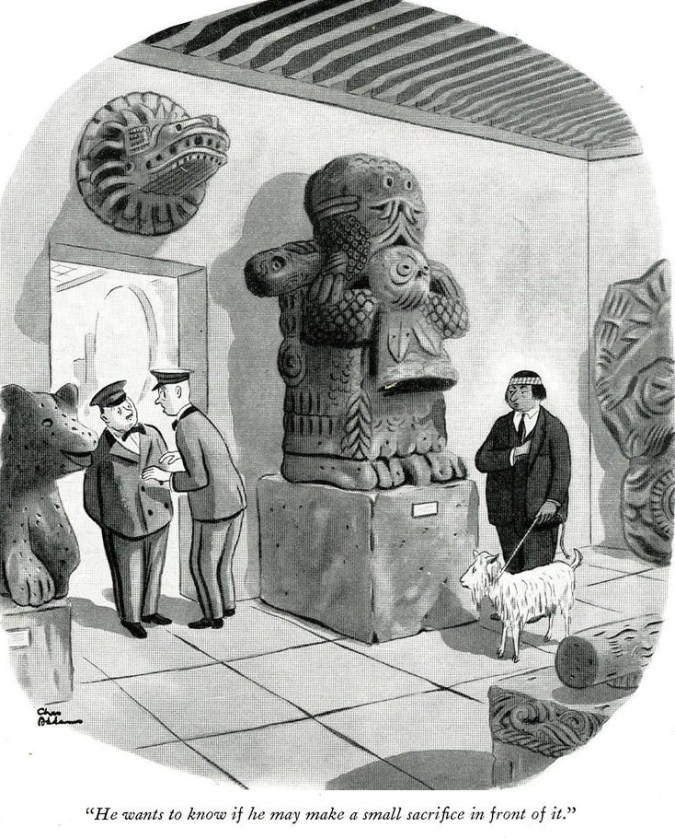
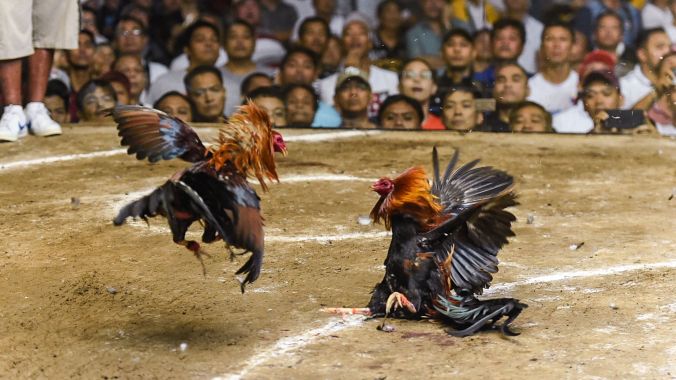
The headline: “Hamtramck City Council votes to allow animal sacrifice for religious purposes in the city.”

The act of animal sacrifice is often practiced among Muslims during the celebration of  Eid al-Fitr, and Muslims make up a majority on the council, it seems. There’s not much more that needs to be said, is there?

Your Ethics Alarms Ethics Quiz to begin this cold and gloomy Thursday (at least where I am) is…

Are animal sacrifices for any reason ethical in the United States of America?

Continue reading

Comment Of The Day: “At Least This Time They Didn’t Blame Pitbulls…”

Happy Boxing Day, for those of you who have servants, butler and and the like! Do make sure your underlings enjoy a Christmas-like experience a day late, after caring for you and your family yesterday!

Ethics Alarms will kick off its Boxing Day festivities with another terrific Comment of the Day by Mrs, Q. I’m hopping it over two other COTD in waiting, in part because I feel guilty: her post was stuck in moderation because I was “making a bit merry yesterday” (Source?) and neglected the blog comments. I apologize to Mrs.Q and my readers. Her comment was stuck because it included many invaluable links to additional information.

She addressed the horrible incident discussed in yesterday’s commentary regarding a fatal dog attack last week that took the life of a couple’s newborn child. Mrs. Q concentrates her ethics marksmanship on an aspect of the story that I mentioned, but only broadly: the parents’ accountability for the tragedy.

Here is Mrs. Q’s Comment of the Day on the post, At Least This Time They Didn’t Blame Pitbulls…

***

Perhaps I’m being harsh, but I do think the parents and every parent or guardian this happens to, should be charged.

We have an incredibly irresponsible ethos going on in the world of dog ownership. People who willingly choose to have a dog, of any size dog, around small children, without educating themselves on danger behavior signals, is complicit in spreading such violence.

The killings of children is just a part of it. 50% of kids under 12 have been bitten by dogs. Most dog bites children experience happen over 70% of the time on the face and neck. Continue reading

At Least This Time They Didn’t Blame Pitbulls…

This is such a horrible Christmas story that even my fecund imagination couldn’t devise an appropriate graphic for it, yet attention should be paid.

On December 23 in Cave Spring, Arkansas, a family’s dog attacked and killed a four-day old infant girl. The dog bit the baby’s head, fatally injuring  the infant’s skull. When I read the story, my second thought after the obvious first one was “Now watch: this will be called another pit bull attack.” Amazingly, it wasn’t: the dog was a Siberian Husky. That didn’t stop the news media from attaching alleged pit bull horror stories to this one, like the attack by two Staffordshire terriers, one of several breeds called pit bulls, that killed two small children and injured their mother in October. I did learn something from the various articles: 32% of all fatalities from dog bites in the U.S. are children 4 years-old and under. Continue reading

“You’re The Dog”

The Wall Street Journal’s James Taranto—how I miss his blog!— famously wrote of accusations that something was a “racist dog whistle”:

“The thing we adore about these dog-whistle kerfuffles is that the people who react to the whistle always assume it’s intended for somebody else. The whole point of the metaphor is that if you can hear the whistle, you’re the dog.”

Bingo. In the last week we have seen two particularly vivid examples of this phenomenon. The most recent is peak Great Stupid: the World Health Organization announced  that it will begin referring to monkeypox as “mpox.” Why? Well, there were complaints that its name constituted “racist and stigmatizing language.”  Yes,  all it takes to make WHO jump is complaints from morons, or perhaps power-seeking activists who want to see how easily they can bend organizations to their will, just to prove they can. Continue reading

Who Would Have Suspected That A Historic Appointment Like Sam Brinton Would Embarrass The Biden Administration?

I wish I could say “I told you so,” but I didn’t, exactly. The last time Ethics Alarms discussed Sam Brinton, Energy Department’s chief of nuclear waste disposal, it was in an Ethics Quiz that asked, “Is it competent and responsible for someone like Sam to hold an executive  position of trust in a Cabinet Department?” To this I added,

“Within this quiz are several other questions, like “Should an individual representing the administration, the Energy Department and the U.S. government be publicizing his kinky ways?” and “Is the judgment of an official who behaves in pubic like Sam inherently questionable?” and “Is there a Simulated Sex with Puppies Deputy Assistant Secretary Principle?”

Yes, one of Sam’s passions is simulated sex with puppies. But he’s just pretending.

I said I would reveal my answers after the commentariat weighed in, but I never did. Now comes the news that Brinton, who was hired by the administration in February, was filmed allegedly stealing a woman’s roller bag at the airport’s baggage claim area by security cameras on Sept. 16, according to a criminal complaint filed on Oct. 27. Security footage also showed Brinton taking the woman’s luggage from the baggage carousel and then removing the tags before leaving the scene at a “quick pace,” according to the complaint. Brinton initially told police that be grabbed the bag and no clothes or objects had been removed. Later he changed his story. The contents of the bag, valued at $2000, have not been found.

Continue reading

Ethics Quiz: A Horse By Any Other Name…

In the pantheon of 2022 “Wait…WHAT?” headlines, “Help! I’m So Embarrassed by the Name of My Daughter’s New Horse!” is an instant classic. This comes by way of a query to Slate advice columnist “Dear Prudence,” and you have to pay to see what wise ol’ Prudence decrees. Well, I’ve read enough of Prudence’s advice over the years and have been unimpressed. I don’t care what she thinks; I care what you think (and what I think, naturally). Here’s the letter:

My 10-year-old daughter is a horse girl. She’s outgrown her first pony, so we just bought her a new horse. This horse was priced right, he’s the perfect size, age, and temperament, and he’s trained in what she wants to do—we seriously could not have found her a better horse. Except for one thing. He’s an almost entirely white Pinto, and his registered name is [Farm Name] White Flight. I don’t want to know what his breeder was thinking. My daughter thinks it’s beautiful. But I would be embarrassed to have my child showing on a horse with this name, and I want to officially change it, or at least call him by another name. I’ve explained the meaning of “white flight” to her, but she still thinks it’s a perfect name for a white showjumping horse and says she wants to use it to mean something good, instead of something bad. How can I convince her to rename her new baby? Would it be too mean to say either the name is changed, or the horse is sold and she can’t have another one?

—Whitest Problem Ever

Ah, the problems of families who can afford to buy their child two horses before she’s eleven! But I digress…

Your Ethics Alarms Ethics Quiz of the Day is…

“Is there an ethical obligation to change the name of the horse from “White Flight”?

Continue reading

Weird Tales Of The Great Stupid: The “Ghost Horses”

We haven’t had Sheriff Bart and the Waco Kid as guests here for a while, and this story seems like an appropriate one for their illumination. I know I keep saying that The Great Stupid has reached Peak Stupid only to find something worse, but I don’t know how one gets dumber than this. The tale out of Lake County, Ohio is even more ridiculous than Biden’s speech last night.

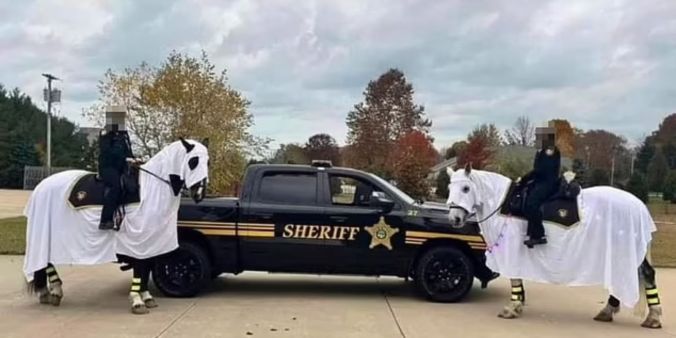
For some reason known only to the rogue neurons involved, the Lake County mounted police decided that it would be a grand Halloween gesture to costume their horses as “ghost horses.” Never mind that nobody knows what a ghost horse looks like. My only clue is the various versions of “The Legend of Sleepy Hollow,” in which the ghostly Headless Horseman rides a black steed with red glowing eyes. Then there were the ghost horses in Disney’s “Darby O’Gill and the Little People,” which were just horses you could see through. It would never occur to me, if I were asked to imagine a ghost horse, that one would look like a normal horse under a sheet with little eye holes cut in it. Nonetheless, that’s what those whimsical cops came up with, as you can see:

Now, since the ghostly steeds made their appearance on Halloween, I admit that was a big clue to the cognitively engaged regarding what the cops were going for.  Nonetheless, many residents, we are credibly informed, were alarmed because they thought these were Ku Klux Klan horses.

“That was poor execution for a ghost,” said one offended resident. “You go back and look at pictures of the Ku Klux Klan, it’s like the exact replica of what the horses looked like.”

Well, now, that’s not exactly accurate. It is true that the Klansmen sometimes had their horses in white sheets… Continue reading

Briefly Noted: Cute! But Insane…

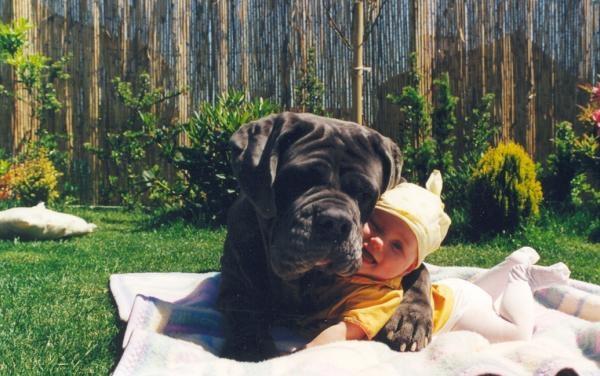
Awwww!

That’s a mastiff, arguably the gentlest dog breed there is. And whoever put that tiny baby there should be arrested.

These are the kinds of episodes that lead to furious protests about “vicious dogs” and legislation that forces people to euthanize undeserving pets. Whoever posted that photo online is an irresponsible idiot as well, even if it isn’t the same dolt who put the baby there. This gives the multitude of ignoramuses who own dogs or have babies (or both) potentially deadly inspirations.

Here’s One Way Websites Lose Credibility On Ethics Alarms…

…Publishing ignorant “pit bull” hysteria.

I like “Not the Bee,” an oddity-collecting, usually political website that up until today sent me a daily bulletin. Today, however, the site decided to join the ranks of those who spread ill-informed anti-pit bull breeds propaganda. I saw a new wave of this coming: a recent news story had recounted how two “pit bulls” in Tennessee had killed a five-month old and a two-year-old and attacked the mother, wounding her grievously. “Not the Bee’s” appeal to authority is conservative pundit Michael Knowles, who as far as I can determine, has no special expertise about dogs whatsoever. Nonethless, NTB quotes a Knowles tweet [“I know some people like them, but we should obviously kill all the pit bulls.”] and headlines its irresponisble (and damaging) story, “Michael Knowles is 100% correct about pit bulls and I could care less how much you think I’m a monster for saying so.”

No, I don’t think the NTB writer (Jesse James) is a monster; he just doesn’t know what he’s talking about. His screed relied heavily on this chart…

Continue reading

The Answer To This “Ethics Question” is Easy, But There’s More To It Than The Answer

The New York Times headline is “How a Dog’s Killing Turned Brooklyn Progressives Against One Another.”

It begins with this opening, which is raw meat tor an ethics blogger:

Real-world ethics question: In a well-used city park, a man with a history of erratic behavior attacks a dog and its owner with a stick; five days later, the dog dies. The man is Black, the dog owner white; the adjoining neighborhood is famously progressive, often critical of the police and jail system. At the same time, crime is up in the neighborhood, with attacks by emotionally disturbed people around the city putting some residents on edge.

In a dog-loving, progressive enclave, where pushing law and order can clash with calls for social justice, what’s the right thing to do? How do you protect the public without furthering injustice against this man?

Well, let’s start with the point that if an ethics question isn’t “real world,” then it’s useless, or at best a waste of time. Ethics is the process of figuring out what the right thing to do is in possible situations that require balancing, prioritizing, and maintaining societal standards and principles without which civilization devolves into chaos. The first question shows flawed ethical analysis from the outset: “In a dog-loving, progressive enclave, where pushing law and order can clash with calls for social justice, what’s the right thing to do?” The right thing to do isn’t affected by how dog-loving the community may be, or what attitudes toward law enforcement and social justice may be. Attitudes, like biases, don’t alter the ethics rules, they just affect whether the results of applying them are popular.

Continue reading