The Easy Ethics Verdict On Trump’s Middle East Immigration Suspension

immigration-protests

There are three steps to evaluating the ethical nature of any law or government action. The first is what was done. The second is how it was done. The third, and usually most difficult to assess, is why it was done, and whether the measure’s objectives are ethical, including whether the measure can reasonable be expected to accomplish them. . What President Trump’s controversial Executive Order temporarily halting immigration from seven Muslim nations is was covered in the previous post on the subject. Thanks to the fact that our mainstream journalists are incapable of reporting some news events without allowing their biases to distort or confuse the facts, the what was misrepresented to the public, and that misrepresentation is reflected in most discussions of the relevant issues on the web.

How the measure was implemented is an ethics  issue, as this involves competence, responsibility, accountability, diligence and leadership.

The Executive Order was incompetent and irresponsible.

There, that was easy.

It’s nice to be able to post an analysis here that nobody will disagree with. Usually I don’t even bother posting such verdicts.

The sudden order (you can read it here) caused world-wide confusion. Passengers were barred from flights to the United States. Customs and border control officials received notice and instructions in the wee hours of the morning, and many began work without knowing what they were supposed to do.  The order  blindsided Trump’s cabinet—what there is of it so far—including Homeland Security chief John Kelly and, incredibly, “Mad Dog”  Mattis, the new Secretary of Defense, who was not consulted by the White House during the preparation of the order and was not given an opportunity to provide input while the order was being drafted. Mattis did not see a final version of the order until a few hours before President Trump arrived to sign it at the Pentagon. Now he really has reason to be be mad. Continue reading

The Media’s Unethical Reporting On Trump’s Refugee Pause Order: Does Telling The Whole Story Fairly And Accurately Even Matter To These Hacks Any More? Does Their Trump-Hating Audience Even Care?

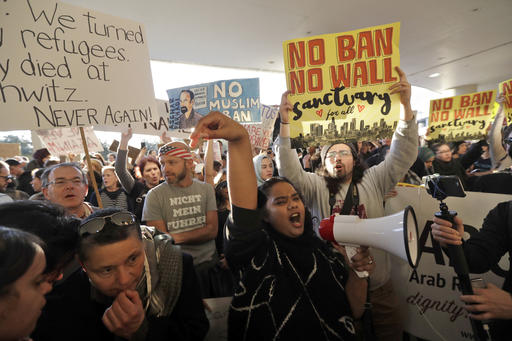
How many of these protesters have read the Executive Order they are protesting? My guess; none of them.

How many of these protesters have read the Executive Order they are protesting? My guess: none of them.

I didn’t intend this to become Outrageously Unethical Journalism Sunday, but that’s how it is turning out. Not my fault. Don’t blame the messenger.

Here, for the sake of organization and clarity, are some things that you may not have been told about the Trump refugee order that all the Sunday Morning TV shows are and the news sources yesterday were going nuts over. I couldn’t watch all of the former, of course, and some are going on as I write this. Maybe some responsible journalism snuck in, and if it did, please let me know who was responsible, in both senses of the word. So far, however, the mainstream news media is doubling down on its determination not to allow facts to get in the way of its 24-7 effort to demonize President Trump, and my increasingly bats Facebook friends, and yours, I assume, are taking it all as the Utter Truth…

I. Calling the Trump Executive Order a “Muslim Ban” is a lie. Nothing less.

II. In 2011, President Obama ordered a halt to the acceptance of refugees from Iraq for six months (that’s twice the three months of the Trump order yesterday) with no adverse reaction from the news media whatsoever.

III. The seven nations targeted in Trump’s order were not his administration’s collection, but Obama’s, with the addition of Iran.

IV. All of this had to be included in any competent, fair and truthful report about yesterday’s order. As of yesterday, none of it was, at least in major news sources, or the information was buried deep in the reports under hysterical headlines.

Got all that?

It is 100% true. If you were not aware of it before, you are misinformed. If you or your family, friends or acquaintances were on social media proclaiming that the order proves Trump is Hitler, just as you suspected, without knowing the above, you are spreading fake news. If you did this while knowing the above, you are deliberately misrepresenting reality to press your misguided false narrative. Or, in the alternative, you are a rationalizing fool.

Remember, no ethical analysis can proceed without accurately establishing the answer to the question, “What’s going on here?” If one does not have the facts, one cannot perform the analysis. Answering the question incorrectly, as in “What’s going on here is that a xenophobic madman just violated the Constitutional right to the free exercise of religion!!!! ARGGGHHH!” also guarantees a flawed analysis.

You will note that the best sources for establishing the shockingly biased and unethical reportage of this event are conservative sources. This is because this right-biased alternative to the left-biased news media developed specifically for situations like this, in which the truth is deliberately skewed by political bias from the exact same people the public has been taught to trust to keep it informed. As the previous post also demonstrates, that trust is no longer warranted.

Right up front, I want to credit Prof. William Jacobson of Cornell Law School. Every single news source had an obligation to include the information he researched and posted on his blog, but none did.  Now, some details:

1. Read the order itself. Scroll past it if you want to my commentary, but as the professor says, “You should read the actual EO, because most of the media and leftist pundits either have not or are lying if they have.” It is long; I have formatted it for easier reading, but it is long. Nonetheless, the news media have proven beyond, not just a reasonable doubt but the shadow of a doubt that its journalists cannot be trusted to digest this kind of document and relay it truthfully.

Res ipsa loquitur: CNN, from which I obtained the text, headlines the order,

Full text of Trump’s executive order on 7-nation ban, refugee suspension

But there is no ban! That headline is fake news. If you don’t read the order yourself, and yet start ranting on Facebook about the suspension of freedom of religion or some other non-factual nonsense, then you are irresponsible, and you are spreading disinformation. Read it yourself, ascertain what it means if you are uncertain, or shut up about it.

And welcome the era of biased, untrustworthy, partisan journalism.

Here is the EO: Continue reading

From The “Double Standard” Files: Obama’s Voter ID Lie

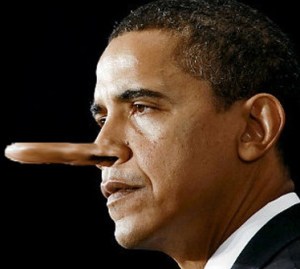
"What? No, I think he looks just fine! He always looks fine!"

“What? No, I think he looks just fine! He always looks fine!”

This will undoubtedly be called a partisan post, and when it is, I will be ticked off. It is not partisan to object to outright lies. It is partisan to ignore and accept lies according to who the liar is. This is the bind the news media has placed itself in, and a brilliant, throbbing example occurred during President Obama’s last press conference.

Discussing his concerns about state voter ID  laws, Obama said,

“We’re the only advanced democracy in the world that makes it harder for people to vote.  It traces directly back to Jim Crow and the legacy of slavery, and it became sort of acceptable to restrict the franchise. . . . we are the world’s oldest continuous democracy, and yet we systematically put up barriers and make it as hard as possible for our citizens to vote….This whole notion of election-voting fraud, this is something that has constantly been disproved. This is fake news.”

Wait, by “this is fake news,” was the President really  announcing that what he just said was fiction? That would be very impressive, and a great new standard: imagine if the news media did that, and flagged their misleading stories!  But I’m pretty sure that he was trying to make us believe what isn’t true, and a falsehood that supports the phony narrative that efforts to ensure the integrity of elections are really racist plots. Explicates John Fund:

“All industrialized democracies — and most that are not — require voters to prove their identity before voting. Britain was a holdout, but last month it announced that persistent examples of voter fraud will require officials to see passports or other documentation from voters in areas prone to corruption…In 2012, I attended a conference in Washington, D.C., of election officials from more than 60 countries; they convened there to observe the U.S. presidential election. Most were astonished that so many U.S. states don’t require voter ID…. [O]ur neighbors require voter ID. Canada adopted voter-ID requirements in 2007 and saw them reaffirmed in 2010; they have worked smoothly since, with almost no complaints. Mexico’s “Credencial para Votar” has a hologram, a photo, and other information embedded in it, and it is impossible to effectively tamper with it. …Britain is painfully learning that it too must take steps to restore confidence in its elections. Sir Eric Pickles, a former Conservative cabinet minister, warned earlier this year, in a government-commissioned report titled “Securing the Ballot,” that voter fraud had been allowed to fester in Muslim communities because of “politically correct over-sensitivities about ethnicity and religion.” Sir Eric said that the authorities were in a “state of denial” and were “turning a blind eye” to fraud cases. Last month, Theresa May’s government responded to the problem. It announced that “endemic corruption” meant that voters in certain areas will now have to show photo identification. The government may even require people to prove their UK citizenship before granting them the right to vote.”

Continue reading

From The “Illiteracy And Incompetence Are Unethical” Files: Moby Dick Restaurant Loses Its Lease

moby

I love this story! Just when I was despairing over the widespead ignorance in the U.S., Canada steps up.

In Vancouver, Mengfa International owns  a commercial building, and in May 2015,  agreed to lease it to Moby Dick Restaurant, a fish-and-chip franchise. The building council won’t allow it, though. They feel that the restaurant’s name is offensive, and its offensive sign would lower property values.

Asks Drew Curtis’s Fark: “What’s so offensive about “Moby”?

This is a Niggardly Principle classic.

Mengfa is suing.

Human Rights Watch Boards The Ethics Train Wreck

human-rights-watch

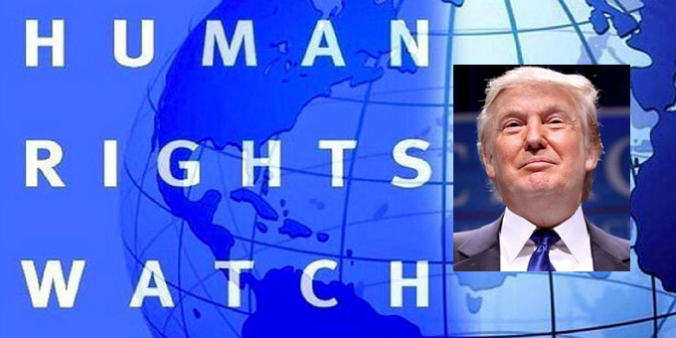
When a supposedly non-partisan organization behaves like Human Rights Watch has, placing a President Elect on its “human rights watch” before the individual has spent a day in office or even remotely violated any human’s rights, we should be grateful. It is a confession of bias and political motivation for all to see and remember for the future.

Yes, incredibly, the Washington, D.C-based organization prepared a  687-page World Report including a U.S. section substantially aimed at stoking the fear-mongering of the Left as a presumptive strike against the incoming executive branch of the U.S. Government.

Beginning by calling Trump’s campaign a “vivid illustration of the politics of intolerance,” the organization made hyperbolic characterizations of the campaign, which is, of course, all it has to go on. As Ethics Alarms has pointed out before, this is the equivalent of pre-crime. The group is calling Trump a human rights threat because it is looking into the future.

“Donald Trump’s election as US president after a campaign fomenting hatred and intolerance, and the rising influence of political parties in Europe that reject universal rights, have put the postwar human rights system at risk,” the group said in its statement announcing the report.  No, political campaigns, as Americans observe ruefully every election cycle,  have disturbingly little to do with what the politicians elected actually do. I’m sure Human Rights Watch knows that, but why should reality dissuade a political hit job?

What does Donald Trump have to do with political parties in Europe? He’s barely conversant regarding his own party. Never mind, never mind: the Left’s theory is that Trump is  to blame for anything and everything they don’t like, and if he hasn’t done some horrible thing yet, they know he will. And since they know he will, why wait before condemning him for it? Continue reading

Ethics Quote Of The Month: Secretary Of State John Kerry

mitchell-kerry_140226

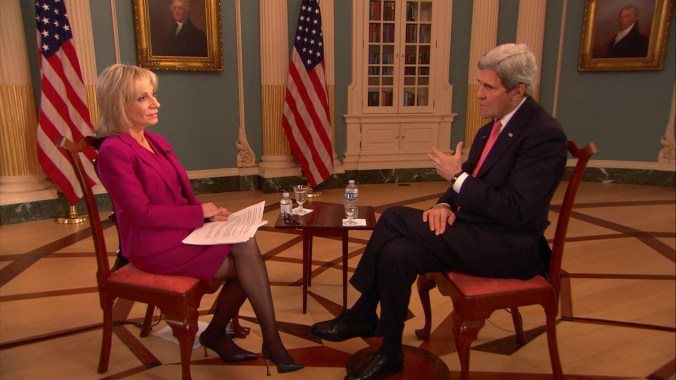
“…I’m proud of all the efforts we made to try to lead people to a peaceful resolution.”

John Kerry, in an interview on MSNBC, when asked if he had any regrets about the Administration’s handling of Syria;

The Sec. of State’s full answer:

Well again, Andrea, I’m going to have a lot of opportunities to be able to look back and digest what choices might have been made. I’m not going to do it now… Except to say to you, very clearly, that I’m proud of all the efforts we made to try to lead people to a peaceful resolution. And in fact, the only solution to Syria will be a peaceful agreement along the lines of what we laid out… and the several communiques that we issued, and the United Nations resolution that we passed. 2254. Those will be the basis for whatever happens, if they get there.

No, I’m not going to call Kerry’s statement an unethical quote, even as close as it came to making my head explode. Fortunately my expectations of John Kerry are basement-level low, from long experience. However, the latest fatuous sentiment from this veteran doofus is provocative and instructive.

In many pursuits, as we discuss here often, whether someone has done the right thing, made the ethical choice, should be evaluated on the basis of whether the conduct was competently considered and arrived at according to facts and ethical considerations before the conduct commenced. Judging its ethical nature  afterwards, when factors the decision-maker could not have foreseen or controlled have affected the result, is a fallacy: “It all worked out for the best” and thus the decision must have been ethical. This is consequentialism, and “the ends justifies the means” in its most seductive form.

A very recent example was the Republican leadership’s decision not to consider President Obama’s nomination of Merrick Garland to the Supreme Court. No, the tactic wasn’t unconstitutional or illegal. It was unethical, however: obstructive, partisan politics defying tradition and fairness. It was also, as I pointed out at the time, stupid. When Obama, knowing of the GOP’s intent, appointed not a flame-breathing left-wing zealot but a moderate-liberal judge of impressive credentials, the GOP majority in the Senate should have rushed to confirm him, knowing well that a nomination by Obama’s presumed successor, Hillary Clinton, would unbalance the Court to a far greater degree.

The GOP lucked out, as we now know. Now President Trump will fill that vacancy on the Court, with major impact on important legal disputes for decades to come. That’s all moral luck, however. The ethics verdict on the conduct still stands. It worked, but it was wrong.

Success is not irrelevant to ethics, of course. Many jobs are ethically complex because getting a desired result is part of the mission. The result and the manner of achieving it are important. If your job is to win the war, you can’t say you did an excellent job if the war was lost. Competence is still an ethical value. A successful CEO’s company does not go belly-up by definition. Government is often analogized to sailing a ship to a destination, or flying a plane, with good reason. Part of the responsibility a government leader has is to make choices that work to the benefit of  those governed, and others as well. A captain whose ship sinks cannot say afterwards, “I did one hell of a job.” Continue reading

Comment Of The Day: The Russian Cyber-Attack Report: Observations And Questions

putin

Ethics Alarms is grateful to reader Greg, the author of this first Comment of the Day of the New Year, for supplementing the recent post here, and providing a critical and more detailed assessment of the intelligence community’s much ballyhooed report on its conclusions regarding Russian cyber-attacks during the 2016 election, with the alleged purpose of defeating Hillary Clinton.

I am particularly relieved that he shares my own reaction to the report, which simply did not deliver on what was promised by James Clapper in the hearings earlier in the week. Oddly, the news media and almost everyone I know miraculously seem to think it did.  The two key issues I, and I assume everyone, wants clarified is 1) whether Russia was indeed trying to elect Donald Trump, as opposed to generally gumming up the works, embarrassing the likely President (Clinton, of course), undermining public faith in the democratic system, and basically making everyone involved look like fools, knaves, and boobs (Note that Trump appeared to be handling his side of that task all by himself) , and 2) did their efforts in fact have any effect on the results? Answering the first clearly and decisively is essential to understanding the second: to most people, if Russia’s actions were designed to make Trump President, and in fact Trump did shock the world by becoming President, this creates a rebuttable presumption that in fact the Russian Government, and Vladimir Putin in particular, did affect the results of the election. That millions of people regard the matter in this way is certain, because we know that millions of people are desperately searching for some conspiracy or sinister outside agency to explain an event that shattered their expectations and world view.

We also know that the false belief that the sequence Conduct  A is intended to cause Result B, A occurs,  B occurs after A, ergo A caused B, is widely accepted, because public school  teachers are too busy teaching that the United States oppresses minorities  to get around to logic.  Now, that sequence is utter crap, validating, among other things, superstitions and rain dances, but never mind most people think that way.

Yet the report provides no evidence to support the intelligence community’s conclusions in either matter. I find that incomprehensible, and also irresponsible. What the report does  say, in essence, is, “Trust us, we’re experts,”  and leaves the rest to confirmation bias. Could the authors not have provided some evidence to support these conclusions? If not, why not?

Here is Greg’s Comment of the Day on the post, The Russian Cyber-Attack Report: Observations And Questions:

This so-called “25-page report” is almost entirely padding and filler. I read it and I don’t see anything in it that adds to what we knew before the report was issued. Continue reading

The Russian Cyber-Attack Report: Observations And Questions

The first page of the Joint Analysis Report narrative by the Department of Homeland Security and federal Bureau of Investigation and released on Dec. 29, 2016, is photographed in Washington, Jan. 6, 2017. Computer security specialists say the technical details in the narrative that the U.S. said would show whether computers had been infiltrated by Russian intelligence services were poorly done and potentially dangerous. Cybersecurity firms ended up counseling their customers to proceed with extreme caution after a slew of false positives led back to sites such as Amazon and Yahoo Inc. Companies and organizations were following the government’s advice Dec. 29 and comparing digital logs recording incoming network traffic to their computers and finding matches to a list of hundreds of internet addresses the Homeland Security Department had identified as indicators of malicious Russian intelligence services cyber activity. (AP Photo/Jon Elswick)

From The New York Times today:

President Vladimir V. Putin of Russia directed a vast cyberattack aimed at denying Hillary Clinton the presidency and installing Donald J. Trump in the Oval Office, the nation’s top intelligence agencies said in an extraordinary report they delivered on Friday to Mr. Trump.

The officials presented their unanimous conclusions to Mr. Trump in a two-hour briefing at Trump Tower in New York that brought the leaders of America’s intelligence agencies face to face with their most vocal skeptic, the president-elect, who has repeatedly cast doubt on Russia’s role. The meeting came just two weeks before Mr. Trump’s inauguration and was underway even as the electoral votes from his victory were being formally counted in a joint session of Congress.

Soon after leaving the meeting, intelligence officials released the declassified, damning report that described the sophisticated cybercampaign as part of a continuing Russian effort to weaken the United States government and its democratic institutions. The report — a virtually unheard-of, real-time revelation by the American intelligence agencies that undermined the legitimacy of the president who is about to direct them — made the case that Mr. Trump was the favored candidate of Mr. Putin.

The Times story is a mostly fair, if incomplete, description of the report itself, which is a provocative, disturbing and infuriating document. Damning? I don’t know about that. Anyone can damn something, but to be sure the damning is just requires evidence.

Observations and Questions:

1. The report isn’t evidence of anything. It just isn’t, and anyone or any source that states otherwise is misleading us. It would not be admissible as evidence if Russia or Putin were on trial in the U.S. for trying to influence the 2016 election. The document is a statement of opinions after analysis of material and sources we are not allowed to see. At the beginning, the report goes to great lengths to explain why this is, and the explanation is sound. Unless, however, the position we are supposed to take is that the intelligence community is to be assumed to be 100% correct, uninfluenced by bias, and  ought to be believed without reservations despite the presence of hard evidence, the declassified report is a statement by experts of an analysis based on experience and study, of exactly what, we don’t know.

2.Regarding the Times story: the intention of the news media to undermine the Trump Presidency and bolster Democrats who want to blame their candidate’s defeat on anything but her own weaknesses and conduct  appears to be on display in the Times story. For example, we have this statement:

“The Russian leader, the report said, sought to denigrate Mrs. Clinton, and the report detailed what the officials had revealed to President Obama a day earlier: Mr. Trump’s victory followed a complicated, multipart cyberinformation attack whose goal had evolved to help the Republican win.”

The leaping to the logical fallacy of post hoc ergo propter hoc (“after this, therefor because of it”) is both a human tendency to be avoided and well-known. This statement appeals to it, intentionally, or incompetently. The fact that Trump’s shocking victory came after the cyber-attacks does not mean or even suggest that the attacks were responsible for that result. The Times immediately, in the next sentence, even states that “The 25-page report did not conclude that Russian involvement tipped the election to Mr. Trump.” Well, those are mixed messages. Do I, based on the uninterrupted anti-Trump attitude of the Times in its headlines, placement of stories, tone and pitch of news reports, op-eds and editorials, conclude that the mixed message is intentional or sparked by negligence seeded by bias?

I do.

3.  Much further down in its story, the Times admits, Continue reading

Major Ethics Alarm: American Journalism Is Crumbling Before Our Eyes [Post Script: Glenn Greenwald]

flag-american-crumbling

Muckraking journalist Glenn Greenwald provided excellent background and searing commentary today on this issue, in his essay, “WashPost Is Richly Rewarded for False News About Russia Threat While Public Is Deceived.” Read it, please.

Some highlights:

In the past six weeks, the Washington Post published two blockbuster stories about the Russian threat that went viral: one on how Russia is behind a massive explosion of “fake news,” the other on how it invaded the U.S. electric grid. Both articles were fundamentally false. Each now bears a humiliating editor’s note grudgingly acknowledging that the core claims of the story were fiction: The first note was posted a full two weeks later to the top of the original article; the other was buried the following day at the bottom.

The second story on the electric grid turned out to be far worse than I realized when I wrote about it on Saturday, when it became clear that there was no “penetration of the U.S. electricity grid” as the Post had claimed. In addition to the editor’s note, the Russia-hacked-our-electric-grid story now has a full-scale retraction in the form of a separate article admitting that “the incident is not linked to any Russian government effort to target or hack the utility” and there may not even have been malware at all on this laptop….

***

After spreading the falsehoods far and wide, raising fear levels and manipulating U.S. political discourse in the process (both Russia stories were widely hyped on cable news), journalists who spread the false claims subsequently note the retraction or corrections only in the most muted way possible, and often not at all. As a result, only a tiny fraction of people who were exposed to the original false story end up learning of the retractions.

*** Continue reading

“Start The Car!” Ethics

“Start the car!” shouts the woman in a ubiquitous IKEA TV commercial for its “Winter Sale.” She has received her receipt, and  the total is so low that she assumes there has been a mistake.  She quickly exits the store with bags of purchases, and while running calls to her husband in the car outside so he will pick her up and hit the gas before someone comes to reclaim the merchandise or demand more payment. As they drive away with what she thinks are her ill-gotten gains, she lets out a whoop of triumph.

The narration explains that IKEA’s sale prices are so low, this how you will feel.

The commercial is unethical. It trivializes and normalizes theft, and rejects the ethical values of honesty, integrity and responsibility. Apparently the ad has been running internationally for a long time (it only just started showing up in my region) and is very popular. Writes one industry commentator, “People relate to the message because at one point or another while shopping we’ve all had that feeling that we just got away with something.”

Really? I haven’t. My father didn’t either (my mom was another story.) I’ve told waitresses and clerks that they undercharged me. I’ve returned excessive change. I’ve handed back money to tellers when two bills stuck together. You don’t? What the hell’s the matter with you? Were you raised by Fagin?

Though the commercial was a hit and positively accepted in all of the nations where it was viewed, there is hope:  it also received many negative comments and complaints. An Advertising Standards Board—I cannot for the life of me find out which; the U.S. has no such board. I’m guessing Sweden— thus considered whether this advertisement breached   its Advertisers Code of Ethics.

The breach would be that the commercial isn’t socially responsible, since it represents taking merchandise from a store that hasn’t been fully paid for as normal and acceptable conduct. The Board viewed the advertisement in light of the complaints and decided that the ad was ethically inoffensive.

Guess why.

No, go ahead, guess.

Continue reading