The Fraudulent Sperm Donor

Sperm Bank

The British cartoon above give me the willies the first time I saw years ago it, and it does still. I tracked it down after reading legal commentary on a nightmarish incident in Canada.

Canadian couple Angela Collins and Elizabeth Hanson chose a sperm donor for their planned child who claimed a 160 IQ, a neuroscience PhD, and a perfect medical history.  After their child was born, they learned the surrogate father’s name though an error by the sperm bank, and discovered that Dad had lied: he never graduated from college, was a convicted felon, and had a history of schizophrenia. His sperm bank profile picture was also a fake; I’m guessing he really looked like the guy in the cartoon.

Other than that, he was fine.
Continue reading

Fairness Quandary In Britain: What To Do With A Dog That Ate His Master?

No photo of Buster is available, but this is a Staffordshire Bull Terrier, and if this image  fills you with fear and revulsion, you're an idiot, at least when it comes to dogs.

No photo of Buster is available, but this is a Staffordshire Bull Terrier, and if this image fills you with fear and revulsion, you’re dangerously ignorant, at least when it comes to dogs.

In Waterloo, England last September, a Staffordshire Bull Terrier named Buster (or Butch…he apparently answered to both names, much in the way I answer to my wife when she calls me “Jack” or “You Idiot”…) found himself in a situation reminiscent of the infamous 1972 Andes plane crash that forced its survivors to resort to cannibalism. His master died suddenly, leaving the dog trapped in the apartment without access to sustenance. After an undetermined amount of time and increasing desperation, Buster  decided “Oh, the hell with it” and ate a sufficient amount of his best friend to stay alive..

I know—“Ick.” Buster may well have felt the same way. Once police had made the grisly discovery, however, Buster found himself in big trouble even though he was was in an emaciated state that suggested that he didn’t do this for fun. The police claimed he was a danger to the community, and the deceased’s family made it clear that it wanted Buster to be put down. Dog lovers and animal rights groups insisted that Buster was a victim of circumstance and that absent evidence that he had plotted to convert his live master into a feast, there was no precedent for blaming the victim in such a case.

After all, those passengers who survived in the Andes by eating the bodies of their less-fortunate companions were not executed. They appeared on talk shows.

Why the different attitude? Well, let’s see: Continue reading

The Catholic Church, Its Rapist Priest, And Shattered Trust

The graphic artist didn't place that halo over the rapist priest's head. The Vatican did.

The graphic artist didn’t place that halo over the rapist priest’s head. The Vatican did.

In the year after “Spotlight” focused renewed public attention on the Catholic Church’s horrific betrayal of its mission, its members and humanity by the enabling of child sexual predators within its ranks, how could the Church not realize that reinstating a convicted rapist priest, as it did this week, undermines all of its efforts to regain the trust and faith it had forfeited?

After months in which Pope Francis presumed to tell the governments of the world what its moral obligations were, how could he allow this to occur?

In short, how can a credible religion have broken ethics alarms? How can the Catholic Church preach morality while rejecting ethics?

Father Joseph Jeyapaul,  a Catholic priest from India, served in the Crookston, Minnesota diocese from 2004 to 2005. While he was there, he raped at least two adolescent girls. I say “at least” because he admitted to raping them to cop a plea. Who knows who else he may have assaulted?

After being charged with the crimes, including rape and forcing at least one of his victims to perform fellatio on him, Father Joseph  escaped to India, where an Interpol warrant got him extradited back to Minnesota.  There he confessed, and as part of a plea bargain, received an outrageously light sentence of a year and a day for pleading guilty to one count of molestation.

Don’t ask me to explain why any prosecutor whose law license wasn’t obtained by passing a quiz about “Law and Order” episodes would make such a deal. I assume that some kind of political pressure from the Church was involved, or that the prosecutors were Catholic, or that they had brain lesions or something. Frankly, I’d rather not talk about it.

Jeyapaul was suspended from the priesthood and served his time in Minnesota. The U.S. deported him back to India with a DO NOT RETURN TO SENDER label after his release last July.  Meanwhile, the Minnesota diocese had to pay millions in a civil lawsuit, during which we learned that the rapist priest had told one of his victims  in the confessional that she was at fault, and had made Jeyapaul “impure” by letting him abuse her.

Does the term “evil” come to mind, or would you call that too judgmental?

Now comes the amazing part. In February, the Vatican lifted  Jeyapaul‘s suspension and restored him to the priesthood. It then assigned him to a new parish in India, where he is now the diocesan head of its commission for education. 

I’m sure it’s also a great place to meet chicks.

Continue reading

The Boaty McBoatface Affair, And What It Means For Donald Trump

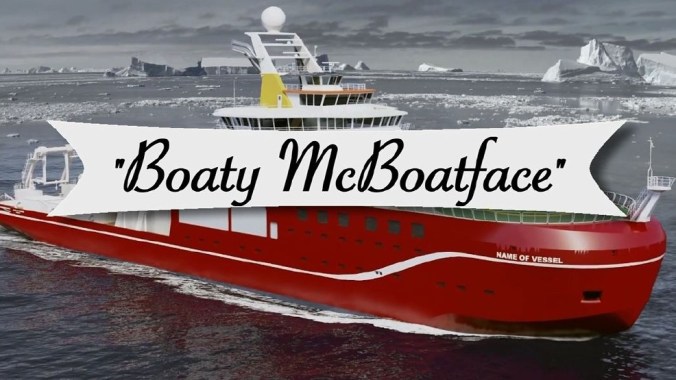
Boaty McBoatface

Great Britain’s National Environmental Research Council has a new $300 million ship being readied for a 2019 launch. It is a 128-yard-long, 15,000-ton beauty designed to serve as a “new polar research vessel which will deliver world-leading capability for UK research in both Antarctica and the Arctic.”  The Council put naming its new ship to the public, and asked for it to choose a name. Apparently in the grip of a Monty Python hangover, the name overwhelmingly chosen in an online vote was “Boaty McBoatface.”

Uh, no. Science Minister Jo Johnson announced that another, more suitable  name would be chosen.“The new royal research ship will be sailing into the world’s iciest waters to address global challenges that affect the lives of hundreds of millions of people, including global warming, the melting of polar ice, and rising sea levels. That’s why we want a name that lasts longer than a social-media news cycle and reflects the serious nature of the science it will be doing,” he said.

Jonathan Turley, who has written two posts about “Boaty McBoatface,” is expressing dismay that humorless bureaucrats would reject “democracy.”  And I’m sure if George Washington Law School decided to have the public pick a new name for the professor’s employer, he’d embrace whatever whimsical, law-mocking choice they made, like “The Greedy McLieface School of Law.”

Turley thinks the ship’s popular name is funny, ergo he thinks its just fine. Of course, he doesn’t have to justify the agency’s budget, or put the gag name on his resume, or convince people to take the projects of an organization seriously when its flagship presents itself as a lark.

Johnson and his colleagues have a higher ethical duty than blindly accepting a “democratic” vote from people who don’t really care about the National Environmental Research Council’s work. “Boaty McBoatface” would be detrimental to the Council’s public image, self-image, moral and effectiveness. They had a duty to reject it. Prof. Turley thought it would be great for T-shirt sales.

He really needs to get off campus more.

Final thoughts: Continue reading

Ethics Quote Of The Week: Secretary of State John Kerry

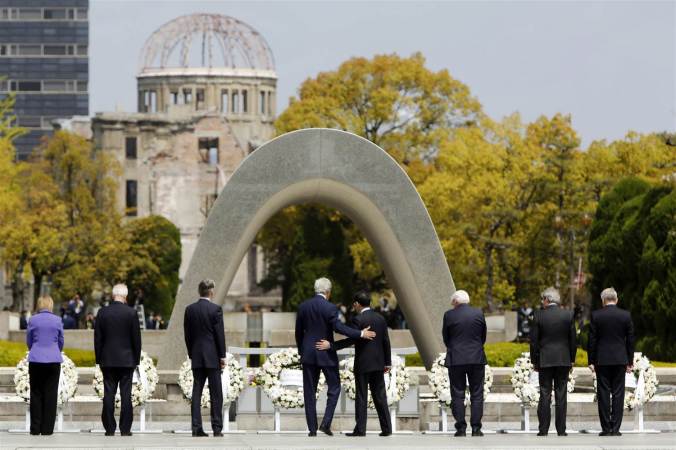
Kerry Hiroshima

“It is a stunning display. It is a gut-wrenching display. It is a reminder of the depth of the obligation every one of us in public life carries … to create and pursue a world free from nuclear weapons.”

—-Secretary of State John Kerry in Japan, as he toured the Hiroshima Peace Memorial and Museum this week before meeting foreign ministers at the G-7 Summit.

I couldn’t quite bring myself to call this an unethical quote, though it is an infuriating one. It is certainly a stupid quote, but we all know John Kerry’s verbal and intellectual deficiencies, and he was indeed in a tough spot. What would have been an appropriate statement to make in this setting, that would not risk insulting his hosts and setting off yet another debate about Hiroshima that would be a distraction from the G-7 Summit’s objectives?

While I agree philosophically with the editors of the Federalist that it would have been more satisfying if Kerry had said that the display was “a reminder of the depth of the obligation every one of us in public life carries to stop extremist regimes like Iran from obtaining nuclear weapons” or perhaps that it was “a reminder of the depth of the obligation every one of us in public life carries to ensure that we are well prepared for the next force that threatens peace,” each carried its own diplomatic and political risks. So would “Sorry you made us do this, but we didn’t bomb ourselves at Pearl Harbor,” which is what I would have been tempted to say. I’m no diplomat, however, as you may have noticed. Continue reading

Ethics Dunces: PayPal, And Those Applauding Its Unethical Grandstanding

PayPal-logo-1

The online payments company PayPal announced that it is cancelling plans to open an office in Charlotte, North Carolina because the state’s so-called “bathroom law” “violates PayPal values.” Dan Schulman, PayPal’s president and chief executive, wrote in a statement this week:

“The new law perpetuates discrimination and it violates the values and principles that are at the core of PayPal’s mission and culture. As a result, PayPal will not move forward with our planned expansion into Charlotte.”

My many knee-jerk progressive Facebook friends immediately slapped their seal-flippers together and barked their approval in unison. “I (heart) PayPal!” more than one wrote. “PayPal is my hero!” wrote others.

Never mind that a corporation has no business using financial muscle to exercise extra-legal vetoes over legislation in states where it is not a citizen and where the actual citizens, in their legal exercise of their rights, have elected representatives who duly passed it. This cheering on excessive and abusive influence on governance by big corporations is especially hypocritical coming from supporters of Bernie and Hillary, who regularly claim that allowing companies the right to engage in political speech magically robs voters of their ability to reason and causes all to vote, zombie-like, according to corporate America’s will.

This is why Bernie Sanders and Donald Trump are leading…wait, that doesn’t make sense, does it? Actually none of the popular and media attacks on Citizens United are grounded in reality, law, or comprehension of the Constitution, and virtually none of the indignant opponents of the decision have read it or listened to the revealing oral argument. But I digress. The point is that the progressives endorse the practice of corporations using their power to warp the system in directions progressives like, but believe that this—this meaning bullying, threats and coercion— is the only form of influence that should be allowed—certainly not speech and advocacy.

That is just half of what makes the cheering for PayPal foolish and cynical. For PayPal is playing these people like a harpsichord, and indulging in outrageous, hypocritical grandstanding. Moving an office into North Carolina where the bathroom privileges of trans citizens are being restricted “violates the values and principles that are at the core of PayPal’s mission and culture,” but somehow… Continue reading

Is It Wrong To Laugh At This Story?

"Now, you're sure about this, right?"

“Now, you’re sure about this, right?”

Jonathan Turley found this strange tale, and the professor managed to find a jurisprudence issue in it. Not me: I want to know if finding it hilarious demonstrates unseemly cruelty.

In Zimbabwe, prophet Shamiso Kanyama instructed his followers to bury him alive as part of a ritual to cleanse their house of evil spirits. They did as he asked, and when they dug him up later he was dead.

The family that buried him is charged with murder. “Now the courts have a case where the victim demanded on religious grounds to be buried alive,” writes Turley. “The followers clearly believed that he could survive out of their own religious zeal. What should be the punishment in such a case?”

Oh, I don’t know: a conviction for murder, but a lighter than usual sentence. I don’t really care: this is Darwinism as work. My question is whether it is proof of a lack of empathy that the story reminds me of Monty Python, and makes me laugh.

Campus “Safe Spaces”= Free Speech Suppression And Intimidation: The Next Step

edinburghBad ideas take root when they are not immediately called what they are—bad—, then mocked, eviscerated, and destroyed with reason, logic and common sense. That is why fools should never be suffered gladly, and why their foolish inspirations should be dashed before they are allowed to draw a breath. Many factors, such as misplaced politeness, mistaking open-mindedness for lack of critical thought, laziness and cowardice  allow these bad ideas to spread like weeds.

Who was it that shrugged when it was first suggested that the U.S. should ignore its own immigration laws? Who was it who failed to point and laugh when someone suggested that rape accusations in colleges should be decided without due process? Who neglected to say, “Whaat?” when a legislator suggested that workers be exempted from doing the duties required of their jobs when their religions disapproved of them? Good ideas can be defended against the attacks of those without imagination or daring. Bad ideas have to slip by, undetected and unrebutted, until they get out of control.

Some, indeed many, allowed the ridiculous “safe spaces” theory to live when it should have been strangled in its crib. Now it is strangling education and open discourse on campuses all over the nation. I’m proud to say that Ethics Alarms did its part deftly when the related argument was raised on various blogs, including this one, that places of debate should be “safe,” in the sense that no commenter risk a harsh rebuttal or an insulting retort no matter what that commenter wrote. We lost a couple of hardy and substantive participants over the issue.

The “safe places” theory is especially sinister, as it also creates places safe for more bad ideas to flourish and grow beyond the stage where they can be stamped out with ease. Of course, not every idea, even good ones, are welcome to all. “Safe spaces” means guaranteed safety from  ideas that are unwelcome to the specific group constructing its safe zone, ideas like, say, “TRUMP 2016.”  It is the culmination of the position that people should be guaranteed the right not to be confronted with opposing views. Now the University of Edinburgh, “influencing the world since 1583,” is showing us what happens when the weeds of “safe spaces” are allowed to spread. Continue reading

MSNBC Reporter Tony Dokoupil Explains Why His Profession Is Incompetent And Untrustworthy

softball_dirt_thumb

On his MSNBC show “Last Word,” host Lawrence O’Donnell expressed surprise that Wisconsin radio personality Charlie Sykes, who conducted a tough interview with Donald Trump this  week, was so much more aggressive that the softball  mainstream media interviewers.

His guest, MSNBC reporter Tony Dokoupil, who is assigned the 2016 campaign beat,  explained that Sykes had done a “one and done” style interview with Trump, which, he said,  journalists who want to have access to Trump over the long haul cannot afford to do.

“People who are on the beat, people who work for our network, they have to keep that relationship going for a long, long time,” Dokoupil said. “Charlie did not have that burden.”

O’Donnell was shocked—shocked!—at this statement. “Well, I don’t think the fact that you have to cover Donald Trump means that you have to then play softball with him so that you can guarantee he will speak to you another time,” he said. “Once the mission of the interview is to get the next interview with the same person, we know how soft that interview is going to be.”

This is hilarious coming from O’Donnell, a blazing partisan who has barely given a tough interview to a Democrat or progressive politician in his life. But I digress.

Dokoupil had committed the cardinal sin of speaking the truth, and it explains a lot. Steve Kroft had essentially made the same confession a couple of years ago when he said that President Obama was willing to do interviews for “60 Minutes” because he knew they would be “fair.” (That was also hilarious, because “fair” is a standard “60 Minutes” has never applied to politicians and leaders it wanted to exhibit in a harsh light. Sorry, digressing again.) The soft-ball approach certainly explains why so many reporters refuse to challenge Trump, and Trump’s boycott and attacks on Fox’s Megyn Kelly for daring to challenge him made explicit the conditions that Dokoupil felt were implied. When ratings are driven by which talking head show gets the falshiest guests, of course most interviewers avoid the “one and done” approach. Is it cowardly? Yes. Does it serve the public interests? No. Does it make lying, misrepresentation and an absence of integrity easy, painless and effective for Trump, Clinton, Obama, Cruz, Sanders, etc., etc.? Sure it does. It also undermines democracy, and is a disgraceful breach of journalism’s obligation to view the public, not its leaders and powerbrokers, as its only constituency.

Would an ethical, trustworthy professional allow this? No, but journalism hasn’t been ethical, trustworthy or professional for a very long time, if ever. For example, the Guardian reported German historian Harriet Scharnberg’s claims  this week that the AP made a mutually beneficial pact with the Hitler regime in order to ensure access to Germany throughout the Holocaust and World War II. The deal had the Associated Press promising to abide by  the Schriftleitergesetz, or editor’s law, agreeing not to publish anything that could be “calculated to weaken the strength of the Reich abroad or at home.” .

I’m sure Lawrence O’Donnell is shocked at this, too.

Ethics Hero: Minu Pauline And Her Curbside Fridge

free food

Ethical people will come up with the damnedest ways to do good things.

After watching the poor and homeless rummage through the dumpster outside of the restaurant she owns in Kochi, India, Minu Pauline thought about how she could facilitate access to the perfectly edible food that her establishment had to dispose of on a regular basis. So when she opened a second restaurant, it included a fully functional refrigerator on the sdiewalk out front.  She stocks it with leftover food from her restaurant, and invites others to do likewise.  Now her customers and residents of the community leave their leftovers and excess food, marked with the date, in the curbside fridge too.The homeless and the poor can take whatever they need 24 hours a day, seven days a week, without having to beg.

Pauline calls the refrigerator  nanma maram, which means “tree of goodness” or “virtue tree.” The name is particularly apt, for she is providing dignity and kindness, as well as charity.

________________________

Pointer: Fred