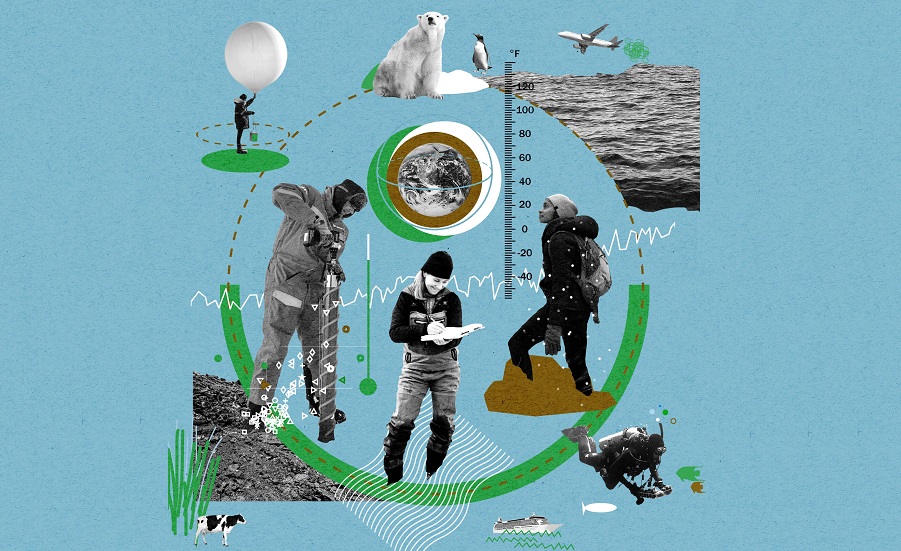
Last month, the New York Times devoted an entire section of its weekly “Science Times” section to an extensive brief for climate change and the policies to undo it, reverse it, mitigate stop it—choose your favorite words. Like virtually everything the Times does now, this was political advocacy, cleverly (cough!) placed in a section that expressly denies its bias and politics. Many things were notable about the section nonetheless; for example, it was written in a style that would be more appropriate for fourth graders, telling us how dumb the Times and their political allies think the public is, and not even the general public, but the portion of the public that reads the New York Times. Furthermore, the piece signals repeatedly its failure by promising more than it can deliver. It begins by promising “facts, evidence, and proof,” but much of what the Times’ reporter, Julia Rosen, calls “proof” is nothing of the kind, and what she calls evidence is subject to other interpretations. She makes it clear on the way that she has made up her mind, calling anyone who questions her conclusions “denialists.” Because she is in the throes of confirmation bias, she can write something like this without either ethics alarms or logic alarms sounding:
“There’s no denying that scientists love a good, old-fashioned argument. But when it comes to climate change, there is virtually no debate: Numerous studies have found that more than 90 percent of scientists who study Earth’s climate agree that the planet is warming and that humans are the primary cause. Most major scientific bodies, from NASA to the World Meteorological Organization, endorse this view. That’s an astounding level of consensus given the contrarian, competitive nature of the scientific enterprise, where questions like what killed the dinosaurs remain bitterly contested.”
But science isn’t determined by a popular vote. The number of scientific questions through the centuries that the majority of scientists had spectacularly wrong and the minority of contrarians had right are too numerous to list. Nor is it an “astounding” level of consensus in a field now overwhelmingly weighted on one side of the political spectrum, in a topic in which dissenters are intimidated, denigrated, and punished academically, professionally, and financially. We are also treated to irrelevancies like this by Rosen: “[Frank] Luntz, the Republican pollster, has also reversed his position on climate change and now advises politicians on how to motivate climate action.”
Oh! A pollster now supports climate change! That certainly settles the issue. Wasn’t this supposed to be about science?
Read the whole piece, which is begging for a thorough fisking. It would be a useful classroom project in critical thinking, if schools taught critical thinking any more. The last section, however, “What will it cost to do something about climate change, versus doing nothing?” is the smoking gun. All of the certainly and “proof” Rosen promises evaporates in desperate double talk, intentional vagaries and contradictions. For example,








 Ethics Alarms