1. I’m cancelling Philip Gallanes. The advice columnist in the Times’ Sunday Styles section has provided some interesting topic for discussion here, but there have to be some consequences for irresponsibly spreading propaganda and falsehoods, even if they are sanctioned by his employers. In response to a “Social Q’s” query from someone who was annoyed that a neighbor had posted a “Defund the Police” sign and asked if it would be ethical to eschew calling the cops if she saw her neighbor’s house vandalized (Answer:Of course not.), Gallanes had to give readers the whole set of George Floyd Freakouts talking points:
“Many of the reports I’ve read about defunding the police focus on limiting the deployment of armed police officers to situations where they may be necessary and helpful — such as violent crimes. Many activists point to the large share of state and local budgets dedicated to police services when many calls to police (about persistent homelessness or family conflicts, for instance) would be better handled by social workers. Why not redirect some police funds to affordable housing and mental health services, they ask?”
Then why not say what you mean, I ask? Defund means defund. I resent this dodge.
“Still others would like to dismantle the current model of policing, as Minneapolis has pledged to do, and reimagine community safety given the frequency with which officers kill unarmed Black men and women.
And how’s that working out so far for Minneapolis, Phil? The frequency in which officers kill unarmed Black men and women is called “infrequently,” and the frequency is decreasing.Continue reading →
Extradimensional Cephalopod lassoed itself a Comment of the Day (I love the image of a cepalopod using a lasso!) with his musings on why races were designated “black” and “white,” since the white/black dichotomy is so frequently used to describe good/evil.
I’ll be back at the end with a rather lengthy discourse of my own on this subject, because it’s a favorite of mine.
I actually find it annoying that on the one hand, human races (groups of humans who share some similarities in appearance) have historically been identified by colors associated with their skin, while on the other hand, completely independently and before meeting humans from other continents on a regular basis, Europeans started to use colors to indicate whether things are good or bad.
This etymology likely came about because when things rot they often turn black, and because blackness implies darkness (the absence of light), which most humans use to evoke ignorance, fear, or bad luck because they can’t see in the dark. (I use the metaphor of darkness in a much more neutral/benevolent sense, but that’s quite rare.) Interestingly, the color white is associated with death and mourning in many Asian cultures.
With the exception of finance (black ink marking positive numbers and red ink marking negative numbers), most historical evocations of the color black indicate evil, corruption, morbidity, or otherwise something negative. “Black heart,” “blackguard,” “black magic,” “black hat,” “black market,” “blackball,” “blacklist,” “black mark,” “black day,” “black comedy/humor”… Continue reading →
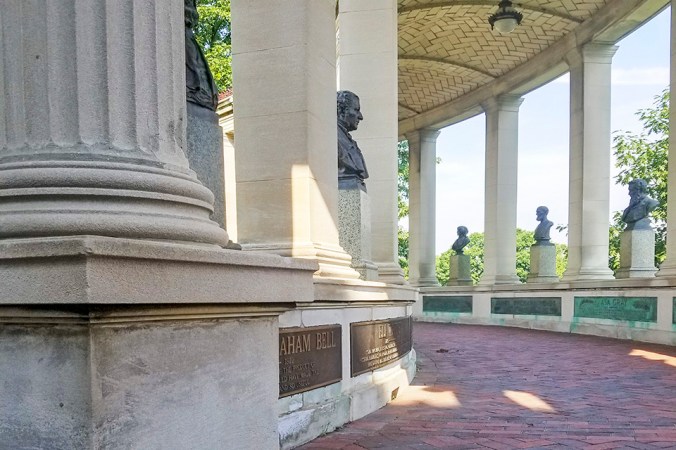
“So today, under the authority vested in me as President of the United States, I am announcing the creation of a new monument to the giants of our past. I am signing an executive order to establish the National [Garden] of American Heroes, a vast outdoor park that will feature the statues of the greatest Americans to ever live.”
President Donald J. Trump, in his otherwise superb July 3, 2020 Mt Rushmore speech.
Ugh. I winced when I read those words, and I’m sure I was not alone. Did the President just come up with that hare-brained idea on the spot? I hope so. I hope his staff is better than to endorse or, worse, support such a terrible, half-baked idea. It is incompetent and irresponsible, and guaranteed to be divisive. Here are three unsolvable problems:
I. The project exposed itself as ill-planned and poorly conceived immediately. The initial list of “great Americans” looked as if it had been assembled by throwing darts at a poster, with someone coming in later to try to make politically correct additions. Here is the (incomprehensible) list, in alphabetical order:
• John Adams
• Susan B. Anthony
• Clara Barton
• Daniel Boone
• Joshua Lawrence Chamberlain
• Henry Clay
• Davy Crockett
• Frederick Douglass
• Amelia Earhart
• Benjamin Franklin
• Ulysses S. Grant
• Billy Graham
• Alexander Hamilton
• Thomas Jefferson
• Martin Luther King, Jr.
• Abraham Lincoln
• Douglas MacArthur
• Dolley Madison
• James Madison
• Christa McAuliffe
• Audie Murphy
• George S. Patton, Jr.
• Ronald Reagan
• Jackie Robinson
• Betsy Ross
• Elvis Presley [2]
• Antonin Scalia
• Frank Sinatra
• Harriet Beecher Stowe
• Harriet Tubman
• Booker T. Washington
• George Washington
• Orville and Wilbur Wright
To only mention some of the choices that make no sense: How can the first group include Douglas MacArthur, who was justly fired for insubordination by President Truman, rather than Dwight Eisenhower, who coordinated the victory over Hitler in Europe, or his boss, General George Marshall? Why would Dolly Madison make the cut, while two far more important First Ladies, Abigail Adams and Eleanor Roosevelt, be omitted? I am an admirer of Davy Crockett, but he didn’t do much of anything except create the model for media-hyped celebrities and manage to get himself killed at the Alamo. There are, oh, I’d say several hundred more substantial “great Americans,” including almost every President, than Davy. If there is going to be an inventors on the list, why only the Wright Brothers? Thomas Edison, Henry Ford, Steve Jobs and Alexander Graham Bell all were of equal importance. Henry Clay’s naive compromises on slavery really did enable the slave trade. He’s a better choice than John C. Calhoun, but less deserving than Daniel Webster. Frank Sinatra? FRANK SINATRA? Ol’ mobbed-up Blue Eyes, leaving off Bing Crosby and Elvis, to name just two equally important pop singers? I’d have Sam Cooke, Buddy Holly, and Chuck Berry planted in the Garden before the likes of Sinatra. Meanwhile, why singers but no songwriters? Where’s Irving Berlin? Rodgers and Hammerstein?The Gershwins? Hank Williams? Why singers but no dancers? Continue reading →
Now the statue-toppling, America-hating, woke-police have come for “Hamilton.”
That’s ignorant and destructive, as well as as stupid, like so much of what we have allowed the Black Lives Matter mobs to do. It is unethical, and as predicted by anyone who has learned the history fanatic movements throughout world history, it was inevitable. Such anger-driven uprisings never stop until they start devouring their own. “Hamilton” doesn’t deserve the attack, but as one of the more arrogant and offensive agents of the resistance when it was just getting rolling on its divisive, self-righteous way, I am finding it difficult to be as sympathetic to its fate as I should be.
You will recall that about a week after the 2016 election, the cast of “Hamilton,” led by its star and creator Lin-Mamuel Miranda, signaled that all rules of fairness, respect and decorum were suspended as the Left vowed vengeance on Donald Trump, his supporters and allies. The cast ambushed Vice-President- elect Mike Pence, who had come to see the performance like any other audience member in any other audience, and who had every right to be treated with the same deference. Instead, the cast called out Pence during the curtain call, and subjected him to a scripted lecture, beginning,
“We hope you will hear us out. We, sir — we — are the diverse America who are alarmed and anxious that your new administration will not protect us, our planet, our children, our parents, or defend us and uphold our inalienable rights. We truly hope that this show has inspired you to uphold our American values and to work on behalf of all of us.”
How naive and quaint those words sound today, a little less than four years later, as the chaotic madness spawned by “the resistance” is in the process of trying to tear down the nation, constrict our rights, and replace our values. Continue reading →
I began the Fourth of July this year by watching the last 90 minutes of “Gettysburg,” Ted Turner’s epic 1993 film. My wife and I had begun watching on July 3, the date of Pickett’s Charge and the final day of the 1863 Civil War battle, but the more than four-and-a-half hour running time took me to Independence Day.
This was the extended version, the Director’s Cut, which adds 17 minutes of deleted scenes to the version shown in movie theaters, itself one of the longest movies ever offered to the American public. We had last watched the un-extended film from beginning to end on a VHS tape almost 30 years ago.
Observations:
“Gettysburg” is an ethics movie, and a great one. I don’t know why this didn’t come through to me the first time I watched it. Primarily it celebrates the Seven Enabling Virtues discussed in yesterday’s post, but the film teaches us a lot about leadership, integrity, compassion, duty, loyalty, and conflicts of interest.
If the film isn’t routinely shown in schools, and I’m sure it isn’t, that is a lost opportunity. A whole course of study could be based on the film alone, and it would be more educational than most history courses.
Some of the added minutes extend the Pickett’s Charge re-enactment, and the length of the sequence adds to its horror and wonder. How could anyone enthusiastically follow orders to attempt such a deadly march into enemy artillery and rifle fire, while lined up like tin rabbits at a shooting gallery, in an open field, even having to climb over fences?
The film makes it clear, and this is accurate, that it was the men’s trust and admiration, almost worship, of Robert E. Lee that made such insane valor possible. At Gettysburg, Lee abused that trust. He was warned that the plan was madness, and he was so certain of his own invulnerability that he persisted.
The film made me realize that it is likely that Lee’s famous “It was all my fault!’ refrain to his returning shattered troops signified his realization that his vanity and pride had been the direct cause for the Pickett’s Charge fiasco, and indeed the entire engagement. After the fiasco, the film shows Lee as a shattered man. General Longstreet, who repeatedly advises Lee to go around the Union entrenchment and take up a position on high ground between Pennsylvania and Washington, reminds Lee that even after the failed Confederate assault on Little Round Top on July 2, it is not too late for his plan to work. Lee replies that such a maneuver would be tantamount to a retreat, saying that he had never left the field of battle with the enemy in control, and is not about to start.
If General Lee was capable of listening to what he was really saying, he would have realized that he was using a personal motive to justify a decision that could not be justified rationally.Continue reading →
For historical and quirky reasons, “The Egg” is my favorite song from “1776.” The number takes place on July 3, as the Continental Congress debates Jefferson’s handiwork, and Tom, Ben Franklin and John Adams sit outside, hesitant to witness the rhetorical carnage they know is coming. I played the role of Adams in several musical reviews, a part I would have loved to have tackled on-stage in a full production, but I am about 7 inches too tall.
Some productions cut this number, which is both bad history and bad theater. (The number to cut is “Cool, Cool, Considerate Men,” a cheap shot at conservatives, and a lousy song.)
1. And I will say, “None of your business, officer!” A new Virginia law, the Community Policing Act that took effect this week, requires police officers to ask individuals pulled over during traffic stops for their race, ethnicity, and gender. I very much doubt that the law will withstand a legal challenge. The change is part of the Governor Ralph “Call me Michael Jackson” Northam regime of enacting every oppressive progressive agenda item he can get away with. This one is aimed at eliminating “bias-based profiling,” and requires officers to record the driver’s race, ethnicity, age, and sex while conducting traffic stops.
Like so many other misguided approaches to fixing “systemic racism,” this one attempts to protect the rights of African-Americans by infringing on the rights of everyone else. If I am pressed to answer the question by an officer, I will answer that I identify as Asian and female. I urge my fellow Virginians to do likewise.
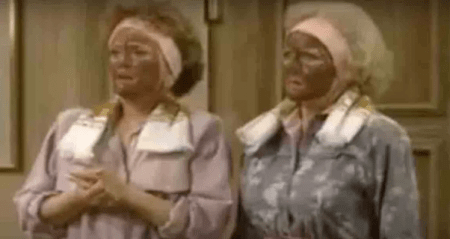
1. Well, there’s blackface, then there’s dark make-up, then there’s stuff that idiots might think is blackface, as well as what someone may get offended over because they think it’s kind of like blackface—oh, what the hell, let’s ban it all. In a 1988 episode of “The Golden Girls,” Dorothy’ son, Michael, who is white like his mother (played by the imposing, also white, Bea Arthur) is planning on marrying Lorraine, a much older black woman. Dorothy objects to the love birds’ age difference while Lorraine’s mother disapproves of Michael’s race, saying, “No daughter of mine is marrying some skinny white boy.” Then flighty Rose (Betty White) and sex-obsessed Blanche (Rue McClanahan) interrupt the potential in-laws show-down by walking into the room wearing their mud facial masks.
Rose stammers: “This is mud on our faces; we’re not really black!”
“The Golden Girls” was a consistently liberal-tilting show, and the episode was obviously making fun of racial sensitivities. Never mind. Hulu has pulled it. Continue reading →
1. I’m current reflecting on a personal and professional ethics conflict. A colleague and long-time professional competitor—I would never call him a friend—has been ousted from his leadership position in the very successful organization he founded as a result of unproven allegations of sexual harassment and assault. It was a “believe all victims” situation, as well as what feels like a successful coordinated effort to “get” someone who had accumulated a lot of enemies, resentment and envy in a notoriously nasty industry once his power was waning.
On one hand, I feel like I should reach out to him and offer my guidance and support (as an ethicist and sexual harassment trainer, not a lawyer, and gratis, of course). On the other, I am pretty certain that he is guilty of at least some of what has been alleged, based on confidential accounts I have recently heard from reliable sources. Ethically, however, his ousting (it appears that he was given the option of “retiring”) lacked due process and fairness, and the organization was guided by public relations motives rather than legal or ethical ones.
Whose side should I be on?
2. Stop making me defend Facebook! As if there wasn’t enough to worry about, the aggressive pandering mode of corporations right now is being exploited by would-be censors of political speech. Facebook CEO Mark Zuckerberg announced updated election policies and stricter “hate speech” rules in response to employee protests and pressure from activists, whose transparent objective is to silence or constrict any political views antithetical progressive positions and goals. In a message last week, Zuckerberg outlined plans to police disinformation relating to voting and elections, to flag certain content that risked triggering violence (I wonder what that standard is like today?) and concluded,
1. Fake news, headline division. Yesterday and today I saw several headlines with some version of “D.C. Statehood Takes A Step Forward.” That’s flagrant clickbait, and false. The House used its Democratic majority to pass a D.C. statehood bill, which is guaranteed the same fate as dozens of other grandstanding bills Pelosi’s minions have sent to the GOP controlled Senate. It’s not a step forward, because there is no actual progress toward statehood at all. (I was surprised to learn that the House hasn’t passed such a bill in 25 years. Democrats hadn’t because it was futile.) The GOP Senate will reject the bill, and if some kind of brain disease struck and they passed it, the President would veto. To have D.C. make it to statehood would require the Democrats to control the House, the Senate, the White House and have a filibuster-proof majority in the Senate.
2. Sheep see, sheep do! Actress Jenny Slate was so impressed with Kristen Bell’s ridiculous stunt of quitting her gig as a voice actress for a mixed race animated character (see, Kristen is white, see, so she can’t really express the essence of a mixed race character even though the show’s producers said her performance was “brilliant,” but a black actress told that she couldn’t voice a white animated character would be screaming “Systemmic racism!” so fast it would make your head spin. This is what they’re toppling statues for, folks! ) that she decided to duplicate the virtue-signal, quitting her role on the animated show “Big Mouth” because she’s white and her character is b-iracial. (Well, really the character is not even a human being and just colored sort of brownish, and her lines are written by a man, but..oh, never mind. Why would I try to make sense out of this?)
Slate said,
“I acknowledge how my original reasoning was flawed and that it existed as an example of white privilege and unjust allowances made within a system of societal white supremacy … Ending my portrayal of “Missy” is one step in a life-long process of uncovering the racism in my actions…”
If this reminds you of the scripted confessions of brainwashed American pilots held as North Korean prisoners of war, it should. Writes Andrew Sullivan, dissecting Slate’s mindless cant,
“It’s a classic confession of counterrevolutionary error… The word “racist,” which was widely understood quite recently to be prejudicial treatment of an individual based on the color of their skin, now requires no intent to be racist in the former sense, just acquiescence in something called “structural racism,’ which can mean any difference in outcomes among racial groupings. Being color-blind is therefore now being racist. And there is no escaping this. The woke shift their language all the time, so that words that were one day fine are now utterly reprehensible. You can’t keep up — which is the point…. So, yes, this is an Orwellian moment. It’s not a moment of reform but of a revolutionary break, sustained in part by much of the liberal Establishment.”
3. What do you say, most ridiculous corporate white guy pandering yet, or what? Chick-fil-A CEO Dan Cathy took part in a televised discussion at Atlanta’s Passion City Church last week with Pastor Louie Giglio and rapper Lecrae in what the church called “an open and honest conversation around how racism has plagued our city for generations, and the steps we can all take to confront it head-on in our church, our neighborhoods, and our hearts.” This was sparked, of course, by the police shooting of Rayshard Johnson, about which there is no evidence indicating that it was based on racism at all.
But the company’s CEO, who is trying to get past being labeled as a homophobe for opposing same sex marriage, seized the opportunity to be “woke.” He shared a story told to him (meaning that it may be made up) about a small town revival meeting in Texas. A young man at the service was “gripped with conviction about the racism that was happening” and responded by kneeling down before an elderly African American man and shining the his shoes. “So I invite folks to just put some words to action here,” Cathy said, standing up and carrying a shoe brush over to the black rapper.
Then he knelt down in shoe-shining position, and said, “If we need to find somebody [ that is, somebody black) that needs to have their shoes shined, we just need to go right on over and shine their shoes and whether they got tennis shoes on or not, maybe they got sandals on, it really doesn’t matter. But there’s a time at which we need to have, you know, some personal action here. Maybe we need to give them a hug, too.”
4. And this is why performers should shut up about politics and stay off Twitter. Chelsea Handler, the female, B-version of Bill Maher, posted a video of racist, homophobic, anti-Semite Louis Farrakhan to her 3.9 million followers on Instagram, writing that she “learned a lot” from watching Farrakhan debate audience members on whether racial prejudice would ever be eradicated. Handler, who is Jewish, was apparently unaware that Farrakhan’s Nation of Islam is generally regarded as a hate group–against whites, gays and Jews. (Apparently fellow celebrities Jessica Chastain, Jennifer Aniston and Michelle Pfieffer, who liked Handler’s choice of a messenger, were similarly ignorant.)Initially Handler doubled-down, saying on her podcast that she…
“…wasn’t thinking about the anti-Semitic thing, but I don’t want to take down the post because I felt the message was powerful and a lot of people did. It was powerful for me the way he spelled it out,” That black people don’t have a history of killing white power. White people have a history of killing black people, for hundreds of years. Over and over again, we kill black people in this country. So everyone needs to remember where the violence came from. It’s not from the black people, it’s from the white people. So I thought it was powerful. So whatever, you know, everybody can fuck themselves.”
Yes, Chelsea Handler thought Farrakhan’s standard racist “white devils” riff was “powerful.” It’s not just that Farrakhan is such a repulsive messenger that nobody should trust anything he says, it’s also that his message is a hate screed and based on a biased and deliberately distorted reading of history.
Then social media told Handler to shape up, so, lacking any integrity and courage herself, she took down the post and grovelled to the Daily Beast:
“I want to sincerely apologize for posting the video of Louis Farrakhan. I didn’t consider the context of his anti-Semitic and homophobic rhetoric,\ that is of course contrary to my own beliefs and values. Part of the process of educating ourselves during this pivotal time is recognizing and working through our mistakes.This was definitely one of mine. I was wrong. It was offensive, and I apologize.””
No, you didn’t know who Louis Farrakhan was before you endorsed him. [Pointer: Other Bill]
The Kennedy Center embarrassed itself in 2010, giving an affirmative action (gender division) honor to Tina Fey. She received its Mark Twain Prize for American Humor, which the Center has awarded every year since 1998 to individuals who have “had an impact on American society in ways similar to” Twain…you know, like Tina Fey.
The Center realized that it was short on female honorees (because humor, historically and now, is a field dominated by men), and because it can only give the award to the living, so it settled on Fey as a weaker than weak addition to the pantheon. I compared the award at the time to Obama winning the Nobel Peace Prize and added,
If she vanished tomorrow, Tina Fey would at best be a footnote in the history of American comedy. Her qualifications for the Mark Twain Prize in 2010 appear to be 1) she is a woman, and there aren’t many women in comedy 2) she is a comedian, though not an especially funny one, 3) she is a writer, though neither of the screenplays she has authored would be called deathless classics, unless you think “Mean Girls” is on par with “Adam’s Rib,” and 4) she looks like Sarah Palin, which allowed her to do a popular impression mocking Palin during the 2008 campaign, and the people who give out the award really, really dislike Sarah Palin.
In short, she didn’t deserve the award in the first place, and the Mark Twain Prize lost its integrity and credibility by her receiving it. Thus there is some condign justice in that decision coming back to bite the Kennedy Center now, along with a second bad decision eight years later.
That year, the Kennedy Center decided to rescind Bill Cosby’s Mark Twain Prize, which the Cos had more than earned in 2009. Cosby did have impact on culture and humor comparable to Twain, and his achievements dwarf those of Fey like “War and Peace” dwarfs “Valley of the Dolls.” Again virtue-signaling to feminists, the Kennedy Center revoked Cosby’s honor after his conviction for sexual assault (which was just accepted for appeal this week).
I didn’t write about it at the time, I guess because there was nothing new to say that I hadn’t said in this post, where I observed,
[L]ast I heard Bill Cosby was still recognized as a major trailblazer in stand-up, TV comedy, and television integration (remember “I Spy”?), an important positive cultural force for race relations and black community self esteem, and a spectacularly talented comedian with a unique voice and presence. None of that has changed. Those were the achievements that prompted Cosby’s bust’s inclusion in Disney’s Academy of Television Arts and Sciences Hall of Fame Plaza, along with celebrities such as Lucille Ball and Oprah Winfrey who, like the Cos, have been inducted into the Television Academy Hall of Fame. O.J. Simpson is still honored in the College Football Hall of Fame, because he was one of the greatest college stars ever. His post-career hobby as a murderer, like Bill’s extra-curricular activities as a serial rapist, have nothing to do with the honor, just as Cosby earned and still deserves, his honor for what he achieved on stage and screen.
That still applied in 2018, and it is true today.
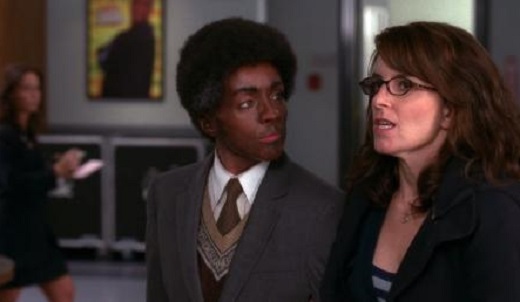
But Bill was deemed unworthy nonetheless. Now, in the midst of the George Floyd Freakout, the frenzied statue-toppling, cancelling-happy, race-offense vengeance-obsessed mob has targeted Tina Fey. During her acclaimed NBC show “30 Rock,” which she created, often wrote, and appeared in, blackface was used for comic effect four times. This week, always seeking to follow the crowd, Fey said her mea culpas and had Hulu pull the shows from circulation, thus putting herself in the cross hairs. (I must note that this censorship, like all censorship, impedes knowledge and reflection, since it is impossible to assess what the use of blackface was. I never watched the show because mega-ass Alec Baldwin was a regular, and I would prefer chewing off my fingers than supporting anything he’s involved in.) Continue reading →