The problem is that when it comes time to honor those who have made a positive contribution to our country and culture, nobody remembers who they are. I confess, it drives me nuts. Today a medical technician revealed that she had no idea what “Ben-Hur” was. No chariot race, no galley slave scene. Well, she’s a drag on the culture. Catch up.
Actress and singer Diahann Carroll, 84, died on October 4, and her death received small and momentary notice. Yet she was another one of the brave, trail-blazing African Americans whose intelligence, charm, talent and willingness to take risks helped move the stubborn needle toward racial conciliation and away from bigotry. Of course, she was remarkable–unusually gorgeous, unusually talented, unusually intelligent. It never seemed like she set out to become a civil rights and cultural icon, but somehow the position just found her. Most important of all, when she was given the chance to make white people think differently about black people, she did it. She also made it look easy. Continue reading →
Now there’s a tidal wave of too many ethics stories and issues to cover…
…and more than ever, I feel that an impeachment information and analysis website is essential, a civic obligation, and likley to foce me to live out of a cardboard box. I also need to get Mrs. Q’s featured column launched. Naturally, I leave on another ethics seminar road trip today.
If the Red Sox were in the post-season, I’d have to shoot myself…
1. The up-side of the NBA’s cowardly pandering to China and its suppression of basic human rights…we learned what a shallow hypocrite LeBron James is. Of course, many of us knew this when James did his grandstanding champion of social justice act and extolled Colin Kaepernick’s useless and incoherent protest. “I stand with anyone who believes in change,” the B-ball superstar said, as if that means something. It was still enough to attract excessive praise from the sports media. Last week, however, as the Los Angeles Lakers returned home from a week-long tour of China, James said,
“Yes, we do have freedom of speech. But at times, there are ramifications for the negative that can happen when you’re not thinking about others, when you only think about yourself. I don’t want to get into a word or sentence feud with Daryl Morey, but I believe he wasn’t educated on the situation at hand, and he spoke.”
Morey, the Houston Rockets GM who tweeted support for the Hong Kong protesters resisting China’s iron boot, only lacked education on how venal and without principles his league was, including stars like James. Morey was “thinking of others”: he was thinking of the people of Hong Kong desperately trying to hold on to as much liberty as they can. No, he wasn’t thinking about James’s giant paycheck, which is clearly all LeBron cares about.
He can take solace in a victory in the NBA’s “It’s not the worst thing” sweepstakes. San Farncisco Warriors coach Steve Kerr, when asked if he’d ever been confronted about human rights abuses on earlier trips to China, Kerr replied, “No. Nor has (America’s) record of human rights abuses come up either… People in China didn’t ask me about, you know, people owning AR-15s and mowing each other down in a mall.”
That’s right, Steve, there is obvious moral equivalency between China’s 30-65 million mass murders and its current oppressive government, and the United States of America. Continue reading →
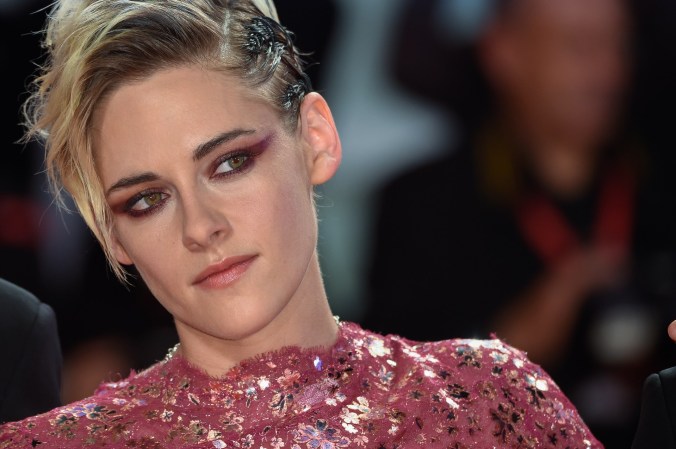
Before it went down the tubes, the leftist commentary website ThinkProgress posted a typical piece (that is, so crippled by bias and a progressive agenda that it was useless as advocacy unless the reader already agreed with it) bemoaning the fate of LGBTQ performers in Hollywood like Kristen Stewart. Stewart, once a rising young star with the “Twilight” Saga films, now approaching 30 without a clear career path.
You’ll get the article’s point of view from the kick-off:
“In an interview with Harper’s Bazaar UK, actor Kristen Stewart, who has been romantically linked to model Stella Maxwell since 2017, said, “I have fully been told, ‘If you just like do yourself a favor, and don’t go out holding your girlfriend’s hand in public, you might get a Marvel movie.’ I don’t want to work with people like that.” Stewart has said publicly she does not identify as bisexual or lesbian, and doesn’t want to choose a label for her sexuality. In the same interview she added, “I was informed by an old school mentality, which is — you want to preserve your career and your success and your productivity, and there are people in the world who don’t like you, and they don’t like that you date girls, and they don’t like that you don’t identify as a quote unquote ‘lesbian’, but you also don’t identify as a quote unquote ‘heterosexual’. And people like to know stuff, so what the fuck are you?’”
Although it may, at times, appear as though LGBTQ representation and participation in Hollywood has achieved some semblance of parity, Stewart’s experience is far from unique. Several young, openly LGBTQ actors such as Ellen Page and Ezra Miller have talked about how their gender and sexuality have affected how people talk to them about their careers.”
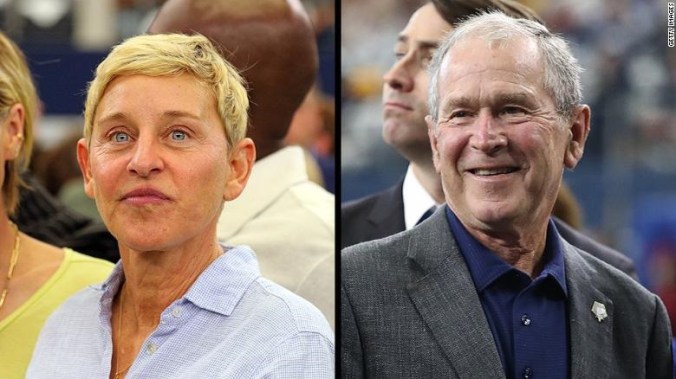
“We’re all different and I think that we’ve forgotten that that’s okay that we’re all different… but just because I don’t agree with someone on everything doesn’t mean that I’m not going to be friends with them.”
—-Ellen DeGeneres, countering social media criticism of her hanging out with former President George W. Bush at a Dallas Cowboys game.
She prefaced that comment with this:
“When we were invited, I was aware that I was going to be surrounded with people from very different views and beliefs. And I’m not talking about politics… I was rooting for the Packers. So I had to hide my cheese hat in [her spouse] Portia’s purse. People were upset. “They thought, why is a gay Hollywood liberal sitting next to a conservative Republican president?… A lot of people were mad. And they did what people do when they’re mad… they tweet.”
If they are morons, that is. These are the people who harass those wearing MAGA hats, who won’t speak to family members who voted differently than they did, who seek to boycott companies and individual who contribute to causes they oppose. They are unethical citizens and corrupted human beings. Continue reading →
1. Impeachment junk! There is so, so much of this. I am trying to decide if my launching an impeachment information and commentary website is feasible (for me, and any volunteers who step up), but it certainly is necessary.
Deja vu…I am again hearing and reading the opinion that the President’s various maneuvers to block testimony and subpoenas are indications of guilt. This is why the Democratic Party’s creeping totalitarianism is ominous—people slip so easily into totalitarian mindsets. “If you have nothing to hide, you have nothing to fear!’ is an anti-civil rights position, and yet here are alleged progressives chanting that Orwellian motto again.
The President has every reason to regard the Democratic fishing expeditions and non-inquiry inquiry into impeachment as an attack on the Separation of Powers and Constitutional government itself. Thus he has every right to make Congress’s abuse of process as difficult as possible, whether he has anything to hide, or not.
Circulating claims of Trump-Russian collusion prior to the 2016 election didn’t work. Using foreign-supplied fake intelligence, from a British spy who utilized Russian sources, to obtain surveillance of the Trump campaign and transition team didn’t work.Intimidating Electoral College Electors to change their votes after the election didn’t work. Having the Director of the FBI lie to, set up and try to entrap the president didn’t work. Having that same FBI Director leak memos to the media to manufacture grounds for a Special Counsel didn’t work.Trying to invoke the 25th Amendment to declare the president unable to perform the job didn’t work.Two years of the Mueller Investigation didn’t work.Three years of a permanent crisis news cycle meant to paralyze the administration didn’t work.
After all these failures to unwind the 2016 election, Democrats and the mainstream media are trying a new tactic: Create a Star Chamber “impeachment” process fueled by anonymous whistleblowers and selective leaks that is not so much designed to remove the president, though they would if they could, but to manipulate the 2020 election…By cloaking witnesses with the protection of whistleblowers, the whistleblower protections are being abused. In response to the announcement of Whistleblower No. 2, we remarked: “Abuse of whistleblower protections. This person is simply a witness to someone else’s complaint who already has been interviewed. Weaponization of whistleblower laws is yet another breach of norms in effort to unwind 2016 election.”…With Whistleblower No. 1 failing to fulfill the mission, there was a leak to the NY Times of a potential Whistleblower No. 2. That’s how this is going to work, there will be leaks to the media to frame the public narrative just like regarding supposed Russian-collusion.”
I think this is probably right.
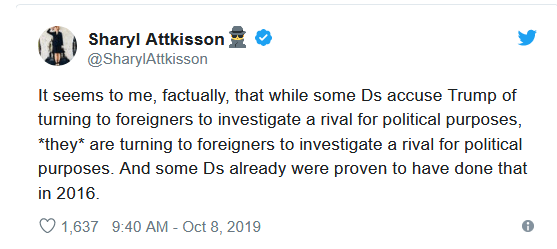
Don’t confuse them with facts, their minds are made up. Ann Althouse passed along Sheryl Attkisson’s tweet:
Nah, there’s no mainstream media bias! Also from Althouse, we learn that the following headline is on the Washington Post’s front page:
“The GOP’s bootlicking cowardice knows no bounds.”
Polls, for whatever they’re worth…According to one poll, President Trump is gaining among independent voters in head-to-head matchups with the Democratic presidential front-runners, according to a new IBD-TIPP poll. This would be expected by anyone other than deranged, impeachment obsessed Democrats, since the non-biased could be anticipated to object to a party attempting to circumvent an election through abuse of the system. but who knows. Conservative pundit Matt Margolis writes, “Many on the right have warned Democrats that impeachment fever will only benefit Trump in the long run—and they appear to be proven right by this poll.”
Wrong. How can a poll “prove ” anything? Yet polls are always being offered as “proof.” It isn’t even honest to describe them as evidence.Continue reading →
Unlike the National Basketball Association, satirists Parker and Stone know that their duties as Americans include representing American values to the world and standing by them even when threatened with negative consequences.
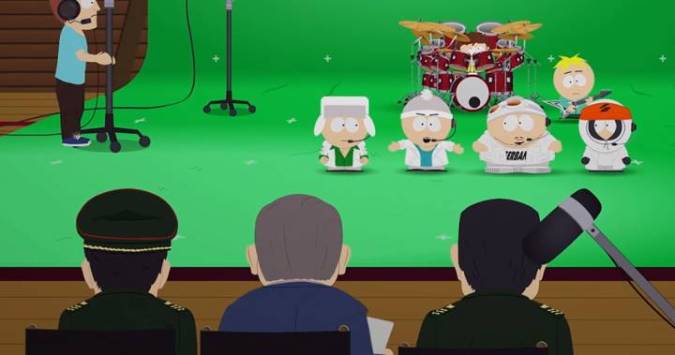
After “South Park’s” latest episode, which mocked China’s influence over Hollywood, the Chinese government banned the series. The Hollywood Reporter revealed that China removed all hints of”South Park” from its Internet, eliminating any social media references as well as episodes and clips from the streaming service Youku.
In response, the “South Park” creators issued a pointed satirical “apology” to China:
“Like the NBA, we welcome the Chinese censors into our homes and into our hearts. We too love money more than freedom and democracy. Xi doesn’t look like Winnie the Pooh at all. Tune into our 300th episode this Wednesday at 10! Long live the great Communist Party of China. May the autumn’s sorghum harvest be bountiful. We good now China?”
Perfect. Now watch the NBA condemn “South Park” as racist, or something.
1. When will Mrs. Q make her debut as a regular contributor to Ethics Alarms? I’m working out the details. She’s ready, I’m behind, we’ll get it done. Very excited.
2. If everything is going to be done online, is it reasonable to expect those companies who force us to interact that way to be competent? Case Study: The Boston Globe just offered me a 6 month digital subscription for a buck. But an old password connected to my email address prevented me from entering the new one necessary to accept the deal. All links went to current subscription or subscribing at the regular price. It took 40 minutes of online chats with robots and a human being (who disconnected me one) to fix the problem, which was in how the Globe set up the offer acceptance page. I ended up using a password made up by “Sherry” because I couldn’t reset my password myself. This kind of thing happens all the time. I wouldn’t have a clue how to set up a website response system, but if that was my job, I would be obligated to do better than this.
3. What good are movie critics whose opinions and tastes aren’t shared by their readers? My view: not much. The job of a critic is to let readers know if readers would appreciate the movie or not. A critic who can’t or won’t do that, and most don’t, is useless. I was thinking about this when I encountered this article in The Guardian listing the films for which audience ratings and critical ratings diverged the most.
Much of the disparity today is caused by critics who allow their ideological biases to dominate their judgment: yes, bias makes them stupid. Another problem, harder to over-come, is that the judgment of people who see hundreds of movies a year and who are often steeped in the art of film-making often has no relevance to the movie average audience member at all. Yet another is the unavoidable fact that few critics are equally qualified to review all genres. Horror movies are especially frequent victims of this problem.
Incidentally, yesterday I watched a new horror movie, “A.M.I.” that exploited the inherent creepiness of online personal assistants like Siri and Alexa. It was pretty bad, but the final scene was so ridiculous (and predictable) that it almost justified the film. Almost. Continue reading →
…and as my father was fond of saying, that should be enough. Of course, he adopted that philosophy during combat in World War II…
1. I have been asked, “With your beloved Red Sox out of the post-season, are you paying attention to the play-offs?” The answer is, “Oh, sure.” I’m not like Yankee fans, what my dad called “summer soldiers.” In fact, the post-season is a more enjoyable, less anxious, purer experience for a fan when his or her team is absent. I can just enjoy the beauty, suspense and constant surprises of baseball without being distracted by my emotions, conflicts of interest, and bias. Post-season baseball is the best of the game; when I am trying to introduce baseball to neophytes, this is the best time to do it. Yes, the dumbed-down broadcasting by the networks is annoying, but it’s always been that way. And yes, I still have some rooting biases: most of my friends are Washington Nationals fans, do a piece of me is supporting them. I like underdogs, so the Twins, Rays, and every National League team but the Dodgers have my sympathies. The Yankees have had such a courageous, astounding season, winning over a hundred games despite having more significant injuries than any MLB team in history, that I even find myself rooting for them, because if any team deserves a championship, the 2019 New York Yankees do.
2. First, do no harm. Second, don’t be an asshole...This is incredible. Employees at a St. Mary’s Regional Medical Center in Lewiston, Maine created a “wall of shame” where they displayed confidential medical records of disabled patients in 2016, the state Human Rights Commission has found.
The records posted on the wall concerned sexual activity, photos and descriptions of body parts and bodily functions of patients. St. Mary’s told CNN that it is “fully committed to ensuring this doesn’t happen again.”
Gee, that’s comforting. How did this happen in the first place?
The Shame Wall was revealed as part of a harassment complaint. MyKayla McCann, an employee who had been treated at the hospital, said that the existence of the “wall of shame” constituted an “abusive environment” where hospital staff displayed open hostility to those with disabilities.
“Coworkers constructed a workplace display ridiculing patients with disabilities. [McCann] encountered the display every day as part of her regular environment, making harassment pervasive,” the investigation said. “The information posted on Shame Wall was intended to demean and humiliate and included supposed ‘jokes’ about the hospital’s physically and mentally disabled patients.”
One employee was fired and another was given a warning in response to the incident. It took the hospital four months after McCann’s complaint to take the Shame Wall down, according to the report. How caring. How efficient.
“The Joker,” opening this week and presenting Joaquin Phoenix’s portrayal of Batman’s arch-enemy as fitting the classic mass-shooter profile, has provoked all sorts of ethics- related debates. Is it responsible to release a film that may risk triggering the psychopathic loaners with access to guns we all know lurk in the shadows? Is the studio risking another Aurora-style theater shooting? Should such films be boycotted? Regulated?
These debates, which are retreads of the same old refrains the nation has been tortured by since dime novels through Warner Brothers gangster movies, EC comics, “The Untouchables” TV series, the Legion of Decency’s reign, Sam Peckinpah films and “A Clockwork Orange,” are all appeals to censorship using “Think of the Children!” rationalizations, and are essentially attacks on free speech. The contrived debate is alarming but not difficult to call: the would-be censors are wrong, motivated by emotion, and that’s that.
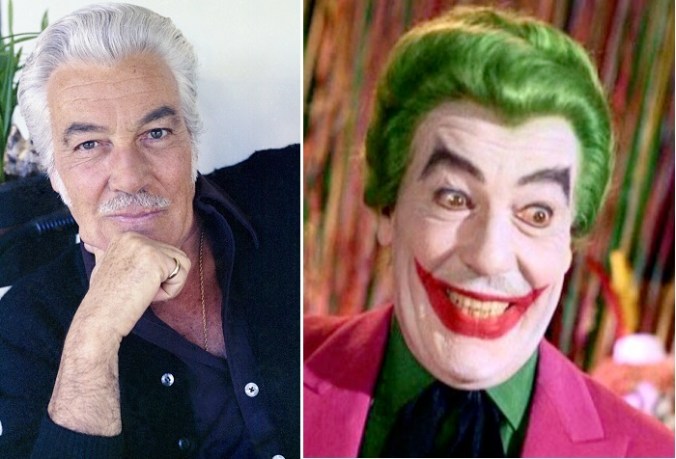
No, the really interesting ethics debate the new movie has revived is another old one: Was it ethical for actor Cesar Romero to keep his moustache when he played the Joker?
Cesar Romero (February 15, 1907 – January 1, 1994) is now largely forgotten, but he was a familiar presence in films, radio, and television for almost 60 years. Sort of a Grade B Riccardo Montalban, Romero had a rather narrow range, with his portrayal of dashing Latin lovers, historical figures in costume dramas, and characters in light comedies all looking and behaving similarly. Romero’s trademark was his moustache, especially in the post-Errol Flynn era when leading men seldom wore them.
When the 1966 camp TV show Batman became a brief sensation in 1966, the casting of Romero as the Joker was a shock. He had never played any role remotely like it, nor was broad, silly comedy his typical milieu. Most shocking of all, when the Joker finally made his appearance on the show it was obvious that Romero hadn’t shaved his upper lip. Reportedly the actor refused to eliminate his moustache for the role, and so the supervillain’s white face makeup was thickly smeared over it throughout the series’ three-year run and for Romero’s co-starring appearance in the 1966 film. Continue reading →
I don’t care: Whenever I get up on Saturday, it’s morning to me.
1. Those fake recordings...I have almost gotten used to the fake versions of famous songs an by iconic artists that show up as background in TV shows and movies, but I still resent them. They are lies, in essence, designed to fool less discriminating and knowledgeable audience members. Many people aren’t even aware of the practice, which is virtually routine, of long-standing, and considered standard practice. A friend of mine , a musician/ actor with a gift for mimicry, once explained the whole industry supported by these frauds, which exist because it is cheaper to record a faux version of a famous recording than to pay to use the real thing in a movie.
For some reason, however, the last 24 hours forced me to hear some unusually obnoxious examples. I just heard fake Roy Orbison, for instance. Nobody sounds like Roy Orbison. I heard fake versions of The Platters’ immortal and inimitable Tony Williams twice, and that really ticks me off. Williams, whose rendition of “Only You” may be my favorite male vocal ever, had a freak voice, and younger listeners who hear inferior versions of his “Twilight Time,” “The Great Pretender,” and “Smoke Gets in Your Eyes” are tragically misled. It is an insult to Williams’ memory and legacy to represent through deceptive imitations that he wasn’t as great as he really was.
Anytime you hear a song playing behind a scene, listen closely. I just heard Fake Any Williams, a really bad imitation. Interestingly, I have noticed that there are some departed artists that nobody dares to imitate. Bing Crosby, for example, is always the real Bing (although I have heard several fake Frank Sinatras). They don’t try to fool anyone with fake Judy Garlands, either; I haven’t heard a fake Freddie Mercury, and hope I never do. But it’s unethical to fake anyone without being transparent about it..
Especially Tony Williams.
2. Still looking for some partners…in the Ethics Alarms Impeachment Project. I have now heard from three volunteers, and I’m grateful…a few more would be ideal. Of course, when and if the website gets published, I expect it will be easier to interest active participants.
The idea is to provide an easily accessible way for “low-information voters” and others to follow this dangerous and depressing drama while having access to the essential materials, facts, context and legitimate analysis without being confused by spin, selective reporting, misinformation and partisan agendas. Here’s an example of information that is relevant to the Democratic impeachment efforts that has hardly been reported at all, because the news media overwhelmingly wants to see the President of The United States impeached, and has made that objective clear to most objective observers for more than three years.
Six months ago, the NY Daily News revealed that Congressman Jerrold Nadler (D-NY)received at least $65,000 in campaign donations “from the music industry and other intellectual property businesses that he oversees as chairman of the House Judiciary Committee.” That was the end of the story; even the Daily News never followed up. Nadler also spent about $30K to host a Grammy Awards gala in LA in February during the Grammy Awards, giving him access to music executives for more campaign donations. Those execs, meanwhile, had their companies pony up $5,000 a ticket to attend the party. This is influence peddling, of course. It’s legal, because Congress won’t criminalize sleazy politics. TechDirt called it soft corruption:
“These are the kinds of practices that are most likely legal, and possibly even common among the political class, but which absolutely stink of corruption to the average American. And that’s a huge problem, not just because of the general ethical questions raised by such soft corruption, but because it creates a cynical American public that does not trust politicians to adequately represent their interests.”
Nadler’s conduct is relevant to the impeachment efforts because it reveals the hypocrisy behind Democratic efforts to impeach President Trump for political practices that are neither illegal nor unusual while making pious pronouncements that belie their own behavior. The purely political assault on the 2016 Presidential election results is obscured by the media’s efforts to hide the true character and motives of the President’s foes, including the journalists and editors themselves.
3. Here’s another example...My New York Times this morning is dominated by yellow-highlighted text messages between the Ukraine’s ambassador with U.S. Ambassador Volker, and a two-column width headline, “Another Official Considers Filing a Report On Ukraine.” When have you ever seen front page news about an anonymous figure “considering” something? That’s not fact, that’s not news, it is entirely prejudicial spin intended to create distrust and suspicion.
Meanwhile, the Times could have made legitimately made the front page stories about last week’s Congressional testimony from Ambassador Kurt Volker, who served for two years as the top U.S. diplomatic envoy to Ukraine, which directly contradicts the pro-impeachment narrative . He testified, under oath, that he was never aware of and never took part in any effort to push the Ukrainian government to investigate former Vice President Joe Biden or his son Hunter, and stressed that the interactions between Giuliani and Ukrainian officials were facilitated not to find “dirt” on Biden, but to address concerns that the incoming Ukrainian government would not be able to get a handle on corruption within the country. The Federalist obtained the full transcript of the testimony, which certainly could have been revealed by the Times as well, if it wanted to.
More later-––I have a terrible headache that has lingered for two days, and I can’t tell if it’s this crap or a brain tumor. Coffee, Tylenol, and the Twins beating the Yankees should help.