Blue Origin (NOT Space X!) shot singer Katy Perry into space today—or yesterday, I really don’t care— and unfortunately, she will be coming back, or is she back already? (See previous comment.)
There are a lot of videos up now with pop star Perry making moronic observations about her trip. She will be accompanies by a slightly less flagrant idiot and a far less influential one, Gayle King, Oprah’s <cough> galpal. (Althouse features another one of Katy’s deep thoughts videos.)
Why are we—anyone— sending celebrity idiots into space? All this does is encourage weak minds to consider them worth listening to when they are not. There must be easily a million Americans whose journey “to the stars” would convey more long and short term benefits on our society.
I’d be surprised if I haven’t posted on this before, but a recent advice column article about the issue made me realize that the common conflict almost all of us with friends in the performing arts face routinely is as perfect example of the phenomenon I have termed “ethics zugzwang” as there is.
Find something to say that is appreciative but also incomplete.
Lie.”
After reporting on interviews with performers and others in show biz, the reporter concludes that the most ethical option is “Lie.” He concludes, “So what to do? The consensus among those I spoke with is that the best way to be a friend is to be supportive. Leave the critical feedback to other people and other settings. ‘I think the move is always to lie,’ said the musical theater composer Joe Iconis . ‘Whether you enjoyed the show or not, if you’re actually a friend to the person who is part of the production, your job is to say ‘great job, fantastic show.’ I have never once appreciated a friend who came to a show of mine and offered unsolicited negative comments.’”
I recently noticed that one of my Facebook friends of long-standing whom I respect greatly is now officially bonkers, thank to the Trump Derangement pandemic. I find this more than sad: it’s terrifying that a lifetime of critical thinking and rational, balanced analysis can be unmoored simply by having too many friends and associates who are ignorant hysterics and not realizing that the news media you frequent every day is mind poison.
Lawyers and ethicists are being hit especially hard; the fact that almost all of my theater associates are freaking out is less of a shock, for most of them have always been this way. My legal ethics specialist listserv is in the process of melting down over a few well-reasoned objections to the most of the opinions being offered residing more in the realm of progressive politics than legal ethics. But Trump is a threat to the rule of law! There wasn’t any concern whatsoever expressed on this same platform when Donald Trump was being targeted by Democratic prosecutors so that their party could continue to hold power. If Merrick Garland or Joe Biden were even mentioned there in four years, I must have missed it. I was amused to see one of the loyal “non-partisan,””objective” ethicists defend the group’s obsession with Trump by quoting the “Man for All Seasons” speech about giving the Devil the benefit of the law (Guess who the Devil is!) as another resorted to the hoary “First they came for the socialists, and I did not speak out..” quote from Martin Niemöller. Trump’s not the Devil, he’s Hitler! My friend, a retired partner in big D.C. law firm, is just about as impossible to argue with now as this idiot. Watching him devolve is like seeing a zombie movie…
Before I leave the first installment of this post and move on to the film’s ethical significance, I should mention that “It’s a Mad, Mad, Mad, Mad, World” caught a cultural wave perfectly, accounting for its box office success. In this it was just lucky, and that moment in time is now long gone, which is why the film appeals to me from a historical perspective more than as entertainment.
There have been many attempts to mine the same property for laughs, and none of the offspring of IAMMMMW have equaled its model in reputation or box office success. Blake Edward’s “The Great Race,” just two years later, was billed as the most expensive movie comedy ever made, and bombed. (Peter Falk is in both IAMMMMW and “The Great Race.”) In 2001, the “Airplane!” gang made “Rat Race,” which was obviously inspired by Kramer’s opus. It had a less starry cast (of course) and made a profit, but was generally regarded as a second rate (second rat?) version of the original. “Scavanger Hunt was a 1979 rip-off with a more IAMMMMW-like ensemble cast, and was a flop. Lesser attempts to recycle the film’s formula, “Midnight Madness” and “Million Dollar Mystery” (note the “m” alliterations) were even more embarrassing failures.
On to the ethics…Much was made of the fact that director Stanley Kramer had never directed or produced a comedy before. In fact, his career output was ostentatiously serious, and often criticized as preachy and overly preoccupied with moral-ethical conflicts. Among his most famous movies are “Judgement at Nuremberg,” “Guess Who’s Coming to Dinner,” “Inherit the Wind,” “The Defiant Ones,” “On the Beach” and “Ship of Fools.” I’m sure that part of Kramer’s motivation for directing a huge slapstick comedy was to show his versatility, just as Spielberg felt that he needed to direct a movie musical with “West Side Story.” However, viewed in light of the times and Kramer’s artistic sensibilities, IAMMMMW now seems schizophrenic, a silly comedy with serious social commentary…and both parts undermine each other.
It’s not precisely an example of Poe’s Law, but it is close enough to be ominous. American society and culture seems to be finally ripping the metaphorical blinders off and recognizing how thoroughly our colleges and universities have abandoned their core mission of education, or at least seem incapable of pursuing it. The schools are indefensibly expensive. They may graduate students without essential skills and knowledge. They seem to place political and ideological indoctrination above intellectual curiosity and critical thinking as their emphasis. Many of them tolerate campus cultures that are hostile to men, Jews, and conservatives. Some of them now pay their student athletes, and demonstrate more passion over sports than academics.
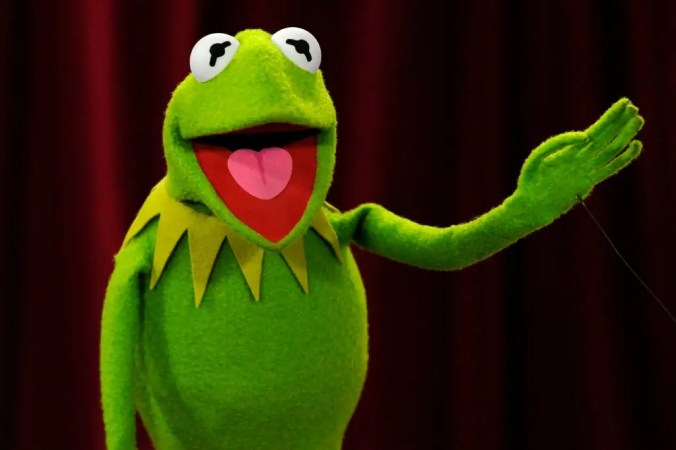
So the University of Maryland decides that this is an ideal time to name Kermit the Frog as its commencement speaker.
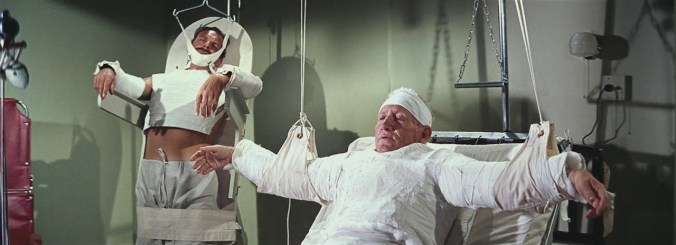
There were three distinct stages in my consideration of the sui generis Cinerama feature from 1963, “It’s a Mad, Mad, Mad, Mad, World.” The movie’s gimmick was that it collected more comedians and comic actors in a single Hollywood production than has ever been featured before, which meant, naturally, that it had to be the funniest movie ever….or so we were told.
I first saw IAMMMMW at Boston’s Cinerama Theater when I was 12. It was the first of the new, improved, seamless Cinerama features, which meant it was inferior to the original format, which wrapped around the audience. There were few effects in the movie that took advantage of the giant screen, either. But like all boys under 20 or so, I thought IAMMMMW was very amusing and a lot of fun. Girls didn’t get it, for the most part, and that has never changed. It’s physical comedy and slapstick throughout, and often cruel slapstick. This is a real male-female divide that appears to be timeless.
I was also, even back then, an omnivore of popular culture. Seeing so many familiar comedy icons of the era (and the previous one) in one movie was a thrill; of course, that was one of the main goals of the film. Sid Caeser, Milton Berle, Jimmy Durante, Jonathan Winters, Phil Silvers, Buddy Hackett, Mickey Rooney and more, with well-conceived cameos by the likes of Jack Benny, Jerry Lewis and Don Knotts—in the waning period of Hollywood all-star cast spectaculars, the idea of doing one with comedians was irresistible.
I saw the movie a second time in my thirties, and was shocked how different my reaction to it was. To be fair, I recalled many of the sequences that would have been funnier as a surprise, but the film seemed over-long, abrasive and, most surprisingly, sad. The subplot in which Spencer Tracy plays an aging police captain who becomes disillusioned with his professional and family life to the extent that he tries to steal the money that has set off an insane race among the assorted loonies is more tragedy than comedy, and, oddly, Tracy didn’t play any of his role for laughs. Grace, my wife, hated the movie in 1963 and hated it just as much when I made her watch it again with me.
I hadn’t followed the Lizzo dieting scandal because, frankly, I couldn’t care less about the in-your-face obese pop star who has been the current champion of the “love your body”/”fat is beautiful” mob. Lizzo, who performed with svelte female dancers to emphasize her proud flab, made defiant fatness part of her brand, wearing costumes that normally would be taboo for any woman not a size 6.
Well, if it works, it’s show business! But somehow toward the end of 2024, Lizzo started slimming down via Ozempic, dieting and a personal trainer, so she is now sporting a more conventional model of female beauty. Predictably, her fat fans feel betrayed, and they should.
We’ve seen this so many times before that I hesitated to even post on it, but no previous fat celebrity so aggressively asserted that she loved her extra pounds and that society’s obsession with fit female bodies had to be rejected. All of these photos…
…accompanied past features about how the singer insisted that fat was “normal” and that she “loved her curves.” And now what is she saying? She doesn’t need to say anything; her conduct speaks for her. She decided to exploit being fat as a gimmick, not caring how it would encourage unhealthy lifestyles among her female fans, then as soon as losing weight and becoming more typically attractive seemed like a wise career move—reinvention!—she discarded “fat is beautiful” like a house guest who had stayed too long.
We shall see if a performer of Lizzo’s rather unremarkable talents can stand out among all the other comely female pop singers. If not, don’t be surprised if she starts hitting the all-you-can-eat buffets again.
Why is the Cognitive Dissonance Scale the graphic I chose for the final word on Disney’s “live-action” remake of Walt’s biggest and most important hit, 1937’s “Snow White and the Seven Dwarfs”? (For some perspective, realize that we have the same relationship on the timeline to that film that it had to the Presidency of Millard Fillmore.) It is clear that this cultural ethics train wreck, which EA has been dutifully covering (here,here, here, here here, and here), is now stuck inextricably in cognitive dissonance territory. For most viewers, what they think about the movie will be influenced far more by their biases and what they associate with the movie than the movie itself.
That’s how the scale works, as I keep explaining ad nauseam. If Disney is generally a plus-5 on a ticket-buyer’s scale (once upon a time, Disney would have been a plus-10 or higher on everyone’s scale) and the movie in a vacuum would be at “Meh”-level Zero, Disney would pull the film into positive territory. If Disney is in negative territory already for a different viewer, the film begins with an anchor chained to its metaphorical ankles.
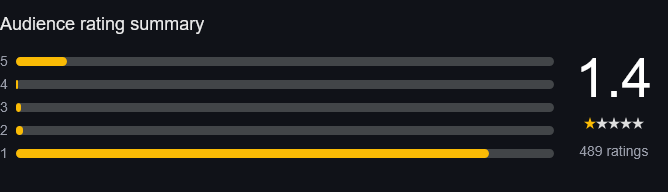
Thus it is hardly surprising to see this as the early returns on the film (which doesn’t officially open in theaters until tomorrow):
This has been happening to me a lot lately: I finish a post under the pressure of my large and enthusiastic dog making it painfully obvious that he wants a walk and won’t leave me in peace before he gets one, rush to get it up while he’s pawing at my arm, and then, on the walk, think of something I should have included in the post.
In this case, I should have mentioned the comparison with the military. We don’t want those suffering from mental and emotional illnesses holding guns and defending the country any more than we want them flying planes, but the standards are much, much lower. A “Section 8” draft deferment required far more serious symptoms than chronic depression.
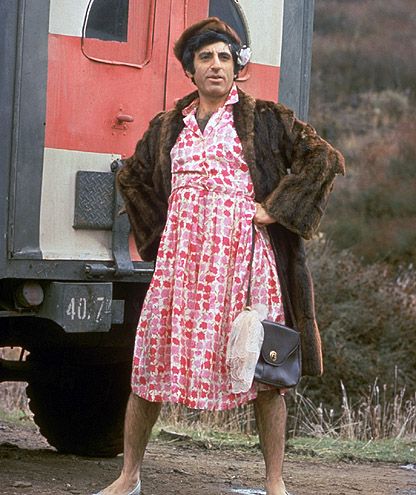
Four famous movies had the issue of mentally ill soldiers at their centers: “Dr. Strangelove…,” “The Dirty Dozen,” “M*A*S*H,” and “Catch 22.” (I never could figure out what was the problem with Trini Lopez in “The Dirty Dozen” except for his obsession with songs about vegetation.) My father was somewhat bitter about the low standards WWII draftees were subject to, I assume because his foot was almost blown off because of a member of Dad’s platoon who had an IQ in the sixties.
A long time ago, I read an article complaining about how nobody says “goodbye” at the end of phone calls in movies and TV shows. Characters just hang up. “Now that I’ve pointed this out, I guarantee that it will drive you crazy,” the author wrote. It does drive me crazy: in stage and movie director terms, it “takes me out of the story.” Because it’s so obviously a device to save time, the omission of “goodbye” reminds me that I’m watching a performance. (Lately, I have noticed, “goodbyes” are appearing here and there, but still in a minority of productions.)
My late wife was a fanatic about such things, and she ruined many a show and film by pointing then out. One of her favorites, a pretty famous continuity botch, was Judy Garland’s constantly changing pig-tails in “The Wizard of Oz”: they are shorter and longer not only from scene to scene, but sometimes from shot to shot in the same scene. Grace was also the one who first pointed out to me the absence of rear-view mirrors in most shots of a character driving a car; now that drives me crazy.





 Ethics Alarms