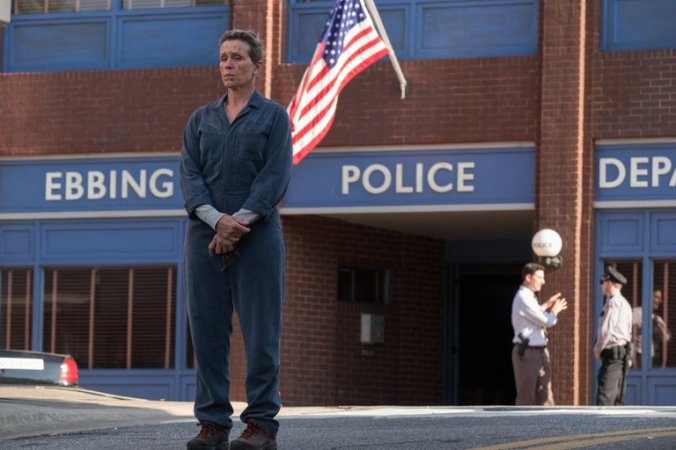
Ethics Review: “Three Billboards Outside Ebbing, Missouri”

I watched last year’s “Three Billboards Outside Ebbing, Missouri,” twice, just to make sure it was the profound ethics movie I thought it was. It is. None of the reviews described it that way, of course. Here is the New York Times:

“The movie opens on low boil with Mildred behind the wheel of her station wagon near three derelict billboards…she uses the billboards to announce her crusade … a way to get things jumping (the investigators, the tale) and splash some foreboding on an outwardly pacific scene. Much of the story involves the ripples of outrage, confusion and buffoonery that the billboards inspire and that soon envelop almost everyone Mildred knows. Months after her daughter’s death, grief has walled her in; isolating and seemingly impenetrable, it is inscribed in the hardness of her gaze and in her grim new identity as a mother of a dead girl. The billboards turn that grief into a weapon, a means of taking on the law and assorted men — a threatening stranger, a vigilante dentist and an abusive ex (John Hawkes) — who collectively suggest another wall that has closed Mildred in….”

None of which addresses what is remarkable about the film, which is that it shows what causes our ethics alarms not to ring—Frances McDormand as Mildred and Sam Rockwell as Dixon, a racist and vicious deputy, in particular demonstrate  what it is like to be driven by non-ethical considerations of the darkest and most passionate sort—and more important, what causes them to start ringing again. Most reviewers described this as a dark and depressing film. The ethics alarms are mostly off again as the film ends, and that is ominous, but its main ethics message is uplifting in many ways. “Three Billboards” teaches us that even broken, ignorant, alienated human beings have the capacity to access their innate instincts for compassion, justice, forgiveness, selflessness and kindness, and even when our ethical selves seem permanently overcome and decisively defeated, they can burst out again, in control, salvaging what’s best about the species.

There is a moment early in “Three Billboards” that signals that it is not only going to show us what monsters anger and grief can transform us into, but also that what George Washington’s list of 110 Rules called “that little spark of celestial fire called conscience” is remarkably resilient.  A sheriff—the ethics compass of the story, played by Woody Harrelson— visits Mildred after her billboard messages embarrass him and roil the town. She is hard and cold as marble as he tries to explain his failure to find her daughter’s rapist/killer, even after he reminds her that he is dying of cancer. Suddenly the sheriff has a violent  spasm: he coughs up blood on himself and Mildred. And we see her fury evaporate in an instant. The compassionate and caring mother she once was emerges, if only for a few moments. ( McDormand is such a superb actress that she pulls off the sudden transition convincingly and movingly: you believe it, though it is like watching Mr. Hyde turn into Dr. Jekyll in the snap of a finger.) Later, when again her fury has been aroused, we see the same woman firebomb the police station and watch implacably as her nemesis deputy burns. A warning: just because the ethics alarms can ring doesn’t mean they are working well enough.

Sam Rockwell’s character also reveals surprisingly that his ethics spark has not been entirely extinguished, again thanks to a catalyst supplied by the sheriff. This transformation caused considerable  criticism of the film among critics and artists in Hollywood, and some attribute the film’s failure to win the Best Picture Oscar to the fact that a racist is redeemed and revealed to have an ethical core. But except for the sociopaths and psychopaths among us, admittedly a disturbingly large group, we all have that ethical core. We have the ethics alarms too, ready to be re-activated, even if they aren’t in perfect working order. Yes, this is  even true of racists. So much of our current political discourse is driven by the false construct that a single belief or a single lapse of reason marks an individual as irredeemable. Its easier to marginalize and demonize them that way. But it isn’t true.

Indeed Ethics Alarms often declares certain conduct and words as signature significance, proving that an individual is unethical because such actions and thoughts are alien to ethical human beings. “Three Billboards Outside Ebbing, Missouri” reminded me that people may be unethical–Mildred and Dixon, the deputy, could never be called ethical, for ethical people don’t set police stations on fire or throw young men out of second story windows, as Dixon does—but that even unethical individuals can find their ethics if you give them a chance.

And if they can find their ethics, so can all of us, and so can society. There is hope.

________________________

Addendum: I cannot leave “Three Billboards” without a salute to one of its most powerful scenes, when Mildred tells a priest why she doesn’t care what he has to say when he comes to her home to admonish her for the messages on the billboards:

Bingo.

Comment Of The Day: “Morning Ethics Warm-Up, 3/6/ 2018: “Remember the Alamo” Edition” (#2: “The Option”))

Commenter Zanshin returned to expand on his answer to the hypothetical I offered a Boy Scout troop based on one of my late, lamented professional theater company’s many dilemmas over the years. Here is the situation again…

The Option

Your professional theater company has limited funds, so it offers its actors an option. They may choose a flat fee for their roles, or get a percentage of the show’s profits, if there are any, on top of a much smaller base fee.

The company just completed an extremely profitable production, the biggest hit your theater has ever had. Nine of the show’s ten cast members chose the percentage of profits option, a gamble, because most of the shows lose money. One, the star, who you know could not afford to gamble, took the flat fee for the role. After the accounting for the production is complete, you realize that every member of the cast will make $1000 more than the star, because of the show’s profits.

Question 1: What do you do?

  1. Give him the extra $1000. It’s only fair.
  2. Pay him the flat fee. A deal’s a deal.

Question 2: You remount the production, and the exact same thing happens. The actor chooses the flat fee, the show is again a huge money-maker,,and the rest of the cast will make much more than him because they chose the percentage. Do you give him the extra amount again?

  1. No. Now he’s taking advantage of me.
  2. Yes. Nothing has changed.

You can read the initial responses here, and check the poll results.

And here is Zanshin’s Comment of the Day, on the post Morning Ethics Warm-Up, 3/6/ 2018: “Remember the Alamo” Edition:

Here are my reflections on this ethical (hypothetical) issue.

Question 1: Some personal background influencing my thinking: In the early years of my career I worked at a small company (about 40 employees). After having worked there for 2 years the owners sold the company, probably for a very good price, because they decided to give every employee about $ 200 for each year that he had worked with the company. Some of my colleagues worked with them for 15 years and more.

For me it would be a nice $ 400 but to my surprise I received $ 1.000 with a handwritten note which stated something like, “We’ll give you $600 extra because we are very pleased with your performance with us. Please do not discuss this with your colleagues.”

Back to the question.

I would go for a third option. First, Pay him the flat fee. A deal’s a deal.

But at the same time, give him in some personalized way, about $500 extra.With personalized I mean, fitting the situation. Why couldn’t he gamble with his reward? For instance, his car is broke, he needs it very bad for whatever reason. Offer to pay a part of the bill, etc.

Question 2: In my opinion the set-up of the first situation (question 1) was already tainted. Just as we expect of journalists that they don’t “interview people who are drunk, drugged, impaired, or not in a mentally or emotionally stable state.” one should also not ask an employee who you know could not afford to gamble to just do that, gamble with his income. Continue reading →

Morning Ethics Warm-Up, 3/16/2018: First They Came For Wonder Woman….[CORRECTED and UPDATED]

Good Morning

… to end a frantic ethics week…

(An unusual number of the items this morning deserve a free-standing post. I’m not sure what to do about that; it’s been happening a lot lately.)

1 Not fake news, just a false news story that everyone ran with...Oops. All the angry condemnations of new CIA director designate Gina Haspel and President Trump (for nominating her, along with existing) were based on a mistake. From ProPublica:

On Feb. 22, 2017, ProPublica published a story that inaccurately described Gina Haspel’s role in the treatment of Abu Zubaydah, a suspected al-Qaida leader who was imprisoned by the CIA at a secret “black site” in Thailand in 2002. The story said that Haspel, a career CIA officer who President Trump has nominated to be the next director of central intelligence, oversaw the clandestine base where Zubaydah was subjected to waterboarding and other coercive interrogation methods that are widely seen as torture. The story also said she mocked the prisoner’s suffering in a private conversation. Neither of these assertions is correct and we retract them. It is now clear that Haspel did not take charge of the base until after the interrogation of Zubaydah ended.

ProPublica, unlike, say, CNN, knows how to accept responsibility for a bad journalism botch. Stephen Engelberg, editor-in-chief, sums up the episode after explaining how the story was misreported:

A few reflections on what went wrong in our reporting and editing process.

The awkward communications between officials barred from disclosing classified information and reporters trying to reveal secrets in which there is legitimate public interest can sometimes end in miscommunication. In this instance, we failed to understand the message the CIA’s press office was trying to convey in its statement.

None of this in any way excuses our mistakes. We at ProPublica hold government officials responsible for their missteps, and we must be equally accountable. This error was particularly unfortunate because it muddied an important national debate about Haspel and the CIA’s recent history. To her, and to our readers, we can only apologize, correct the record and make certain that we do better in the future.

Perfect. This is a news source we can trust.

2. That was ProPublica. This is CNN (The Chris Cuomo post was here originally, but it got so long I posted it separately.) Continue reading →

When Ethics Alarms Don’t Ring: Snapchat Approves A Domestic Abuse Game Ad

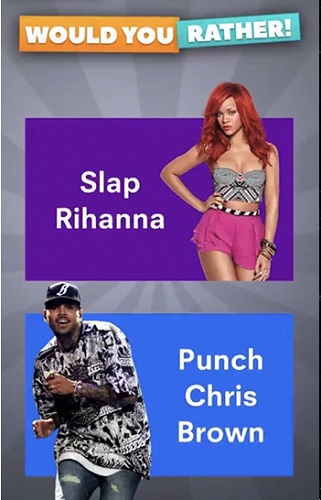
On February 8, 2009, Chris Brown beat up pop megastar and then-girlfriend Rihanna. Five months later, Brown pleaded guilty to a felony assault and was sentenced to community labor, five years probation, and domestic violence counseling. Naturally, someone looking to make a buck off of the millions of ethics dunces who use social media recognized this as an appropriate basis for a game, and paid Snapchat to run their ad, which you can see above.

The “Would You Rather” ad was removed earlier this week, and Snapchat released an apology, saying “The advert was reviewed and approved in error, as it violates our advertising guidelines.” What does “in error” mean in such a case, though? It means “we have erroneously been hiring people at high levels with the ethical sensitivity of mollusks, and upon reflection, this was a miscalculation.” What  deadness of soul and mind could ever ever explain someone, indeed a chain of employees, seeing an ad mocking domestic abuse and reacting by saying, “Great! Put it up and bill ’em!”

Advertising on Snapchat is purchased through a self-serve advertising platform and subject to review,  the company says. Review by incompetents,  creeps and fools, apparently. Unfortunately, they are far from unique.

Rihanna posted a rebuke to Snapchat on Instagram, writing in part, Continue reading →

The Stolen Kiss: By #MeToo’s Standards, Katy Perry Sexually Assaulted Benjamin Glaze On TV. NOW What, Feminists?

The stolen kiss is an iconic romantic moment, celebrated in literature, films and popular culture. But sexual harassment law and feminist outrage has dictated that it is, when unwelcome—immediately or later—sexual assault serious enough to warrant national shunning, social isolation, media condemnation and a marred career and reputation.

On this week’s premiere of the rebooted “American Idol,” a 19-year-old cashier  Benjamin Glaze prefaced his audition by telling the judges that he had never kissed a girl. “I have never been in a relationship and I can’t kiss a girl without being in a relationship,” he said.

Pop singing star Katy Perry beckoned the shy young man. “Come here. Come here right now,” she said.

Perry was using her stardom, her superior status, and the glare of the TV lights to exert power over the young man. This is often the modus operandi of workplace predators.

When Glaze come over to the judges’ table, she thrust her face toward him. making an obvious demand. “On the cheek?” he said. The singer smiled in response. Glaze tentatively  touched his lips to her cheek, but Perry complained that it wasn’t sufficient,  that he hadn’t even made the “smush sound.”  He began to kiss her again on the cheek, but Perry quickly kissed him squarely on the lips. “Katy!” he exclaimed.  “You didn’t!” Ms. Perry raised her arms in victory, like she had scored a winning goal.

Remember, Perry once said in a video, “I’m automatically attracted to beautiful…I just start kissing them. It’s like a magnet. Just kiss. I don’t even wait.” Oh, I’m sorry, I got confused for a moment. Candidate Donald Trump said that as part of his macho, locker room pig-boast caught on tape, for which he has been assailed by feminists ever since, and called a sexual predator, although he has never been seen on  coast-to-coast TV kissing any woman without warning or consent.

OK, now what? That kiss by Perry was sexual assault, and the “Idol” judges were gleeful about it. Glaze didn’t let Perry off the hook, either, by saying he was thrilled.  He made it clear that Perry’s kiss was unwelcome. Continue reading →

Morning Ethics Warm-Up, 3/15/2018: The Last Of Hillary, More NCAA Enabling, And Hoping For The End Of “Pride” In Student Ignorance

Good Morning!

1 To be crystal clear about the student walk-outs:

a) The only reason schools are tolerating them is because a majority of teachers and administrators share the anti-gun agenda the protests represent. Ethics Foul. Educators’ political views should be irrelevant to how they do their job, which is to educate students, not encourage them to skip class.

b) The students who walk out should be disciplined, and the reason they walked out should be neither a mitigation nor an enhancer. If they want to engage in civil disobedience, fine: its a grand old tradition, for causes noble and dumb alike.

c) The news media hyping the protests is unconscionable, and just another example of journalists taking sides rather than reporting.

d) Anyone who says in public that they are “proud” of these children should be fitted with a dunce cap and have it super-glued to their heads. Proud of what? That they have allowed themselves to be used as puppets, pawns and human shields by cynical politicians and activists? That they have failed to make a single valid or persuasive argument in over a month, while polluting the discussion with statistical falsehoods, blame-shifting, name-calling and demonization? That they are reveling in and parading their lack of intellectual honesty and critical thinking skills?

e) The walk-outs and protests are not merely sort of like, but exactly the same, as the “screaming at the sky” demonstrations. Those was embarrassing, and so are the wlak-outs. In particular, educators should be embarrassed. This is the level of critical thinking they are training our young to master.

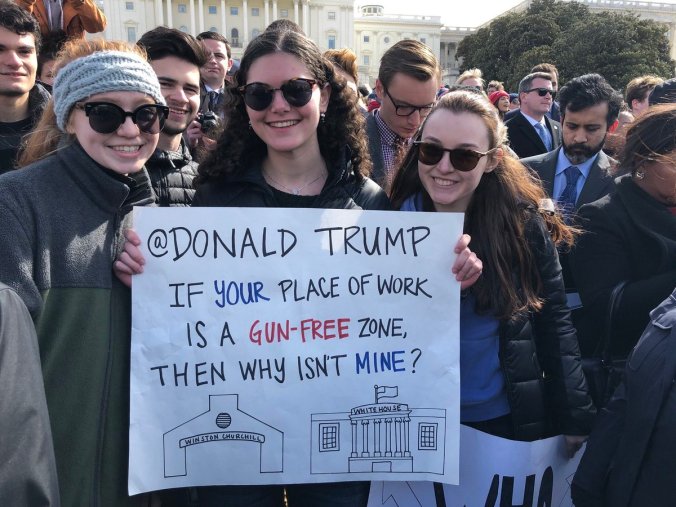
f) This idiotic sign, on display in my area yesterday, nicely sums up the level of seriousness, common sense and acumen the anti-gun students have displayed so far:

2.  I’m going to try to make this the last time I pay any attention to what Hillary Clinton says. I really am. During that infamous interview the India Today Conclave  over the weekend, the one where she again implied that anyone who voted for President Trump was a bigot or a moron, Clinton made another statement that raised metaphorical eyebrows She was asked why she thought most white women voted for Trump, and said, Continue reading →

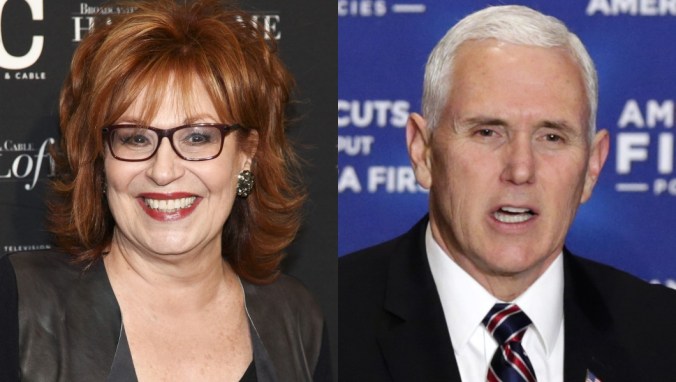
Stop Making Me Defend Joy Behar!

Preview: Conservative boycotts designed to punish individuals for speech are exactly as unethical as progressive boycotts for the same purpose.

The Victim: Joy Behar, alleged comic and long-standing co-host of ABC”s “The View,” or “A Lot Of Loud-Mouth Celebrity Women Without Special Expertise Or Insight Ranting Against Republicans And Conservatives With An Occasional Lame Interjection From A Token Conservative Woman Of Moderate To Negligible Erudition And Wit.”

Behar’s main function on “The View” is to be the upper limit for extreme abrasiveness and obtuseness. If a host exceeds Behar’s level of either, she has to go; thus former child star Raven (dumber than Joy) and Rosie O’Donnell (even more obnoxious than Joy) had to go.

The Controversy: In a February 13 segment discussing Vice President Mike Pence’s belief that God speaks to him, Behar said: “It’s one thing to talk to Jesus. It’s another thing when Jesus talks to you. That’s called mental illness, if I’m not correct . . . hearing voices.” Other members of “The View” panel piled on as the audience clapped and laughed.

The Aftermath: In a “People” interview about whether she would consider running for President, Oprah Winfrey, who can do no wrong in the eyes of The View-ers, said,

“I went into prayer: ‘God, if you think I’m supposed to run, you gotta tell me, and it has to be so clear that not even I can miss it.’ And I haven’t gotten that.”

Shortly after this, Behar said that she was only joking about Pence.

The Boycott: The conservative Media Research Center launched a campaign against “The View,” pressuring its advertisers to pull support for the show until Pence and viewers received a formal apology for Joy’s “crass, bigoted comments.”  Almost 40,000 calls were made to ABC from the MRC’s grassroots followers. The National Center’s Justin Danhof confronted Disney CEO Bob Iger at a Disney shareholder meeting last week, and asked, “Specifically, do you think, like Ms. Hostin and Ms. Behar, that having a Christian faith is akin to a dangerous mental illness?”

The Capitulation: First, Vice President Pence confirmed that Behar had called him and apologized personally. He told Sean Hannity yesterday that he had forgiven Behar, and that he had urged her to make a public apology to the millions of Christians she offended with her comments. Today, on “The View,” Behar said,

“I was raised to respect everyone’s religious faith and I fell short of that. I sincerely apologize for what I said.”

Continue reading →

Morning Ethics Warm-Up,3/8/18: “What Can I Cover Before I’m Late For My Seminar In Atlanta?” Edition

Good morning, from another ProEthics road trip!

1 A life in a lie, or delusion? Today’s obituaries mark a rare variety of hoax that I had somehow missed: Alan Gershwin died, after a virtual lifetime of claiming that he was the illegitimate son of the famous composer, who never made it to  his 39th birthday. Read the Times story: it’s amazing. Alan essentially lived on that claim after he was discharged from service after WWII, based primarily on an uncanny resemblance to George. Was he a con man? If he believed his tale, he was not lying, just deluded. Gershwin recalls the more famous story of the American woman who said she was the Princess Anastasia.

2. Stormy weather…The most important lesson of the ongoing tabloid story involving the porn satr who is now suing President Trump is not the obvious ones. The major take-away is that this is what happens when an unholy alliance between the news media, political opponents and the Presidents themselves strip away the traditional and vital shield of public appreciation of the honor and respect the office of the Presidency has had in the past, since George Washington. Does anyone honestly believe that other Presidents did not have shady people in their personal lives who could have come forward with claims and tales embarrassing to them? Why didn’t they play the game the Stormy Daniels is engaged in? Again, the answer was simple cognitive dissonance scale reality. Traditionally the President has been so high on the scale that any gratuitous, publicity seeking attacker would fear the fury of public opinion, and correctly so. The idea of someone as low on the scale as aa porn star facing off against the President would have been unthinkable, and the news media would have left it to the National Enquirer to emblazon on its front page along with “Boy trapped in refrigerator eats foot!” Continue reading →

Morning Ethics Round-Up, 3/5/2018: An Oscar Hangover, A Panamanian Mess, An Australian Play, And A 7-11 Moment

Hello!

1 Let’s get the Oscars out of the way. I didn’t watch, choosing instead to finish streaming Netflix’s excellent “Seven Seconds.” I have skimmed the transcript and checked the reporting, however, and these items leap out..

  • On the “red carpet,” Ryan Seacrest was snubbed by the majority of the stars he tried to chat with them. Seacrest was accused of sexual harassment by his ex-personal hair stylist last year. His employer hired an independent counsel to investigate, and could not confirm her allegations, so he kept his job.Never mind: he was snubbed like a leprous skunk at a picnic anyway.

This is a flagrant Golden Rule fail. Not one of the over twenty stars who walked by him while he was trying to do his job would feel fairly treated if they had been in his position. It also is as perfect and example as there is of how the #MeToo movement is a witch hunt, not interested in facts, or fairness, just power and the ability to destroy without due process.

If I was going to watch the Oscars, the treatment of Seacrest in the pre-show would have changed my mind. These are awful people. To hell with them.

  • The disgusting and smug Jimmy Kimmel hosted, because he’s “America’s Conscience of America” despite seeking ratings by encouraging parents to be cruel to their own children for his amusement.

He began the night with a penis joke.

  • As I noted in yesterday’s Warm-Up, the Oscars are now part of the effort to divide the nation. Bigotry is good, as long as it’s trendy bigotry:

…Presenting the best director award, Emma Stone introduced the nominees as “these four men and Greta Gerwig.” Nice. Misandry is funny! (Gerwig lost. GOOD.)

…Maya Rudolph assured the presumably racist white viewers, “Don’t worry, there are so many more white people to come.” Bite me, Maya.

…And, of course, “Get Out!,” the racist film that I have already written about more than it deserves, won Best Screenplay, because representing all white people as monsters is award-worthy.

  • In the past I have devoted whole posts to the Academy’s snubs in its “In Memoriam” segment, which is supposedly Hollywood’s final salute to film artists who made their final exits. At this point, I really don’t care what the Academy does, but the loved ones and fans of the snubees care, and that should matter to the Academy. Here is the complete list of omissions that at least someone has complained about. I’ve highlighted the ones who really should have been included:

Bill Paxton
Stephen Furst
Powers Boothe
Juanita Quigley
Ty Hardin
Francine York
Miguel Ferrer
Skip Homeier
Anne Jeffreys
Lola Albright
Lorna Gray
Dina Merrill
Conrad Brooks
Robert Guillaume
John Hillerman
Jim Nabors
Rose Marie
Adam West
David Ogden Stiers
Dorothy Malone
Della Reese
Dick Enberg
Tobe Hooper

The names fall into five categories. Bill Paxton is in one of his own: he was left out of the list due to a silly technicality: he died right before last year’s Oscars, so it was too late to include him in 2017, and some jerk decided that since he was a 2017 death, he couldn’t be honored this year either.  The second category is flat-out mistakes: Dorothy Malone won a Best Actress Oscar; if that isn’t enough to be listed, what is? Director Tobe Hooper was responsible for a film that revolutionized horror movies, “The Texas Chain-Saw Massacre,” and also directed “Poltergeist.” He was an important director. When two of your films launched sequels, remakes, sequels to remakes, and endless knock-offs, Hollywood should show some respect: it made millions because of Tobe Hooper.

Category 3: John Hillerman and Powers Boothe were successful and prolific film actors in some major movies, though both are remembered best for their TV work. There is no good argument for omitting them.  In the fourth category are TV actors who made a few mostly  forgettable films: West, Jeffreys, Merrill, Ferrer and Hardin. I can see the argument: they will be honored at the Emmys.

Stephen Furst deserves a category all his own. He played a memorable character in a classic, iconic film: “Flounder” in “Animal House.” That should have been enough to earn a place in the roll call.

That’s it for the 2018 Academy Awards.

Let us never speak of it again. Continue reading →

Morning Ethics Warm-up, 3/4/18: Special Academy Awards I Won’t Be Watching Edition!

Good morning!

1 One more institution falls to partisan poisoning. Tonight is the Academy Awards show, and outside of some suspense as to whether Warren Beatty and Faye Dunaway will botch the Best Picture reveal again (whoever had the idea to have them do an encore of their legendary fail is brilliant), I cannot imagine why anyone would waste their time and raise their blood pressure watching the show. I used to love the Oscars because I love movies. Except for periodic embarrassments where infamous jerks like Marlon Brando and Richard Gere defiantly injected politics into the party, it was fun, if usually too long. Now the show is just a platform for presumptuous performers to parade their ignorance and egos, virtue-signalling, grandstanding, lobbying and politicking. At this they are no better, and often worse, than plumbers, teachers and mail-carriers. What they are good at is looking good and making movies, and in most cases, not much else, including critical thought.

I watched a recent interview in which outspoken actress Jennifer Lawrence became visibly uncomfortable when she had to admit that she dropped out of middle school. It’s obvious that Lawrence is intelligent (she is also the most exciting and talented young actress to come along in a long, long time), but all of her noisy opinions are based on gut instincts. She is untrained and not very grounded in history, law or government: there is no reason for her opinions on politics or finance to be newsworthy. This is also true of her colleagues. Yet we have been informed that tonight will be “about” sexual abuse and gun control, so we will have to endure periodic outbursts all night long about “Time’s Up” and  “Never Again.”  There are side political controversies, like whether or not “woke” stars like Lawrence will snub E! red carpet host Ryan Seacrest because he has been accused of sexual misconduct by a former stylist. Never mind that Seacrest may be innocent, or that she decided to reinterpret what happened in order to join the #MeToo club. (“Oh come on!”)

We already know that the Oscar voting is now polluted by an unspoken demand that black actors and artists get their EEOC quota of honors. This year, we have the special treat of cheering for a nominated a movie that represented all white people as conspiring to make mind-controlled slaves out of blacks.

In the most bitter and divisive political climate in more than a century, institutions like Hollywood have a duty to unite us and emphasize what we have in common, which is a lot. The Oscars and the industry has abandoned that mission. Let them suffer the consequences.

2. The return of “Death Wish.”  Critics are already panning Bruce Willis’ “Death Wish” remake, which has  12 percent “Rotten” at RottenTomatoes.com.  Just from the trailer, it is pretty clear that this reboot has to be much better than the incredibly successful original and its progressively worse sequels. Here are some typical critic rants: Continue reading →