In a post on the Legal Ethics Forum, not as active as it once was but still one of the best legal ethics sites around, Legal ethicist and law professor Steve Lubet clarifies something I have always wondered about, and like a lazy slug, never investigated.
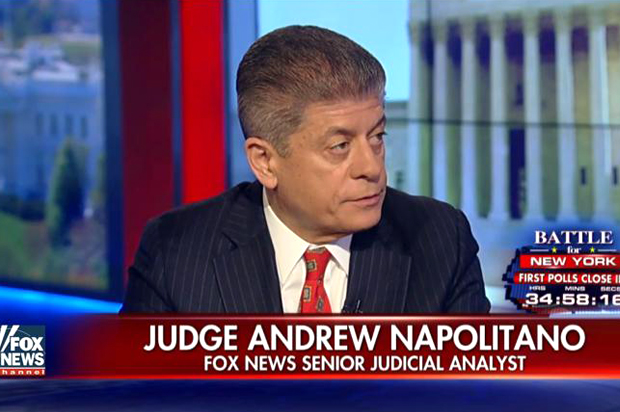
Fox News contributor Andrew Napolitano, most recently in the news for claiming that the British intelligence service GCHQ colluded with President Obama to conduct surveillance on the Trump staff during the 2016 campaign, is always called “Judge Napolitano” during his appearances. Lubet points out that he’s not a judge any more. Napolitano once served on the New Jersey Superior Court, but resigned in 1995 and has not held judicial office for more than two decades. It is apparently at Napolotano’s insistence that he is always addressed as “Judge” in Fox. His website, JudgeNap.com, refers to him as “Judge Napolitano” throughout, as does his bio on the Fox News site.
Lubet notes that The American Bar Association has held that the use of judicial titles by former judges practicing law is misleading and unethicalin connection with law practice. ABA Formal Opinion 95-391 says that continued “use of the title is misleading because it may be misunderstood by the public as suggesting some type of special influence” or “to create an unjustified expectation.” In fact, said the ABA, “there appears to be no reason for such use of the title other than to create such an expectation.” Of course, Napolitano isn’t practicing law when he bloviates on Fox News, so it isn’t a Rules violation, but the Judge label is still misleading
The Ohio Rules of Professional Conduct, Lubet found, goes further by decreeing that it is only ethical for a former judge to use the titles “Judge” or “The Honorable” if they are preceded by the word “retired” or “former,” and the rule does not limit this caveat to ex-judges actively practicing law. Again, Napolitano is not out of compliance, because he is not subject to the Ohio Rules. That doesn’t make what he calls himself strictly accurate, or sufficiently accurate. (I confess, I have had a bias against such things ever since I suffered through a year with an insufferable high school history teacher who called himself (and insisted that we call him) “Dr. Arthur” because he had a PhD in history.) Continue reading →
Atlanta’s Out Front Theatre Company’s production of “The Most Fabulous Story Ever Told” opens on April 27, but Paul Rudnick’s 1998 silly comedy that recasts Bible stories with all gay characters is being protested as blasphemous. The outraged in this case is the conservative Catholic group America Needs Fatima, whose members are particularly offended by the spoof’s portrayal of the Virgin Mary as a lesbian. It has an online petition demanding that Out Front’s Artistic Director Paul Conroy cancel the production.
Sure. Like that’s going to happen.
“I fear God’s wrath will fall upon us if reparation is not made,” the hysterical screed concludes. Over 40,000 hysterics have signed it. Yes, I’m sure that God has nothing better to do than to punish humanity for a theatrical production of a 20 year-old comedy in Atlanta. The group then threatens to oppose the play “loudly, peacefully, and legally in as large a protest as we can help make possible” if the production goes forward. Idiocy, of course. Last I heard, nobody is forcing anyone to go to see the play, and the First Amendment is pretty clear about the ability of the law to censor performances based on content. The contention from the religious right in this case mirrors the Left’s fervent efforts at the moment to censor speakers they don’t agree with and “hate speech.”
If you don’t think that you will enjoy a play, the remedy is not to go see it. Simple as that. Trying to interfere with the production in any way, or to prevent those who want to see a production in which Adam and Eve become Adam and Steve, is unethical. It is also directly contrary to the principles the United States was founded to ensure.
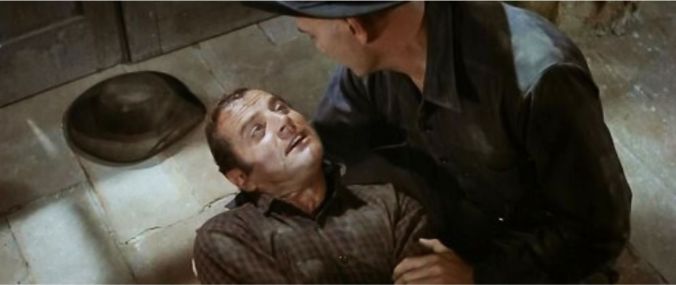
In “The Magnificent Seven,” the original classic, not last year’s disappointing re-make, Harry Luck (Brad Dexter) had always been convinced that the real reason the Seven had agreed to help a poor Mexican village fight a predatory bandit band was because the town had a secret treasure to share. (It didn’t.) Harry refuses to join the rest as they make one desperate effort to help the farmers, then at the peak of the gunfire gallops back into the village to join the battle–and is promptly shot. Dying, he begs Chris (Yul Brenner) to confirm his suspicions…
Harry Luck: Chris… I hate to die a sucker. We didn’t come here just to keep an eye on a lot of corn and chili peppers, did we? There was something else all along, wasn’t there?
Chris: Yes, Harry. You had it pegged right all along.
Harry: I knew it. What was it?
Chris: Gold. Sacks of it.
Harry: Sounds… beautiful. How much?
Chris: At least a hundred and fifty.
Harry: My cut would have been what?
Chris: About seventy thousand.
Harry: I’ll be damned. (He dies)
Chris: Maybe you won’t be.
Today’s news has another story involving lying to a dying man, a really stupid story.
Michael Garland Elliott, 75, died of congestive heart failure in his Oregon home ,surrounded by his caregivers, neighbors and friends. Right before the end, his ex-wife,spoke with him over the phone from her home in Austin, Texas.
She told him that President Trump had been impeached. “I knew it was his very, very last moments,” Teresa Elliott told reporters. “I knew that would bring him comfort and it did. He then took his final breath.”
Your Ethics Alarms Ethics Quiz of the Day is…
Is it ethical to lie to dying friends and loved ones?
An ethics bomb exploded on the CBS reality show “Survivor” last week.
Ethics bombs are unforeseen and unforeseeable incidents that suddenly start a chain reaction of ethics problems, dilemmas and conflicts in all directions. This was a lulu. Well, it was a lulu unless one thinks that nothing that happens on a reality show can teach any ethics lessons at all, since they are all, by definition, fake news. If you watch the show, what happens on it matters to you; you have accepted the devil’s bargain of pretending what is manipulated and edited by writers and directors is “real” in exchange for being diverted and entertained—so the ethics scenarios that periodically break out seem worthy of serious consideration. If you would rather watch paint dry—this is my niche—caring about the pseudo-real crises that actually happened months ago in the most contrived situation imaginable makes as much sense as cheering at a professional wrestling match.
However, just as illuminating ethics issues are raised on “The Walking Dead”—kind of a post-apocalyptic version of “Survivor” with zombies—they can arise on a reality show. In this case, the ethics bomb spread out into unscripted “reality.”
“Survivor” has been on the air for 17 years and 34 seasons—I can’t believe I just wrote that— and is itself an ethics bomb, since it launched the reality TV virus into the culture. Copied from a Japanese show, the idea is that a group of contestants are forced to compete in a remote and harsh location, divided up into teams (tribes) that are guided through daily challenges that yield various prizes, ranging from food to immunity from being ejected.. Each episode sees the losing team gathered around a campfire (“the tribal council”) where they vote on which team member to kick “off the island,” a phrase that has entered our lexicon. Contestants form alliances with each other and often reveal their character, or lack thereof, by engaging in various Machiavellian tactics to survive, all captured on camera. Some contestants lie, cheat and steal. Sometimes it works.
Last week, the tribal council took a sharp turn into real world social tensions when player Jeff Varner, knowing that he was poised to be jettisoned by his tribe and desperately trying to get their ire focused elsewhere, attempted to undermine fellow contestant and tribe member Zack Smith. Varner began by darkly claiming that all was not as it appeared, for there was widespread “deception” afoot.
“There is deception here,” Varner said. “Deception on levels, Jeff, that these guys don’t even understand.” “Continue,” said show host and producer Jeff Probst, who has presided over and moderated each tribal council from the beginning of the franchise.
Varner then turned to Smith and said: “Why haven’t you told anyone you’re transgender?”
The Wall Street art ethics controversy pitting a nearly 30-year-old sculpture of an angry bull against the upstart statue of a defiant little girl has fascinating cultural implications. The ethical solution to the confrontation are simple and undeniable, however, though the legal issues a bit less so. “Fearless Girl” has got to go.
Arturo Di Modica created “Charging Bull” in response to stock market travails during the late 1980s. The three-and-a-half-ton sculpture was placed near Wall Street in the dead of night, and was embraced by the financial ditrict and New Yorkers as iconic public art. The artist copyrighted and trademarked his work, which he has said was meant to symbolize “freedom in the world, peace, strength, power and love.”
I don’t get the love part, but okay: the point is that the bull is a positive metaphor, not a sinister one.
The “Fearless Girl” statue was positioned this year, the night before International Women’s Day, in a direct stand-off with the bull. It had been commissioned by State Street Global Advisors, a financial firm based in Boston, as a public relations and advertising move and classic virtue signalling. State Street Global’s home page trumpets the new statue’s message of “the power of women in leadership” and uses it to urge “greater gender diversity on corporate boards.” The metal girl’s cynical and self-serving origins don’t seem to bother the work’s fans though.
The problem is that the message of “Fearless Girl” requires the participation of the bull to make any sense and to have any power at all. Otherwise, it might as well be Pippi Longstocking. In essence, the new statue appropriates Di Modica’s work, and violently alters it. The artist is a furious as a charging bull that what he intended as a symbol of capitalist power and national vigor has been transformed into a sexist representation of male domination. Di Modica and his lawyers demand that the statue be moved away from its bull-baiting position, arguing that State Street Global commissioned “Fearless Girl” as a site-specific work conceived with “Charging Bull” in mind. It thus illegally commercialized Di Modica’s statue in violation of the artist’s intent and copyright. They also claim that the city violated the artist’s legal rights by issuing permits allowing the four-foot-tall tyke to face off with the bronze bull without the artist’s permission. Letters to the Mayor DiBlasio, Ronald P. O’Hanley, the president and chief executive of State Street Global; and Harris Diamond, the chairman and chief executive of McCann Worldgroup, State Street Global’s marketing agency demand the removal of “Fearless Girl” forthwith.
Ethically, “Fearless Girl” doesn’t have a leg to stand on. Continue reading →
It is tragically clear now that Madison Avenue has decided there is a cultural consensus that it is incredibly funny to imply vulgar words and make sexual allusions in TV commercials. Objections to this as juvenile, culturally degrading and gratuitous from this quarter have no effect, accept to attract the usual “lighten up” comments from applauding vulgarians. Well, I don’t care. Ethics Alarms will keep pointing out what wrong anyway. You want a President who boasts about the size of his penis during a debate? THIS is how you get a President who boasts about the size of his penis during a debate. You want a President who uses a menstrual reference to attack a female journalist? This is how you get that too.
The only satisfaction, I suppose, is the same uncivil vulgarians who most object to the results of this cultural pollution are also the ones sending the “lighten up” comments.
Since August of last year, the Kraft Heinz Company’s newest frozen meals brand, Devour, has been advertising its products with a TV ad in which a boss catches his employee becoming sexually aroused by his lunch, to which he applies a sexy spank with his fork. The ad’s tagline: “Food You Want to Fork.”
Nice.
Kraft says the ad is aimed at men aged 25-35, so I guess that’s okay then. Everyone knows that demographic is made up of assholes—is that the theory?—and the best way to please them is to make the kind of juvenile sexual innuendo that we had in naughty songs like “Shaving Cream” about when I was 12. It’s so hilarious when people use a word that sounds like a dirty word in a context where it is obviously intentional, but don’t really say the word, because, see, its, like, not polite. Got it. My sides are splitting. Continue reading →
I used to watch Bill Maher regularly during his Comedy Central days, before he decided he was such an insightful political pundit that he could afford to eschew comedy and just engage in full-time conservative and Republican smearing. On his HBO show Bill is only useful now to remind us of the ugliest tendencies of the Young Angry Left, as Maher will engage in such “comedy” as calling Sarah Palin a cunt, while his audience of fawning dim bulbs clap and bark like hyper-active seals. All Maher does is try to fan the flames of societal division and hate, and HBO is apparently satisfied with that, since there are enough progressive fans of societal division and hate that being funny isn’t deemed essential. Maher’s weekly partyist ranting has even spawned imitators on other networks, like Samantha Bee and John Oliver. Both are funnier than Bill.
Still, millions of people see this poison and spread it around the internet, so I guess it’s past time to point out how Maher is either ignorant or determined to spread stupidity via confirmation bias. We can stipulate that he’s no longer funny, and seldom even attempts to be.
At the end of last week the latest episode of “Bill Foams At the Mouth” debuted, with the confirmation of Neil Gorsuch the primary object of Bill’s wrath, I mean “wit.” He began with his monologue.
If anyone senses a joke, raise your hand.
“I don’t know why you’d be happy today. Today is a day Republicans are happy. They got their two favorite things — a right-wing asshole on the Supreme Court and Trump finally blowing some shit up.”
Please note:
Bill assumes that only one side of the political divide watches him. He’s right, but it’s not healthy for the culture, and he’s one of the reasons comedy and the arts now divide rather than unite us.
Maher calls a dedicated jurist and legal scholar an “asshole” simply because he’s conservative. This is bigotry. Denigrating, stereotyping and demonizing whole categories of people based on their priority of values is no different ethically from denigrating them based on their religion or ethnicity. It’s unfair, disrespectful, irresponsible and undemocratic.
Did you raise your hand? Maher, a professional comedian, gets laughs by using words like shit, asshole, and cunt. There was a guy I knew named Larry who did that quite successfully too.
Of course, we were in the 5th grade…
Then Maher, as usual, moved on to calling Republicans racists.
In 2013, 98 Republicans signed a letter saying bombing Syria in response to a chemical attack was unconstitutional without congressional authorization. But this is different because Obama was President then. That would have involved bombing while black, and you can’t — can’t do that.
In the wake of the embarrassment and the exposure of President Obama by President Trump’s decisive handling of an issue that his predecessor made into a trademark display of his weakness, fecklessness and dithering, the desperate Obama Fan Club has virtually made Maher’s spin a talking point. Almost all media accounts bolstering their narrative leave out the actual sequence of events, which was… Continue reading →
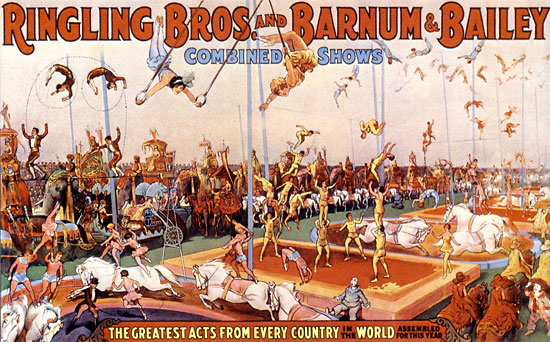
The Ringling Brothers Barnum and Bailey Circus will bring down its metaphorical Big Top for the final time in May. Its business model simply does not work any more, as an executive of the arena entertainment company that owns it said recently—especially since the circus capitulated to animal rights activists and fired its performing elephants. (Ticket sales dropped by almost a third.) This was an iconic cultural institution vanishing, so I had to say farewell, and did so last weekend, when the circus came to Washington, D.C. for the final time.
Observations:
1. It is still an entertaining show, even though the Ringling brothers would never have recognized it as a circus. Several of the acts were worth the ticket price (in our cases, about 75 bucks) all by themselves.
2. The Verizon Center was about a third filled for the final show of the legendary Ringling Brothers Barnum and Bailey Circus. The Center itself was sparsely staffed; it took 20 minutes in line to buy popcorn. Americans, as a group, don’t care about history, culture and significant changes in it landscape any more. The circus and its components gave us imagery, lore, metaphors—“walking a tight rope,” “three ring circus,” (this one is now a two-and-a half ring circus at best), “ringmaster,” “dog and pony show,” “the big tent,” “side-shows,” “clown act,” —and “The Man on the Flying Trapeze.” The nation is a little poorer and less colorful without it.
3. The public also increasingly sees little value in the mass audience experience. Live entertainment, especially family friendly varieties, were traditionally seen as an important and natural way to strengthen community ties, by bonding disparate members of society through a shared experience involving witnessing something transforming and memorable.
4. Assisting in the death of this experience is the trend of making sure all arena and stadium events are filled with loud, never-ending, pounding electronic music that would make Phil Specter grab ear plugs. Once, the circus’s dramatic music consisted of drum rolls, bands and soft calliopes. If you watch the Cecil B. DeMille movie “The Greatest Show On Earth,” you will see spectators talking to each other during the acts, or shouting out to performers. Either is virtually impossible now. Conversation consists of screaming a few words repeatedly until your companion nods. This continues the cultural trend of making meaningful interaction with fellow human beings passe. How can this possibly be a healthy development for society?
I did see a lot of people texting….maybe to those sitting next to them.
5. Almost no venders were walking among the seated. A single snow cone from one of these cost $12.00.
6. This is how unintended cultural pollution takes place. The conglomerate that owns the circus also owns various ice shows, like Disney on Ice. To cut costs, it decided to employ performers from the ice shows in the circus too, meaning that instead of a sawdust path around the rings, the track around the performing areas are ice. Everyone is on skates half the time. It isn’t a bad effect: it’s faster than the old-style parades. But now the circus is an ice show. Continue reading →
I saw an online article that called Bill O’Reilly the “Bill Cosby of Fox News.” That’s not entirely fair: O’Reilly is likely just a serial sexual harasser, whereas Cosby is a rapist. Then again, they are both named “Bill,” and there are other similarities. Both have paid hush money to accusers, both have had a series of accusations made against them by women, the watermark of the sexual harasser (though Bill Cosby, so far, is way ahead in that category), both angrily deny the charges against them, and both have indignant defenders.
Both also are probably sociopaths.
Is it possible that Cosby has been wrongly maligned? Let me think…NO. Of course not. Over 50 women (what is the current count now?) do not accuse the same innocent man of sexual assault. Is it possible that the other Bill is a victim, not a predator? My “no” here isn’t quite as emphatic, perhaps, but…no. The New York Times piece yesterday thoroughly covers the evidence, and the odds against all this being meaningless boggles the mind: Continue reading →
Once again, a Hollywood film has political correctness furies attacking its casting. This time, it’s the sci-fi “Ghost in the Shell,” starring Scarlett Johansson.
The sad fact is, movie makers can’t win. If a black actor isn’t cast to play a white character in the source material, Hollywood is engaging in bias by eschewing “non-traditional casting,” which is necessary to remedy de facto segregation and prejudice in movies. If Charlton Heston is cast as a Mexican, as in “Touch of Evil,” it’s “whitewashing”—prejudicial and racist casting of whites to play non-whites. Of course, when Morgan Freeman, an African American, is cast to play a dark skinned Semitic character in “Ben Hur,” nobody calls that “blackwashing,” for there is no such thing as blackwashing. Casting Denzel Washington as a white character from “The Pelican Brief”: great! Who doesn’t like Denzel? Casting Denzel as the white hero of “The Magnificent Seven” in the remake, when the white hero was non-traditionally cast with the sort-of Eurasian Yul Brenner in the original, was also great, because—who doesn’t like Denzel? Casting Andy Garcia, a Cuban-American, as member of the Italian Corleone family in “Godfather III” was also fine and dandy, but not the casting of sort-of Eurasion Brenner as the King of Siam in “The King and I,” (even though he won the Tony and the Academy Award for an iconic performance)—, especially with all those great Thai musical comedy stars available. So that was–what, “sort-of-whitewashing”?
All right: how about a musical conceived with the novel conceit of having the Founding Fathers played by young black and Hispanic performers? Is that non-traditional casting? Minority-washing? Is it racist to stay with the original (brilliant) concept and tell white actors they can’t audition to be Hamilton, Jefferson, and Aaron Burr? Of course it’s not racist. After all, those actors are white. Screw ’em.
Are you seeing a theme here? Neither am I. What matters in casting a play, film or writing an adaptation is whether the final result works: How well do the actors play their roles? Is it entertaining? Does it make money?
Now the casting of Johansson as an originally Japanese character in a Japanese manga comic and animated film is being attacked as racist. Whitewashing, you know. No, in fact the words applicable here are “adaptations,” “movies,” “cultural cross-pollination” and “commerce.” In this case, not always, but in this case, the accusation of “whitewashing” is pure race-baiting.
More than forty years ago, the real life German prison camp escape engineered by captured WWII British fliers was made into the film “The Great Escape.” Brits were annoyed as production got underway, however, by the presence of heroic American prisoners in the cast, the characters played by U.S. stars James Garner and Steve McQueen. This was, British critics and veterans said, an outrage: Americans had nothing to do with the real escape. The answer by the producers contained three segments:
1. We own the film rights, and can do whatever we think will make the best movie.
2. The film is fictionalized, and makes no representations to the contrary.
3. Garner and McQueen will ensure that the film makes a profit in the U.S, plus they are both great and entertaining young stars.
Good justifications all. “The Great Escape,” as we now know, is a classic, still honored the real event, and made lots of money. Somehow, British self-esteem recovered.
The Brits also didn’t complain when Japan’s great film auteur director, Akira Kurasawa, made an all-Japanese cast adaptation of “King Lear,” which is about a Celtic king. Wasn’t this–what, “yellow-washing”? Don’t be silly: all good stories can be told in myriad ways, in many cultural contexts. “Ghost in the Shell” is a science fiction fantasy. It is not about real people, and the characters were Japanese because the author and intended audience were Japanese—you know, like the original “King Lear” was in Elizabethan English.
“Ghost in the Shell” director Rupert Sanders cast Johansson as the cyborg assassin named Motoko Kusanagi in the original and renamed the character “Mira Killian.” It is the “Who doesn’t like Denzel?” non-traditional casting principle, except the even more understandable “Who doesn’t like Scarlet, especially when she looks naked for much of the movie?” variation. The perambulations of critics trying to find something racist about the most obvious box office casting choice imaginable border on hilarious. At some point, actress Johansson decided it was more lucrative and fun being the next female action movie star than starring in solemn costume drama bombs like “The Girl With The Pearl Earring” and “The Other Boleyn Girl.” Since then, she has been rising as a bankable star in blockbusters like “The Avenger” films and “Lucy.” Quick: name another hot (I mean, of course, popular and bankable) female action star?