I’m watching “It’s A Wonderful Life,” Frank Capra’s ultimate ethics movie. Don’t forget to review its ethics dilemmas, conflicts and conundrums with the handy
Arts & Entertainment
Vice President Biden May Be A Boob, A Hypocrite And An Ethics Dunce, But He Understands The American Culture Better Than Most Of His Party
I’m late to the blog today, because I spent it giving a special program for the Smithsonian Associates called “From Stagecoach to Django Unchained: The Hollywood Western and Its Influence on American Values, Aspirations and Culture.” It consisted of me talking, a terrific Powerpoint presentation by the gifted Grace Marshall, and almost three hours of clips from classic Westerns—the whole session was five hours. My primary message is that anyone who is not literate regarding the Hollywood Western really doesn’t understand the myths and archetypes that powerfully influence U.S. culture to this day. Within that “anyone” are the majority of pundits and journalists, a large percentage of citizens under 50, and the vast majority of women and minorities. This is a problem.
For example, no one can consider the vast influence of the Western genre on American culture and be the least bit surprised that gun control has an uphill battle with the American public. No other culture has as its primary source of heroes, legends and lore figures and events so dependent on firearms as a means to right wrongs, protect the innocent, and punish evil. Frankly, if a pundit doesn’t understand why John Wayne (who died in 1979) just set a Harris poll record by being included in its annual list of top ten most popular movie actors for twenty consecutive years, from 1994 to 2014, I don’t think they can comprehend the nation sufficiently to opine on it.
Joe Biden, however, understands. I have been critical of Joe, as he is frequently an embarrassment, and there was a lot wrong with his comments today as he was honored with the “Voice of Solidarity” award by Vital Voices, a women’s rights charity, at their event celebrating “men who combat violence against women.” Still, Biden proved that whether he knows it or not, he is more atuned to U.S. culture than most of his colleagues. He deserves credit for that, if nothing else.
You see, Biden told a fascinating personal anecdote from his childhood. He related:
“I remember coming back from Mass on Sunday Always the big treat was, we’d stop at the donut shop…We’d get donuts, and my dad would wait in the car. As I was coming out, my sister tugged on me and said, ‘That’s the boy who kicked me off my bicycle.’ So I went home—we only lived about a quarter mile away—and I got on my bicycle and rode back, and he was in the donut shop.”
Biden said the the boy was in a physically vulnerable position,“leaning down on one of those slanted counters,” so he took immediate advantage:
“I walked up behind him and smashed his head next to the counter.His father grabbed me, and I looked at his son and said, ‘If you ever touch my sister again, I’ll come back here again and I’ll kill your son.’ Now, that was a euphemism. I thought I was really, really in trouble… My father never once raised his hand to any one of his children—never once—and I thought I was in trouble. He pulled me aside and said, ‘Joey, you shouldn’t do that, but I’m proud of you, son.’”
The lesson, Biden said, was that one should to “speak up and speak out” to correct wrongdoings. Like much of what come out of Biden’s mouth, this was nonsense in the context of his own story, and was not what the lesson was at all. The lesson was that force, punishment, violence and intimidation is sometimes necessary to stop bullying, discourage misconduct, protect the innocent and vulnerable, set standards, and give more than lip service to core values. Little Joey Biden didn’t “speak up”: he bashed a bully’s head and threatened to kill him. Apparently it worked, too. America, Americans, the culture and our history—as well as the Duke–have long believed that sometimes violence is necessary to stop violence, and send important messages, and can therefore be virtuous and ethical. Biden understood that when he was ten, and somewhere deep in that mess of mush he calls a mind, he understands that now. Continue reading
Unethical (and Cynical) Donation Of The Year: The St. Louis Rams’ Forgiveness Bribe To The Backstoppers
Let us be undiplomaticly clear about what the five St. Louis Rams players did when they came onto the field at the start of a Monday Night Football games with their hands in the air like the fictional, idealized, sanitized, imaginary and politically useful version of Michael Brown—you know: the angelic young college-bound African-American male who did nothing whatsoever to cause the circumstances of his own death.
The players were saying, on national television, with millions of people watching, that Officer Darren Wilson executed Mike Brown in cold blood; that the St. Louis police do such things, want to do such things, and will do such things, because they routinely target young black men for harm; and that police generally, around the nation, are virulent racists. That’s what the gesture meant, and that is what it was devised to convey. Continue reading
On Peter Pan, Pippi Longstocking, And Ethics Of Applying Political Correctness To Art And Literature
Cultural events earlier this month brought to light, on two continents, the problem of maintaining the integrity of art and literature under the onslaught of political correctness.
In Sweden, a controversy has erupted over the re-broadcast of a 1969 television adaptation of the Pippi Longstocking books, the children’s classics authored by Astrid Lindgren. The Swedish national TV station, SVT, announced that it is revising a scene from the 1969 television series about Pippi which she says her father is “king of the Negroes,”a direct quote from one of the stories. Believe it or not, this has set off a contentious national debate.
The family has approved the station’s desire to change the TV version, but is keeping the term in future editions of the books. In 2006, the family added a preface explaining that today, the word is considered “offensive,” but that when the books first appeared, “Negro was a common expression for people with black skin who lived in other parts of the world than ours.” That’s a sensible solution. Period and context is important in art and literature: the urge by some to constantly purge the world of any reference, word or attitude in past creations that seem out of place now leads to a form of cultural self-lobotomy. Erik Helmerson, a columnist at Dagens Nyheter, an influential Stockholm newspaper, called the changes a form of censorship. “I’m very sensitive to the fact that people are offended by the N word,” he said in an interview. “I’d never use it myself.” He even called revising the TV series “a huge interference into freedom of speech.” “Where do we draw the line? What do we cut and what do we keep? Who should decide? Who needs to be offended before we cut a word?” Continue reading
Getting Eaten Alive By A Really Big Snake Ethics: The Rest Of The Story
When we left naturalist and filmmaker Paul Rosolie, we were told that he journeyed to the Amazon, donned a special suit, slathered himself in pigs’ blood, and allowed himself to be swallowed whole by an anaconda on “Eaten Alive,” in a two-hour special produced by the Discovery Channel that would air December 7. Rosolie would be removed from the snake by a cord attached to his suit, presumably before he was digested. Animal rights groups and zoologists objected, quite accurately, that this was cruelty to animals for sport.
What did viewers see on December 7? (I’m sorry: my sock drawer desperately needed organizing that day. I’m basing this on published accounts.) Rosolie found an appropriately large and hungry snake and attracted its attention in the water. The 20-feet long reptile attacked, wrapped around him and then began to constrict. Then the snake started to try to eat the naturalist head first: Rosolie’s helmet camera provided a lovely shot of the anaconda’s gaping throat.
At that point, Rosolie did a terrific imitation of Gene Wilder as “Young Frankenstein” after he had himself locked in a room with the Monster with instructions that nobody should let him out no matter how much he begged. (“Let me out! Let me OUT OF HERE!!! GET ME THE HELL OUT OF HERE!!!….Mommy!” ) Rosalie’s team rushed in and pulled him away, disappointing the snake. Continue reading
Signature Significance Verdict: Lena Dunham Is An Awful Human Being
UPDATED!
If her boasting about abusing her little sister in her memoir wasn’t enough, Lena Dunham’s revealed conduct regarding “Barry” in the same tome rings the signature significance bell. No human being with a sufficient amount of decency would do something like this, even once.
In case you have not followed the latest ethics scandal involving the over-praised creator and star of HBO’s “Girls,” what occurred is this:
In one chapter of Dunham’s memoir “Not That Kind of Girl,” the feminist actress describes as factual an episode of sexual assault or rape that she says she experienced while an undergraduate at Oberlin. Her assailant was a well-known campus “Republican,” she says, a conservative whom she refers to as Barry—without the conventional quotes that would indicate a pseudonym.
There was, as it happens, a real Oberlin college graduate from the same period named Barry, then well-known as a conservative, which then as now, is a species about as common at Oberlin as velociraptors. Besides his name and campus reputation, Barry fit some of the other details given by Dunham, such as wearing cowboy boots and sporting a flamboyant mustache. Now the 28-year-old man (the same age as Dunham) is being tarred as a rapist, and has been forced to take down his social media accounts. He has hired a lawyer named Aaron Minc, with the help of donations from GoFundMe to help pay his legal fees, and has promised that any money he receives from the suit exceeding legal fees will go to charities assisting survivors of rape and sexual assault.
Dunham has not had the courage or decency to say anything, to or about Barry. But yesterday Random House did, in an extraordinary statement and admission: Continue reading
Ethics Dunce: George Stevens, Jr.
Abuse of power, abuse of position, disrespect, unfairness and old-fashioned pettiness—these are just some of the ethics fouls the Kennedy Center’s George Stevens, Jr. committed during the 37th Kennedy Center Honors program last night in Washington, D.C.
“Take this job and shove it” is a pleasing anthem of the abused and disaffected in the workforce, but acting on the sentiment is usually a bad idea, and in some cases, like this one, a terrible idea. The Kennedy Center Honors program was Stevens’ baby from its inception nearly two decades ago, a gala honoring the greats of American culture with a star-studded stage show attended by the glitterati of Washington and Hollywood. Through his skill and showmanship—it runs in his family: he is the son of the great Hollywood director George Stevens, who directed “Shane,” among other classics–he had made the annual event an institution. The awards were considered the official confirmation of icon status, and the program was one of the few culture-related presentations remaining that was deemed worthy of a yearly network telecast. Apparently, Stevens felt that he made the Honors what they were, so he had the right to warp it to his own selfish ends.
Kennedy Center Chairman David Rubenstein thanked the audience for its support, and then, in a gesture unchanged from past years, thanked producers George Stevens Jr. This time, however, instead of waving from the audience as in past years, Stevens came on stage and announced that Rubenstein was forcing him out as producer after 37 years. “We accept that this will be our last Honors,” Stevens said. “This is our good night.” It was hardly a spontaneous show of pique, for he had programmed his comments into the teleprompter.
The sour note interrupted the flow of the evening, and cast a pall over the tributes to honorees Lily Tomlin and Sting, which had not yet begun. (The celebrations of the careers of Tom Hanks, ballerina Patricia McBride and soul singer Al Green had been completed.)
Stevens had been engaged in contentious talks with Kennedy Center management, which wanted to move the Honors show in a new direction and sought a fresh creative vision. In a messy split redolent of Jerry Lewis’s divorce from the Annual MS Labor Day Telethon, an aging creator of a cherished tradition was being retired against his will, and felt betrayed.
Jerry Lewis, however, did not crash the telethon to announce his departure.
This kind of petulant and vindictive exit may feel good in the doing, but is always destructive. The victims included the honorees, the audience, and Steven’s own good will and reputation, as well the event itself. Can this be justified by the momentary satisfaction of telling his foes at the Kennedy Center off, and holding them up for brief, unwanted criticism? Of course not. All this act accomplishes is to make it clear why the leadership of the Kennedy Center concluded that it was time for Stevens to go. This was not the act of a professional nor the act of a gentlemen. It is the act of an egotist, or perhaps that of someone who has stayed too long and through age or complacency forgotten that maxim of both the theater and life, that you always want to leave your audience wanting more.
Cellphone Videos Of Stand-Up Comedy Routines Are Unethical: Ban Them
Vulture features an interview with Chris Rock, on which he waxes forth on many topics.I don’t especially care what Chris Rock has to say about Ferguson, but I care a lot about his views on stand-up comedy, where he qualifies as an expert, and the disastrous effect unauthorized videos are having on his art.
Rock has walked off the stage in appearances when he couldn’t stop audience members from filming him, and for very good reasons. He doesn’t want untested, half-baked material to get out to the public via YouTube:
“There are a few guys good enough to write a perfect act and get onstage, but everybody else workshops it and workshops it, and it can get real messy. It can get downright offensive. Before everyone had a recording device and was wired like Sammy the Bull, you’d say something that went too far, and you’d go, ‘Oh, I went too far,’ and you would just brush it off. But if you think you don’t have room to make mistakes, it’s going to lead to safer, gooier stand-up. You can’t think the thoughts you want to think if you think you’re being watched.”
On Elahe Izadi’s Syle Blog in the Washington Post site, other comics voiced similar concerns. Continue reading
Comment of the Day: Daily Comics Ethics: When Did Erection Gags Become Appropriate For The Funny Pages?
Traversing such seemingly unrelated topics as aphrodisiacs, “Mr. Ed,” post-war culture, literacy, and the evolution of childhood, Penn’s Comment of the Day is one of my all-time favorites. Here it is, a response to the post, “Daily Comics Ethics: When Did Erection Gags Become Appropriate For The Funny Pages?” I have a lot of reactions, but here are three:
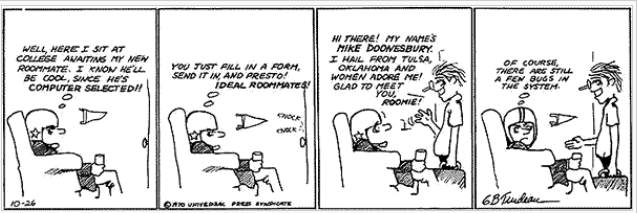
- If kids really don’t read the funny papers any more, what good are they? Who does read them? The Washington Post and other papers used to take “Doonesbury” out of the section and place it in the main body of the paper on the theory that it’s humor was “adult.” (Of course, “Doonesbury’s” humor has also been non-existent since around 1978—but I’ve never seen an erection joke there, either.)
- Just because little kids are familiar with the term “horny” doesn’t mean they have any idea of what it refers to.
- I like the “Mr. Ed” song!
In reply to your rhetorical (and tertiary) query, Jack, you missed (that small part of the) evolution just as we all did and do, because it was an evolution, a slow-moving American tsunami of post-war change beginning in the late 40s.
As a child, I recall controversy, strictly among adults, over things that wouldn’t be even thought of today such as the idea of having a girl (Lois Lane?) take up a weapon against a villain instead of waiting, albeit bravely, for Superman, to come rescue her. It was argued to be unladylike – and therefore, unsuitable for children’s comics — for females to fight for themselves if there was a man around, even as the WACS, nurses and ambulance drivers returned home, joining widowed moms & rosie-riveters in job-hunts. Or unless it was Wonder Woman. And oh the struggles to allow Wonder Woman — she of the skin-molding, crotch-height tights and the noticeable chest bumps, however well armored — into the son’s bedroom. Or the daughter’s wardrobe (next, she’ll want a bra!) Continue reading
Daily Comics Ethics: When Did Erection Gags Become Appropriate For The Funny Pages?
When did I miss the evolution of the newspaper comics, always regarded as the young tyke’s entry into the newspaper perusal habit, into one more entertainment medium requiring ratings and advance parental review? The comic above appeared in today’s Washington Post and elsewhere. I think it’s funny—for a Playboy cartoon. Maybe it’s not too racy for the New Yorker. But the funny pages? Seriously? This is an erection joke! In a strip with Mother Goose in the title! (The strip is “Mother Goose and Grimm” by Mike Peters, who is also an award-winning political cartoonist.) It refers to the classic naughty line that had censors screaming when Mae West said it (after writing it.) My Dad read the daily comics to me before I could read, then explained the jokes that I couldn’t understand. Is this the kind of joke toddlers will be having explained to them now? Continue reading