Q. “Oh, ICK! Why would you take money for THAT?” A. Because it’s valuable, they want it, and I own it, you idiot.
Slate Magazine’s Josh Voorhees seems to think there is something unseemly about Feidin Santana, the bystander who recorded the film on his smartphone showing North Charleston police officer Michael T. Slager shooting and killing Walter Scott on April 4, seeking payment from news outlets who use his video.
In an article revealing that Santana’s lawyers are making the case that he is entitled to compensation, Voorhees writes, “While it may seem opportunistic to try to make money off a video of someone’s death…” and later,
“Regardless of how you feel about Santana trying to cash in, if nothing else it provides another incentive—albeit a less noble one—for bystanders to whip out their phones and start filming when they see a police confrontation.”
Let me be uncharacteristically blunt: anyone who sees anything unethical, unseemly, ignoble or opportunistic about Santana seeking fair payment for his property when it is being used by news outlets all over the country as if the video was shot by their own employees is either… Continue reading →
At 10:30 a.m. on Monday, Amal Clooney walked into Classroom 103 in William and June Warren Hall at Columbia Law School. The human rights lawyer and wife of the actor George Clooney …was by herself, far from the tangle of paparazzi who gather outside the Carlyle hotel, where the couple are staying while Mr. Clooney is in town making “Money Monster,” a film directed by Jodie Foster and co-starring Julia Roberts. Ms. Clooney, 37, greeted a man preparing slides for the class in human rights for which she is a guest lecturer this spring. As she spoke, passers-by peeked at her through the sliver of glass in the door. If anyone had thoughts to share about Ms. Clooney, they weren’t talking.
“We are under strict orders not to discuss her or anything about her class,” said a student who declined to give her name. A representative from the law school politely asked a reporter to leave.
What?WHAT?Columbia University can’t “order” students not to talk about a professor! How did they get the idea that they could, or that it was appropriate to try? Of course, Columbia of late has shown less than a sterling respect for the values of academic freedom and the Bill of Rights. Still, this is pure abuse of power.
WHAT?What kind of jello-spined, ignorant, submissive worm are they admitting to Columbia who would accept such outrageous “strict orders”? [ Well, we do have some strong indications…] I couldn’t care less about Ms. Clooney, but if my law school said that to me, I’d hold a press conference.
WHAT? Why does this woman, who voluntarily thrust herself into the limelight, warrant special privileges that justify restricting a law school’s students right to talk about anything they want to?
University classes have been taught for more than a century by men and women with far more impressive accomplishments and greater fame than Amal Clooney. Shouldn’t Columbia be combating celebrity culture rather than catering to it?
Any students who meekly accept such restrictions on their speech and autonomy are too craven to be trusted to practice law, and no institution that would demand such restrictions should be trusted to teach them.
Let me tell you, it’s quite a shock when Britt’s head spins around and that forked tongue starts flecking…
Anyone who spends much time watching TV knows that “lookism” is the way of the world in the broadcast news business. From Nora O’Donnell on ABC to Robin Meade on HLN to Erin Andrews and the bevy of Fox blondes, it is obvious that if you are female, talent as a reporter won’t get you as far as some beauty contest creds. Plain, even conventionally pretty women are at a great competitive disadvantage in this field.
One of the more blatant beneficiaries of this bias, ESPN’s Brit McHenry, has just been outed on the web as an ugly human being in a flashy disguise. Her car was towed, and a camera caught the reporter taking out her frustration on the poor clerk who was tasked with collecting her fee.
“I’m in the news, sweetheart, I will fucking sue this place,” McHenry says as the video opens.“Yep, that’s all you care about, is just taking people’s money,” she continues. “With no education, no skillset, just wanted to clarify that. … Do you feel good about your job? So I could be a college dropout and do the same thing? Why, cause I have a brain and you don’t?…Maybe if I was missing some teeth they would hire me, huh? ‘Cause they look so stunning … ‘Cause I’m on television and you’re in a fucking trailer, honey.”
“Lose some weight, baby girl,” she taunted as she left.
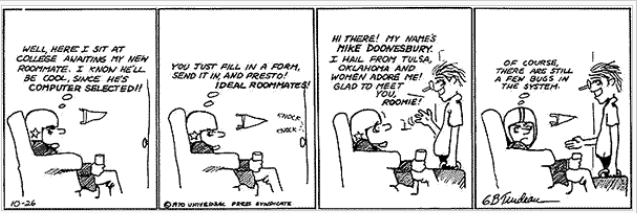
The exquisitely rendered artwork of Gary Trudeau, circa 1970.
“At some point free expression absolutism becomes childish and unserious. It becomes its own kind of fanaticism.”
—-Doonesbury cartoonist and relentless critic of the Right, Garry Trudeau,in a speech delivered on April 10 at the Long Island University’s George Polk Awards ceremony, where he received the George Polk Career Award.
Trudeau is a Yale grad, so perhaps we should cut him some slack muddled thinking. (Kidding!) However, in making his weak case that legitimate and socially acceptable satire only consists of “punching up,” he appeared to be advocating government prohibition of certain kinds of speech, to be designated by Trudeau and his ideological allies, who, of course, know best.
In doing this, Trudeau came very close to aping the popular theme from activists on the Left, especially on campuses, that “hate speech isn’t protected by the First Amendment.” “Hate speech” is an invention of progressives, and is generally defined as political or social criticism of members in good standing of their club, or groups and individuals they sympathize with or approve of. Saying that you hope Rush Limbaugh’s kidneys fail is funny and deserved; saying Mike Brown engineered his own demise by attacking a cop is hate speech. It’s easy when you get the hang of it: just look at the world like Gary Trudeau.
Earlier in his speech, he talked about “red lines” in satire, and blurrily–that is, inarticulately enough that he has plausible deniability, called for restrictions on “hateful” cartoons like those that prompted Islamic assassinations in Paris: Continue reading →
For those who think that our ethical sensitivities don’t evolve for the better over time, I prescribe a careful viewing of that family classic, “It’s A Wonderful Life.”
At the film’s climax, George Bailey, the self-sacrificing hero who has been granted his inadvertent wish to see what the world would be like if he had never been born, finds the love of his life and (in the life he has given up for this dystopian hell) the mother of his children now unmarried, alone and working as a librarian despite the fact that she looks like Donna Reed. He embraces her, and since she’s never met him in this alternate reality, she screams, believing she is being sexually assaulted by a madman. Kind, jovial police officer Bert is summoned to quell the ruckus, and George, who is a bit upset, punches him in the face to avoid arrest, and runs away. Bert then takes out his pistol and fires it at George repeatedly.
He’s a lousy shot.
In 1946, when audiences first saw this film, nobody thought there was anything unusual about Bert’s professional conduct. Many, many films right through the 1960s show police officers, “good guys,” even ones not trapped in a strangely mean alternate reality like Ward Bond’s Bert, shooting at fleeing suspects or criminals. That was considered appropriate police procedure then, and the public, society and U.S. culture saw nothing amiss. You were expected, as a good citizen, to submit to a police officer’s lawful authority. If you resisted arrest and ran, then it was fair and reasonable for the officer to shoot you, ideally after a “Stop or I’ll shoot!” warning. Indeed, many people were shot, and killed, this way. If it was news, it wasn’t on the front page, and it wasn’t considered any kind of an outrage.
Now consider the public and media reaction to Michael T. Slager’s shooting of Walter Scott. We now know that Scott was resisting arrest: he had a bench warrant out on him for non-payment of over $18,000 in child support, and Slager was trying to bring him into custody. Instead of doing as the officer demanded, Scott resisted and ran. Burt would have shot at his back too; the difference is that Slager is a better shot, and George was faster. Slager, however, is completely reviled across the country; even his own lawyer found him so repugnant that he refused to represent him.
That represents a massive shift in cultural values in a little over half a century. Continue reading →
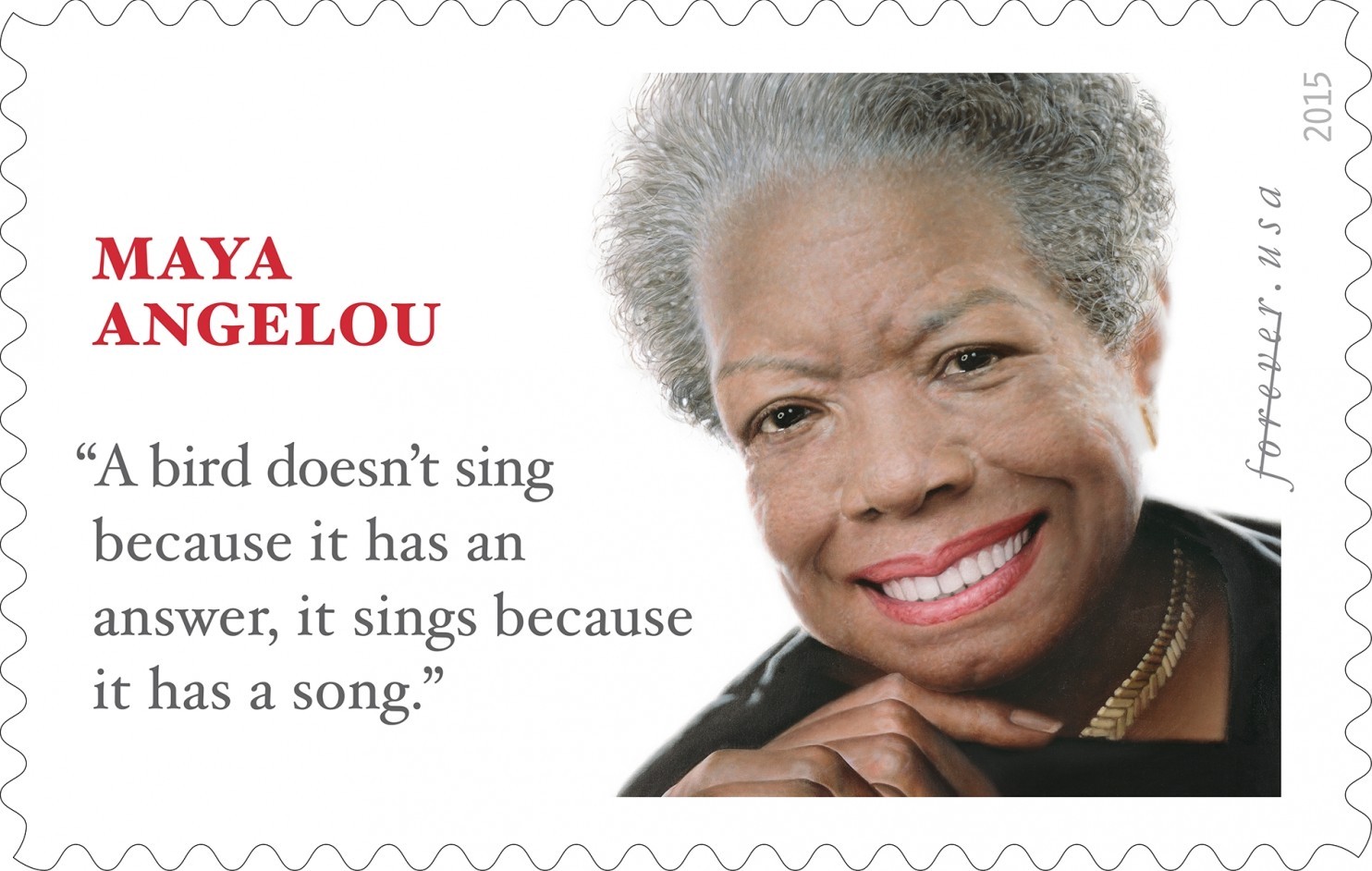
Yesterday the Post Office unveiled its new Maya Angelou stamp. The earlier announcement of the stamp had me sighing; Angelou is proof that affirmative action can be applied to the arts, distorting artistic taste, standards and values in the process. I would rank her talent as a poet near that of the recently deceased Rod Mckuen, but he was not black, a civil rights advocate or female, so his work was judged more or less on its merits. Angelou, in contrast, is called “an icon.” The idea of a stamp honoring the much derided McKuen would have been reflexively mocked; ah, well, fame is fickle.
There is no excuse for the stamp itself, however. Fame may be fickle, but the Postal Service is obligated to be professional, diligent and competent like any other government agen—STOP LAUGHING!!!.
The poet’s “quote” on the Angelou stamp is “A bird doesn’t sing because it has an answer, it sings because it has a song.”
Fox’s Chris Wallace has apologized for making a gratuitous and unkind crack about pop singer Kelly Clarkson’s weight on a conservative talk radio show (he was suckered into it by the host, Mike Gallagher, who has also apologized to Clarkson.)
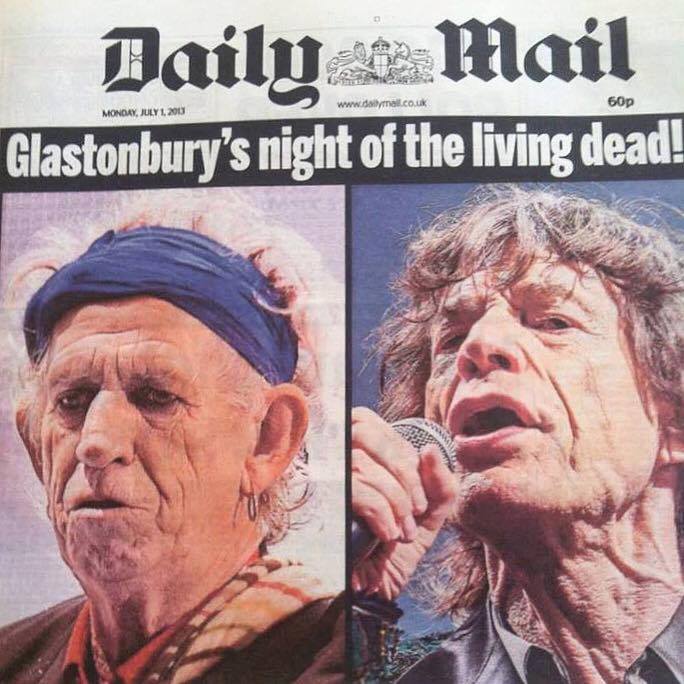
Today I have seen the above graphic circulating on Facebook with many “likes” and snarky comments about Mick and Keith’s faces.
My restrained reply is “Shut up, jerks, and show some respect.”
Original members Mick Jagger, Keith Richards and Charlie Watts are over 70 now. Nevertheless, they are embarking on another North America tour. They can still play, in some ways better than ever; Mick can still sing, and can still dance like a chicken. The Stones show passion and professionalism in every performance; those who have seen their concerts leave amazed. The Stones are not like the Beach Boys or the Turtles, croaking out 50-year-old hits to grandparents at county fairs. The Stones can still rock, still have musical integrity, still give their audiences their money’s worth and then some.
I wonder how many of the Facebook trolls writing about how the Stones, who are going to be 73 this year, look old—they are old, and so what? What exactly are they supposed to do about that?—know how hard performing at a professional level is, how exhausting it is, how it impossible to get to sleep for hours after a show because you are soaked with adrenaline, and how much wear and tear it places on the body, emotions and mind.
My guess? Very few. And very few of these obnoxious critics will be able to walk upstairs quickly at the age that the Stones are still rocking arenas. I give three hour, interactive ethics seminars, and I’m a lively speaker. After about two seminars in a week with the related travel, I am fried—and the Stones are expending more energy, more often, then I am. They are also a decade older than I am. I can’t be certain I’ll be able to do my Ethics Chicken Dance when I’m 73. They are an inspiration. Continue reading →
Sometimes you just need a good lobster. I’m from Boston. Trust me on this.
Years ago, my wise and wonderful first year Contracts professor at Georgetown Law Center, the late Richard Alan Gordon, made a permanent impact on my conscience with a spontaneous rant. He was discussing a case involving a welfare recipient who had been sued by a Washington department store for failing to keep up with installment payments on a Hi-Fi system. The court voided the contract, saying that it was unconscionable for the store to intentionally create incentives for poor people to spend public assistance money on “non-essentials” like music systems. (I wish I remembered the name of the case, but then I only got a C+ in the course.)
As the students nodded their heads in agreement with the opinion, Professor Gordon cut them short and thundered (I am copying from faded old notes: Dick’s rants were always eloquent and memorable, and I began reconstructing them after class for posterity):
“Outrageous! Who are you, or a court, or a government, or any authority to tell another human being that feeding his body is more important than feeding his soul? Music is “non-essential”? I suppose that means that literature, culture, inspiration, wisdom, knowledge…or a moment of joy, the thrill of discovery, experiencing a concert, admiring a great work of art, or sharing an intimate and timeless moment with the love of your life is “non-essential” too! Neither the law nor any court nor a government authority has a right to dictate what is essential to any human being, whether he is receiving public assistance or not. Being poor imposes its own cruel restrictions on liberty and autonomy. Imposing more still is both an abuse of power and a violation of basic human rights. This is an assault on human dignity.”
Iconic comic actress Lucille Ball was born in Celoron, New York, and in 2009 the town’s residents commissioned a statue to honor her. It was designed to show the comedienne performing one of the most famous of her routines on “I Love Lucy,” the “Vitameatavegimin” bit. For some reason, however, the sculptor either decided to portray Lucy as a creature from Hell, or had never actually seen a picture of Ball and just guessed, badly, at what she looked like. The result, which a sighted “Let’s Honor Lucy” committee member should have rejected at first glance, now stands in the town park, an eyesore and an insult to Ball’s memory.
Now some of the residents are trying to get the town to junk the statue, and rallying Lucy fans to put pressure on the town leadership to act. My question is, what took them so long? Six years of this incompetent abomination is six years too long. A memorial is ethically obligated to honor its subject, not insult and defile her memory. Would the public tolerate a Lincoln Memorial where Abe was sculpted to look like an ape? Would it have stood by at the unveiling and said, “Well, okaaay, I guess we can live with that…I guess. I mean, its paid for and all”? What’s the matter with the populace of Celeron? Continue reading →
This isn’t just your usual, run-of-the-head Kaboom! where my brains go everywhere after a story makes my head explode. This is an angry Kaboom! where I kick my brain chunks around in disgust before the clean-up.
There is no possible excuse for this. The University is taxpayer funded, and if I lived in Houston, I’d be picketing graduation. The University announced in January that the 2013 Academy award-winner was speaking but avoided revealing his fee, until the persistent the Houston Chronicle got the word on March 31. The paper said that the Celebrity Talent agency tried to block the Chronicle’s Freedom of Information requests, arguing “that if UH tells the public how much it plans to pay McConaughey, a ‘reporter or someone’ might create ‘unfair negatives online.’ Yes, I think that was a reasonable assumption.