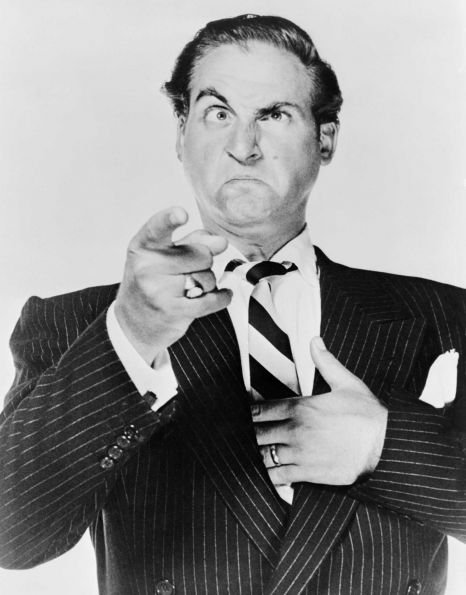
“I remember a satire we did on ‘High Noon.’ The townspeople were supposed to abandon me and return their deputy badges to me by pinning them on my chest. I was supposed to have a sponge inside my shirt. But I didn’t have time to change. So they kept coming, saying, ‘Sorry, Sheriff,’ and pinning on the badges. After it was over, I went backstage, and somebody said, ‘Hey, you did real good pain takes.’ I told him the pain was for real.”
—-Comedy great Sid Caesar,who died yesterday at the age of 91, recounting for the New York Times an example of a how he suffered for his art, which was, always, making us laugh.
Caesar’s anecdote is as perfect a description of professionalism as I have ever seen, or ever will see.
Thank you, Sid Caesar, for devoting your life, body and soul, to laughter.
Jackson was wrong, Rubinwas correct, and Jackson’s long riff, funny as it was, about how white guys can’t tell black actors apart was both a cheap shot and viciously unfair. Rubin made no such mistake. Jackson owes him an apology. Watch this trailer:
Did you see that black actor in two places in the video? That was Samuel L. Jackson, not Laurence Fishburne. That video di run during the Super Bowl, and was obviously what Rubin was referring to when he began his question with “You’re working for Marvel…” Marvel Comics, the creators of Captain America, in which Laurence Fishburne has no role. Continue reading →
Shirley Temple Black, perhaps best known to most of us as Little Miss Marker, Curly Top,the Littlest Rebel, Heidi, or, most of all, Shirley Temple, died overnight. I learned of her passing this morning in a Facebook update from child performer advocate Paul Petersen, like Shirley a distinguished and successful former child star who has dedicated his post-performing career to important causes. He wrote:
SHIRLEY TEMPLE passed in the night. She was 85…and no age at all. What a life. What a treasure. A woman of amazing courage and dignity.The world was enriched by her accomplishments. She will always be a part of us. Rest now, Shirley Temple. We love you.
There really isn’t too much more that needs to be said. Few human beings ever began having a positive impact on society so soon in life (she began making adults smile at the age of three, when she made her first film) and continued to do so for so long. From show business, a profession that so often leads to ethical rot, and a rarefied corner of it infamous for leaving its practitioners spoiled, narcissistic, addicted to fame and dysfunctional, Shirley Temple emerged as an adult who was industrious, courageous, intelligent, compassionate, and dedicated to public service. Often dismissed and mocked as a washed-up child star, she proved again and again that her detractors were not just wrong to pre-judge her, but spectacularly wrong. She excelled as a diplomat, serving as U.S. ambassador to Ghana and Czechoslovakia, using her Hollywood fame to open doors and hearts, and also as the U.S. delegate to the United Nations. Temple never played the celebrity: my favorite Shirley moment was when she returned, in her seventies, to join a large group of former Oscar winners (hers was a special award, at the age of six) on the stage of the Academy Awards. As they announced the names of the famous performers and the camera panned the group, it was Shirley who received the most loving response from the Hollywood crowd, which stood and cheered. Shirley looked genuinely surprised, beamed, showed those famous dimples, and handled it, as she always handled everything, with charm and poise.
A proto-feminist, Shirley Temple was one of the first celebrities to go public with a diagnosis of breast cancer, and raised national awareness by promoting a frank discussion of mastectomies. In her autobiography, she also had the courage to point out the predominance of sexual predators in the the Hollywood power structure and culture, recalling that MGM musical unit head Arthur Freed*, whose career is celebrated in “Singing in the Rain,” exposed himself to her in his office when she was barely 13. (She laughed at him; he threw her out of his office.)
Historians credit Shirley Temple with saving the movie studio RKO and raising America’s spirits during the Great Depression; she also was a Cold Warrior, a mother, the inspiration for a best-selling line of dolls as well as the alcohol-free cocktail that still bears her name, and one of a kind. It is fair to say we will never see her like again.
Late in life, she told an interviewer, “If I had it all to do over, I wouldn’t change a thing.” How many of us can say that sincerely?
Paul was right. What a life!
Take a curtain call, kid…
* The original version of the post incorrectly referred to Arthur Freed as Alan Freed, who was an influential disc jockey in the early days of rock and roll. I apologize to both of them.
Not a composer, not deaf, and maybe Irish, female, and 12-years old, for all we know.
There need be no debate about whether this was unethical, or why. It is obviously one of the great arts hoaxes of all time.
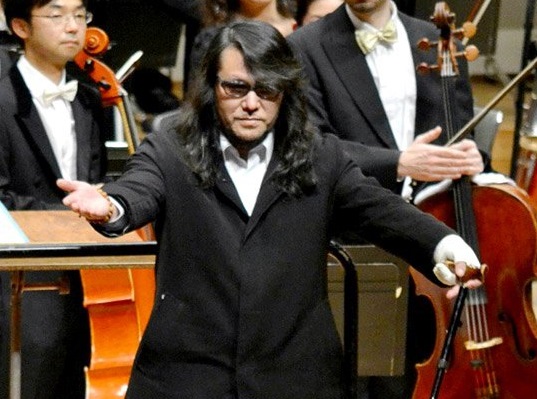
Mamoru Samuragochi, the composer sometimes known as “The Japanese Beethoven,” was exposed this week as being more like a Japanese Milli Vanilli. A double fraud, he didn’t compose the works that made him Japan’s most popular classical composer, and he isn’t even really deaf, which was a large element of his fame and notoriety. Samuragochi has perpetrated a long, elaborate, audacious hoax, hiring a musical ghostwriter to compose for him over nearly two decades. The Man Behind the Curtain revealed himself as Takashi Niigaki, a lecturer at a Tokyo music college, who admitted to writing more than twenty compositions for Samuragochi since 1996, receiving the equivalent of about $70,000. Samuragochi’s most famous works include Symphony No. 1 “Hiroshima,” the theme music for the popular video games “Resident Evil” and “Onimusha,” and especially the “Sonatina for Violin,” which is the program music for the Japanese Olympic figure skater Daisuke Takahashi.
What interests me most about this strange story is how it illustrates the power of cognitive dissonance in the arts. Continue reading →
One wonderful thing about extreme success combined with middle age is that you can, if you have the integrity, speak unpopular truths without caring who objects. Thus it was the Jerry Seinfeld correctly dismissed as irrelevant and misguided the suggestion that seeking racial and gender balance should be an objective in his comedy shows. In response to a question challenging his Web series, “Comedians in Cars Getting Coffee“as too white and male, the comedian said:
“People think it’s the census or something, it’s gotta represent the actual pie chart of America. Who cares? Funny is the world that I live in. You’re funny, I’m interested. You’re not funny, I’m not interested. I have no interest in gender or race or anything like that, but everyone else is, kind of with their little calculating, “Is this the exact right mix?” To me, it’s anti-comedy. It’s more about PC nonsense than ‘are you making us laugh or not’.”
Exactly. Not that the race and gender bean counters will let Seinfeld escape with an explanation of such obvious common sense. Here’s Mediaite’s Tommy Christopher playing his full hand of gender, race, guilt and quota cards: Continue reading →
Listen to me, Roger, and I mean this in the nicest way: stick to gossip.
The Hollywood wagons are already circling around Woody Allen, accused—again, but now as an adult who can speak for herself—by Dylan Farrow of sexually abusing her when she was only 7 years old. Reading some of the statements issuing from Tinseltown, I am struck again by the ugly opposition any non-celebrity victim must face when accusing a powerful industry figure of wrongdoing. Luckily, many of the most vociferous defenders signal their desperation and their lack of basic comprehension of the issues, undermining their arguments.
Exhibit A is veteran Hollywood journalist Roger Friedman, who was quick to issue an article alleging, as he has for 20 years, that Dylan’s story is all part of a Mia Farrow plot to destroy innocent Woody. On his website, Friedman headlines his piece, “Mia Farrow Uses Close Pal Journalist in Woody Allen War: Writer of Latest Piece is Close Friend.” Friedman’s concept of what constitutes a “conflict of interest” is intriguing. His argument is that Times journalist Nicholas Kristof, who published Dylan’s open letter on his blog, is friends with Mia Farrow (Friedman implies that they are romantically involved while specifically saying that he isn’t implying it–his evident journalistic sliminess would undermine even a fair article, which this is not), and that this makes Dylan’s letter less credible. What he doesn’t explain, since he can’t, is why the same letter would be any more credible or reliable whether Kristof published it or someone else did. Continue reading →
Dylan Farrow was 7 years old when, she alleges, her adoptive father Woody Allen began sexually molesting her. Although this became the focus of the legal and public relations battle between her mother, actress Mia Farrow and Allen as their once romantic and domestic relationship—-already destroyed by Allen’s courtship, seduction and marriage of Dylan’s older, also-adopted sister Soon Yi—exploded onto the scandal sheets more than 20 years ago, the now-married Dylan has never spoken out about it herself, though her mother and other siblings have. Allen avoided any criminal charges despite an investigation that found probable cause, and his popularity among film-goers and his stature in Hollywood seemed to be undamaged. Last month, however, a lifetime achievement award at the Golden Globes (accepted by a fawning Diane Keaton) re-opened the unhealed wounds for the Farrows, and Allen’s Oscar nomination last week for his original screenplay for “Blue Jasmine” was apparently too much.
Now Dylan Farrow has decided to tell her own story, and has done so in open letter form, published on the blog of New York Times columnist Nicholas Kristof.
I ask that you read it now, here, before you read anything else. Her courage in writing this powerful statement earns the right to have it received on its own terms.
I have been wading through the many online complaints about Facebook’s aggressive policy, begun in earnest back in 2012, of reducing the number of “friends” a Facebook user’s posts reach (by about 85%) and then charging the Facebook user a fee to reach more of them. Frankly, as a less-than-intense Facebook user who necessarily spends most of his web-content time running a blog, I didn’t even pay attention to the “promote” button, and wasn’t even aware of the change. The Facebook revenue-generating move is described here and here, but what happened is pretty simple and easy to understand. Having sucked a lot of people, groups and businesses into using their free service to reach family, friends, like-minded souls and potential customers, Facebook then changed the rules and is now charging for them to get the same reach that was free for quite a while. Is this unethical?
“This is a clear conflict of interest. The worse the platform performs, the more advertisers need to use Sponsored Stories. In a way, it means that Facebook is broken, on purpose, in order to extract more money from users. In the case of Sponsored Stories, it has meant raking in nearly $1M a day.”
This is Dangerous Minds, in a widely circulated attack on Facebook called “I want my friends back”:
“It’s perhaps the most understated stick-up line in history, worthy of a James Bond villain calmly demanding that a $365 million dollar ransom gets collected from all the Mom & Pop businesses who use Facebook. How many focus groups do you reckon it took until Facebook’s highly paid marketing and PR consultants finally arrived at such an innocuous phrase for describing information superhighway robbery?”
Robbery? Conflict of interest? A hold-up? Bait and switch? This is the kind of tantrum that shows how easy it is for unscrupulous politicians to use the profit motive, free enterprise and capitalism as cheap scapegoats for every problem under the sun, all the better to build support for a massive, all-powerful government that will make everything right, and ensure that we all have lollipops and rainbows regardless of talent, effort, hard work or the cruel turns of fate.* Facebook created this service millions use for free—how dare the bastards try to make money out of their ingenuity and enterprise? Don’t we all, in a real sense, own Facebook? Shouldn’t we? Continue reading →
Since the NTP is back in the news—Kaitlin Pearson, whom Ethics Alarms dubbed the perfect example of the Naked Teacher Principle, was allowed to continue her job as a teacher’s aide—this is a propitious time to address a question I received off-site by an esteemed reader, who sent me a photo similar to the one above (but of another female competitive bodybuilder/mom—who is 50 years old) and commented, “This is a picture of a local soccer mom with a teenage son. Is she setting a good example for her son, and does her conduct trigger the Naked Teacher Principle?”
Let me finish with Kaitlin first. I personally wouldn’t have let her continue, if only because she was not forthcoming about her other pursuits when she interviewed for the job. That doesn’t mean that the resolution of her particular case is in defiance of the NTP. It states, Continue reading →
“Was Pete political? Of course,”wrote singer Tom Paxton in a featured Washington Post salute to folk legend Pete Seeger, who died this week at the age of 94.“He was political as Walt Whitman was political, as Clarence Darrow and Woody Guthrie were political; as, for that matter, all of us should be political. He felt that ordinary people deserved protection from bullies of all stripes and his was the gift of being able to express this belief in music and in the way he lived his life.”
Reading Paxton’s dewy-eyed remembrance and the formal obituaries and tributes from most of the news media, one would never suspect that Pete’s belief in protection against all bullies didn’t stop him from being a fervent supporter of and an apologist for one of the worst bullies in human history, Josef Stalin, and not just momentarily, but for most of Seeger’s life. The fact that supposed news organizations nearly unanimously decided to gloss over that element of Seeger’s legacy tells us a lot about the Left, our journalists, bias….but not a lot about Pete Seeger.
If I followed my heart and my tapping foot but not my brain (and if all I knew about Pete was what I read in the newspapers and read from my theater colleagues on Facebook—“And only in our Orwellian reality would someone of such incomparable achievement, one who displayed such overwhelming humanity, have been held in contempt of congress. An inspiring life,” wrote one, who should know better), I would have made Seeger an Ethics Hero Emeritus. He had some notable heroic moments, as when he stood up to the House Un-American Activities Committee, refusing to take the Fifth Amendment while defying the Committee in defense of the First, and getting himself cited for contempt of Congress and blacklisted as a result. I was thrilled and proud of him in 1968, when fresh off the blacklist he appeared on the Smothers Brothers show and sang his “Big Muddy” song (which you can watch above) with anger and passion, condemning the Vietnam war in metaphor and calling LBJ a fool on national television at a time when such a direct insult against the President was taboo. I didn’t even completely agree with Seeger at the time, but this was brave protest art at its finest and most effective.
If only the hypocrisy of continuing to support a system of government and a regime that tolerated no freedom of speech and that would have squashed a protester like Seeger as if he were a maggot had occurred to the folk singer while he was doing these things. But it did not. Folk singers tend to be like that, and Pete Seeger, one of the greatest folk singers, was more like that than any of them. Continue reading →