“You may encounter many defeats, but you must not be defeated.” That quote, from Maya Angelou, inspired The Undefeated, an ESPN media platform that, from its start in 2016, has helped shape the national conversation by exploring the intersection of race, sports and culture from a Black point of view. On Monday, ESPN said it would rebrand and expand the operation, which will now go by the name … Andscape…
“It’s time to talk about Black and everything,” Raina Kelley, Andscape’s editor in chief, said in a phone interview. “Far beyond just sports and athletes.” She continued: “How do you be an individual as a Black person in America with your own unique set of interests, some of which are bound together by melanin, but not all of them? And how do you feel whole? We wanted to create a space where Black people could be Black people: Black led, Black P.O.V., absolutely. But also where there were no definitions and no rules about what being Black meant, what you had to talk about.”
Among of the most emotionally resonant and thrilling moments in movies are when a large group spontaneously expresses unity of mind, loyalty, sentiment, or just the joy of living by lifting up their voices in song, as one. A healthy society should engender such moments and nourish the shared values and emotions that create them.
What today could prompt a large group to sing together today? The National Anthem once provided such moments, but the NFL has aided race-separatists by forcing the so-called “Black National Anthem” to compete with the “Star-Spangled Banner,” making it, despicably, a “white national anthem.” Today’s preeminent musical form, hip-hop, doesn’t lend itself to mass singalongs.
Here are six memorable examples from the Hollywood archives of movies celebrating the human instinct to burst into shared intense feeling, expressed in song. Incredibly, I found none of these classics in various on-line lists of “greatest movie crowd singing scenes.” The people who put together those lists don’t get it (and also don’t know classic films.) No, the “Wayne’s World’ lip-syncing of “Bohemian Rhapsody” doesn’t qualify, great as it is. It’s not a crowd scene, and Queen is doing all the singing anyway.
The Ethics Alarms top six, in random order:
1. From “The Sound of Music”:“Edelweiss”
This is the only entry from a musical, but the context is entirely dramatic, and the scene could have easily been in a straight drama. The Nazis have taken over Austria. Captain Von Trapp (Christoper Plummer), ordered to take his place in the Nazi navy, mourns the end of the Austria he knew, and knows that his fellow Austrians watching his family perform in a music festival as the uniformed Nazis loom over them, share his sentiments. He sings a simple Austrian folk tune, manages to give the audience an opportunity to express their sadness and defiance.
2. From “San Francisco”: “The Battle Hymn of the Republic”
This isn’t even the best crowd singing moment in the great 1936 Clark Gable/Spencer Tracy/Jeanette McDonald movie that climaxes with the San Francisco earthquake of 1906. At the end of the film, Gable, a cynical rogue whose romance with opera singer McDonald has foundered on his rejection of religion, has searched for her in the ravaged city. He finds her alive and helping survivors, and is so moved that he thanks God for the first time in his life. Then the news comes that the fire is out, and the people of San Francisco resolve to rebuild their city bigger and better than ever, as Jeanette leads them in song…
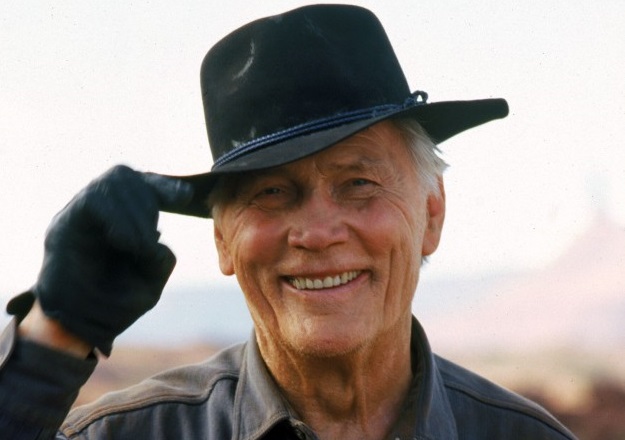
It involves one of my mother’s favorite Hollywood villains, Jack Palance. Younger readers probably remember him only in his long, lucrative late-career self-parody period (Watch “Shane”: what’s the matter with you?), which got him one of those weird Best Actor Oscars for just doing what he had done naturally for decades, but hammier, in “City Slickers.” (He was also aided by lines like “I crap bigger than you.” (To Billy Crystal.)
The actor was born in Pennsylvania as Volodymyr Palahniuk, the son of Ukrainian immigrants. In 2004, after Palance’s final film and just two years before his death, a Hollywood celebration of “Russian Nights” in Los Angeles ended with an awards ceremony. “Russian Nights” was a week-long film festival that celebrated “Russian contributions to the world of art,” and was sponsored in part by the Russian Ministry of Culture. Russian president Vladimir Putin endorsed the propaganda event. Scheduled to receive “narodny artyst” awards ( translated as “the Russian People’s Choice Award”) were Dustin Hoffman and Jack Palance. Hoffman, like Palance boasted of Ukrainian heritage.
“You know, you just, you plan a trip, you wanna go there. I’ve wanted to go to Italy for four years and I haven’t been able to make it because of the pandemic, and now this, you know?”
—“The View” co-host Joy Behar, explaining why she was upset about Putin’s invasion of Ukraine.
The full exchange:
Co-host Sonny Hostin: “Estimates are 50,000 Ukrainians will be dead or wounded and this is going to start a refugee crisis in Europe,” said. “We’re talking about 5 million people that are going to be displaced. It’s heartbreaking to hear what is going to happen.”
Behar: “Yeah, I’m scared of what’s gonna happen in Western Europe, too. You know, you just, you plan a trip, you wanna go there. I’ve wanted to go to Italy for four years and I haven’t been able to make it because of the pandemic, and now this, you know? It’s like, who’s gonna, what’s gonna happen there?”
Fortunately, a smaller and smaller percentage of Americans pay attention to TV award shows like the Oscars, Tonys, Emmys and the rest. That’s just moral luck, though: it doesn’t diminish the unethical nature of what they are trying to do.
This coming Saturday night, on Feb 26, BET will broadcast the 53rd Annual NAACP Image Awards. Presenters will include Issa Rae, Kerry Washington, LL Cool J, Morgan Freeman, Questlove, Tiffany Haddish, Zendaya, and others. Special honors will go to Samuel L. Jackson (the NAACP Chairman’s Award) and Nikole Hannah-Jones (the Social Justice Impact Award). The winners of the non-televised awards have been announced already: every winner, like every nominee is black. Continue reading →
The assault on free expression as well as the speech-chilling practice of seeking to publicly crush those who do not observe the social justice dictates of progressives in power advanced ominously yesterday. Unsurprisingly, the episode at issue occurred at an Ivy League University, as our educational sectors have been among the trailblazers in speech and idea suppression. Unsurprising to me at least was that it involved Twitter. Just like in the Illya Shapiro controversy at Georgetown Law Center, a scholar didn’t use quite the words he should have (to be safe, and safety is everything these days) according to the Democrats’ Little Red Book. This time, however, the hammer fell harder. Continue reading →
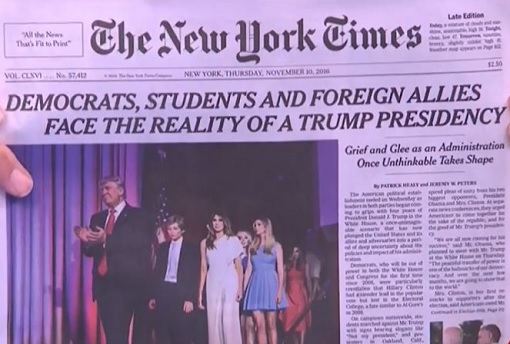
A relentless Times apologist–you know which one—chides me for leaving out this from his interview in the New Yorker, which is the context for the “version of the truth” gaffe, when Baquet said the quiet part out loud (if the Times-enabler hadn’t begun his complaint with “Um,” I might have let it go):
The system of “objectivity” (and I know that’s going to be a bad word) was designed to create a system—Wesley Lowery is right when he describes that—in which the organization’s job was to make sure that whatever your perspective was it didn’t get in the way of reporting the truth. I believe in that very strongly. That’s not the job of every institution. But the job of the New York Times should, in the end, be to come out with the best version of the truth, with your own political opinion held in check by editors and editing. Not everybody believes that, but I believe that. And I think that if you come to work for the New York Times—if you really want to work for the New York Times—you have to embrace that, because that’s what the New York Times is.
In fact, I intended to include that outrageous and insulting lie, but felt it would have just muddled the more important point of the post. (That, and the New Yorker site blocked my access unless I subscribed…) Continue reading →
Stephanie Selby was the subject of “A Very Young Dancer,” photographer Jill Krementz’s best selling 1976 book that inspired a generation of would-be ballerinas and future dance stars. When Stephanie, only 10, was chosen for the lead role of Marie in “George Balanchine’s The Nutcracker,” Krementz decided to make her the star of her planned book. She followed Stephanie for a year, taking photos and notes, and produced a fascinating behind-the-scenes portrait. Stephanie became an instant celebrity and role model for thousands of other “very young dancers.” She appeared on the “Today” show and a one-hour “Mister Rogers’ Neighborhood” Christmas special, while getting an avalanche of fan mail.
But Stephanie was emotionally fragile, and her periodic outbursts resulted in her being told to leave her dancing school at 13. Increasingly plagued by clinical depression, she found it difficult to find a stable place in life. The expectations created by the book and her sense of failure for not meeting them were part of her burden. A 2011 interview produced the reporter’s observation that “Stephanie acknowledges that she might have had troubles in life regardless of her association with ballet and the book but says her experience as a child no doubt contributed to her depression later in life.”
Matthew B. scored a Comment of the Day by raising an issue I had never thought about before: how the misapplication of PowerPoint leads to inadequate training and information dissemination within organizations and bureaucracies. He also references the reluctance of managers to know when to hand over decision-making to subordinates. That is something I have thought about, a great deal.
Two of my favorite movies illustrate how competent leaders and managers know when to delegate a crucial decision down. “Topsy-Turvy,” the superb 1999 film depicting the creation of “The Mikado” by Gilbert and Sullivan, accurately depicts the real incident when, after the final rehearsal, W.S. Gilbert told the “Mikado” cast that he was cutting “My Object All Sublime,” also known as “The Mikado’s Song.” Gilbert was a tyrannical director, and the cast was terrified of incurring his wrath. This time, however, they stood up to him. The cast as one told him that he was making a mistake. The soloist, Richard Temple, they told their shocked and steaming director who also had conceived of the song, should have the chance to perform it in front of an audience. His fellow cast members were certain it would be a hit. Gilbert, recognizing the certitude the cast must have had to risk his fury at being contradicted, decided that his performers might have a clearer understanding of the show even that he had, and relented. Temple would sing about letting “the punishment fit the crime” on opening night.
The song was an instant sensation, like “The Mikado” itself, and is still one of the most quoted of all G&S songs.
The other example is at the climax of “Hoosiers,” the great basketball film based on the true story of the miraculous Indiana state championship won by a tiny school from Milan, Ind. in 1954. During the last time-out before the team’s last chance to score, which would, if successful, give the team a one-point victory over their greatly favored competition in the championship game, the coach (Gene Hackman), who has led the ragtag group this far by emphasizing teamwork over individual achievement, lays out a play in which the team’s superstar, Jimmy Chitwood will be a decoy. He plans for another player to take the final shot, but the team doesn’t move. “What’s the matter with you?” he shouts as his players just stare, looking hesitant. “If I get the shot, I’ll make it,” Jimmy says, after a long pause. So the coach, who has insisted all season that his word was law, makes the same decision Gilbert did. When your subordinates are that sure, trust them. They know better than you.
Jimmy shoots and scores the winning basket as time runs out.
1. There is hope! The new Amazon Prime Jack Reacher series, “Reacher,” has no mixed race couples in it whatsoever. I was amazed, and wonder if this means the thing was made in 2019, before Hollywood decided that the accidental killing in Minnesota of a black perp by a brutal white cop in an incident having nothing to do with race meant that the world film and TV present to America must be one where nearly 100% of all married and unmarried relationships consist of two races. Isn’t it amazing that a casting feature that was once not only routine but accurate seems remarkable by its absence, and it was completely benign then and would still be accurate now?
2. Just for curiosity, I’m going to keep getting these Harvard alerts. The unethical though famous institution I graduated from once is marking this big reunion year with special online events for participants. The first one, not surprisingly, deals with…climate change! You would think that such a university, with all the subjects it covers and all of the departments available, could put together a schedule that didn’t consist of partisan obsessions, wouldn’t you?
But no. I fully expect subsequent programs to include, “Systemic Racism,” “Protecting the Right to Choose,” “The January 6 Insurrection” and “Mainstream Media Conservative Bias.”
I’m getting enough propaganda on climate change, thanks. Today I learned that “Once considered comic relief to anchors, television meteorologists are making it clear to viewers that they are covering a crisis in real time.” The “news story” headline begins, “As Storms Intensify…” Intensify based on what? There is no proof that storms are “intensifying” that justifies stating this as fact.
But you can’t deny that Al Roker is an “expert” on climate science though! After all, he attended the State University of New York at Oswego where he received a BA in communications in 1976….







 Ethics Alarms
Matthew B. scored a Comment of the Day by raising an issue I had never thought about before: how the misapplication of PowerPoint leads to inadequate training and information dissemination within organizations and bureaucracies. He also references the reluctance of managers to know when to hand over decision-making to subordinates. That is something I have thought about, a great deal.
Two of my favorite movies illustrate how competent leaders and managers know when to delegate a crucial decision down. “Topsy-Turvy,” the superb 1999 film depicting the creation of “The Mikado” by Gilbert and Sullivan, accurately depicts the real incident when, after the final rehearsal, W.S. Gilbert told the “Mikado” cast that he was cutting “My Object All Sublime,” also known as “The Mikado’s Song.” Gilbert was a tyrannical director, and the cast was terrified of incurring his wrath. This time, however, they stood up to him. The cast as one told him that he was making a mistake. The soloist, Richard Temple, they told their shocked and steaming director who also had conceived of the song, should have the chance to perform it in front of an audience. His fellow cast members were certain it would be a hit. Gilbert, recognizing the certitude the cast must have had to risk his fury at being contradicted, decided that his performers might have a clearer understanding of the show even that he had, and relented. Temple would sing about letting “the punishment fit the crime” on opening night.
The song was an instant sensation, like “The Mikado” itself, and is still one of the most quoted of all G&S songs.
The other example is at the climax of “Hoosiers,” the great basketball film based on the true story of the miraculous Indiana state championship won by a tiny school from Milan, Ind. in 1954. During the last time-out before the team’s last chance to score, which would, if successful, give the team a one-point victory over their greatly favored competition in the championship game, the coach (Gene Hackman), who has led the ragtag group this far by emphasizing teamwork over individual achievement, lays out a play in which the team’s superstar, Jimmy Chitwood will be a decoy. He plans for another player to take the final shot, but the team doesn’t move. “What’s the matter with you?” he shouts as his players just stare, looking hesitant. “If I get the shot, I’ll make it,” Jimmy says, after a long pause. So the coach, who has insisted all season that his word was law, makes the same decision Gilbert did. When your subordinates are that sure, trust them. They know better than you.
Jimmy shoots and scores the winning basket as time runs out.
Here is Matthew B.’s Comment of the Day on “Comment Of The Day: ‘Catching Up: Professional Ethics And The Challenger Disaster’”:
Continue reading →