Morning Ethics Warm-Up, 9/23/2019: Post Emmys Edition [UPDATED]

I’m kidding; I  didn’t watch the Emmys, have not watched a second of the Emmys in decades, and can’t imaging a greater waste of time than watching the Emmys, and that includes the time I spent watching “Tusk,” the Kevin Smith black comedy in which a madman played by Michael Parks traps a jerk podcaster played by Justin Long and surgically transforms him into a human walrus. I kind of liked it, to be honest.

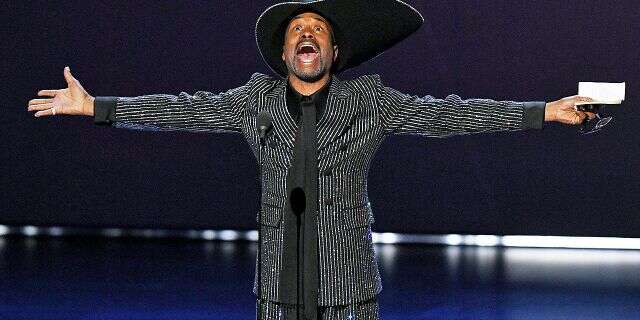
That’s Billy Porter above, by the way, the first openly gay actor to win a performing Emmy, after the many, many non-openly gay actors who have won over all these years. Making a big deal out of this diminishes his honor, since it suggests that his sexual orientation had something to do with his winning the award. I don’t see any reason why who an actor chooses to have sex with should have any relevance to an acting honor.

[UPDATE: Not that it matters, but the Emmy broadcast ratings hit an all-time low. What? People voluntarily passed up a chance to see actresses use their podium time to lecture about acceptance of trans individuals, and basing industry pay levels on gender  equity rather than value?]

1. Country music’s Jackie Robinson. Ken Burns’ documentary “Country Music,” on PBS now, convinced me that Charlie Pride, the first black country music star, deserves more accolades than he has received, as do the white producers and allies, like Chet Akins, Jack D. Johnson, and Louis Allen “Al” Donohue, who made it possible for him to break that culture’s color barrier.

Inspired by Robinson, Pride resolved as a teen to escape the cotton fields. He played minor league baseball, and sang in bars to make extra cash. Then he was “discovered” by two country music figures and advised to go to Nashville.

It’s an amazing story (why Pride’s life hasn’t been made into a movie, I don’t know). Apparently at the beginning of his career, stations played his records without noting his race. In the documentary, Pride describes a Detroit concert where he was introduced to an all-white audience of nearly 20,000 that roared and applauded when he walked out, and then suddenly became silent when they saw his skin color. Do you think that scene might have inspired Richard Pryor to write this one?

2.  Jerk of the Year? Just being the NFL Jerk of the Year is an achievement (there is so much competition), but Antonio Brown, the star receiver signed by the New England Patriots (in their own bid for NFL Jerks of the Year) after he had jerked his way off his previous two teams, then released after two sexual misconduct allegations against him surfaced, went out in a blaze of jerkness.

Immediately after being ditched by the embarrassed Pats, Brown unleashed a torrent of attack tweets, attempting to position himself as a victim. Continue reading →
Sunday Ethics Warm-Up, 9/22/2019: Five Ugly Ethics Stories (Sorry!) [Corrected]

A pleasant Sunday…

as long as I don’t read the newspaper or watch the Talking Heads…

1. Before I finish a long post about the most recent contrived Brett Kanavaugh smear by the New York Times, ponder this quote from the Times review of “The Education of Brett Kavanaugh”: “[The authors] come to a generous but also damning conclusion, which is that Blasey Ford and Ramirez are believable and were in fact mistreated by Kavanaugh as teenagers, but that over the next 35 years he became a better person.”

Ugh. The conclusion is “damning” because it relies almost entirely on confirmation bias: Blasey Ford’s own lawyer revealed that her motive in using her “recovered memory” against Kavanaugh was to discredit any future anti-abortion opinions he participated in as a member of the court. The accusation by Ramirez isn’t, apparently, even believable to Ramirez herself, since she says she isn’t certain that the Mad Penis-Dangler was Bret Kavanaugh. Why then, do the authors find the claims “believable”? Oh, because they want to believe them, of course; they work for the New York Times, and they certainly weren’t going to get their book promoted by their employer and snatched up by its readers if they concluded, as objective reporters would, that there is no more reason to believe Justice Kavanaugh did these things than there is reason to believe he didn’t.

The real ugh is this, however: if even these biased analysts conclude that the accusations, even if true, do not have any relevance on the grown man who was nominated to the Supreme Court because they relate to a minor who existed 35 years ago—and who has, as most children do, grown up—then the episodes that their book focuses upon literally don’t matter, shouldn’t have been brought into Kavanaugh’s hearing,  and should not be used now to denigrate and discredit him.

2. From “Social Q’s,” a glimpse of what a malfunctioning ethics alarm is like. Prompting the frequently appearing question in my mind, “How does someone get like this?” was the query into Phillip Gallane’s advice column from a woman who threw herself a birthday party, directed guests not to bring gifts but to make a donation to a charity she supports instead, and was annoyed that some brought gifts anyway. She asked if it would be inappropriate to send the gifts back with a disapproving note so they “would listen” to her “next time.”

I know what I would do “next time”…

3. Hey, sounds great, Facebook! Why wouldn’t everyone trust your judgment? Facebook announced  a series of changes last week to squelch hate speech and extremism—meaning what Facebook and its allies consider such— on its platform in a letter to the chairman of a House panel. Facebook said it would prevent links from the fringe sites 8chan and 4chan from being posted on its platform—you, know like it blocks links to Ethics Alarms!  Then it explained how it would develop an oversight board of at least 11 members to review and oversee content decisions—like the decision that a wide-ranging ethics blog that has no political affiliation or agenda, written by a professional ethicist of some note, doesn’t meet the Facebook “community standards.”

In other, unrelated news regarding the obstacles being thrown in my path, the Appeals Court in Massachusetts finally alerted me that it was taking “under advisement” the request for an appeal of the rejected frivolous defamation suit filed about two years ago by a banned commenter here whose boo-boo I wounded.

(I am not concerned.) Continue reading →

Reporting The Mysterious Ukraine “Scandal”: Once Again, I’m Fighting The Urge To Conclude That These Are Just Corrupt, Terrible People


And losing.

When the first notice of the unnamed whistle-blower’s complaint about—well, something involving the President and the Ukraine surfaced on the New York Times front page, in an article that was so devoid of facts, details and corroboration that its only excuse for publication was to titillate Trump-Haters, I wrote,

“This is what the Times considers front page news now. Instantly, “resistance” members and Democrats will leap to the conclusion that whatever it is, it’s impeachable. Those who are thoroughly sick of the successive coup attempts will assume that this is one more concocted sliming by the Deep State, so we can have a “Russiagate” style investigation that will hamstring President Trump’s second term… For my part, I’ll wait for actual facts, thanks. I don’t trust “the intelligence community” not to manufacture ways to undermine the Presidency, not after Comey, McCabe, the FISA fiasco, the FBI lovebirds texts, and Mueller’s statements, among other smoking guns. I don’t trust the Times reporting, I don’t trust President Trump not to do or say something that crosses ethical or legal lines, and I certainly don’t trust Congressional Democrats to determine what are serious transgressions by this President and what are typical maneuvers that have only become ominous because he isn’t Barack Obama.”

Well, I’ve been waiting. As predicted, Democratic impeachment-mongers and Presidential hopefuls are screaming to the skies, and the mainstream media has been flogging the as-yet non-story, another species of fake news, as if it were the Second Coming. Yet here is how the New York Times itself explained the alleged scandal:

What did Mr. Trump do?

In a July 25 phone call, Mr. Trump is said to have pressed the president of Ukraine, Volodymyr Zelensky, to investigate Mr. Biden’s younger son, Hunter, who sat on the board of a Ukrainian energy company. Mr. Trump has seized on an unsubstantiated theory that Mr. Biden was trying to protect the company from prosecution when he called for the firing of Ukraine’s top prosecutor in 2016. Rudolph W. Giuliani, one of Mr. Trump’s personal lawyers, has pushed the Ukrainian government to investigate the matter.

Is “said to have”? By whom? This is not news reporting, it’s gossip. The Biden theory is unsubstantiated? The theory the Times has published multiple stories about regarding the President’s interactions with the Ukraine is far less substantiated.

Why is this coming up now?

Because of an intelligence community whistle-blower who filed a complaint last month about the president’s actions. An inspector general deemed the complaint “credible” and “urgent” and forwarded it to the acting director of national intelligence, Joseph Maguire, who has refused to share it with Congress….

Amazingly, it has now been revealed that the “whistle-blower” did not have  direct knowledge of the communications between President Trump and the foreign leader in question. An official who has been briefed on the matter, however, told CNN that the whistleblower “didn’t have direct knowledge of the communications.” The official said that the concerns and subsequent complaint came in part from the whistleblower “learning information that was not obtained during the course of their work.” That’s hearsay by definition, and means that the report has no probative or evidentiary value whatsoever until it is independently verified. Until then, it is also not news.

What did the whistle-blower claim?

The full extent of the whistle-blower’s complaint, as well as the whistle-blower’s identity, is not publicly known. Reporting by The New York Times and others has established that the complaint involves Mr. Trump’s interactions with Ukraine and a phone call with a foreign leader — possibly, but not necessarily, Mr. Zelensky. It is not clear if it includes other matters.

This is really what the Times itself says. A “whistleblower” from the intelligence community made a complaint about something he was told by an an unnamed party about a private phone call with a yet to be identified official.

Here’s my favorite, though: Continue reading →

Someone Explain To Arizona Democrats How Ethical, Democratically-Elected Representatives Are Supposed To Act, Please? [CORRECTED]

While I was running around my hotel room yesterday trying to through everything into my travel bag and check out, I faintly thought I heard that the Arizona Democratic Party would be holding a vote this week to determine whether Sen. Kyrsten Sinema (D-Ariz.) should be censured. As I was dashing down the hall to the elevator, I mused on what Sinema possibly could have done to warrant such a sanction. A blatant conflict of interest, perhaps? Maybe the spoken work, a politically incorrect noun that the Party of Censorship ( as well as Censureship) found intolerable? The discovery that she had made a joke about trans people on her private social media account?

Digression: On the Comedy Central Roast of actor/comedian/mega-jerk Alec Baldwin, which I didn’t watch once I realized to my great disappointment that he would not be on an actual spit and rotating over real flames, that noted female comic Caitlyn Jenner, said, in her new higher-pitched by not quite female voice, that if Baldwin didn’t like her barbs, he could “suck my dick.” (CORRECTION NOTICE:  I missed the news that Caitlyn’s vestigial man-thing  was removed in 2017, and suggested otherwise before being corrected by commenter Rich in Ct, who keeps track of such matters.)  If any one else made that —ick—joke, they would be run out of town as un-woke wetches.] Continue reading →

A Bias Detection Test

What is the obvious (and in my estimation) amazing bias and prejudice the video above embodies? Here’s another one: same problem.

I hope it jumps out at most of you as much as it does to me. This product’s most obvious market, both in terms of those who most need it and those most willing to look ridiculous wearing it, is seniors. My parents, both of them, would have loved to have one of these on their regular excursions. Yet the promotional video not only doesn’t show any users over the age of 35, it seemingly doesn’t know such creatures exist.

My mother used to complain bitterly once she reluctantly reached her Golden Years that younger people acted as if she were invisible.  I wonder if this video is one more example of the fracturing of American culture and consciousness into hostile groups that choose to regard non-group members as “the other,” not worthy of consideration or acknowledgment.

After all, one would think that at least the profit motive would be enough to prompt us to include the elderly in our world view. In this case, at least, apparently not.

Open Forum, Or “I Guess I Picked The Wrong Time To Start Driving All Over Virginia!”

Today’s legal ethics smackdown in Richmond went swimmingly, but I only got home in time to change clothes and head off to the site of tomorrow’s repeat performance. I actually started a post about the unfolding New York Times smear fiasco (and the astounding number of pundits and pols who are trying to spin it away from the only possible and fair conclusion), but I just couldn’t get it done.

I’ll be back in the blog saddle til late tomorrow. Meanwhile, I am once again turning the keys over to you, dear readers. You haven’t let Ethics Alarms, or me, or ethics, down yet.

Go to it.

Signature Significance (Again) From the New York Times: A Trustworthy Newspaper Does Not Do This [CORRECTED]

That would be a more useful rule, of course, if there were any trustworthy newspapers.

The most recent Ethics Alarms filing under “Nah, there’s no mainstream media bias!” appeared yesterday.  A story headlined Brett Kavanaugh Fit In With the Privileged Kids. She Did Not appeared in the Sunday Times, with the sub-head, “Deborah Ramirez’s Yale experience says much about the college’s efforts to diversify its student body in the 1980s.” And why were Yale’s efforts to diversify in the Eighties suddenly worthy of a Times feature in September, 2019? Because the real purpose of the article was not to talk about Yale, but to smear Supreme Court Justice Brett Kavanaugh —again.

Ramirez was Kavanaugh’s Yale classmate  who had told The New Yorker last year during the justice’s confirmation hearings that she’d been severely inebriated at a party at Yale in her freshman year when “something” had happened. She said that “a male student pointed a gag plastic penis in her direction” and  a “third male then exposed himself to her.” The assumption is that the flasher was Kavanaugh, though Ramirez never directly named him. New York Times reporters Robin Pogrebin and Kate Kelly tried to verify the story, and could not. Never mind: they wrote a book anyway.

In “The Education of Brett Kavanaugh: An Investigation,”  they quoted the same individuals the New Yorker had tracked down who said that they “heard about” the incident, as well as Ramirez’s mother, who says—now this is a smoking gun if there ever was one—that  she was told at the time that “something happened” at Yale.

Nevertheless, the Times reporters are convinced that Ramirez’s claim is correct. They wrote,

A classmate, Max Stier, saw Mr. Kavanaugh with his pants down at a different drunken dorm party, where friends pushed his penis into the hand of a female student. Mr. Stier, who runs a nonprofit organization in Washington, notified senators and the F.B.I. about this account, but the F.B.I. did not investigate and Mr. Stier has declined to discuss it publicly. 

Not “fit to print,” apparently, was the that Stier was not only a non-profit executive but also had served as one of Bill Clinton’s defense attorneys. Heck, why should that be relevant to his credibility? But I digress… Continue reading →

Ethics Hero: Dave Chappelle

I know: just a week ago, I began the last section of the  day’s warm-up with “He’s not exactly an Ethics Hero, but…Dave Chappelle’s new concert video, now streaming on Netflix, is thought-provoking, brave, and full of ethical insights and analysis. I could do a two hour ethics seminar using just his material.” Several things have changed since then, however…

  • I am desperate for ethics heroes. We all are. If the Democrat candidates debate proved anything, it was that.
  • Chappelle is being attacked, hard, by the very same cancellation culture and political correctness dictators he has been willing to  challenge.
  • There is an organized effort to try to discourage the public from watching his Netflix special “Sticks and Stones,” not because it won’t be funny to anyone still capable of finding things funny, but because it will inspire people to think. Can’t have that…
  • Only one reader, the usually intrepid and culturally aware Humble Talent, commented on the issue last week. Sometimes I think that including a topic in the warm-up rather than devoting a whole post to it causes some Ethics Alarms readers to gloss over the issues involved, or maybe miss the item itself, as if each warm-up topic  is only 20% of a serious ethics topic because there are typically five in a post. The benefit to me of this format is that it saves time (you would not believe how long it takes to set up an individual post after the text is written) and helps me avoid an ethics backlog, but sometimes whether a particular issue is covered in a warm-up item or in a full post is arbitrary, a matter of timing, what else has occurred and my mood at the time.
  • Upon further reflection, I have concluded that Chappelle is an Ethics Hero.

Continue reading →

Sunday Ethics Warm-Up, 9/15/2019: Opinions, Ethical And Not

It’s a glorious day here in Northern Virginia!

Makes me feel like things are looking up, even though they probably aren’t.

1. I refer you to the most recent post about “the resistance’s” arsenal of big lies. specifically Big Lie #5, “Everything is terrible.” In the Times’ Sunday Review section, usually a resistance nest to one degree or another, though less so in recent months, Trump Deranged Times columnist Michelle Goldberg offers a long essay beginning with the assumption that current day America is a dystopian society. How does she justify this ridiculous assertion? Referencing the science fiction novel “The Handmaid’s Tale,” in which women in the U.S. “are stripped of their identities and consigned to reproductive slavery for the elite.” Goldberg writes,

“It’s hardly surprising that in 2016 the book resonated with people — particularly women — stunned that a brazen misogynist, given to fascist rhetoric and backed by religious fundamentalists, was taking power despite the wishes of the majority of the population.”

I especially like the “despite the wishes of the majority of the population” part, but the whole statement is dishonest  agitprop. Nobody “took power;” an election took place under Constitutional constraints. Goldberg cannot possibly gauge the “wishes” of the majority, since, as usual, the majority didn’t feel sufficiently concerned about the Presidential election’s outcome to bother to vote, meaning they didn’t “wish” for either candidate to win with enough seriousness or commitment to be  part  of any persuasive analysis. Meanwhile, the President was elected according to the system the United States has operated under since its inception. And describing Trump, who is about as religious as most recent Presidents, which is to say, not at all, was “backed by religious fundamentalists” is as accurate as saying that Barack Obama was backed by anti-white racists.

Read the whole stupid thing. It is irresponsible for a legitimate newspaper to publish such crap, but no more so than for one to employ a biased disinformation specialist like Goldberg as a regular contributor.

2. Once again, Andrew Sullivan finds his way toward calling out unethical journalism. In a recent essay for New York Magazine, the occasionally conservative, gay, religious, emotional but determined truth-teller—as he sees it, anyway—declares  the New York Times a publication that has abandoned journalism for activism.

Two quick reactions: a) Ya think, Sherlock? and b) THIS was your first clue?

He concludes strongly, though, writing, “To present a truth as the truth is in fact a deception. And it is hard to to trust a paper engaged in trying to deceive its readers in order for its radical reporters and weak editors to transform the world.”

Hard? The right word is “irresponsible.”

Related: This excellent essay by Peter Wood expounds further on the duplicity of the Times’ much heralded “1619 Project.” Continue reading →

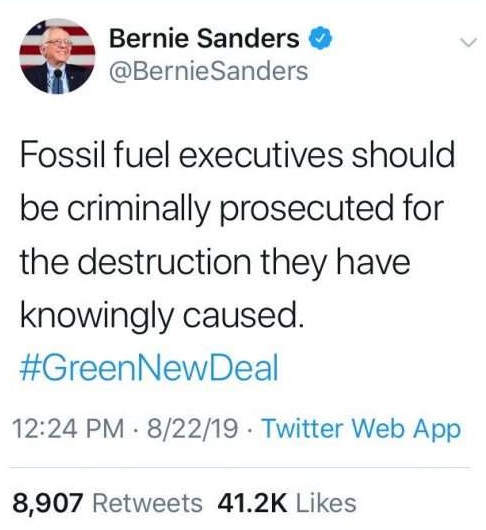
This Would Be The Most Unethical Tweet Of Any Normal Year, But The 2019 Competition Is Too Tough…

Observations:

  • I can’t respect anyone who would support a candidate who could think this, much less publish it, to be President of the United States.
  • By the way, did you know that President Trump is a threat to democracy? Bernie has said so many times.
  • Sanders really needs to bone up on what “democracy,” “rule of law,” “due process,” “ex post facto,” and other core concepts mean.
  • Trump puts out tweets like this occasionally, suggesting that there “should” be some way to legally penalize various individuals who do things that are completely legal. This usually spawns angry, insulting and indignant op eds all over the media. I will patiently wait for the equivalent reaction to Bernie’s tweet. In vain.
  • Will anyone ask Sanders about this sentiment in the next debate?
  • For a U.S. Senator and political leader to state that it is appropriate to imprison U.S. citizens for the non-existent crime of not conforming to progressive cant is itself undermining democracy.
  • Yet Presidential candidates who do this should not be criminally prosecuted for the destruction they are knowingly causing. They should  be ridiculed, condemned, and ignored.