Ethics Hero: Rep. Marie Gluesenkamp Perez (D-Wash.) [Corrected]

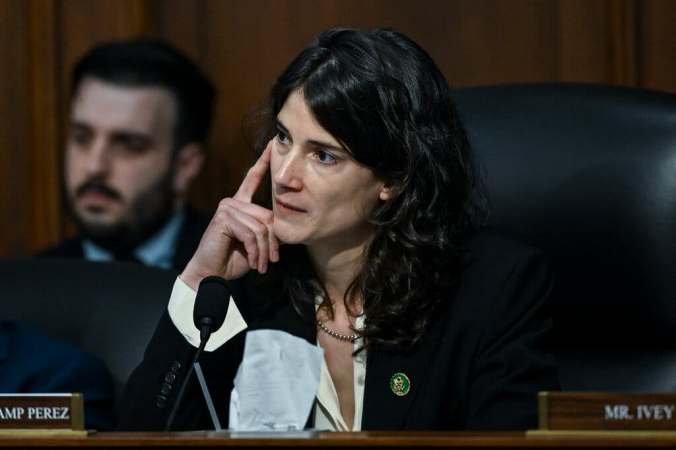
Perez, a 37-year-old auto shop owner, second-term congresswoman and co-chair of the center-leaning Blue Dog Coalition, horrified colleagues on both sides of the aisle by offering an amendment to the “Legislative Appropriations Act”, H.R. 4249. Her addition would have required Congress to create basic guidelines in Congress to ensure that members were able to serve the public “unimpeded by significant irreversible cognitive impairment.” The amendment was unanimously rejected, but she is not giving up. In a poll of the 230,000 people who subscribe to her newsletter, more than 90% supported the proposal. Perez says her constituents raise the issue frequently, and their belief that elected officials are frequently too impaired by age to be effective is causing spreading distrust of our government.

Gee, I can’t imagine why they would feel that way…

…but I digress.

Rep. Perez noted that she found it disturbing that among the oil paintings of the past chairs of the powerful Appropriations Committee is a large portrait of Kay Granger, the former Republican congresswoman from Texas who suffered from mental decline for years when a conservative news outlet found her, at the age of 81, living in an assisted living facility that included a memory care unit while she still held office.

There are now more members of Congress age 70 and above than ever before, while the second oldest President ever to serve is in the White House. Perez insists that there should be standards that prevent members from serving past the point where they no longer have the capacity to cast votes and do business on behalf of their constituents.“It’s a question of whether the elected member is making the decisions,” Rep. Perez said. “It’s really not about a single member; it’s about a systemic failure.”

Bingo.

Geewhatasurprise: Hospitals Harvest Organs From Living Patients

Waaay back in 1978, the film version of physician/novelist Robin Cook’s science fiction novel “Coma” (above) gave audiences the heebie-jeebies about being operated on. An “ends-justifies the means” chief of surgery had devised a diabolical way to have fresh organs ready to become life-saving transplants: one specially rigged operating room turned healthy-ish patients into brain dead victims (A young Tom Selleck was one of them!), and they ended up in a storage facility where their bodies were kept fresh and breathing until hearts, lings, livers or kidneys were needed.

Haven’t you always assumed that hospitals sometimes took essential organs from organ donors who were still alive, if barely? I have friends who aren’t organ donors specifically for that reason, and, yes, most of them remember “Coma.”

From an HHS press release this week:

Continue reading

The UK’s New Bereavement Policy Makes No Sense Ethically, But Then When Has Abortion Made Any Ethical Sense?

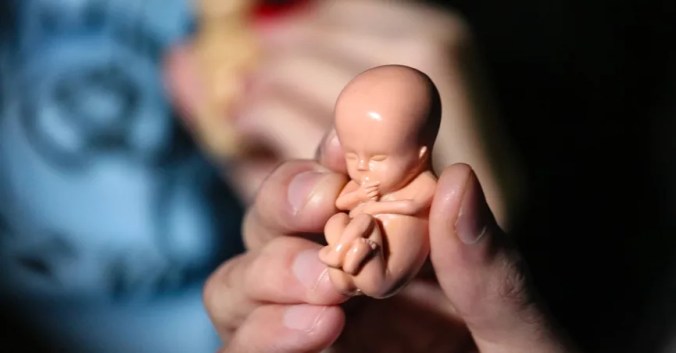
Ok, explain this: In the UK abortion is generally permitted up to 24 weeks of pregnancy, with some exceptions for special circumstances. Now the UK has extended its bereavement laws for miscarriages, which currently is two paid weeks off if the unborn child was 24 weeks old, to a week of paid bereavement for an unborn baby who is less than 24 weeks old.

Got that? A mother can kill the gestating embryo if it’s less than 24 weeks because that child is not viewed by the law as a human being worthy of protection, but if a child of the same age dies of other causes, it’s human enough to warrant bereavement benefits. Actually, I’m not sure if a mother who kills her child legally can still claim bereavement benefits. I don’t see why not.

Musician and broadcaster Myleene Klass, an activist who led an awareness movement in Great Britain, has said, “You’re not ill, you’ve lost a child, there’s a death in the family.” Why is it a death in the family when the child dies in a miscarriage, but just a matter of “choice” when the death is engineered by the mother herself?

“It’s a taboo,” she added. “Nobody wants to talk about dead babies – but you have to actually say it as it is. To lose a child is harrowing, it’s traumatic.” Well, it’s harrowing when the child dies of natural causes. When the cause of death is an abortion, it isn’t a child at all. Or something.

If there were any honesty and integrity in the abortion debate, the pro abortion movement would be recognized as not having an ethical leg to stand on.

“The Ethicist” Begins 2025 With a De Minimis Ethics Dilemma and an Impossible One

2024 was a bad year for the New York Times’s ethics advice columnist, Kwame Anthony Appiah. “He”The Ethicist” showed unseemly sympathy for the Trump Deranged all year, and not of the “You poor SOB! Get help!” variety, but more frequently of the “You make a good point!” sort, as in “I can see why you might want to cut off your mother for wanting to vote for Trump!” I was interested to see if the inevitability of Trump’s return might swerve Prof Appiah back to more useful commentary on more valid inquiries. So far, the results in 2025 have been mixed.

This week, for example, Appiah thought this silly question was worth considering (It isn’t):

I am going to tell a brief story about my friend at his funeral. The incident happened 65 years ago. The problem is that I am unsure whether the details of the story, as I remember them, are factual or just in my imagination. No one who was a witness at the time is still living. Should I make this story delightful and not worry about the facts, or make the story short, truthful and perhaps dull?

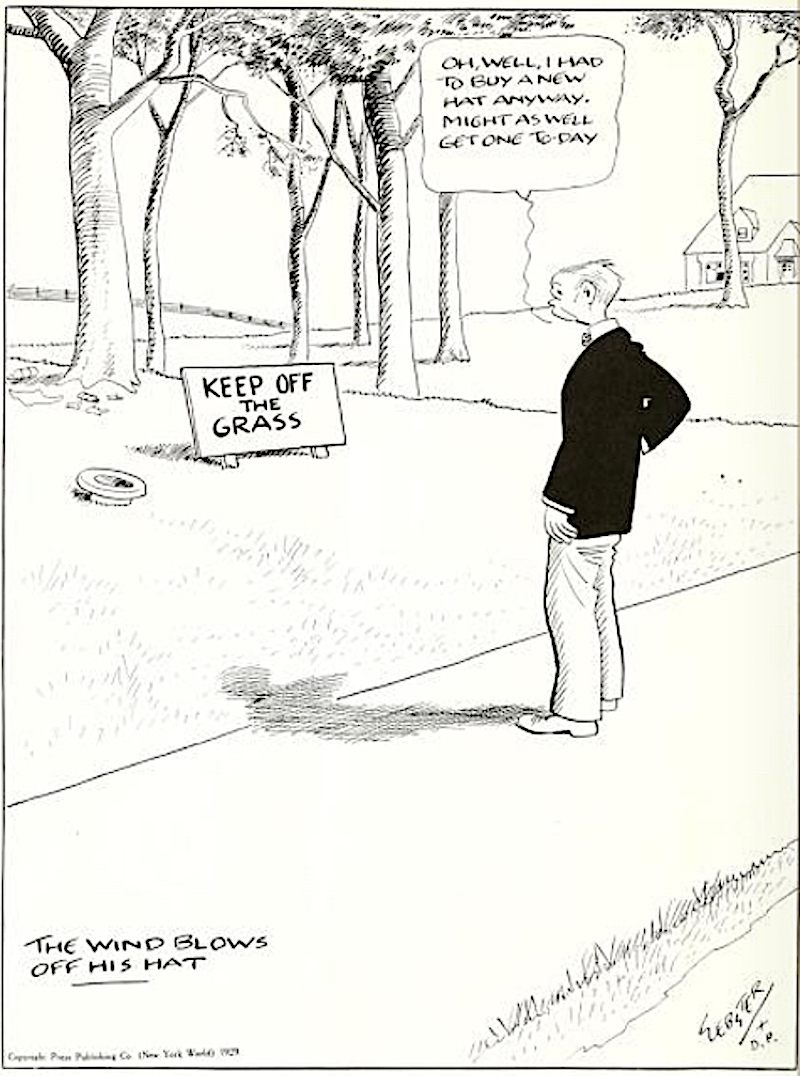
Good heavens. This guy is the living embodiment of Casper Milquetoast, the famous invention of legendary cartoonist H.T. Webster. Casper was the original weenie, so terrified of making mistakes, defying authority or breaking rules that he was in a constant case of paralysis. The idea of a story at a memorial service or funeral is to reveal something characteristic, admirable or charming about the departed and, if possible, to move or entertain the assembled. This guy is the only one alive who can recount whatever the anecdote is, so to the extent it exists at all now, he is the only authority and witness. So what if his memory isn’t exactly accurate? What’s he afraid of?

The advice I’d be tempted to give him is, “You sound too silly to be trusted to speak at anyone’s funeral. Why don’t you leave the task to somebody who understands what the purpose of such speeches are?” Or maybe tell him to watch the classic Japanese film “Rashomon,” about the difficulty of establishing objective truth. “The Ethicist,” who shouldn’t have selected such a dumb question in the first place, blathers on about how “everybody does” what the inquirer is so worried about and cites psychological studies about how we edit our memories. Blecchh.

Continue reading

“Ick” or Ethics? The Miracle Baby

Awww. Isn’t that romantic? Two inmates charged with murderer managed to conceive a love child while in prison without ever meeting each other face to face.

Daisy Link, 29, is charged with second-degree murder after being accused of killing her boyfriend in 2022. Joan Depaz, 23, (pronounced “JO-an”] is facing trial for first-degree murder. Both are being held at Metrowest Detention Center in Miami.

Link began talking to Depaz through the connecting vents in their cells. They fell in love. Then the love birds decided to have a child together. So Depaz deposited his semen in Saran Wrap about five times a day for about a month. The packages were pulled through the vents by Link using bedding material. Link inserted the fresh sperm using a yeast infection applicator. Eventually…success! She became pregnant, and now Depaz’s mother is raising the baby girl born in June.

Officials are conducting an internal affairs investigation. Yes, I’d agree that this is prudent.

What a lucky kid. She gets to grow up with the prospect of having both parents locked up until she’s out of high school, after being raised by a family that already spawned one killer, and is stuck with some problematic material from the gene pool. Memories of “It’s Alive” are creeping through my fertile but twisted brain.

Still, you never know: where there is life, there is hope. Some remarkable people have been born under less promising conditions. I think.

______________

Pointer: JutGory

Comment of the Day: “Is This the Level of Critical Thinking Devoted To Pro-Abortion Advocacy?”

That post was partially triggered by the bombardment of intellectually dishonest or outright false pro-abortion campaign ads I’ve had to endure lately from Maryland and Virginia Democratic candidates. (Did you know that the Republicans will enact a national abortion ban?) In one, a GOP candidate is mocked for saying that the Dobbs decision overturning Roe was legally correct. “Huh?” says a woman or actress whom I guarantee didn’t read the opinion (or Roe) and who couldn’t explain the legal arguments if a gun was pointed at her head. Almost all legal scholars and lawyer admit that Roe v. Wade was incompetent; their major argument for not reversing it is “It’s too late: stare decisus!” Let’s ask that “Huh” lady to define stare decisus.

As he/she/it often does, one of Extradimensional Cephalopod‘s posts, this time an argument for abortion, prompted a sterling response. Here is Ryan Harkins’ Comment of the Day on the post, “Is This the Level of Critical Thinking Devoted To Pro-Abortion Advocacy?”.….

***

The topic of “nature” is an important one to discuss, because ethics follows nature. Classically, we can ask what something is, and what about that thing makes it what it is. The whole notion of taxonomy relies on defining “what” something is. When we examine things, we notice two main categories of details. One category is essentials, and the other category is accidentals. It is essential to the nature of water to be composed of two hydrogen atoms and one oxygen atom, and it is essential to the nature of water to be a solid at some temperature, a liquid at another temperature, and a gas at a third temperature. It is accidental to water to be wet, because ice and super-heated steam are not wet, and it is an accident of water to be white, because snow is white but steam is transparent. Another way to put that is water can lose wetness and still be water, but if water loses its hydrogen atoms, it is no longer water.

There is such a thing as human nature. We can discuss and reason and argue about what details of human existence are essential and which are accidental, but I think we can agree that at some point if enough details are removed, what remains is no longer human. If we take the evolution of species (which Catholics are allowed to believe in), while we notice a gradation of speciation, we nevertheless notice that distinct species have disparate traits that are essential to being that species. Certainly it seems that a very distinct and essential detail of being human is being a rational creature. What Sarah B. brought up about rational kinds notices that a rational nature, while necessary, is not sufficient to identify as human, as there could be rational alien races in the universe, and the Catholic belief in purely spiritual beings that we call angels and demons postulates rational natures that are not human. In a similar way, there are shared details among primates, but there are different details about humans that distinguish them from other primates.

Continue reading

Yeah, I Think It’s Fair To Say That Tricking a Guy into Having Sex-Change Surgery So You Can Marry the New Her and Gain Control of Her Family’s Property is Unethical….

As weird as things have gotten in the U.S., much weirder stuff goes on abroad, and I ignore most of it. This story, however, requires that attention be paid.

Mujahid, a 20-year-old from Muzaffarnagar, Uttar Pradesh–that’s India—claims a hospital staff performed a sex change operation on him without his consent. A man named Omprakash, the alleged victim claims, had been harassing him for years and deceived him into believing that he was suffering from a serious medical condition. He then offered to take him to Mansoorpur hospital, where he was sedated and then operated on. “He brought me here, and the next morning I had an operation. When I regained consciousness, I was told that I had been changed from a boy to a girl!” a sobbing Mujahid told NDTV reporters. “When I woke up, Omprakash told me that I am a woman now and that he would take me to Lucknow to marry me. He threatened to kill my father if I resisted.”

Yeah, definitely unethical, in my expert opinion.

Continue reading

From the Unethical Expert File: A Pet Expert Proves She Knows Nothing About Pets

Why would TIME magazine print such self-evident junk? Oh, I know, I know…it’s about dogs and cats, so it is guaranteed clickbait, she’s written a book, so she must be an “expert” and if you can’t believe an ethicist, who can you believe? “The Case Against Pets” is intellectually dishonest, silly, and violates the Ethics Alarms principle that advocating an impossible course of action is unethical no matter how wonderful it would be if it could happen. (My favorite: pacifism.)

The author is Jessica Pierce, a bioethicist and the author of several books, including the one this thing is obviously meant to hype, “A Dog’s World: Imagining the Lives of Dogs in a World without Humans.” Boy, talk about a title signaling a dumb book! Next up: “Imagining the Lives of Dogs If They Could Graduate From Law School.”

Has this woman actually ever owned a dog? She says she has pets: I’m betting that it’s a hissing cockroach. Here are some of her assertions:

Continue reading

“The Ethicist” Is Persuaded By Pro-Abortion Double-Talk: 10 Observations

I find the latest query posed to The Ethicist to have such an ethically obvious answer as to be unworthy of publication, unless the objective was to demonstrate how weak and intellectually dishonest ethical the position of pro-abortion advocates is.

Here it is:

I’ve always supported a woman’s right to choose, not least because legal access to abortion once saved me from an untenable situation. I also believe that if a woman chooses to abort, her wish should supersede any opposition to it by the father. The physical, practical and emotional effects on a woman obliged to carry a child to term (and to care for it afterward) are, in my view, far more significant than they are for the father.

But what about the reverse? What about a case in which the father (in this case, my son) is adamantly opposed to having a child, but the woman (his ex-girlfriend) wants to keep the pregnancy? While it’s not relevant to the moral question, the pregnancy is shockingly unexpected given a medical issue of the father’s. And the couple’s relationship has almost no chance of success, even without a pregnancy. Given that the woman has neither a willing partner nor a job and is already responsible for a child from a previous relationship, her decision to continue with the pregnancy is viewed by most in her circle as reckless and certain to risk her already precarious mental health. Here, her right to choose to carry the child will have a profound impact on three (soon to be four) people and is likely to be very difficult for all.

Is it right to force someone to be a parent, even if in name only? Many people, me included, would say no if that person is a woman. Recent events have shown how fraught this issue is. And yet a man who does not wish to be, has never wanted to be and was told that his chances of ever being a parent were nil can find himself in a situation where his opposition carries no weight. While it’s evident that he will have financial obligations, what might his moral responsibility be?

What a god-awful, ethically-obtuse letter to be send for publication, never mind circulated by an ethicist! Let’s see:

Continue reading

Fevered Musings on Abortion, Love Canal, and the Broken Ethics Alarms of American Women

(This may end up as more of a rueful observation than a post.)

Last night I watched PBS’s “American Experience’ because it was late, my satellite package has amazingly few channels that aren’t commercial junk (No TCM for example, and I miss it) and no baseball games were on. It was a new episode about the Love Canal protests during the Carter Administration, something I hadn’t thought about for a long time.

It was the first toxic waste dump scandal—PBS was celebrating “Earth Day”—- and a landmark in the environmental movement: one can get some sense of the kind of things going on from “Ellen Brockovich,” about a another community poisoned by chemical manufacturers. That account focuses on the legal battles, but Poisoned Ground: The Tragedy at Love Canal centers on the local activists, mostly housewives and mothers, who organized, protested and kept the pressure on local, New York State and national government officials to fix the deadly problem, something the bureaucrats seemed either unwilling or unable to do.

One feature of the tale I had forgotten: the furious women briefly held two EPA officials hostage, and released them promising a response that would make that crime “look like Sesame Street” if President Carter didn’t meet their demands for action in 24 hours. And Carter capitulated to the threat! It doesn’t matter that the women were right about the various governments’ foot-dragging and irresponsible handling of the crisis: a competent President should never reward threats from people breaking the law. Jimmy just didn’t understand the Presidency at all, the first of four such Presidents to wound the U.S. from 1976 to 2024.

That wasn’t my main epiphany, however. It was this: In the late 1970’s, before the feminist movement took hold, so-called ordinary women, mostly mothers, became intense and dedicated activists fighting for the lives, health and futures, of their babies and children, as well as their unborn children because the Love Canal pollution was causing miscarriages and spontaneous abortions. The women were heroic, and the public and news media were drawn to them because they projected moral and ethical standing by fighting to save lives.

Continue reading