Now THAT’s Hypocrisy! OWS Protester Tracy Postert, Hypocrite of the Year

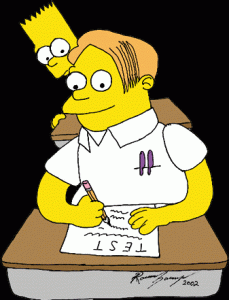
Tracy Postert, before and after. Integrity is not a job requirement on Wall Street.

Out of work Ph.D Tracy Postert spent 15 days at Zuccotti Park advocating revolution, condemning the corruption of Wall Street and decrying the moral bankruptcy of the capitalist system. Then she decided to hold up a sign advertising her degree and specialty while she was protesting the evil ways of the financial district. Wayne Kaufman, chief market analyst for John Thomas Financial Brokerage, saw her on the street, was intrigued by her background in biomedical science, and took her resume. Then he asked her if she’d like to come for an interview.

Kaufman offered her a job as a junior analyst evaluating medical companies as potential investments, and she accepted. Postert has now just completed her third week as paid employee of the system she was railing against on the street, studying for exams to be a certified financial analyst.

“I want to get a perfect score,” she told the New York Post. She gets a perfect hypocrisy score already. Imagine Martin Luther King agreeing to accept  a special membership in all-white country club, or taking a lucrative job as Sen. Strom Thurmond’s advisor on racial matters. Imagine Jane Fonda signing an Army contract to recruit soldiers for the Vietnam War. Wall Street and capitalism were the embodiment of evil and injustice for Postert, until she had a chance to move from the “99%” to the 1% whose values she had sneered at.

Is there anything wrong with working as a Wall Street analyst? Hell no—unless you have derided Wall Street analysts as the scum of the earth before you had the chance to be one. I don’t assume that Tracy Postert is typical of all OWS protesters, but I am confident she is typical of many of them. Not principled, but angry. Not idealistic, but envious. Not serious, but cynical. In other words, hypocrites, just waiting for the opportunity to show it.

Here is the irony. The fact that Wall Street would make a job offer to someone as ethically inert as this intellectually dishonest and feckless class warrior shows that Occupy Wall Street is not entirely wrong about the dearth of ethical values in the business community

And the fact that an Occupy Wall Street protester would accept such an offer shows that Wall Street may be right about the protesters.

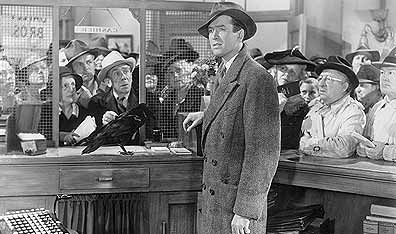
“It’s A Wonderful Life” Ethics, Part 3

Here is the final installment of the Ethics Alarms overview of the ethical issues raised in Frank Capra’s classic. Some of the comments on Parts 1 and 2 have suggested that my analysis is unduly critical. Nothing could be further from the truth. I love the movie, and have already said that I find it ethically inspiring. Noting that characters act unethically in a movie about ethics is no more criticism than pointing out that people in horror movies never just leave when things start getting weird (as I would). I know that their actions drive the plot and are necessary. This is, however, how an ethicist watches a movie with as many ethical choices as “It’s A Wonderful Life.” I can’t help it.

Now back to George, Mary, and Bedford Falls:

11. Uncle Billy screws up as we knew he would

11.  Christmas Eve arrives in Bedford Falls, and Uncle Billy manages to forget that he left the week’s deposits in the newspaper he gave to Mr. Potter. Thus more than $8,000 is missing on the same day that the bank examiner is in town. Why is Uncle Billy still working for the Savings and Loan? He’s working there because George, like his father, is putting family loyalty over fiduciary responsibility.  Potter, of course, is a thief; by keeping the lost money to trap George, he’s committing a felony, and an unnecessary one. As a board member on the Savings and Loan, Billy’s carelessness and George’s negligence in entrusting him with the bank’s funds would support charges of misfeasance. Mr. Potter, had he played fair, might have triumphed over George legitimately, and no Christmas miracle or guardian angel could have saved him. But this is the inherent weakness and fatal flaw of the habitually unethical: since they don’t shrink from using unethical devices, they often ignore ethical ways to achieve the same objectives that would be more effective.

12. George folds under pressure Continue reading

“It’s A Wonderful Life” Ethics, Part 2 (of 3)

When we last saw George Bailey, he was defending his father’s dubious loan practices. In this, Part 2 of the three installments of  “It’s A Wonderful Life” Ethics, we take the saga up the fateful Christmas Eve when George Bailey meets his guardian angel.

6. George’s Fork in the Road

George Bailey’s decision to give up his plans to go to college to save the Savings and Loan is clearly not motivated by his personal dedication to the institution; he doesn’t like the place. He says so over and over again. He admires his father’s motivations for starting it. Had Potter not sparked his resentment with his nasty comments about George’s late father, George would have been out the door. But his passionate speech in rebuttal of Potter’s words put him on the spot: after those sentiments, turning down the Board’s appointment of him to be the new operating manager of the S&L would have made George a hypocrite in his own eyes, and rendered his passion  laughable. If George had integrity, then he had to accept the appointment.

It is one of the most interesting ethical moments in the film, because it represents a realistically complex ethical decision. George does what he does for selfish reasons as well as altruistic ones, and irrational reasons as well as considered ones. He wants to respect himself; he fears what might happen to his family and the community if Potter becomes the only financial power in town, and knows he will feel guilty if the consequences are bad. He feels like not staying will be taking Potter’s side over his father’s—completely irrational, since his father had given his blessing to George’s college plans, and wasn’t alive to be harmed by whatever he chose to do anyway. A large proportion of George’s decision seems to be motivated by non-ethical considerations, for he doesn’t like Potter—even hates him, perhaps—and wants to stick it to the old tycoon by foiling his victory. There are few ethical decisions in real life that are made purely on the basis of ethics, and Capra makes George’s decision wonderfully impure. Continue reading

“It’s A Wonderful Life” Ethics, Part I (of 3)

“It’s A Wonderful Life” made its now traditional holiday season appearance on network television, and naturally, I watched it. The movie is one of the great ethics movies of all time, as well as being one of the great American movies of all time, perhaps director Frank Capra’s masterpiece. One of the markers of a classic film is how one can find new things in it upon every viewing, and that is certainly true of “It’s A Wonderful Life.” I was struck this time around by how many ethics issues are raised in the screenplay, some, no doubt, unintentionally.

1. “If It’s About Ethics, God Must Be Involved”

The movie begins in heaven, represented by twinkling stars. There is no way around this, as divine intervention isat the core of the fantasy; heaven and angels were big in Hollywood in the Forties. Nevertheless, the framing of the tale advances the anti-ethical idea, central to many religions, that good behavior on earth will be rewarded in the hereafter, bolstering the theory that without God and eternal rewards, doing good is pointless.

We are introduced to George Bailey, who, we are told, is in trouble and has prayed for help. He’s going to get it, too, or at least the heavenly authorities will make the effort. They are assigning an Angel 2nd Class, Clarence Oddbody, to the job. He is, we learn later, something of a second rate angel as well as a 2nd Class one, so it is interesting that whether or not George is in fact saved will be entrusted to less than heaven’s best. Some lack of commitment, there—then again, George says he’s “not a praying man.” This will teach him—sub-par service! Continue reading

Comment of the Day: “The Compassion Bullies Strike Again!”

Beware that slippery slope!

Ethics Alarms is blessed with an unusually wise, articulate, philosophically diverse and often cantankerous readership. One of the luxuries this affords me as that I do not have to raise every single relevant issue in an ethics commentary, because I can be reasonable certain that a commenter will raise it, often with a perspective that I had not considered. Among benefits, this keeps my posts from being even longer than they already are. An example of this phenomenon  is this comment from Mike Martin, on yesterday’s post regarding the family that bullied US Air into refunding non-refundable tickets because the mother was diagnosed with Stage 4 breast cancer. My first draft of the post had discussed the important  issue Mike raises, but I decided to stick to the main topic, the conduct of the Compassion Bullies.

Here is his Comment of the Day, on “The Compassion Bullies Strike Again”:

“The question now is: how does US Air like its position on the proverbial slippery slope? Continue reading

The Compassion Bullies Strike Again!

(I know everyone is going to hate this.)

"Be compassionate, damn you!!! This thing is loaded"

Having a terminal illness does not justify bullying corporations into waiving fair and valid contracts, and using the media and public opinion to extort money out of companies that they have no obligation to surrender is unethical.

Sorry. But it’s true.

US Air has capitulated to a classic example of compassion bullying and agreed to refund the non-refundable airline ticket Lynn McKain purchased as part of a family vacation to Belize. This occurred after the McKain family sicced the media on the airline when a recurrence of breast cancer caused Lynn to cancel the trip on doctor’s orders. She requested a refund based on her misfortune, although there was nothing in the deal that suggested that there were exceptions to the ticket’s non-refundable features. Then, after the airline politely declined to waive the terms the McKain’s had agreed to in order to pay discounted ticket fees, the family alerted the media, with predictable results. There were heart-wrenching stories about McKain’s cancer treatment, making out the airline as an avaricious, mean-spirited cabal of inhuman monsters.

Finally, the airline gave in. It had no choice; the media and the McKain’s would keep the pressure on, making the episode a full-fledged public relations catastrophe, unless it did. The Compassion Bullies won, as they almost always do. Don’t think for a moment that this is good triumphing over wrongdoing, however. It is the opposite. Continue reading

Now Here’s A Terrible Idea: Mandated Disclosures for Photoshopped Images of Celebrities!

And if you look real closely at the lower left corner, you'll read, "The model for Venus was a short, middle-aged bald man named Gino. His appearance was altered by the painter in the creation of this painting."

Here is another candidate for enshrinement in the Pantheon of Well- Intentioned But Terrible Ideas.

In an article published Monday in the journal “Proceedings of the National Academy of Sciences,” Dartmouth researchers Hany Farid, a professor of computer science, and Eric Kee, a doctoral student, propose a rating system of publicly displayed photographs of models, actors and celebrities to let viewers know exactly how and how much an image has been altered by photoshopping, airbrushing or other means.

“Impossibly thin, tall, and wrinkle- and blemish-free models are routinely splashed onto billboards, advertisements and magazine covers,” the two write. “The ubiquity of these unrealistic and highly idealized images has been linked to eating disorders and body-image dissatisfaction in men, women, and children.” In the interest of limiting the damage caused by unrealistic images of human beauty, the researchers argue that graphic images should include labels that disclose  “geometric adjustments” such as slimming legs, hips and arms, as well as adjusting facial symmetry—reducing a nose in size, or slightly enlarging eyes.  Users of such photos should also flag photometric adjustments that change the appearance of skin tone, blemishes and texture, such as wrinkles, dark circles under the eyes or cellulite, say the researchers.

Please, for the love of God, nobody introduce these guys to Sarah Deming and her lawyer, who are suing the distributers of the film “Drive” because the trailer was more exciting than the movie. And let us all remember this proposal when we are tempted to pooh-pooh accusations that the government is regulating creativity, commerce, art and enterprise right out of existence, and with them, individual liberty as well.The tea parties should use Farid and Kee’s article for recruitment. Continue reading

The SAT Cheating Scandal

Over at Curmudgeon Central, Rick Jones appropriately eviscerates the Educational Testing Service for its role—the role being negligent facilitator–in an unfolding scandal involving students cheating on their SATs by having surrogates take their tests. 20 people have been arrested thus far as either the fake test-taker of the fraudulent scholar paying for said test-taker, and Rick’s guess that there must be a hundred times the ETS’s estimate of 150 incidents of cheating on the SATs  is extremely conservative. The problem is that the SATs are taken under incredibly lax  security, and Rick reveals something I never would have suspected: if someone is caught cheating after the SAT service investigates, he or she is given a refund and allowed to take the test again—and no college is ever notified! Rick writes…

“…in a just universe, the cretinous yahoos at the CB/ETS who decided on this policy would lose their jobs, have “unethical moron” branded into their foreheads, and be publicly pilloried. Preferably literally.” Continue reading

Unethical Website of the Month: “Occupy Black Friday” Facebook Page

The  intellectual, logical and ethical deficiencies of the tiresome “Occupy” movement are on full outrageous display on “Occupy Black Friday,” a Facebook page that is part of the effort to harm large retailers by interfering with holiday shopping. Naturally, as with segments of the “Occupy” groups that have advocated or engaged in violence, used anti-Semitic rhetoric, broken laws and made ridiculous statements, defenders of the movement will dismiss this as an aberration, not representative of the principles of the “Occupiers” as a whole. This is the group’s genius, or something: by being infuriatingly vague, it avoids accountability.

But an organization is accountable for the events it sets in motion, and the harm that its pretensions wreak. The idea promoted by the group’s Facebook page is for mobs of Occupiers to swarm stores during their deep discount sales today, interfering with shoppers and bringing commerce to a halt:

“The idea is simple, hit the corporations that corrupt and control American politics where it hurts, their profits. Black Friday is the one day where the mega-corporations blatantly dictate our actions, they say “shop” and we shop! Pushing their ledgers from red to black. This Black Friday, we will boycott all of the corporations that corrupt our government, and put profits before people.”

The idea is simple minded. Continue reading

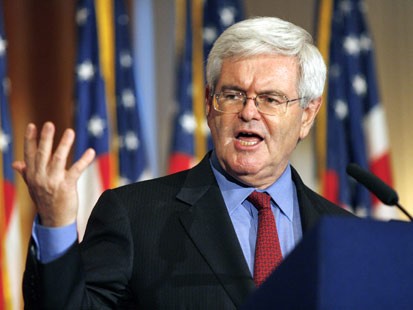
Ethical Quote of the Month: Newt Gingrich

The Good Newt (newtus virtuous), once believe to be extinct, was sighted in D.C.

“I do not believe that the people of the United States are going to take people who have been here a quarter century, who have children and grandchildren, who are members of the community, who may have done something 25 years ago, separate them from their families, and expel them. I do believe if you’ve been here recently and have no ties to the U.S., we should deport you. I do believe we should control the border. I do believe we should have very severe penalties for employers… I don’t see how  the party that says it’s the party of the family is going to adopt an immigration policy which destroys families that have been here a quarter century. And I’m prepared to take the heat for saying, let’s be humane in enforcing the law without giving them citizenship but by finding a way to create legality so that they are not separated from their families.”

—-GOP Presidential hopeful Newt Gingrich, telling CNN debate moderator Wolf “Blitz” Blitzer his approach to illegal immigration, and spitting into the wind of Tea Party and and conservative Republican ideology on the subject.

Continue reading