Pet Goat Ethics: Is There Anyone Behaving Ethically In This Mess?

Are they just not installing ethics alarms any more?

Above you see Cedar the Goat with his 9-year-old owner, now grief-stricken because Cedar ended up on a State Senator’s menu thanks to a series of unethical acts that could have been short-circuited if anyone with power or authority had been a little more ethical, but no.

Jessica Long bought Cedar last year as a pet for her nine-year-old daughter, but for some reason decided to hand the beloved pet over to a livestock auction at a district fair, which stipulated that the all sales were final and Cedar, like all the other farm critters, would be sold for meat. The fair’s brochure clearly stated “no exceptions.” But Long’s daughter was distraught about the prospect of losing Cedar, so her mom begged the fair to give him back before bidding started.

“Pet schmet,” the fair’s rulers essentially replied. “Making an exception for you will only teach our youth that they do not have to abide by the rules that are set up for all participants,” Shasta District (that’s in California) Fair Chief Executive Officer Melanie Silva lectured in an email. So Cedar was duly auctioned off to a representative of California State Senator Brian Dahle for $902. Just $63.14 of that goes to the state fair and the rest, $838.86 to Long.

Thinking hard (but not well) about how to please her daughter, Jessica kidnapped the goat and decided to “take the goat that night and deal with the consequences later.”

Oh, good thinking there, Mom!

The fair’s livestock manager contacted Long warning of “serious consequences” if the goat wasn’t returned. Then a sheriff from Shasta County, filed a search warrant, a judge signed off on it and officers used “breaching equipment to force open doorway(s), entry doors, exit doors, and locked containers in pursuit of their target.” Cedar was the target. Clever Long, however, had sent Cedar into hiding at a distant farm in Sonoma County, but it still didn’t work: authorities got her goat anyway and drove him 200 miles to Shasta County for slaughter.

It is believed that the little goat was served at a community barbecue to which he had been donated as a gesture by Senator Dahl. And that he was delicious.

Continue reading

“Ick” Or Ethics? Michael Crichton’s 1981 Film “Looker” Is Coming True…

In “Looker,” a 1981 science fiction thriller starring Albert Finney, James Coburn and Susan Dey, involves a high tech research firm that concludes that real, live models, even after cosmetic surgery, can’t approach the physical perfection that will optimally influence consumers. Models are offered a contracts to have their faces and figures scanned to create 3D computer-generated avatars, indistinguishable from them, which are animated for use in commercials. Once their bodies duplicated digitally, they get lifetime paychecks (though not for as much as Miguel Cabrera, currently at $400,410,623 and counting, gets) and can retire, since their computer-generated, more perfect dopplegangers will be doing their work for them. For some reason, the evil tech firms has all of the models murdered, but that part of the plot is irrelevant here.

42 years later, Levi Strauss & Co. announced in a press release yesterday that it is partnering with an AI company to “increase the number and diversity of our models for our products in a sustainable way.” Yeah, those digital models in “Looker” were also “sustainable,” even though the models’ flesh and blood models were disposable. Levi’s will test the use of AI models to “supplement” real-life models later in 2023.

“While AI will likely never fully replace human models for us”, “—-yeah, tell it to Susan Dey—-we are excited for the potential capabilities this may afford us for the consumer experience,” said Dr. Amy Gershkoff Bolles, global head of digital and emerging technology strategy at Levi Strauss & Co, sounding a lot like James Coburn, the evil advertising genius in “Looker.”

Meanwhile, in arguably related news, Levi Strauss & Co. will be laying off 800 employees — almost 20% of its corporate jobs.

Continue reading

“Nah, There’s No Big Tech Bias!” Google’s AI ChatBot Provides A Smoking Gun

I think the first appearance of the ironic refrain, “Nah, there’s no mainstream media bias!” in an Ethics Alarms headline was in 2018. Since then, I’ve used it dozens of times, and easily could have justified using the sarcastic refrain hundreds, indeed thousands of time since. Even though the evidence of sinister, relentless, intentional and unethical biased reporting by the mainstream media is manifest and continuing daily, its allies (and naive “useful idiot” defenders) continue to argue that declaring that it is what it is constitutes a conservative “conspiracy theory. In doing so, they aid and abet the attempted destruction of American democracy.

The mainstream media’s perceived role as propaganda and deception merchants for the Left is reinforced by similar efforts by social media, the entertainment industry, and Big Tech, though the latter’s machinations are a bit more difficult to nail down. Google, a prime villain, has so many ways to slant public discourse and hamstring non-compliant voices, one main way being through the alignment of search results through its mysterious algorithms. Google’s latest innovation, however, unintentionally provides a window into the biases of the people behind the tech.

Google’s just launched an Artificial Intelligence chatbot called “Bard” as a competitor of ChatGPT, which had been getting lots of publicity lately. Bard’s screaming progressive/Democratic bias quickly revealed itself when conservative users ran some basic tests.

“Not the Bee’s” tech specialist Neo submitted two identical questions to Bard:

The answer to the first question:

Continue reading

Parody Ethics: What Is This Case Doing At The Supreme Court? [Corrected]

Well, KABOOM! There goes my head.

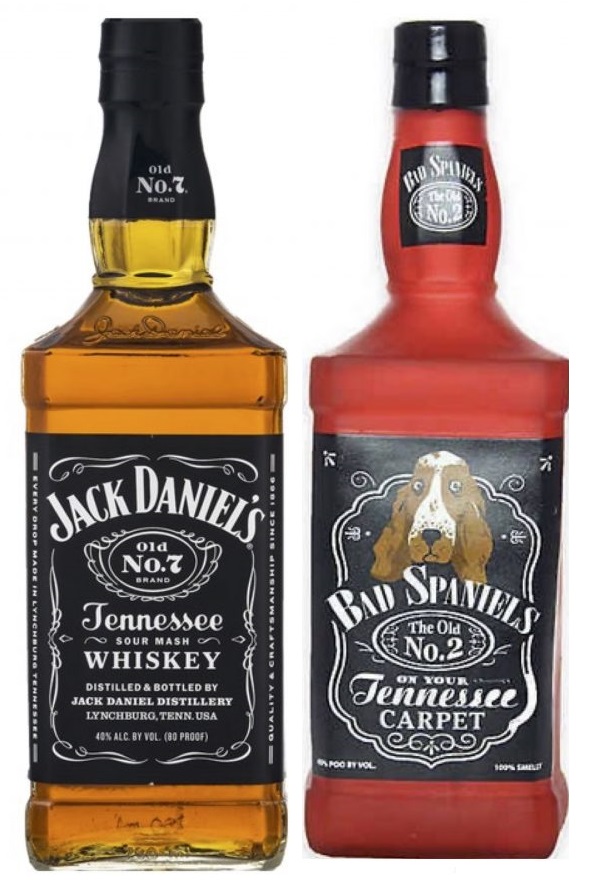
Absurdly, Jack Daniel’s, the largest American whiskey manufacturer, sued VIP Products, one of the principle American dog toy manufacturer (Spuds loves their toys) over a parody plastic squeaky toy modeled on Jack Daniel’s bottles. (Spud likes a squeaky toy that looks like a Coor beer bottle). On the dog toy, as you can see, instead of describing “Old No. 7 Tennessee Sour Mash Whiskey” manufactured by “Jack Daniel’s,” the toy is “Bad Spaniel,” “Old No. 2 on your Tennessee carpet.”

Oral argument at the Supreme Court was yesterday. Finding a likelihood that consumers would confuse the “Bad Spaniels” toy with Jack Daniel’s, the trial court ruled in favor of the liquor company and barred VIP from continuing to manufacture the parody toy, ruling, believe it or not, that that consumers would confuse the “Bad Spaniels” toy with Jack Daniel’s whiskey. Yeah, I always have that problem, mixing up dog toys with liquor bottles. The U.S. Court of Appeals for the 9th Circuit reversed on both counts, because the trial court’s theory was…well, let Sidney Wang explain:

Continue reading

Showdown At Staples: A Duty To Confront Saga [Corrected]

This morning, my wife sent me on a mission to buy a new portable calculator. At the nearby strip-mall, there are three retail options right in a row: Target, Staples, and Best Buy. Target looked crowded, and the Best Buy is huge and bewildering, so I chose the more modest-sized Staples, where ProEthics has an account.

When I entered, none of the aisle and section signs—there were about two dozen— indicated that the store even offers calculators, though I knew that couldn’t be the case in an office supply store. There was a 15 foot banner proclaiming “CUSTOMER SERVICE,” however, with one female clerk beneath it, processing the purchase of an ancient man who was moving in slow motion. After waiting a few minutes and realizing that the transaction might take until Arbor Day, I asked the Staples employee where I could find the calculators, assuming it was an easily and quickly answered query and that I could get the information before the aged customer finished searching through his wallet.

The employee obviously had no idea. She said, “I think it’s down there somewhere,” pointing to the other side of the store. “Is there an aisle sign that I should look for?” I asked. “You know, let me check with somebody; just wait a minute,” she replied, and went back to Methuselah.

“Bye!” I said sharply, and left the store. [ Update: I was wrong to write that, because I did NOT say anything, sharply or otherwise as I left Staples. A sharp “bye” would have perfectly expressed by state of mind, however. Still, that was a false account.] I then went to Best Buy; its customer service staffer gave me directions, pointed out a sign and a section, and I had picked out the item in less than five minutes.

After completing the purchase, I went back to the young man at the service desk and thanked him for his competence. I also told him how his counterpart at Staples had blown it, and that Best Buy had my business from now on.

I wasn’t done yet, however.

Continue reading

Stop Making Me Defend Ticketmaster (And Louis Farrakhan)!

Ugh.

Next to the totalitarian, censorship-obsessed, indoctrination-pushing ideology of current American progressives, the inability of American conservatives to observe basic intellectual integrity and avoid disqualifying themselves as trustworthy defenders of democratic principles may be the greatest threat to the U.S.’s existence as a free republic.

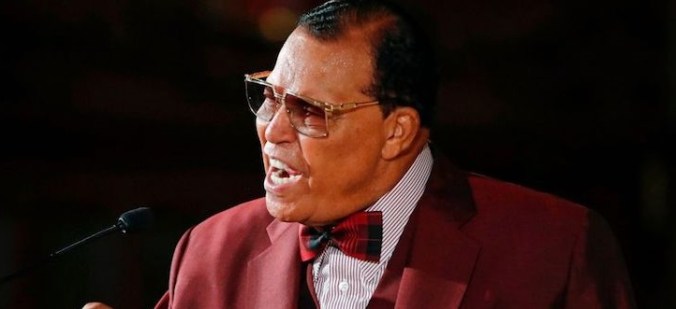
The Washington Free Beacon, often a helpful source of conservative analysis, apparently thinks that everyone, especially members of Congress should be condemning Ticketmaster because it sold tickets to a Louis Farrakhan event:

The ticketing giant hated by Taylor Swift fans and everyone else who has ever tried to buy concert tickets is now under fire from Jewish activists for selling tickets to a Louis Farrakhan event in which the minister defended Adolf Hitler and predicted another Holocaust against Jews. But many of Ticketmaster’s biggest critics on Capitol Hill don’t seem to care.

Ticketmaster, which charges service fees on each ticket it sells, raked in money selling tickets to Farrakhan’s annual Saviours’ Day conference in Chicago last weekend. During his speech at the event, Farrakhan assailed the “stranglehold that Jews have on this government” and claimed “Jewish power is what has all of our people of knowledge and wisdom and talent afraid.”

The event was met with crickets on Capitol Hill, with almost no one in Congress speaking out against Ticketmaster for making money off of the Farrakhan event. The reaction is a stark contrast to lawmakers’ response when Ticketmaster bungled sales last year for Taylor Swift’s much-anticipated concert tour. That fiasco was in the news cycle for weeks and led to a Department of Justice investigation as well as a Senate hearing. Lawmakers on both sides of the aisle say Ticketmaster and its parent company, LiveNation, have a monopoly over the ticket industry, leading to price-gouging and a failure to crack down on automated scalping.

“Daily reminder that Ticketmaster is a monopoly, it’s merger with LiveNation should never have been approved, and they need to be reigned in [sic],” wrote Rep. Alexandria Ocasio-Cortez (D., N.Y.) in a Twitter post in November. Sens. Richard Blumenthal (D., Conn.) and Amy Klobuchar (D., Minn.) called on the Department of Justice to investigate. None of their offices responded to a request for comment on Ticketmaster’s Farrakhan sales.

Only Sen. Marsha Blackburn (R., Tenn.)—who also spoke out about the Taylor Swift debacle—weighed in on the Farrakhan controversy when contacted by the Washington Free Beacon.

“It is extremely concerning that Ticketmaster is choosing to use its platform to elevate and promote a well-known anti-Semite. The targeting of the Jewish people has gone on far too long and must stop,” she said.

Rep. Cathy McMorris Rodgers (R., Wash.), a Ticketmaster critic who serves as the chairwoman of the House Energy and Commerce Committee, also sent a  comment after this story was published.

“Anti-Semitism has no place in America,” said McMorris Rodgers. “Ticketmaster should be completely transparent on why it chose to profit off of Farrakhan’s abhorrent history of hatred and violent threats of genocide against the Jewish people.”

The author is Alana Goodman. Naturally, Republicans (and conservative websites and pundits) took the bait. Democrats don’t like democracy, Republicans are dumb as eels. Morons. Ethics dunces. Hypocrites.

Continue reading

Comment Of The Day: “‘Ick Or Ethics’ Ethics Quiz: The Self-Repossessing Car”

There were many enlightening responses to the ethics quiz involving Ford’s patent application for devices that would allow a deadbeat car purchaser’s automobile to progressively punish its owner and eventually repossess itself.

This one is through the auspices of Ethics Alarms vet Neil Dorr, whose Comment of the Day followed the post, “‘Ick Or Ethics’ Ethics Quiz: The Self-Repossessing Car”….

***

To my eyes, this extends far beyond normal penalties for a non-payment or breach of contract, especially since they get increasingly punitive and paternalistic. In most cases, if you stop making payments on a car they send you increasingly-nasty letters before finally hauling it away in the middle of the night. None of it includes the “tsk tsk” finger-wagging demonstrated here. Limiting you to “emergency use only” (whose emergency?) “Geofencing”? That’s what we do to dogs and cattle by way electronic collars (which often prove ineffective). “Annoying sounds”? Like the ones they play outside of convenience stores here to discourage vagrancy? Then, a final “lockout” where your allowed the privilege of looking at your car, shading some driveway, and providing them free storage (at least until they call it home) without use. Talk about cruel and unusual.

Continue reading

‘Ick Or Ethics’ Ethics Quiz: The Self-Repossessing Car

This one has my ethics alarms ringing, but I can’t seem to find anything unethical about it.

A recently published patent application from Ford describes a system that would lock drivers out of their vehicles for nonpayment and allow the vehicle to repossess itself.

The patent document was formally published on February 23. Titled “Systems and Methods to Repossess a Vehicle,” it outlines different methods that could be taken if the vehicle’s owner misses payments. This would trigger a”repossession system computer,” which would be capable of disabling “a functionality of one or more components of the vehicle,” including the air conditioning, and radio.” “Incessant and unpleasant sound” could be turned on “every time the owner is present in the vehicle.” Finally, the car could be placed in a “lockout condition,” unable to be driven except in the case of an emergency.

Continue reading

Why Punish Dilbert For His Creator’s Rant?

Ethics Alarms discussed the weirdly illogical, emotional and intentionally inflammatory reaction of cartoonist/pundit Scott Adams based on, of all things to freak-out over, a poll by Rasmussen that was even more unreliable than most polls, which is saying something. The fact that I assumed something like the resulting backlash would occur and that Adams should have expected it doesn’t make the reaction any less unethical.

Hundreds of newspapers have now stopped printing the popular workplace satire comic strip. The statements of the San Antonio Express-News, which is part of Hearst Newspapers, and the USA Today Network were typical. The Express-News said that it will drop the Dilbert comic strip “because of hateful and discriminatory public comments by its creator.” USA Today tweeted that it will stop publishing Dilbert “due to recent discriminatory comments by its creator.”

Continue reading

“The Great Stupid” Across The Pond: We Helped Save Roald Dahl’s Children’s Books From The Censors; Now They’re Coming For OO7

…who might soon be called “008” to soothe readers offended by the number seven. Seven deadly sins, seven dwarves, that creepy Morgan Freeman movie with Gwinneth Paltrow’s head in a box…it’s a touchy number, you have to admit.

I’d like to think in some tiny way Ethics Alarms helped spread the news of the despicable bowdlerizing of Dahl’s classics that resulted in his publisher backing down and adopting the New Coke solution to a fiasco: the anti-authors’ rights business announced over the weekend that it will henceforth offer “Dahl Classic” along with the vandalized “New Dahl.” Yeah, let’s see which sells more copies. There was hardly time to pop the champagne, however: we then learned that Ian Fleming’s James Bond novels are being re-written for “modern readers“to omit alleged “racist language” and “racial references.” The censored novels will be published in April to mark the 70 years since “Casino Royale,” the first in the series, was published.

There’s nothing quite like honoring an author by defacing his most famous works. At least they’re leaving “Chitty Chitty Bang Bang” alone. I think.

The indefensible conduct comes after Ian Fleming Publications Ltd, which owns the rights to Fleming’s work, commissioned a review by “sensitivity readers.” The British really don’t get that freedom of speech and expression thingy, do they? Neither does the rest of the world beyond our shores and porous borders. Now watch: U.S. progressives will argue that once again, the United States is out of step with its betters by not censoring literature and movies with the same wild abandon that it pulls down statues.

The disclaimer accompanying Fleming’s reissued novels, echoing Dahl’s publisher Puffin, will read: “This book was written at a time when terms and attitudes which might be considered offensive by modern readers were commonplace. A number of updates have been made in this edition, while keeping as close as possible to the original text and the period in which it is set.”

If Ian Fleming “might be considered offensive” to the political correctness police, imagine what’s going to happen to Mark Twain.

Continue reading