Hypocritical Or Just Responsible And Competent? Hollywood’s LGBTQ Problem


Before it went down the tubes, the leftist commentary website ThinkProgress posted a typical piece (that is, so crippled by bias and a progressive agenda that it was useless as advocacy unless the reader already agreed with it) bemoaning the fate of LGBTQ performers in Hollywood like Kristen Stewart. Stewart, once a rising young star with the “Twilight” Saga films, now approaching 30 without a clear career path.

You’ll get the article’s point of view from the kick-off:

“In an interview with Harper’s Bazaar UK, actor Kristen Stewart, who has been romantically linked to model Stella Maxwell since 2017, said, “I have fully been told, ‘If you just like do yourself a favor, and don’t go out holding your girlfriend’s hand in public, you might get a Marvel movie.’ I don’t want to work with people like that.” Stewart has said publicly she does not identify as bisexual or lesbian, and doesn’t want to choose a label for her sexuality. In the same interview she added, “I was informed by an old school mentality, which is — you want to preserve your career and your success and your productivity, and there are people in the world who don’t like you, and they don’t like that you date girls, and they don’t like that you don’t identify as a quote unquote ‘lesbian’, but you also don’t identify as a quote unquote ‘heterosexual’. And people like to know stuff, so what the fuck are you?’”

Although it may, at times, appear as though LGBTQ representation and participation in Hollywood has achieved some semblance of parity, Stewart’s experience is far from unique. Several young, openly LGBTQ actors such as Ellen Page and Ezra Miller have talked about how their gender and sexuality have affected how people talk to them about their careers.”

Well, of course it does. Continue reading
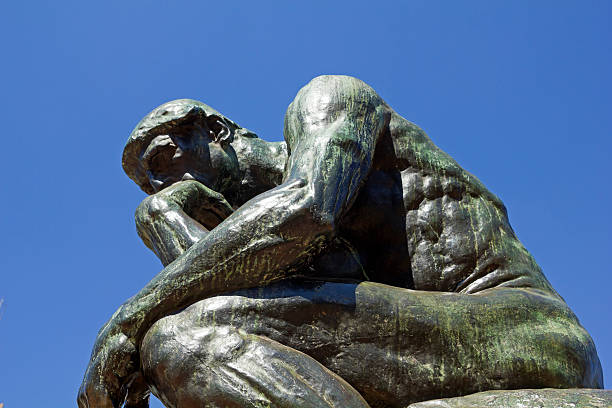
Monday Ethics Musings, 10/7/2019: Questions, Questions…

Thinking…

Wait, where are my clothes???

1. When will Mrs. Q make her debut as a regular contributor to Ethics Alarms? I’m working out the details. She’s ready, I’m behind, we’ll get it done. Very excited.

2. If everything is going to be done online, is it reasonable to expect those companies who force us to interact that way to be competent? Case Study: The Boston Globe just offered me a 6 month digital subscription for a buck. But an old password connected to my email address prevented me from entering the new one necessary to accept the deal. All links went to current subscription or subscribing at the regular price. It took 40 minutes of online chats with robots and a human being (who disconnected me one) to fix the problem, which was in how the Globe set up the offer acceptance page. I ended up using a password made up by “Sherry” because I couldn’t reset my password myself. This kind of thing happens all the time. I wouldn’t have a clue how to set up a website response system, but if that was my job, I would be obligated to do better than this.

3. What good are movie critics whose opinions and tastes aren’t shared by their readers? My view: not much. The job of a critic is to let readers know if readers would appreciate the movie or not. A critic who can’t or won’t do that, and most don’t, is useless. I was thinking about this when I encountered this article in The Guardian listing the films for which audience ratings and critical ratings diverged the most.

Much of the disparity today is caused by critics who allow their ideological biases to dominate their judgment: yes, bias makes them stupid. Another problem, harder to over-come, is that the judgment of people who see hundreds of movies a year and who are often steeped in the art of film-making often has no relevance to the movie average audience member at all. Yet another is the unavoidable fact that few critics are equally qualified to review all genres. Horror movies are especially frequent victims of this problem.

Incidentally, yesterday I watched a new horror movie, “A.M.I.” that exploited the inherent creepiness of online personal assistants like Siri and Alexa. It was pretty bad, but the final scene was so ridiculous (and predictable) that it almost justified the film. Almost. Continue reading

The Ethically Inert NBA Shows Its Corrupted Soul

It was less than a week ago that the New York Times’ John Branch wrote,

“…the best thing about the start of the N.B.A. season — or just the preseason, which began this week — is that it thrusts the league back into the conversation. Not just about sports, but about the connection sports have to everything else, from politics to fashion, civil rights to gun rights…The N.B.A. is comfortable being connected. Opinions count. Expression is (mostly) encouraged. Politics is not filtered through political correctness, not parsed by focus groups or marketing departments…the N.B.A. does at least one thing better than other leagues: It joins the conversation and adds to it. It is a game for adults.”

Right on, John. And here’s what the NBA just added to the conversation: the league will kowtow to a repressive totalitarian regime and punish employees who choose freedom over submissiveness if it’s good for the bottom line.

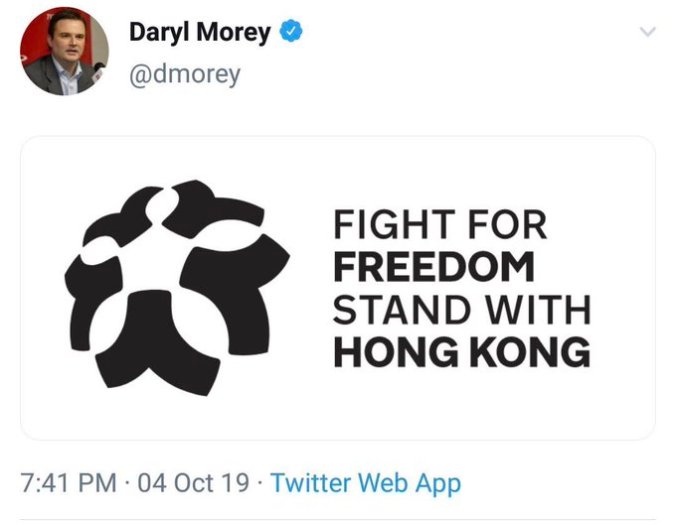
Houston Rockets GM Daryl Morey posted this on Twitter:

The Horror! Who in the U.S. doesn’t support the Hong Kong protesters, other than maybe Bernie Sanders and Rep. Ocasio-Cortez? Well, interestingly given Branch’s puff piece, the NBA doesn’t. The reason? Why money, of course. The NBA regards China as a growth market; never mind the slavery, political prisoners and repression of basic rights. Are you ready to ruuuuuumble???  Rockets owner quickly slapped Morey down, tweeting, 

Listen….@dmorey does NOT speak for the @HoustonRockets. Our presence in Tokyo is all about the promotion of the @NBA internationally and we are NOT a political organization.

Well, unless a Rockets player is bashing the United States as racist…that’s just fine.

Morey was forced to take down his tweet (betting is that he will be fired), and then issued a Galileo-style apology, if Gallileo had used Twitter:

I did not intend my tweet to cause any offense to Rockets fans and friends of mine in China. I was merely voicing one thought, based on one interpretation, of one complicated event. I have had a lot of opportunity since that tweet to hear and consider other perspectives…I have always appreciated the significant support our Chinese fans and sponsors have provided and I would hope that those who are upset will know that offending or misunderstanding them was not my intention. My tweets are my own and in no way represent the Rockets or the NBA.

“Other perspectives.” Here’s one: “Chinese state media urges quicker trials and heavy sentences for Hong Kong protesters…People’s Daily says the city’s judiciary has been too lenient in dealing with those arrested during months of unrest Xinhua slams school of 18-year-old shot in chest by Hong Kong police for failing to denounce him, after school said it shared young people’s concerns…” Continue reading

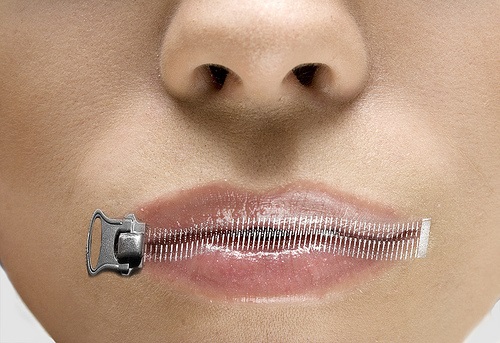
The Attacks On Free Speech From The Left Are More Dangerous Than Any Speech Progressives Want Banned

Another day, another progressive effort to erode pubic support and understanding for the First Amendment. This is at the root of America’s current ethics conflict: a perverse and puckish God has made one of the most unethical and least reflective of public figures  the crucial bulwark against a massed and relentless assault against core national values.

The New York Times, taking a hand-off from its ideological twin the New Yorker, has published an attack on free speech from New Yorker writer Andrew Marantz. Even though he is a professional writer, he has managed to complete an elite education (Brown, NYU School of Journalism) without managing to grasp the essence of freedom of speech, and why it is the structural load-bearing beam that allows our democracy to exist.

Marantz simply doesn’t get it, or he does get it, but would love to see less liberty and more enforced line-toeing by those lesser intellects and deplorables who cannot accept the inherent rightness of the progressive view of the universe. He writes, for example,

Using “free speech” as a cop-out is just as intellectually dishonest and just as morally bankrupt. For one thing, the First Amendment doesn’t apply to private companies. Even the most creative reader of the Constitution will not find a provision guaranteeing Richard Spencer a Twitter account. But even if you see social media platforms as something more akin to a public utility, not all speech is protected under the First Amendment anyway. Libel, incitement of violence and child pornography are all forms of speech. Yet we censor all of them, and no one calls it the death knell of the Enlightenment.

I guess Brown has no mandatory course in government theory.  The Constitution is the enabling document of the U.S. mission statement—you know, the one that begins by announcing that there are inalienable rights to life, liberty, and the pursuit of happiness. That such a governing document that could only limit government restrictions on free speech also stood for a cultural, societal and ethical norm that freedom of speech was central to the Declaration’s summary of human rights would normally be clear to anyone who bothered to study the two documents as well as research the relationship between law, morality and ethics. It’s true that Richard Spencer can’t be assured of a Twitter account, but a society that denies him one is chopping at that load-bearing beam. Continue reading

Baseball Ethics: Integrity, Records, And The “Juiced Ball”


The Boston Red Sox didn’t make the play-offs (and made me physically ill in the process), but that doesn’t mean I won’t find some baseball ethics to write about during October, which will cover the play-offs and World Series involving  five teams from each league. Some weeks ago commenter JutGory asked about the ethics implications of the so-called juiced baseball. and I was not in a mood to think that seriously about baseball, since the Red Sox were engaged in the final throes of an epic, inexplicable, season-long choke that, among other bad things, soured my wife on the game, undoing years of careful nurturing by me. I’m OK now, and Jut was right, the juiced ball does raise ethics issues.

Early on in the 2019 season, it was obvious that the ball was different somehow. The very first month had more home runs than is normal in the spring, and the phenomenon only got more extreme as the weather got warmer. Pitchers like Houston Astros ace (and likely Cy Young winner as the AL’s best pitcher) Justin Verlander and former Cy Young winner David Price called out MLB management directly, accusing them of messing with the ball to help the hitters. Baseball’s brass denied it initially, but eventually they had to admit that something was weird about the balls.

Researchers  confirmed  that the 2019 ball was traveling farther when hit with the same amount of force than the balls in seasons past. The change was determined to be that the balls’ seams were flatter, less raised, than they had been before. This reduced the drag when they were flying through the air, resulting in longer distances.

How and why this happened is  a mystery. Major League Baseball swears it was an accident,  but nonetheless the sport is completely in in control of the manufacturing of baseballs. It owns the company that makes them. The current theory is that this was a quality control issue or, perhaps, a quirk in which eliminating a flaw in the balls made them too uniform, too exact.

Among the ball’s many specifications, the degree to  which the stitches were raised had never been included. Continue reading

Evening Ethics Nostrum, 9/30/2019: The “Already Sick Of Impeachment Narratives” Edition [Updated And CORRECTED]

Ugh.

That’s all. Just “Ugh.” That’s all I’m saying about the latest attempted coup today

1. What’s going on here? This time, I have no clue.  Last week,  the U.S. website for  Captain Morgan rum was found to be  asking visitors to check a box confirming that they were “non-Muslim.” The question was quickly removed, but a different question lingers: Why? Why does Captain Morgan care what religion, if any, a consumer follows?

It is not illegal for Muslims (or anyone)  to drink alcohol in the United States, so this appeared to have been related to Sharia law, which does forbid alcohol consumption. . The company swears that “far from being a case of discrimination or an attempt to appease religious zealots, it turns out a technical error was behind the puzzling message.”

That’s obviously a lie: what kind of  technical glitch suddenly starts grilling website visitors on whether or not they are Muslim? Someone deliberately added the box.  There is speculation that the Diageo company, which owns the Captain Morgan brand, was reacting to a  threat from Islamic extremists that violent consequences would befall them if they dared to continue to make alcohol available to Muslims.

That seems far-fetched too, but it’s more likely than a “technical error.”

CORRECTION and UPDATE: There was a lie here, all right, and it was the P.J. Media author Robert Spencer who was the villain. In his article he misrepresented the Metro’s summary of what the Captain Morgan spokesperson said caused the box to appear as the statement itself. This advanced the article’s conspiracy narrative about companies being threatened into enforcing Sharia law, but it was also false. What the company really said was,

Over the weekend, a misconfiguration on our age-gating files for our US Captain Morgan website meant that people were shown our United Arab Emirates age gate window in error. ‘In the United Arab Emirates it is commonplace for alcohol brands to request verification of this kind, in addition to age-gating, in line with UAE alcohol licensing requirements. We corrected this as quickly as possible.’

That made sense, and the mystery is solved. Metro didn’t help by burying that statement after a string of tweets, and I compounded the confusion by not reading the Metro article far enough. A botch all around.


2. Well, it was good to get it off his chest, I guess… Last week Tamarac City commissioner Mike Gelin felt he had to mar an awards ceremony, interrupting it and verbally attacking Broward County Sheriff’s Deputy Joshua Gallardo as he was being honored as an Officer of the Month.  NBC Miami reported that after Gallardo and others were honored, Gelin  grabbed the microphone and called out to the officer, “It’s good to see you again. You probably don’t remember me. But you’re the police officer who falsely arrested me four years ago. You lied on the police report. I believe you are a rogue police officer, you’re a bad police officer and you don’t deserve to be here!”

Nice.

Gelin was referring to a 2015 incident where he was arrested  resisting and obstructing  police while they responded to an alleged battery incident. He was not a city commissioner at the time of the arrest and charges were eventually dropped.

The city’s mayor said, in response to Gellin’s outburst, Continue reading

Morning Ethics Warm-Up, 9/27/2019: Five Indefensible Ethics Breaches, In Approximate Order Of Harm Done [Corrected]

And it’s a beautiful day…

1. Probably the last Boston Red Sox baseball ethics note of the 2019 season…In yesterdays’ meaningless afternoon game with the Texas Rangers, the Sox, who will finish the season an incredible 24 wins or more worse than last season’s championship team despite essentially the same squad and no major injuries, faced starter Mike Minor, who was seeking to end his season with 200 strikeouts, a milestone that might earn the free-agent-to-be an extra million or so on the open market this winter.

Minor entered his last start of the season at 191 strikeouts, and began the top of the ninth inning with 199 and a solid lead. Sox catcher Sandy León flied out to left field for the first out, bringing up sub-.200 hitter Chris Owings.

[Notice of Correction: Apologies to Chris Owings fans, if there are any, for originally misstating that Owings was a minor league call-up. In fact, he had been a journeyman infielder with the NL Diamondbacks. for six seasons until landing in the AL this season.Thanks to Other Bill for setting me straight. ]

With a 1-1 count, Owings popped up a pitch  halfway down the first base line in foul territory. Rangers first baseman Ronald Guzmán appeared to let it drop, trading out #2 for strike #2, and thus giving Minor a shot at his 200th strikeout. Minor got it when routinely incompetent home plate umpire CB Bucknor called strike three on a ball well out of the strike zone.

Manipulating the game’s results so a player can fatten his stats is unethical and hurts the integrity of the game. Guzmán  and the Rangers should be fined by MLB.

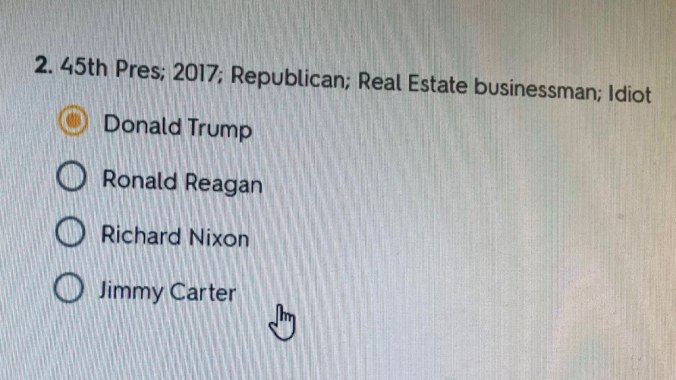
2. Our unprofessional, biased and untrustworthy public schools. Watson B. Duncan Middle School in Palm Beach Gardens, Florida is investigating a teacher who included this question on a test:

Continue reading

An Ethics Train Wreck So Dumb That I’m Embarrassed To Have To Write About It…

…but, as Hyman Roth said, “This is the life we have chosen.”

The train wreck farce unfolds in three acts:

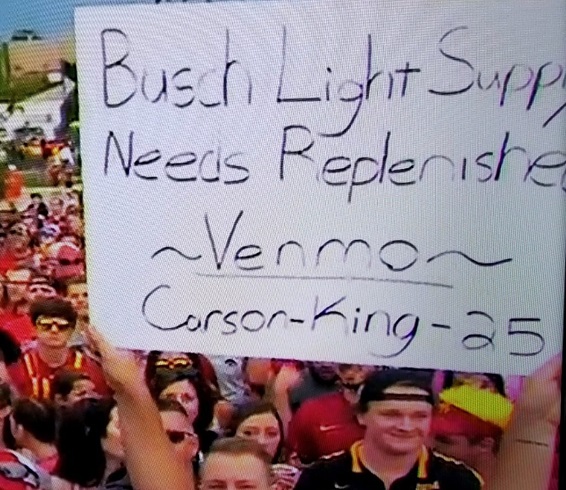
Act I, Scene One: Iowa’s Carson King, 24,  was seen on “ESPN College GameDay”  holding up a moronic sign in a football game crowd that read, “Busch Light supply need replenished. Venmo Carson-King-25.”  That isn’t comprehensible English even by stadium sign standards. Needs to be replenished? Needs replenishment? Giving people positive reinforcement for being illiterate is irresponsible, and makes the public stupid.

Act I, Scene Two: People actually sent money to King’s beer fund on Venmo. With all the really desperate people in this country and all the legitimate objects of charity, this boob’s scrawled plea for beer money struck a chord. People sent in contributions who would normally sneer at homeless people begging on the street.

Act I, Scene Three:  Venmo and Anheuser-Busch, seeing a promotional opportunity, both  pledged to match  donations to Kings “Help me be a drunk!” fund. The sign raised $1.14 million.

Now comes the one moment of reason and ethics in the tale: King decided to donate the money to  the   University of Iowa Stead Family Children’s Hospital.  Act I ended on a positive note.

Intermission. Continue reading

Saturday Night Ethics Fever, 9/21/2019: Crazy Stuff

1. A simple, factual, ethical rebuttal to Beto O’Rourke, who panders to the anti-gun Democratic base by saying that he’ll confiscate the weapons he thinks we don’t “need.” Lauren Boebert, who with her husband owns local restaurant Shooters Grill, where she and a lot of the staff  open carry a loaded firearm,  confronted  O’Rourke at a town hall in Aurora Colorado. “I was one of the gun-owning Americans who heard you speak regarding your ‘Hell yes, I’m going to take your AR-15s and AK-47s.’ Well, I’m here to say, ‘Hell no, you’re not!”

She was, of course, correct, just as Beto was grandstanding to the ignorant and fearful, in deliberate defiance of the Constitution.

To his credit, Beto tried to control the rabid anti-Second Amendment fanatics in his crowd  who tried to shout Boebert down, as she continued,  “We all have these stories. We all have the experiences. I was living in Aurora during Columbine. I had just recently moved when the Aurora shootings happened. Yet I have very close ties here. Yet all of those people were there defenseless.”

“They had no way to defend themselves against a crazed shooter, so I want to know how you intend to legislate the hearts of men and leave American citizens like myself, American mothers,” Boebert said. above the  abuse from the crowd. “I have four children. I’m 5 foot zero, one hundred pounds, and cannot really defend myself with a fist.”

Then she told a heckler near her that  she didn’t have her AR-15 with her, but  was carrying her Glock. “Well, you shouldn’t have that,” the man said.

Wrong again. It’s not his call, nor his business, whether she has a pistol or not.

2. From the wasteful and pointless protests files: “Hundreds of thousands” of 20-somethings and kids took part in a global protest against “inaction on climate change.” What do they know about climate change? Only what they have been told by agenda- driven activists, teachers and politicians, almost all of them without genuine scientific comprehension of the complexities, vagaries and uncertainty of the topic themselves. Are hundreds of thousands of people who don’t really know what they are talking about more persuasive than, say, one? Should they be?

No. Leading these innocents to believe otherwise is a cruel joke. Margot Guillen of Harvest Collegiate High School, told Yahoo News she was there to send a message, saying, “By protesting peacefully, it shows how committed our generation is to making a change and showing that we know what’s happening and we need to stop it.” They don’t know what’s happening, though, and they don’t know how to stop “it,” in part because they don’t know what “it” is, when “it” will occur, what the extent of “it” will be, and even whether “it,” whatever “it” is, will occur at all.

Good protest.

Typical. Continue reading

Ethics Quiz: The Declining Neighborhood Contractor

Two weeks ago, The Ethicist (that’s , the real ethicist who authors the New York Times Magazine’s advice column) was asked about the most ethical response to a true ethics conflict. A neighbor who frequently did contracting work in his neighborhood had recently  begun delivering shoddy work.

The inquirer writes, “He has made numerous mistakes, which have required fixes. He occasionally smells of alcohol and admits that he has “a beer” at lunch. Although he is on the job every day, he has not fulfilled the oversight component that we expect from a general contractor, and we have gradually taken over managing the project. “

The inquirer knows the man’s family, which has been going through a difficult period, “which may have impacted his mental health and drinking patterns.” Now he wonders where his loyalties and responsibilities lay. Does he have an obligation to alert neighbors, through a community consumer referral website, that their neighbor’s work is now unreliable? Or is the kind, compassionate action of trying to help the friend work through his current problems, while letting neighbors take their chances, despite the fact that everyone knows the inquirer has referred the contractor favorably in the past?

Appiah makes the predictable ethicist call that the duty to the many over-rides the duty to the one, especially since the inquirer has some responsibility for the community’s trusting the rapidly declining contractor. His advice asserts the equivalent of a duty to warn.

Your Ethics Quiz of the Day:

Is The Ethicist right?

Continue reading