Ethics alarms test: Scott Boras, lawyer and player agent, represents two Washington Nationals free agents in their prime. One is Stephen Strasburg, one of the best and most sought after starting pitchers in the game. He was seeking, on the advice of his agent, a long-term contract of more than 30 million dollars a year. Another is Anthony Rendon, third-baseman, and the Nationals’ best player in 2019, their championship year. He also is seeking a salary of at least 30 million per year, over many years. He is a fan favorite in Washington, D.C., and obviously enjoys playing there. Contrary to popular belief, however, Major League baseball teams do not have endless supplies of money, though they have a lot. Mike Rizzo, Washington Nationals general manager, told the sports media and Washington fans that the team could not afford to sign both Strasberg and Rendon at the rates they were demanding and the marketplace dictated.
Is there a problem, and if so, what is it?
You shouldn’t need much time to answer, but then again, thousands of baseball sportswriters and the entire baseball establishment havn’t figured this out over many years, do I’ll give you a “Jeopardy!” period of reflection:
A.M. Golden asks, in his Comment of the Day, “When did Americans start thinking that destroying someone and/or that person’s livelihood is acceptable behavior when it comes to a difference in opinion?” It is an issue also raised in the previous COTD, considering the mall Santa fired after someone complained about his Facebook post showing him as the Jolly Old Elf, but wearing a red MAGA cap. A.M. understands that this is not an idle question, but an important one that raises vital concerns about the erosion of core American values, the public’s belief in our founding documents, and the acceptance of the ethical standard of reciprocity.
When did Americans start thinking that destroying someone and/or that person’s livelihood is acceptable behavior when it comes to a difference in opinion?
This goes far beyond boycotts to allow blacks to sit at the front of the bus or at lunch counters. This goes well beyond punishing companies for dangerous or illegal practices that have harmed customers. It goes against the heart of what it means to be an American. Too often, we are told that opinions have consequences. Sure, they do. They always have. Doesn’t it seem, though, that the consequences have become far more ominous than they used to be?
I have never understood ideological boycotts. I remember the Disney boycotts of the ’90s when people with too much time on their hands began seeing obscene Easter Eggs in the new animated films. When gays started congregating at Disney parks on certain days, the company was castigated for not warning people ahead of time that it was Gay Day, despite its protests that Disney had no sponsored days for any groups at its parks.
I thought the whole thing was silly then and it’s still silly.
While in college, I worked at a McDonald’s restaurant. One day, sitting in church, a woman pressed a news article into my hands that reported on health benefits being extended to same-sex partners at McDonald’s corporate offices (I didn’t have health benefits myself at the store where I worked).
I gave her a funny look as if to say, “What am I supposed to do with this?”. She whispered, “Well, you WORK there!” Continue reading →
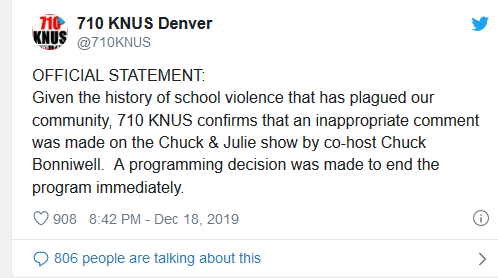
Chuck Bonniwell and Julie Hayden, a husband and wife team, co-hosted the “Chuck and Julie “show on KNUS AM TalkRadio in Denver. Riffing about the impeachment this week, Bonniwell said, “All right, here, a little after 1:30, talking about the never-ending impeachment of Donald Trump. Then he added, chuckling, ” You know, you wish for a nice school shooting to interrupt the impeachment news….” Julie quickly jumped in, saying, “No! No! Don’t even — don’t even say tha!. No, don’t even say that! Don’t call us. Chuck didn’t say that!”Still laughing, Bonniwell tried a save, finishing his handing sentence with “in which no one would be hurt.”
Jason Salzman of the Colorado Times Recorder, who said that after hearing Hayden’s plea for listeners not to call their complaints about her husband’s joke, he “called anyway.” Sandy Phillips, who lost her daughter in the Aurora theater shooting, posted on Twitter: “This guy should be fired. Total ignorance. Shootings hurt us all … just ask witnesses and first responders. You don’t have to be shot to be wounded.”
Bonniwell isued an apology the next evening after 24 hours of criticism on the “Chuck & Julie” Twitter feed, saying, “I made an inappropriate comment meant as a joke. I’m sorry it was not received that way.” Too late. KNUS fired Chuck and Julie later that evening:
Was this a fair decision?
I’m not sure it was. As I have held here on other occasions, those who take extemporaneously for a living, especially when they are expected to be amusing, are constantly walking a high wire. Occasional gaffes, including moments when certain metaphorical landmines are tread-upon or lines are crossed, are inevitable, and the more creative and bold the talent, the more likely such events are. A no-tolerance policy is unreasonable, and it is virtually always the ethical approach to treat the first such error with a warning or punishment short of dismissal. Virtually, because there may always be single gaffes that are so terrible and potentially destructive to the talent’s employer that firing is the only response.
Thus the question here is whether Chuck Bonniwell’s comment falls in the latter category. My view si that it does not:Continue reading →
Even the satisfaction of knowing that the President reads Ethics Alarms, or at least thinks like I do…wait, that came out wrong. Anyway, today I expect to be uncomfortable, hungry and distracted, so who knows what might appear here today?
You were warned.
1. The Ethics Quote of the Daycomes from ex-Marine and TV talk show host Montel Williams (who was very nice to me when I was on his show), on the “scandal” of some cadets flashing the dreaded “OK” sign during the Army-Navy Game:
“Both West Point and Annapolis are investigating, and it strikes me as defamatory that some in the media have branded these young people as racists without a shred of evidence. I understand that a handful of racists (perhaps living in their parents’ basements) attempted to co-opt the ‘OK’ sign as a symbol of white power … but that is not evidence that these kids were motivated by racial animus. We owe these young people, who had the courage to sign up to be part of the 1% who defend this democracy, better than this,”
I would say that we owe them better than even investigating such trivia. A ambiguous gestures are ambiguous, and no student, in a military academy or anywhere else should have to defend or explain them. The students are entitled to the benefit of the doubt. As with the “It’s OK to be White,” flyers, the rational, responsible approach by administrators is to ignore them, rather than to make a scandal out of nothing.
When will we see the first “It’s OK to make the OK sign” flyers? Heck, I may put some up myself…
2. Nah, there’s no progressive “war on Christmas,’ and there’s no mainstream media bias, either. And CNN’s Brian Stelter isn’t the most incompetent and absurd “media critic” since the term was coined! Imagine: Stelter asked on Twitter,
“Justice Neil Gorsuch is on “Fox & Friends” right now. The Q: How is it appropriate for a Supreme Court justice to try to goose sales of his three-month-old book by chatting on one of the most partisan shows on TV?”
More “Q’s”: Would it be appropriate for Gorsuch to chat on another network, like, say, CNN? Would “wtachdog” Stelter bitch about that? What does the level of partisanship of a show have to do with whether a Supreme Court Justice should appear there? Is there any rule or precedent holding that it is unethical for a sitting Justice to promote a book? (I’ll answer that one: no.)
Stelter’s whining wasn’t close to the most contrived objection to Gorsuch’s visit to the Fox and Friends couch, though. This was: Continue reading →
The issue of whether a mall should have fired a long-time Santa who posed for gag photo in a MAGA cap inevitably invited comparisons with the Naked Teacher Principle, which holds “that a secondary school teacher or administrator (or other role model for children) who allows pictures of himself or herself to be widely publicized, as on the web, showing the teacher naked or engaging in sexually provocative poses, cannot complain when he or she is dismissed by the school as a result.” There are many variations of the NTP, including the recently visited Naked Congresswoman Principle, which cost Rep. Katie Hill her seat.
The question: Is there, or should there be a “President Trump-supporting Santa Claus Principle?
“I think this one might fall into The Naked Teacher Principle.”
I think I can understand why you would say that, but I think there are a few problems with that assessment. I will try to explain:
First, a school teacher who engages in sexual misconduct, is transgressing in a limited area. Our social norms — though this is changing of course — does not allow teachers of children to appear to be loose sexually. Long ago, and more especially for women who were teachers — and mostly women were teachers — it was part of cultural norms that a teacher have a ‘chaste appearance’.
But in a sense there is no issue of ‘speech’ involved when and if a teacher posts a naked photo. That is, there is no ‘speech content’ or political opinion expressed. If there is a ‘speech’ issue it is only of a vary limited sort.
The Santa who had his photo taken with a Trump hat should never have had to apologize to anyone. He was completely free to take such a photo of himself. There is no possible argument that could be brought out in a so-called free society that could successfully take the man’s right away. Continue reading →
1. Lesson: Don’t underestimate the Duke! It looks like John Wayne is stronger than the cancel culture after all. Earlier this year the Woke Avengers tracked down an old Playboy interview where the actor made some inflammatory remarks about blacks and Native Americans (I thought then and I think now that the Duke was deliberately trolling his liberal critics, but it was still a bad interview.) Predictions were rife that the most enduring, influential and popular screen icon of all time had reached the end of his run. It doesn’t appear so: at least two cable channels are running John Wayne film marathons on or around Christmas.
2. The ethical response: feel compassion for Hillary. There are people who get run over and squashed by life, their own failings, and bad luck. We don’t have to like all of them, but the Golden Rule argues that we should feel some pity and compassion for them, even though many have brought some of their misery on themselves.
I think about this when I see, for example, Marcia Clark, the losing prosecutor in the O.J. Simpson case, and her desperately tucked and altered face as she transitioned into a B-media personality. The earliest example of this syndrome that I can remember noticing was perennial Republican Presidential candidate Harold Stassen, with his dazed expression and bad toupee, who once thought he was going to be President. Dubbed the “Boy Wonder,” Stassen was only 41 when he seemed to be on his way to winning the Republican nomination for President for the 1948 election in which President Harry Truman was widely regarded as both a lame and dead duck. Stassen lost the convention battle, however, to Thomas Dewey, of subsequent “Dewey Defeats Truman!” fame. After that, Stassen ran for President in 1952, 1964, 1968, 1980, 1984, 1988, and 1992 , gradually becoming a laughing stock. (He also ran unsucessfully for Governor of Minnesota, the United States Senate twice, Governor of Pennsylvania twice, Mayor of Philadelphia once; and U.S. Representative). I just thought he was a buffoon until my father told me about his many accomplishments before his dreams were crushed. He was one of the founders of the United Nations, for example.
As I made pretty clear in 2016, when I wrote almost as many critical posts about her and her generally awful ethics as I did about our current President when he was a candidate, I am not a fan of Hillary Clinton. I’ve continued to write critical commentary about her, because she continues to operate with wildly malfunctioning ethics alarms. She is stuck now, in Kübler-Ross terms, in the first three stages of grief: denial, pain and guilt, and anger and bargaining because she lost the election she was certain she was going to win. (So is the entire Democratic Party.)
Now look at her:
3. Marvin Miller makes it into the Hall of Fame. Yecchh. Marvin Miller was described in his obituary as “an economist and labor leader who became one of the most important figures in baseball history by building the major league players union into a force that revolutionized the game and ultimately transformed all of professional sports.” I have no quarrel with any of that. Miller was a labor activist who did his job extremely well. I would put him into a labor leader’s Hall of Fame—-I’m sure one would get at least a hundred or so visitors a year—without blinking. He no more belongs in the the Baseball Hall of Fame in Cooperstown, NY than I do, but he was posthumously elected to that Hall of Fame last week. Continue reading →
In Part I, I said I was glad that Clint Eastwood’s latest film “Richard Jewell” was bombing, because the film impugns the integrity of a now-deceased reporter simply to spice up its story. After I read some of Clint’s comments yesterday in response to the controversy, I’m even more glad. Clint said that nobody knows how reporter Kathy Scruggs got a crucial leak from the FBI, but that it could have occurred because she traded sex for information. That’s despicable.
Nevertheless, the other dud among the Hollywood releases over the weekend, “Black Christmas,” deserved to flop even more than Eastwood’s epic.
The original “Black Christmas” (1974) was released under the name “Silent Night, Evil Night.” I saw it with my sister a few days after its opening (I was amused at the ad’s catchline, “If this movie doesn’t make your skin crawl, IT’S ON TOO TIGHT!!!”) and it scared the bejesus out of both of us, but especially her: she slept with the light on for weeks, and to this day my uncanny imitations of the maniac’s phone calls upset her (so I keep doing them, of course.)
Arriving before John Carpenter’s “Halloween” and its later, cheesier rip-off “Friday the 13th,” what was soon re-titled “Black Christmas” anticipated many of the themes and techniques of the slasher genre, perhaps too well. Blessed with a much better cast than any subsequent movie of the type (Olivia Hussey, Keir Dullea, Andrea Martin, John Saxon, and Margot Kidder) and clever and gutsy director Bob Clark (“A Christmas Story,” “Porky’s”), the film was declared too disturbing by many critics. I thought it was easily the best horror movie I had ever seen, and recommended it to many friends, some of whom were not grateful after spending the following night jumping at every sound. It was very gratifying to see “Black Christmas” finally emerge as a cult film and the acknowledged inspiration for the slasher film genre (along with “Psycho,” of course.)
I saw the 2006 “sequel,” which was terrible, and had a sense of dread when I learned that Hollywood would try again. It was clear that the new film was already off to an unethical start when I saw the trailer: this was another example of producers hijacking a familiar title while making a movie barely connected to the older film it was evoking. That trick, essentially a bait and switch, always ticks me off. In the trailer for the new film, we could see that the killer wears a black robe and uses a longbow. Clark’s original famously never shows the maniac murderer at all: much of the movie is shot from his perspective (I assume it’s a he), though we see his shadow, one mad eye, and his arm at various times. We also hear him, and a more crazy-sounding killer has never been recorded.
The new “Black Christmas” takes place in a sorority house around Christmas, and there’s someone knocking off the girls. That’s about the extent of the similarity. To be fair, the advent of cell phones ruined the original film’s most iconic scare: it was the first movie in which we heard the chilling words, “The phone calls are coming from inside the house!”
The promotion of more female film directors is a feminist cause right now. There’s even a Christmas commercial where a little girl tells her parents who have just bought Disney princess toys to put under the tree for her, “I don’t want to be a princess any more. I want to be a film director!” I have always championed female directors for the stage; there is no question that there are multiple biases against them in theater, and I assume the same bias afflicts them in Hollywood. However, I do not want to see more female directors because they bring a special, feminine perspective to their work, and I really don’t want to see more female directors so they can use their plays and films as feminist propaganda vehicles. Just make a good movie, kid: if your work only stands for the proposition that women can’t just make entertaining and effective films, but have to clobber the audience with feminist tropes, you will have created a legitimate reason for the industry to be wary of female directors. Continue reading →
Oh, the world is your snowball, see how it grows That’s how it goes, whenever it snows The world is your snowball just for a song Get out and roll it along
1. That this kind of thing could happen at a major bank in 2019 is inexplicable and disgusting. Jimmy Kennedy, a nine-year NFL veteran, earned $13 million during his nine-year career and had been told that he would be accepted as a “private client” at JPMorgan Chase, an elite designation with perks like travel discounts, exclusive event invitations and better deals on loans. When he went to his local JPMorgan branch in Arizona to determine why he had not been accepted into the cataegory, he was told by his representative, who is black, “You’re bigger than the average person, period. And you’re also an African-American. We’re in Arizona. I don’t have to tell you about what the demographics are in Arizona. They don’t see people like you a lot.”
Kennedy recorded the conversation, and after pulling most of his money out of JPMorgan, complained to the bank as well as an industry watchdog agency. The bank sent him a letter saying, “You stated that Mr. Belton informed you that our firm was prejudiced against you and intimidated by you because of your race. We found no evidence to substantiate your allegations.”
He also sent the recording to the New York Times, which wrote about Kennedy’s experience. A few days later, Jamie Dimon, the chairman and chief executive of JPMorgan Chase, sent a memo telling employees that such behavior “does not reflect who we are as a company and how we serve our clients and communities every day.”
That’s the Pazuzu Excuse: “It wasn’t me!” Sorry, chief, but if you have employees treating African Americans like Kennedy was treated, that is who you are as a company, and as CEO, you’re responsible. Continue reading →
The two big flops among movies that opened last weekend were director Clint Eastwood’s “Richard Jewell” and “Black Christmas,” the second attempt to re-boot the 1976 slasher cult film. Both disasters have ethics lessons to teach, or not teach. Let’s look at Clint’s movie first.
“Richard Jewell” made lass that $4.5 million in its first weekend, and has also been snubbed by the various year-end awards. It is based on the now mostly forgotten story of how Jewell, initially hailed as a hero for his part in foiling the 1996 Atlanta Olympics bombing plot, was falsely accused of complicity by local law enforcement, the FBI, and the news media. Conservative outlets loved the film, but the other side of the divide focused on a subplot, as the film’s screenplay suggested that a named Atlanta Journal Constitution reporter, now deceased, used sex to persuade a source to break the story. The Journal Constitution has been attacking the film, denying that Kathy Scruggs would ever used he body to get a scoop. Her colleagues, friends and family all insist that she would not have slept with a source, and reporters around the country circled the metaphorical wagons to proclaim they were shocked–shocked!—that anyone would even suggest such a thing. Jeffrey Young, senior reporter for HuffPost tweeted, “The lazy, offensive, shitty way screenwriters so often treat female journalists infuriates me. Depicting women using sex to get stories is disgusting and disrespectful. It’s also hacky as hell. I was planning to see this movie but not anymore.’ Melissa Gomez of the Los Angeles Times wrote, “Hollywood has, for a long time, portrayed female journalists as sleeping with sources to do their job. It’s so deeply wrong, yet they continue to do it. Disappointing that they would apply this tired and sexist trope about Kathy Scruggs, a real reporter.’ Susan Fowler, an opinion editor at the New York Times tweeted “The whole “female journalist sleeps with a source for a scoop” trope doesn’t even make any sense…”
This would be damning, except that while it may not be standard practice, there are plenty of examples of female journalists doing exactly what Eastwood’s film suggests. Last year the Times—yes, Susan Fowler’s paper—reported on the three-year affair between Times reporter Ali Watkins and James Wolfe, senior aide to the Senate Intelligence Committee, and a regular source for her stories. In October, an employee of the United States Defense Intelligence Agency was arrested for leaking classified material to two reporters, and he was involved in a romantic relationship with one of them. Both reporters are still employed by their respective news organizations, the Times and CNBC, so its hard to argue that sex-for-scoops is being strongly discouraged.
Frank Skinner, who has played Santa Claus at a mall in Waycross, Georgia for 50 years, says he was nearing the end of a long shift with kids on on and off his knee and the mall was finally empty. For fun, he put on a MAGA cap as he sat in his Santa chair and took his own photo. Then he shared it for friends on his Facebook page.Predictably, some jerk sent it to the mall’s management with a complaint.To be clear, the picture didn’t show Santa reading Hustler, or feeling up a busty co-ed, or snorting coke. It showed him wearing the campaign cap of the President of the United States.
The mall responded, “We apologize for this occurrence and will be addressing this right away. The Mall at Waycross does not support any specific political party. Thank you for bringing this to our attention. Kindly, Mall Management.” Then the mall’s manager told reporters that the posing of the photo was “done completely without our knowledge” and added that “it’s safe to say he will not be wearing this hat around here. This particular Santa has been replaced.” Frank was fired.
Your Ethics Alarms Christmas seasonEthics Quiz of the Dayis…








A.M. Golden asks, in his Comment of the Day, “When did Americans start thinking that destroying someone and/or that person’s livelihood is acceptable behavior when it comes to a difference in opinion?” It is an issue also raised in the previous COTD, considering the mall Santa fired after someone complained about his Facebook post showing him as the Jolly Old Elf, but wearing a red MAGA cap. A.M. understands that this is not an idle question, but an important one that raises vital concerns about the erosion of core American values, the public’s belief in our founding documents, and the acceptance of the ethical standard of reciprocity.
Here is A.M.’s Comment of the Day on the post, “From The Ethicist: Revealing The Real Bigots Among Us.”