The Great “Les Miz” Bait-And-Switch

“Les Misérables,” the bloated faux opera based on the Victor Hugo novel, has been running continuously in London’s West End, the theater district, since December 1985.  It holds the Guinness World Record for the longest run of a musical in London. In the U.S., the musical held on for a somewhat less embarrassing  16 years, running from 1987 into  2003, closing after 6,680 performances.

It was always a cynical project, as so many Broadway musicals have become since the genre became a nostalgic invalid in the 1970s. The show itself is derivative crap, and obviously so to anyone who has a passing familiarity with its superior sources. The translated from French lyrics have the resonance of Hallmark cards; there literally isn’t a clever or memorable pack of words in the whole three hour extravaganza. What “Les Miz” has, or rather had, is spectacular stagecraft, thanks to the original staging by Trevor Nunn that mounted the series of scenes on a massive raked turntable that allowed quick transition and the illusion of excitement. The musical didn’t exactly disprove the old Broadway saw that “Nobody leaves the theater humming the scenery”—the TV ad jingle-like earworms in the score assured that—but it came close.

When I saw the touring company version of the show, I realized immediately that the production could never have a life in high school, college, community theater or even in regional professional theaters, because the turntable, and the special effects it permitted, were essential to the production. Not only are stage turntables extremely expensive, they are notoriously risky, since a mechanical breakdown means the performance must be cancelled. Sure enough, after the Broadway production closed in 2003, there were no productions of the show other than the three professional touring companies owned by the Broadway producers. Then the show’s owner had an idea: let’s see if we can eliminate the turntable and get away with it! Continue reading →

Ethics Observation On The Tempe, Arizona Starbucks Incident

Ethics Alarms does not endorse any organized boycott efforts against any product, business or organization. However, if any corporation is begging to be boycotted, it’s Starbucks…

In case you missed it:

On July 4th, six Tempe, Arizona police officers visited a local Starbucks to get some coffee. The officers paid for their beverages and stood together, sipping coffee and chatting. A barista approached one of the officers, whom she apparently knew by name because he is was a frequent customer, and informed him that a customer  currently in the store “did not feel safe” because of the police presence. She asked the officers to move out of the customer’s line of sight (!) or to leave entirely.

The officers  left, but apparently reported the incident to the Tempe Officers Association, which described the incident on Facebook and added,

This treatment of public safety workers could not be more disheartening. While the barista was polite, making such a request at all was offensive. Unfortunately, such treatment has become all too common in 2019. We know this is not a national policy at Starbucks Corporate and we look forward to working collaboratively with them on this important dialogue.

The Tempe Police put out their own statement:

Starbucks, proving at least that it has not completely lost its mind, quickly apologized to the  Department, with a representative meeting with the police chief.  The statement:

“When those officers entered the store and a customer raised a concern over their presence, they should have been welcomed and treated with dignity and the utmost respect by our partners (employees). Instead, they were made to feel unwelcome and disrespected, which is completely unacceptable,”

Observations: Continue reading →

From The Ethics Alarms “Awwww!” Files: The Happy Shoplifter

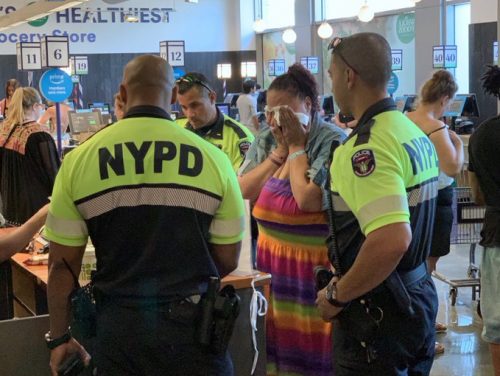
At a Whole Foods in New York City,  a woman attempted to steal some food and was detained by supermarket security officers. Three police officers on the scene, however, chipped in and paid for the food she had been seen slipping into her shopping bag.

Naturally the heartwarming scene was  captured in a photo, showing the woman’s tears of gratitude. Their deed, as well as the woman breaking into tears, was captured in a photo that was shot by a customer who described himself as heartened by the unexpected gesture. “It was a nice moment for, you know, people, it was compassionate and the woman obviously was really grateful,” the amateur photographer said.

The police department approves, I guess.  NYPD Chief Terence Monahan tweeted, “Cops like Lt. Sojo and Officers Cuevas and Rivera of the Strategic Response Group are the kind-hearted cops who quietly do good deeds for New Yorkers in need.”

Is this the new department policy then? When officers decide that a thief is in genuine need, they will now pay for the merchandise stolen? I may have rolled out of bed bitter and jaded, but this seems like the “Awww!” Factor, where sentimentally appealing conduct is mistaken for ethical conduct. From the Ethics Alarms glossary: Continue reading →

Prison Labor Ethics

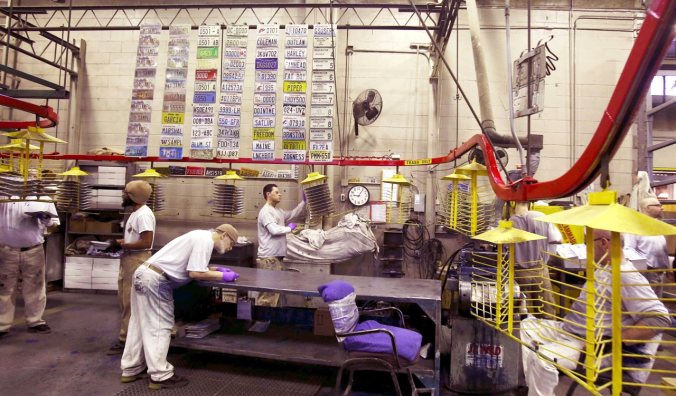
Prison labor is an ethics issue that I have never considered before. Apparently that’s true of a lot of people. In Massachusetts, an Amherst-Pelham Regional High School  student named Spencer Cliche (great name!) was challenged to undertake an investigative journalism project, He eventually published a 3,000-word exposé  on prison labor topic in his school’s newspaper.

The high school, it seems, had contracted with a local prison to re-upholster its auditorium seats,  taking its low bid for the job over another bid by a local business. As a result of the uproar sparked by Spencer’s work, the school superintendent issued a statement to school staff members promising never to contract with the prison again.

It does not appear, however, that this decision was based on  careful balancing of the ethics issues involved, but rather, as usual, a lazy capitulation to avoid an emotion-based controversy.

The local  newspaper, The Daily Hampshire Gazette, eventually picked up the story. as did a local radio station that featured Cliche’s report as the “question of the morning.” Then the issue was raised by The Marshall Project, a prison and justice system reform project.

In addition to routine prison labor, which is usually handled in a prison facility, there are also state-run “correctional industries,” such as MassCor, which arranges for inmates to do work for  schools, nursing homes, towns, non-profits and other institutions. Obviously, their costs are lower than competing businesses, because prisoners earn less than a dollar an hour on average for their labor, according to Prison Policy Initiative.

Thus we have multiple looming ethics issues, among them…

  • Is it ethical to force prisoners to work at all?

I don’t see how an honest argument can be formulated that argues that it is not. Work organizes the time and attention of the jailed, keeps them occupied, minimizes boredom and the opportunity to get into trouble. Social justice advocates seem to think that prisons should be like summer camps, with sports, crafts, and other pleasant diversions. That approach is both expensive and undeserved. Prison, among other things, is and ought to be punishment.

  • Is it ethical to pay prisoners less than the minimum wage? Isn’t forced labor with no compensation or minimal compensation virtual slavery?

Convicted prisoners forfeit most of their constitutional rights. Some forms of forced labor might rise to the level of cruel and unusual punishment, and prison labor is ripe for abuse (just ask Andy Dufresne, the protagonist of “The Shawhsank Redemption”), but criminals are a burden on society, and warehousing them is expensive. There is nothing unethical about requiring those who have imposed that burden to help alleviate it.

  • Are prison-based businesses like MassCor unethical?

 Cara Savelli, a spokeswoman for the Massachusetts Department of Correction interviewed by the student journalist, defended the program, saying,

Continue reading →

Morning Ethics Warm-Up, 7/2/2019: Monkeys, Howlies, Nikes, And The Great Tag Hoax

Gooooood Morning!

1. Talk about a newspaper column that is exactly the opposite of the truth! The Times had an essay in its “Review” section this Sunday with a title that gave me a shock: “Want to Be Less Racist? Move to Hawaii”

The headline would have been more accurate if it read, “Want to live in the only state with lawful and open racial discrimination? Move to Hawaii!” Hawaii gives special benefits to residents with full or partial Native Hawaiian ancestry. There is a special  Hawaiian registry program which verifies an individual’s Native Hawaiian ancestry, so the favored race can receive such goodies that are unavailable to other racial groups as buying land for a home at only $1 a year,  low-interest loans, and admission for their children to the elite Kamehameha Schools.

Anecdotally, I can also state that the only time in my life that I felt I was the target of racial epithets was in college, when the Hawaiian contingent frequently derided me and my white room mates as “howlies,” a disparaging Island term reserved for anyone who is not a native Hawaiian. I will always remember my 6’5″ roommate Dave ending the practice by saying to the two main offenders, “If I ever hear that word from any of you again, I promise that I will shove you, Howie, directly up Reggie’s ass, head first.  Are we clear on that?”

Dave never bluffed, and seldom joked. That was the last time we were called “howlies.”

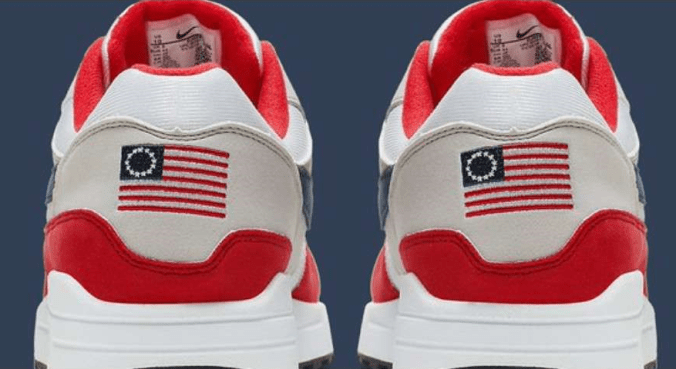
2. Nike is not just scum, but cowardly, sniveling scum. Nike Inc. cancelled a U.S.A.-themed sneaker featuring the Betsy Ross American flag because Head NFL Kneeler Colin Kaepernick, a Nike endorser, told company officials that he and others felt that the  historic flag is an offensive symbol because of its connection to an era of slavery.

The Air Max 1 USA had been designed for release in celebration of the July Fourth holiday, and scheduled to go on sale this week. The heel of the shoe featured a U.S. flag with 13 white stars in a circle, the original flag created during the American Revolution and known as the Betsy Ross flag.

Wow! How racist can you get!

Continue reading →

Sunday Ethics Warm-Up, 6/30/2019: Post Rugby Edition

This just has to be a better day than yesterday.

And I’m not even referring to the Yankees beating the Red Sox 17-13 in the first MLB game ever played in Europe.

Also, much thanks to the many readers who sent their condolences to me and my family. It helped.

1. Keepin’ a-goin’!  Believe it or not,  having to say farewell to our sweet, vocal and witty Jack Russell terrier  was not necessarily the worst part of our Saturday. This makes today another ethics challenge, that being the theme of the intentionally simple-minded poem used by comic actor Henry Gibson on “Laugh-In,” “The Dick Van Dyke Show,” and later as a country music song in Robert Altman’s “Nashville.”

The ditty was “Keep A-Goin,” and Gibson, unethically, left the impression that he had written it. He hadn’t: the poem was written Frank Lebby Stanton (1857-1927), now forgotten, and Henry (who died  in 2009) bears some of the responsibility for that, though the poem was ripe for stealing since the copyright expired long ago.. The “Nashville” credits claim Gibson was the author of the song. Wrong. Here it is:

Ef you strike a thorn or rose,
    Keep a-goin’!
  Ef it hails, or ef it snows,
    Keep a-goin!
  ‘Taint no use to sit an’ whine,
  When the fish ain’t on yer line;
  Bait yer hook an’ keep a-tryin’—
    Keep a-goin’!

  When the weather kills yer crop,
    Keep a-goin’!
  When you tumble from the top,
    Keep a-goin’!
  S’pose you’re out of every dime,
  Bein’ so ain’t any crime;
  Tell the world you’re feelin’ prime—
    Keep a-goin’!

  When it looks like all is up,
    Keep a-goin’!
  Drain the sweetness from the cup,
    Keep a-goin’!
  See the wild birds on the wing,
  Hear the bells that sweetly ring,
  When you feel like sighin’ sing—
    Keep a-goin’!

Since around 4:30 pm yesterday, I have felt like doing absolutely nothing other than grieving and helping the rest of my family deal with the sadness that engulfs us. But, as another poet memorably said, I have promises to keep, and miles to go before I sleep.

So do we all. Continue reading →

“Reputation Laundering” And The Dirty Money Fallacy

Meharry Medical College is a 143-year-old historically black institution in Tennessee. Last week it announced that it had received the second-largest grant in its history, a $7.5 million gift to study public health issues that affect African-Americans.

But the gift has prompted attacks from African-American health experts and activists. The source of the funds, Juul Labs, is the fast-growing e-cigarette company and partially owned by the tobacco giant Altria. “Juul is cozying up to the black community, and that makes it harder for some parts of the black community to call them out on their targeting of African-Americans,” says Sharon Y. Eubanks, who is an advisory board member of the Center for Tobacco Control Research and Education at the University of California. By “targeting African-Americans”, she means that the company and Altria market its completely legal products to blacks (among other groups), who choose to buy them. [Full disclosure: I worked as an ethics consultant for Altria for many years, and enjoyed the relationship tremendously. Altria was the reason I shaved my head.]

According to the NAACP’s Youth Against Menthol campaign, about 85 percent of African-American smokers aged 12 and older smoke menthol cigarettes, compared with 29 percent of white smokers, and Juul markets menthol pods while Altria markets menthol versions of its cigarettes, like Marboro.  And how, exactly, is the African -American community helped if Meharry,  the nation’s largest medical research center at a historically black institution, refuses the Juul grant to demonstrate, well, something?

You got me. This, however, is part of a growing fad among the virtuous and the “woke”—refusing to allow organizations, entities and families that they have decided are bad from using  alleged ill-gotten gains to do good. Continue reading →

Perhaps Hollywood Was Just Virtue Signaling And Grandstanding On The “Inclusion Rider.” If So, Good.

Apparently there is some disappointment among social justice warriors that the much ballyhooed “inclusion rider,” promoted by actress Frances McDormand in her 2018 Oscar acceptance speech, has not taken the city by storm despite abundant lip service from the Tinsel Town “woke.”  What a surprise: a business that either thrives or falls on the quality and popularity of its product chooses to make artistic decisions based on talent and merit rather than tribal quotas.

The “inclusion rider,” in its most literal form, is essentially a pledge to engage in discrimination, and to subjugate the purpose of art to “diversity” goals. All one has to do is observe the practices of “inclusion” advocates like Ava DuVernay,  currently embroiled in controversy over her racially slanted portrayal  of the Central Park Five story in her series, “When They See Us. She has vowed to hire only female directors for her series “Queen Sugar.” And how is refusing to hire an entire gender for a project “inclusion”? Well, one has to comprehend the tortured logic of the Diversity Nazis to answer that question. Continue reading →

Walmart And The Unethical “Mission Impossible” Instruction.

From the New York Times:

For more than a decade, Walmart used middlemen to make dubious payments to governments around the globe in order to open new locations, United States prosecutors and securities regulators said in a settlement agreement on Thursday. But even as employees frequently raised alarm, the company’s top leaders did little to prevent Walmart from being involved in bribery and corruption schemes.

That lack of internal control led to a seven-year inquiry that culminated on Thursday with Walmart’s Brazilian subsidiary pleading guilty to a federal crime. The guilty plea, and the $282 million in fines that Walmart has agreed to pay, capped one of the biggest investigations ever under the Foreign Corrupt Practices Act, which makes it illegal for American corporations to bribe overseas officials.

“Walmart profited from rapid international expansion, but in doing so chose not to take necessary steps to avoid corruption,” Brian A. Benczkowski, an assistant attorney general, said in a statement.The investigation, which was conducted by the Department of Justice and the Securities and Exchange Commission, came after The New York Times revealed in 2012 that Walmart had made suspicious payments to officials in Mexico and then tried to conceal them from top executives at the company’s headquarters in Bentonville, Ark. And even when the issues reached the main office, an internal investigation essentially went nowhere.

The remarkable story of how the road to Walmart’s international expansion was paved by bribes is fascinating, and perhaps especially so to me, as I have long identified and inveiged against the coercive and unethical technique among businesses, governments and law firms that I call the “Mission Impossible Directive.” You recall the way “Jim Phelps” (and before him, “Dan Briggs”) got his marching orders for his Impossible Missions Force, don’t you? Continue reading →

Unethical Pet Product Of The Year: The Canine Onesie

No, this isn’t a gag. I wish it were.

As frequent visitors here know, my family is very fond of dogs, both ours and everyone elses. One disturbing reality of the dog-owning world is how many people acquire dogs who don’t really understand anything about them, or, in many cases, even like them. The degree to which this manifests itself ranges from outright dog abuse, which is incomprehensible to me; neglect, which is cruel and irresponsible even when it is the result of financial problems or stupidity to lack of compassion and respect. In this category are those who buy dogs as fashion statements or home accessories, seldom paying sufficient attention to them or giving them the affection they want and need. The group also includes the Dog Dictator, who only will tolerate a pet that  will do tricks, come, stay, and lie down on command, but that will never be allowed to act like a dog. [Full disclosure: Our current dog and our previous one represent Jack Russell Terriers, which are going to act like not only dogs but a terrifyingly wilful, witty and sometimes diabolical dogs no matter what you do.] Continue reading →