Of Course Bishop Tutu Deserves Statues…Then Use The Same Standard To Get Our Toppled Statues Back Up

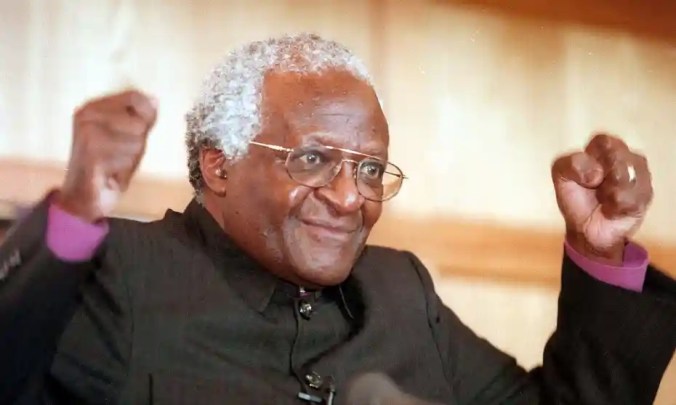
Wow. Here I was expecting to be reading nasty post-mortems on the despicable Harry Reid before his corpse was cold, and instead a wave of negative punditry appeared about, of all people, revered Desmond Tutu, whose body is only slightly cooler. The controversy? Nobody doubts that he played a major role in ridding South Africa of apartheid. In 1984, he was awarded the Nobel Peace Prize (whatever that’s worth). However, as the Times of Israel sees it, “underneath the godlike humble appearance was an insidious anti-Semite and anti-Israel vein that throbbed and surfaced in writings, public speaking, and conversation.”

In the U.S., the opposition to honoring Tutu was joined by lawyer and Harvard law professor Alan Dershowitz, who told Fox News that by the standards the U.S. was now holding its metallic and rock honorees to, Tutu is unworthy. He said on the air,

The world is mourning Bishop Tutu, who just died the other day. Can I remind the world that although he did some good things, a lot of good things on apartheid, the man was a rampant anti-Semite and bigot?…When we’re tearing down statues of Jefferson and Lincoln and Washington, let’s not build statues to a deeply, deeply flawed man like Bishop Tutu. Let’s make sure that history remembers both the goods he did and the awful, awful bads that he did as well….He didn’t talk about the Israel lobby, he talked about the Jewish lobby. He minimized the suffering of Jews during the Holocaust. He said that getting killed in gas chambers was an easy death compared to apartheid. He said that Jews claimed a monopoly on the Holocaust. He demanded that Jews forgive the Nazis for killing them…[Tutu] encouraged others to have similar views and because he was so influential, he became the most influential anti-Semite of our time…The bottom line is that at a time when people are reckoning with the careers, of people with mixed legacies, whether it be Thomas Jefferson, Abraham Lincoln, George Washington, and others, we have to include in a reckoning of Tutu his evil, bigotry against Jews, which has existed for many, many, many years.

I don’t care to dispute the fairness or accuracy of the case that Tutu was an anti-Semite. His worshipers are already doing that; I note that Wikipedia, which, like every other information source today, just can’t play it straight, shaded its article about Tutu this week to note his support for the Palestinians while adding that he professed a “simultaneous belief in Israel’s right to exist.” (The two positions are impossible to hold “simultaneously.”) It doesn’t matter; for the purposes of the ethical analysis, I will accept that Tutu was as much of an anti-Semite as Dershowitz says. Continue reading

Ethics Hero: Sixth Grader Davyon Johnson

This story out of Muskeegee County, Oklahoma, seems too good to be true. I hope it is true. It is a measure of how much distrust the news media has engendered that such a story is impossible to accept without doubt today. Here, however, is the story we are being told.

Davyon Johnson, 11 years-old, was near the water fountain at his school on December 9 when he heard a seventh-grade boy gasp, “I’m choking! I’m choking!” The kid had used his mouth to open a water bottle and the cap had popped down his throat.  Davyon, who had learned  the Heimlich maneuver off of YouTube (his uncle is an emergency med tech, which Dayvon says he also aspires to be), began applying it to the older boy. On the third squeeze to the boy’s abdomen, the cap flew out.

Later that evening, when his mother was driving with Davyon on the way to an evening church service, the car passed a house that had some smoke billowing out of it. Ms. Johnson says that Davyon persuaded her to turn the vehicle around and check. They saw small fire near the back of the house, and cars outside that indicated that there might be people in the house who may not have been aware of the fire. Davyon’s mom honked her horn and called 911. Davyon got out of the car and knocked on the door.

Five people in the house stepped outside; they had not been aware of the fire. They ran, leaving an elderly woman with a walker struggling to leave the burning home on her own. (Nice.)  Davyon helped her along and led her to the truck that the rest had climbed into.

When he was 8 years old, Davyon said later, he watched his father enter a burning apartment complex to make sure everyone was safe.  Davyon’s father  died last summer.

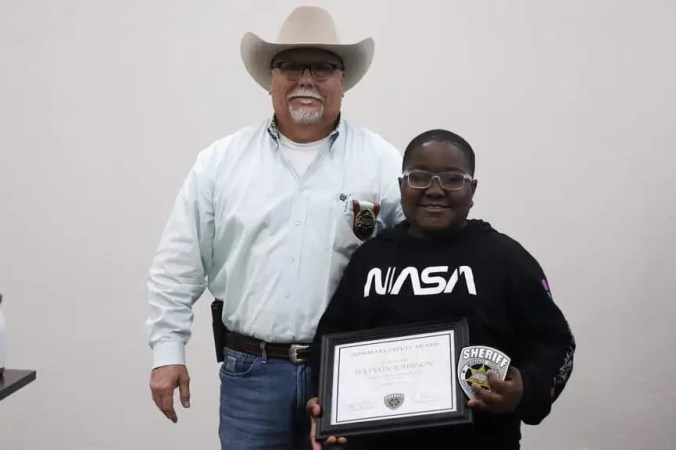
The Muskogee Police Department and Muskogee County Sheriff’s Office presented Davyon with a certificate on December 15 in recognition of his big day of community service. According to media accounts, the boy claims to not understand why everyone is making such a big deal over him doing what he calls “the right thing.” ‘I don’t want everyone to pay attention to me. I kind of did what I was supposed to do,” he was quoted as telling a teacher.

Here’s the kicker, which depending on how cynical you have become, will either get you choked up or make you thing, “Oh, come on!” The New York Times reports that Davyon doesn’t tell people about his recent burst of heroism unless he’s asked, and even then relates a simple, straightforward account.

“But there was one person he did want to tell,” says the Times. “One morning this month, he put on his sneakers and gray hoodie and went to the cemetery to see his father. He squatted, picked at the dirt and started to tell the stories, beginning with the scene at the water fountain.”

Luckily, a newspaper photographer just happened to be passing by…

__________________________

Source: New York Times

H Jackson Browne And “Life’s Little Instruction Book”

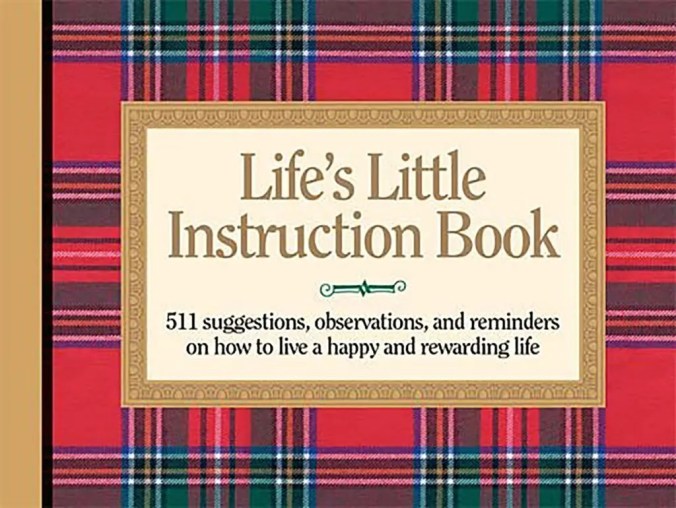
In 1991, H. Jackson Brown Jr. hit the best seller lists with a humble tome called “Life’s Little Instruction Book.” It consisted of 511 pieces of advice, common sense, traditional wisdom and best practices in life, adapted from a hand-written 32 page guide he handed to his son when he went off to college. “This is what your dad knows about living a rewarding life,” Brown told his son. He had tried his hand at authorship with two earlier books of fatherly advice, but decided that his latest approach had more promise.

It sure did. Re-tooled and expanded into “Life’s Little Instruction Book,” it was a bestseller for years, much imitated, and a contribution both to Brown’s fame and financial well-being and the nation’s healthy ethics alarms. By 1997, the book had sold about seven million copies, and it was translated into 33 languages

The book is all about ethics, though not explicitly. Even the corniest of the entries are based in ethical principles. “Resist the temptation” just means to keep your ethics alarms functioning and not let them be silenced by non-ethical considerations. #34, “At meetings, resist turning around to see who has just arrived late,” is a Golden Rule application; #22, “Learn three clean jokes,”is a subtle way to remind us to not allow incivility to become a habit.  “Avoid sarcastic remarks,” # 81, is no more than a caution against being a habitual jerk. #89, “Don’t let anyone ever see you tipsy” is a call for dignity and decorum. #254, “Learn to show cheerfulness, even when you don’t feel like it,” is a reminder that being a responsible member of society means not allowing your own feelings to undermine your group’s spirit. “Overtip breakfast waitresses”  was #7, a call for generosity and gratitude. #144, much ridiculed at the time, is “Take someone bowling.” It just means be kind, and to reach out to someone who might be lonely.

Ethics is never considered cool, and efforts to encourage good behavior is typically mocked. Journalists and critics mostly ridiculed “Life’s Little Instruction Book” as collection of naive nostrums unrelated to the real world. Pittsburgh Post-Gazette columnist Brian O’Neill wrote, in a typical reaction, that the book was “designed to teach nothing but how to part with $5.95.”

In truth, what Brown’s book most resembled was  “110 Rules of  Civility & Decent Behavior in Company and Conversation,” which our first President was forced to commit to memory by his father. Those rules served George well, and had a major impact on the degree to which he was trusted by the infamously competitive and back-stabbing Founders. Pretty much all of George’s guidelines turn up in various forms in the “Instruction Book;” I have often wondered if Brown ever read them. His book also has one advantage over the “110 Rules”: it isn’t interrupted with archaic howlers like George’s #13:

 Kill no vermin, or fleas, lice, ticks, etc. in the sight of others; if you see any filth or thick spittle put your foot dexterously upon it; if it be upon the clothes of your companions, put it off privately, and if it be upon your own clothes, return thanks to him who puts it off.

Continue reading

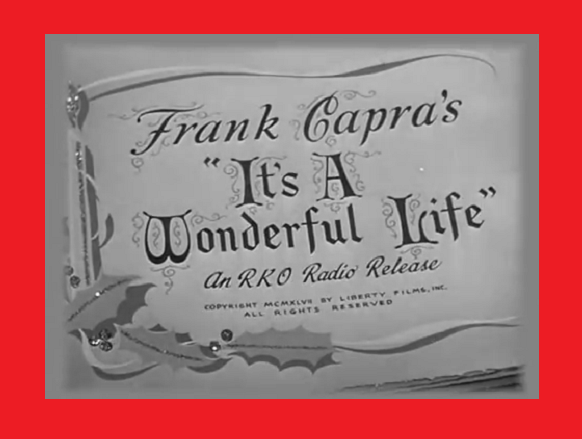
The Ethics Alarms 2021 Christmas Eve Edition Of The Complete “It’s A Wonderful Life” Ethics Guide!

Wonderful Life2

2021 Introduction

I haven’t seen the film yet this holiday season, but I did listen to the radio version, also starring James Stewart and Donna Reed last night. It’s not much of a substitute. As it was with last year, this movie’s intended message needs to be considered and taken to heart in 2021. Frank Capra, the movie’s director ,designed the film to explain why it’s a wonderful country we live in. It may be that more and more vocal and powerful people want to send the opposite message today than ever before.

The fascinating and moving documentary “Five Came Back” (on Netflix) has been shown several times in the Marshall house this year. It tells the story of how five of Hollywood’s greatest directors, William Wyler, George Stevens, John Ford, John Huston and Frank Capra were recruited by the Pentagon to document World War II, some of their efforts to be used as propaganda, some as a record of remarkable time. All five directors were profoundly changed by what they saw, and Capra was no exception. He went into the war as perhaps America’s most popular film director, creator of upbeat movies celebrating common Americans doing extraordinary things, the nation’s families, the power of love and American exceptionalism. They called his movies “Capra Corn,” and the description fit such classics as “Mr. Smith Goes To Washington,” “Meet John Doe,” and other critical and box office hits. Following World War II and his experience overseas, Capra no longer felt as upbeat about life and human nature, though he remained a passionate patriot. Like the returning soldiers found the culture changed and his emotions raw. Families whose loved one had died or returned with disabling wounds struggled to believe that their sacrifices were justified. The atom bombs that ended the war also opened up a dangerous new era of paranoia and fear.

Capra and his director compatriots in the war effort decided to start a new production company, driven by directors rather than soulless studio moguls.  “It’s A Wonderful Life,” a far more complex and often dark story than the pre-war Capra creations, was chosen to be the first project of the new Liberty Pictures. Based on an idea by author Philip Van Doren Stern, it was the story of a good man who becomes bitter and disillusioned when his plans and aspirations become derailed by the random surprises of life.  Unable to get his short story published, Stern had sent it to friends as a 21-page Christmas card. Film producer David Hempstead read it, and bought the movie rights for Capra’s company. The story was just what America needed, Capra reasoned, to restore its belief that what the nation had accomplished was worth the pain, loss and sacrifice, and that the nation itself had led a “wonderful life” despite many mistakes and missteps. The new film could restore the nation’s flagging optimism, pride and hope.

Capra immediately thought of actor and now war hero James Stewart to play protagonist George Bailey. Three years of flying bombing raids against the Nazis in the US Air Force had left the the 37-year-old suffering from post traumatic stress syndrome, and like his non-celebrity comrades in arms, Stewart returned home in 1945 to find that everything had changed: his contract with MGM had run out, his agent had retired, and other stars had taken his place. Stewart signed on with the ambitious project, hoping neither of them lost their  touch.

As production proceeded in 1946, the cast and crew felt they were making an important movie. Bedford Falls became one of the largest American film sets ever created to that point at four acres, with 75 fake stores and buildings, a three-block main street, and 20 full-grown oak trees. To avoid the traditional problem of fake-looking snow, the special effects department invented a new and more realistic process. (I wish it was used more often: fake snow drives me crazy in movies.)

Stewart, who was still suffering from the effects of the war and at times was close to quitting. In the scene where George, in a roadside bar, desperate and defeated, is praying to a God he doesn’t believe in. He rubs a trembling hand against his mouth, and starts to cry. The gesture wasn’t in the script, or requested by Capra. It was real.

Stewart explained years later,

“I felt the loneliness, the hopelessness of people who had nowhere to turn, and my eyes filled with tears. I broke down sobbing. That was not planned at all.”

Stewart felt George Bailey was his career’s best performance (it is) and Capra believed he had made his best film. “I thought it was the greatest film I ever made,” he said later. “Better yet, I thought it was the greatest film anybody ever made.”

It may be, but it started out as a catastrophic flop. The movie lost money and its failure killed Capra’s production company. His directing career never recovered, and what he believed was his greatest work was forgotten for decades. Republic Pictures, which owned the film’s copyright, didn’t bother to renew the rights in 1974. It was essentially free to local television channels, and they began showing it constantly.

Quality and genius have a way of defeating critics. Capra was right, Stewart was right, the cast and crew were right. It is a classic; more than that, it is a movie that can change lives. The story accomplishes just what Capra intended it to accomplish. In a New York Times piece about the movie by a self-professed cynic, Wendell Jamieson wrote about seeing the movie for the first time as teen in a classroom showing, and confessed,

It’s something I felt while watching the film all those years ago, but was too embarrassed to reveal….That last scene, when Harry comes back from the war and says, “To my big brother, George, the richest man in town”? Well, as I sat in that classroom, despite the dreary view of the parking lot; despite the moronic Uncle Billy; despite the too-perfect wife, Mary; and all of George’s lost opportunities, I felt a tingling chill around my neck and behind my ears. Fifteen years old and imagining myself an angry young man, I got all choked up. And I still do.

Yeah, me too. But the reason isn’t that its a manipulative, sentimental ending, though that was what contemporary critics complained about. The reason is that Harry’s toast states a life truth that too many of us go through our own lives missing. What makes our lives successful (or not), and what makes makes our existence meaningful is not how much money we accumulate, or how much power we wield, or how famous we are. What matters is how we affect the lives of those who share our lives, and whether we leave our neighborhood, communities, associations and nation better or worse than it would have been “if we had never been born.”

It’s a tough lesson, and some of us, perhaps most, never learn it. “It’s A Wonderful Life,” though it shows how one man finally got  the message using Heaven, alternate reality, angels and fantasy to do articulate it, can be a powerful ethics tool.

1. “If It’s About Ethics, God Must Be Involved”

Continue reading

Needed: A Civil Substitute For “Oh, Bullshit!” To Describe Kamala Harris’s Excuses

I know Ethics Alarms has covered this before ( like yesterday’s compendium, #4), but it’s “Popeye” territory: there’s only so much I can stand. Or “stands.”

Several sources are quoting (Ugh! Yecchh! Ptui!) Hillary Clinton’s assertion that poor Kamala Harris is being unfairly criticized because of her gender. You know, like Hillary was. ( I actually typed that without breaking up laughing. It’s a Christmas miracle!) The losing Presidential candidate responsible for the most incompetent campaign in U.S. political history said,

“There is a double standard; it’s sadly alive and well,” Clinton told the newspaper. “A lot of what is being used to judge her, just like it was to judge me, or the women who ran in 2020, or everybody else, is really colored by that.”

Harris, meanwhile, has been reportedly whining to staff and confidantes about how none of the previous 48 Vice-Presidents were covered as negatively as she, nor so insulted by critics. So now we know that on top of her other throbbing deficiencies, Kamala Harris don’t know much about history, to quote Sam Cooke. Continue reading

Hillary’s Unethical Lawyer Has An Unethical Plan To Keep The House Democratic

Machiavelli

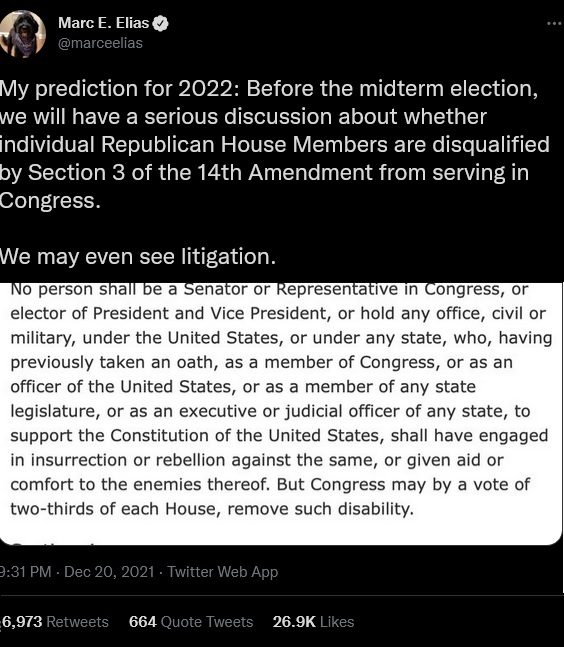
It is increasingly looking like Marc Elias, the chief lawyer architect of the Hillary Clinton campaign’s efforts to manufacture baseless suspicion that Donald Trump and his campaign “colluded” with the Russians to tilt the 2016 election, may face legal and ethical consequences for his role. We shall see: the investigation’s results are still being analyzed. Meanwhile, Elias is unrepentant and still devising ways to assist his favorite political party ( he has been often called the most prominent Democratic attorney in America ) with strategies for which “dubious” is a compliment.

Behold this tweet by Elias from this week:

Elias tweet

Continue reading

Rationalizer Of The Year: Drunk Driver Perla Aguilar

(I was hoping to get Sidney Wang out one more time before New Years…)

Perla Aguilar, 27, was arrested for DUI in Oklahoma, and had an excuse she apparently thought would clear everything up. Slurring her words as she spoke, Perla explained to the arresting officers that she should be in the clear because she “does this all the time.”

Continue reading

From The Signature Significance Files: “The Divine Miss M” Demonstrates When An Apology Is Too Late And Meaningless

Another thing everyone should thank Joe Manchin for is the way his decision not to capitulate to pressure on the irresponsible “Build Back Better” bill has caused so many prominent Americans to unmask themselves as the jerks, liars and frauds thet are.

Take Paul Krugman...please! The ultra-biased and partisan Times pundit is supposedly a Nobel Prize-winning economist, yet his attack on Manchin’s “betrayal“—yes, a Democrat voting his conscience rather than meekly submitting to orders is a betrayal—is an embarrassing concoction of appeals to emotion, appeals to authority, and “everybody does it.” A high school paper columnist could have written the screed. “And studies show that policies to mitigate climate change will also yield major health benefits from cleaner air over the next decade,” Krugman writes. Yes, and other studies say they might, and still other studies doubt they can.

This economist also calls the multi-trillion dollar bill “Biden’s moderate spending plan,” though the CBO estimates that enacting this legislation would result in a net increase in the deficit of at least $367 billion over the 2022-2031 period, and that’s with increased taxes. He should be ashamed of himself for abusing his own perceived authority and his readers’ trust with such garbage, but we know my now that he’s shameless.

But my favorite self-indicting jerk is Bette Midler.

Continue reading

Anti-Weenie Of The Year: Sen. Joe Manchin (D-WV.)

no weenies

In a year scarred by so many individuals, from celebrities to academics to mere social media users, resorting to pathetic groveling in response to bullying and threats of repercussions for rightful conduct or simply stating an opinion that does not conform to Woke World cant, Sen. Joe Manchin’s refusal to be a weenie stands out like the shining city on the hill. And after several frustrating days in which I have been searching my data banks to find ten public figures I could justifiably say I admired, Senator Manchin has made the list. (I’m still three short.)

Continue reading

Proposition: A Refusal To Answer A Direct And Relevant Question Like This Should Immediately Disqualify A Judicial Nominee As Untrustworthy

Judicial nominee ducks

Anne Traum, a law professor at the University of Nevada-Las Vegas, was nominated by President Joe Biden in November  to be the United States District Judge for the District of Nevada. Traum’s name was selected by a judicial commission in Nevada consisting of Democratic State Senators Catherine Cortez Masto and Jacky Rosen. During last week’s U.S. Senate Judiciary Committee hearing, Republican Louisiana Senator John Kennedy, asked Traum, “Do you think we should forgive criminal misbehavior in the name of social justice?”

Prof. Traum replied, “Senator, thank you for that question. I recognize that all issues of crime and all responses to crime are fundamentally policy issues. So, those are important issues, they are important for our community and our nation, but I leave those policy issues to the policymakers if confirmed as a judge I would not be a policy maker.”

That does not respond to the question, and Kennedy was not satisfied. He asked again, after prefacing his second framing by saying,  “I’m not asking your opinion as a judge. I’m asking your opinion as a person, as a law professor. I’ll stipulate, with all of you, that you’re all going to be fair and unbiased.” Then he repeated,  “Do you think misbehavior and illegal acts should be forgiven in the name of social justice?” Continue reading