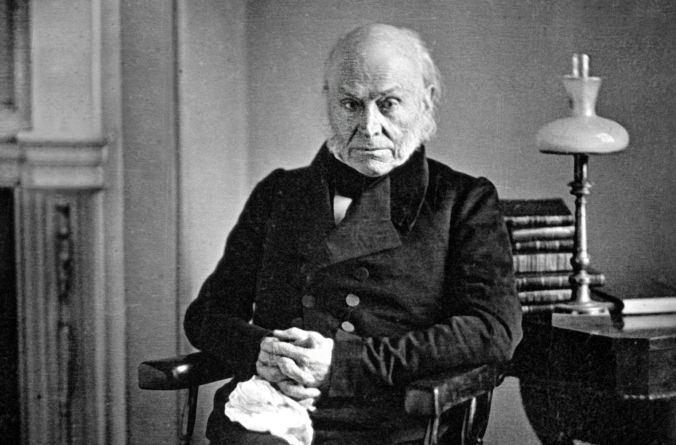
I bet Michael, when he submitted this Comment of the Day, had a feeling I’d groove on it. After all, it’s about a President, I’m a Presidents nut, and he ends up agreeing with me, which is always welcome.
He also raises and interesting question that was not considered in the post. If we judged Presidents on a racism scale that weighted their attitudes according to how they compared to the culture and predominant beliefs of the day, which Presidents would come out looking best? That’s how baseball stat analysts judge players across eras, and it makes sense: players are compared to league averages while they were playing, and then the stats are adjusted accordingly. For example, Carl Yastrzemski’s .301 average in 1968 was more impressive, and represented better hitting in his offensive context, than Lou Gehrig’s .354 mark in 1936, when ten players hit at least .350.
Analyzed that way, Woodrow Wilson comes out as the most racist President, more than the slaveholders. Jefferson, despite being a slaveholder, looks relatively good in the context of his times. So, I think, does Teddy Roosevelt, unapologetic white supremacist that he undoubtedly was.
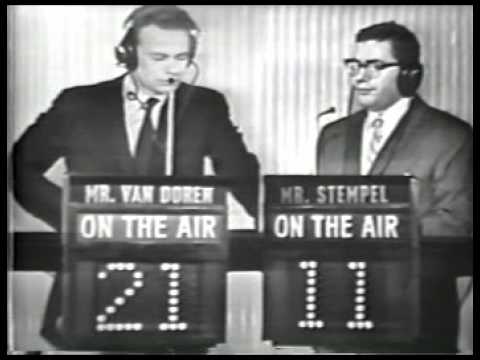
I missed Herb Stempel’s death last month. If you aren’t 95 years old or didn’t see Robert Redford’s “Quiz Show,” that name probably doesn’t ring a bell, but Herb was a seminal figure in American popular culture ethics, and his story raises issues still unsettled today.
On the evening of December 5, 1956, Stempel, a City College student from Queens, was in his eighth week on the highly-rated NBC quiz show “Twenty-One.” He had won a total of $49,500, but the producers decided that his trivia-obsessed nerd persona (deliberately played up by the show, which instructed Stempel how to look especially dorky) was wearing thin. It was decided that his handsome, Columbia University professor challenger Charles Van Doren should end Herb’s reign as champion, so Stempel was ordered to “take a dive.” Despite Stempel’s protests, he was forced to whiff on the question, “What movie won the Academy Award for best picture in 1955?,” an especially bitter pill because Stempel not only knew the answer, the winning film, “Marty,”was his favorite movie. Those who knew Stempel were shocked that he would answer, “On the Waterfront,.”
Van Doren went on to become the most celebrated quiz-show contestant of all time—yes, even more so than Jeopardy’s Ken Jennings [Not “Jenkins” as I wrote here originally. Ken Jenkins is an actor, and he jumped into my head without being invited.] He was on the cover of Time magazine and received bags of fan mail and endorsement offers. Then Stempel, in part humiliated by the question he was forced to botch, in part out of jealousy, and maybe with a smidgen of public spiritedness, decided to become the prime witness as a federal investigation exposed the corrupt quiz show culture, telling the news media, prosecutors and congressional investigators that “Twenty One,” (and probably the other popular shows like “The $64,000 Question,” “Tic Tac Dough’) was a fraud on the American public.
Van Doren was disgraced. Stempel styled himself as a whistleblower and a hero. He assisted in the production of Redford’s 1994 Oscar-nominated movie “Quiz Show,” and also in a 1992 documentary for the PBS series “American Experience.” After the film revived interest in the quiz-show scandal, Stempel gave lectures and made radio and television appearances.
In other words, he cashed in. I see nothing admirable about Herb Stempel, though he is typical of many, perhaps most, whistle-blowers.
He testified that before his first appearance on “Twenty One,” the producer asked, “How would you like to win $25,000?” “Who wouldn’t?’” Stempel said he replied. Before each show, Stempel was given the questions and correct answers. He was coached to bite his lip, mop his brow, stammer, sigh, and act as if every question to which he had already been provided the answer might be the one to defeat him. He signed a false statement that he had not been coached and that he had lost to Van Doren, who was also provided answers, fairly. In exchange, Stempel was promised future paid television appearances. It was when the network reneged on those promises that Stempel blew his whistle and let the public and law enforcement know that the quiz shows were fixed.
They didn’t recover until quite recently, with shows like “Deal or No Deal?” and “Who Wants to be a Millionaire?” having success on prime time. Before that, the format was mostly relegated to daytime television. It’s strange, though. The appeal of shows like “Twenty One” was the same as the appeal of today’s competition reality shows, like “Survivor” and “The Amazing Race”: the illusion that audiences were watching real people dealing with a genuine challenge. The ethical line between a contestant faking that he isn’t sure of an answer to a question in order to ratchet up the suspense, and a reality show contestant following a scripted plot is vanishingly thin. Various levels of fraud exist in most of these programs.
I even believed that Paul Lynde was so clever he came up with those hilarious answers on “The Hollywood Squares” spontaneously.
“We’ve had racists, and they’ve existed, they’ve tried to get elected president. He’s the first one that has.”
—-Joe Biden at a virtual town meeting yesterday, giving a novel version of American history.
Where to begin? I suppose it’s obligatory to point out, again, that the now routine assertion that President Trump is a racist is based on distortions, innuendo and outright lies. The Democratic Party/”resistance”/mainstream media axis doesn’t even bother to try to support the claim any more, because, I explained here, this is a a Big Lie strategy, pure Hitler/Goebbels, from the same source, ironically, of the Big Lie (it’s #3 on the list) that the President is like Hitler. Joe’s Big Lie yesterday is #4. It probably should be #1, since it was formulated from the moment Trump, in announcing his candidacy, said, very clearly, that a lot of illegal immigrants from Mexico were dangerous criminals. That is undeniably true, but it was reported, and has come to be believed, that he said all Mexicans were dangerous criminals.
I’m not going to rehash why Big Lie #4 is a lie; in you haven’t figured it out, please go to the link. However, it is amazing what happens when you ask anyone, even the most articulate and intelligent Trump basher, how they conclude Trump is a racist. They just can’t do it without resorting to misrepresentations and distortions, then bubble over with rage when you point them out.
Joe Biden, as we all know, isn’t articulate or intelligent, and never has been. Now, sadly, he is existing in the twilight world of some kind of mental deterioration. As an aside, I wonder how the news media and those who would vote against President Trump if whoever was running against him “shot somebody in the middle of Fifth Avenue” are going to rationalize Joe’s increasingly garbled pronouncements. “Be fair. That’s just Joe being Joe. You know, he’s senile!”? “OK, he’s lost it, but at least he’s not a racist”? Incidentally, Joe’s statement describing Barack Obama as “clean” back when Biden had all of his marbles, which were never abundant to begin with, was a more reliable marker of racism than anything Donald Trump has said in public in his long career. Continue reading →
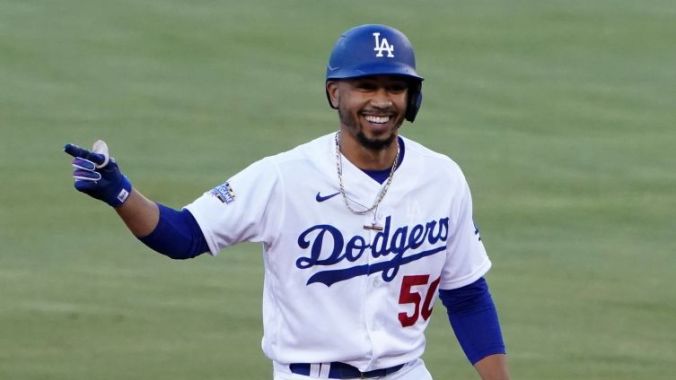
It is being reported that the Los Angeles Dodgers are about to sign an extension with new right-fielder Mookie Betts, acquired over the winter in a stunning trade with the Boston Red Sox, for an estimated 12-13 year contract at about 35 million dollars a year.
When I was giving my lecture to the Smithsonian about baseball this week, I mentioned writer Bill James’ argument that baseball is not “just a business” as detractors like to say. He has pointed out that because baseball’s market does not treat it as a business, but as a pastime, entertainment, a cultural touchpoint and a community institution, baseball teams are not run as rational businesses. Indeed, they are frequently run irresponsibly and incompetently, based on emotion and sentiment.
‘Twas not always thus. In the early days of professional baseball right up the end of the Calvin Griffith era in Minnesota, many teams were run as the sole sources of income by their owners, though by the time Griffith died, he was the last of that species. Beginning with Tom Yawkey’s purchase of the then perennial doormat Red Sox, however, the baseball owner as community philanthropist was born. Yawkey was a rich lumber tycoon, and he spent money lavishly on Boston teams to win games and make fans happy. He certainly increased the value of his sports franchise asset, but from a business standpoint his management was often irrational.
The Dodgers contract with Betts is in this tradition. Betts is a free agent after this year; that’s why the Red Sox traded him, because he was going to put himself up for sale to the largest bidder. The Dodgers sensed that the virus-truncated season changed the equation for them and the player: Mookie, one of the most talented, productive and likable players in the game, would not have a chance in 60 games to enhance his value, and each year passed for a player is depreciation. Betts will be 28 this season, and most players peak at that age. Continue reading →
1 .Another shoe drops: The Boston Red Sox announced that they would “support” any players who chose to kneel during the National Anthem when The Strangest Baseball Season since World War II, when teams fielded 16-year-old infielders and one-armed outfielders, commences tomorrow. The announcement was no surprise, and this team in particular had little choice.
Boston’s AL team is forever viewed with suspicion on race issues because it was the last major league team to break the color line, and because it passed on opportunities to sign some of the early black stars. Last season a visiting player claimed to hear a racist slur hurled his way from the Fenway Park bleachers, and the Red Sox management has been ostentatiously “woke,” cancelling Tom Yawkey from the Fenway environs though the team owes its existence to the long-time owner’s beneficence. He was rumored to be a racist, however, and that was enough to justify erasing his name (except from his initials in Morse Code on the scoreboard).
2. Bad service only matters for drug stores, apparently. State regulators in Oklahoma cited and fined CVS for conditions found at four of its pharmacies, including inadequate staffing and errors made in filling prescriptions. Staffing just about everywhere is unfriendly to consumers—indeed, most stores were understaffed even before the lockdown, now half-lockdown while the teachers extort the country.
Our local CVS, where I have many ethics adventures, now has minimal staff, including in the pharmacy, because there are so few customers lately. Hilariously, the store’s auto-scan checkout option is one of the features that requires staff: the damn things don’t work half the time, or a staffer has to lead some confused senior through the process.
3. Unfortunately, it’s more difficult than ever to believe sexual harassment allegations. #MeToo so egregiously overplayed its hand and has been so schizophrenic in its standards that I have to look at any high-profile allegations as potentially motivated by politics. In an action that must have been well underway before the Washington Redskins suddenly caved and agreed to change the team’s name (yet another poll, a new one, has indicated that the vast majority of football fans and Native Americans have no problem with “Redskins”), 15 female ex-employees told The Washington Post that they were sexually harassed while working for the organization. Shortly thereafter, a Fox News staffer and periodic on-air guest filed suit in federal court alleging they had been harassed or raped by Ed Henry, the Fox News reporter who was fired for “willful sexual misconduct in the workplace,” The suit also alleges harassment by Tucker Carlson and Sean Hannity, the latter perpetually on “the resistance’s” hit list and the target of boycotts, and Carlson recently becoming a force as a pundit. Therefore he must be destroyed.
Do I find it hard to believe that the Redskins, or any NFL team, has a culture hostile to female employees? No. Do I think that Fox News has effectively banished its pervasive workplace sexism and misogyny since the forced exits of the late Roger Ailes and Bill O’Reilly? Absolutely not. Do I think weaponizing sexual harassment allegations has become a predictable and unethical tactic on the Left, (See: Mathews, Chris) thus making the timing of both of these sets of complants suspicious?
Is Bismark a herring?*
4. More things now as predictable as they are indefensible. The University of Southern California’s School of Cinematic Arts will remove its John Wayne exhibit as part of the school’s efforts to address “systemic racism” in society with obnoxious, shallow and foolish gestures.
The Duke graduated from USC, of course (he was raised in Iowa), and the justification for his dishonoring was an admittedly dumb interview he gave Playboy in 1971, where he was obviously (to me, anyway, at the time) trolling a liberal and hostile magazine by saying exactly the kinds of things the Wayne haters expected him to say. (I always assumed he was drunk during that interview.) This move by USC was expected—California, universities: you know, morons. As Spiked noted, Wayne’s importance to the culture and the history of film by virtue of his on-screen portrayals should not be diminished by any interview the actor did.
As an actor and a director,Wayne was careful to portray characters who respected blacks and other minorities as human beings. In “The Cowboys,” for example, he is routinely reprimanded and shown up by his black cook, played by the great Rosco Lee Browne. In many movies, like “McClintock!,” “Hondo” and “Fort Apache,” he demonstrated sympathy and respect for Native Americans; Wayne also prominently featured Chinese-American actor H.W. Gim in his films whenever feasible from 1942 on, notably as his landlord Chin Lee in “True Grit.”
If his character was a racist, Wayne didn’t hesitate to represent racism negatively, as when he opposed his black ranch hand (Woody Strode) learning to read in “The Man Who Shot Liberty Valence” because Wayne’s character is hostage to archaic traditions, or when he seems determined to murder his white niece (Natalie Wood) because she has lived with Native Americans and presumably had sex with a chief.
All of John Wayne’s wives were also Mexican, meaning that his four children are “Persons of Color.”
Never mind. Wayne’s legacy and hold on the culture is unbreakable. Just last week I stumbled about four of his films on cable. They’ll get Mt. Rushmore before they shoot down the Duke. [Pointer: Pennagain]
__________________________
*Cultural literacy bonus points for identifying the source.
1. Final plug, as the bat above (and in my hands) reminds me: If you are set up with Zoom (it’s free, you know), you still have time to register for the Smithsonian Associates program tomorrow evening (at 6:45 pm, EST) wherein I hold forth on how baseball has influenced American culture, values and history. Yes, it’s $35 bucks, but it goes to a good cause, and may help the Institute hire more competent employees who don’t peddle junk like the chart on “whiteness.” You’ll be able to ask questions, and I’m storing these experiences for the Ethics Alarms Zoom experience to come. Read all about it here…
The ideology of the racism-training industry …collapses all identity into racial categories. “It is crucial for white people to acknowledge and recognize our collective racial experience,” writes [ Robin DiAngelo, of temporary “White Fragility” fame,] whose teachings often encourage the formation of racial affinity groups. The program does not allow any end point for the process of racial consciousness. Racism is not a problem white people need to overcome in order to see people who look different as fully human — it is totalizing and inescapable. Of course, DiAngelo’s whites-only groups are not dreamed up in the same spirit as David Duke’s. The problem is that, at some point, the extremes begin to functionally resemble each other despite their mutual antipathy…. In some cases its ideas literally replicate anti-Black racism.”
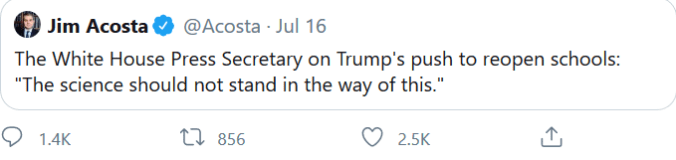
Jim Acosta is the epitome of a CNN anti-Trump hack, one of many. Jake Tapper, once a reliable oasis of integrity in the expanding desert of corrupt and biased mainstream media reporting, has understandably rotted on the CNN vine since joining the network, but now and then Good Jake surfaces.
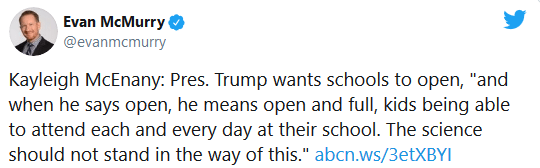
In a White House briefing last week, press secretary Kayleigh McEnany discussed President Trump’s call for children to go back to school in the fall.
“The science should not stand in the way of this, but as Dr. Scott Atlas said — I thought this was a good quote, ‘Of course, we can do it. Everyone else in the Western world, our peer nations are doing it. We are the outlier here.’ The science is very clear on this. For example, you look at the JAMA pediatric study of 46 pediatric hospitals in North America that said the risk of critical illness from COVID is far less for children than the seasonal flu. The science is on our side here. We encourage localities and states to just simply follow the science. Open our schools.”
Acosta, who was there, deliberately redacted her words to make it appear that McEnany was dismissing the relevance of science, thus confirming a persistent mainstream media narrative about the Administration being science-deniers.
Other sources and websites followed the same course; here, for example, is ABC social media editor Evan McMurry:
And the shameless Trump-hating site Boing Boing…
I’ve been tempted to see how many of my Trump Deranged, biased media-enabling Facebook friends have passed on the lie to the acclaim of many “likes,” but I have enough aggravation.
Whether Acosta was Liar Zero or whether he got the idea from another reporter doesn’t matter. He circulated deliberate fake news, and could have no innocent justification. Later, after being called out on social media, Acosta added the missing context, but the fact is, he was caught.
He should be suspended at the very least for this, and probably fired. A news source with any journalism integrity at all would immediately discipline him. Of course CNN has said nothing and done nothing.
1. Rep. John Lewis died, and respect should be paid. BUT...Lewis played extreme and divisive partisan politics for years, exploiting and abusing his reputation as a “civil rights icon.” His boycott of the Trump inauguration did incalculable damage to race relations in this country and undermined a new President before he had a chance to show what he could do. It was unforgivable, and like Barack Obama, Lewis is substantially accountable for the racial enmity we are witnessing today. And he should have retired long ago.
2. I guess I have to say something about Mary Trump. The parade of people, including employees and officials, choosing to cash in and trash the President of the United States while he’s in office and trying to govern has been disgusting for years now. It is more disgusting, of course, when the slimy tell-all authors are those who had positions of trust, but the efforts of others, like Trump’s niece Mary Trump, to peddle dirt to the large Trump-hate market is nauseating as well.
Since the act of making such claims against a family member for profit is itself signature significance for a crummy, venal, untrustworthy and vindictive human being, there is no reason to regard her book as anything more than more anti-Trump porn. I have a pretty close family, and I can say with certainty that neither my many cousins, nor my sole surviving aunt, nor my nephew and niece, have sufficient first hand knowledge of my life to make any reliable claims about me at all, good or bad.
3. Quick observations on Andrew Sullivan’s departure from New York Magazine…Sullivan published his last column for the extremely left-wing anti-Trump magazine, announcing he was leaving because the culture there was intolerant of his insufficiently woke principles. At one point he writes,Continue reading →
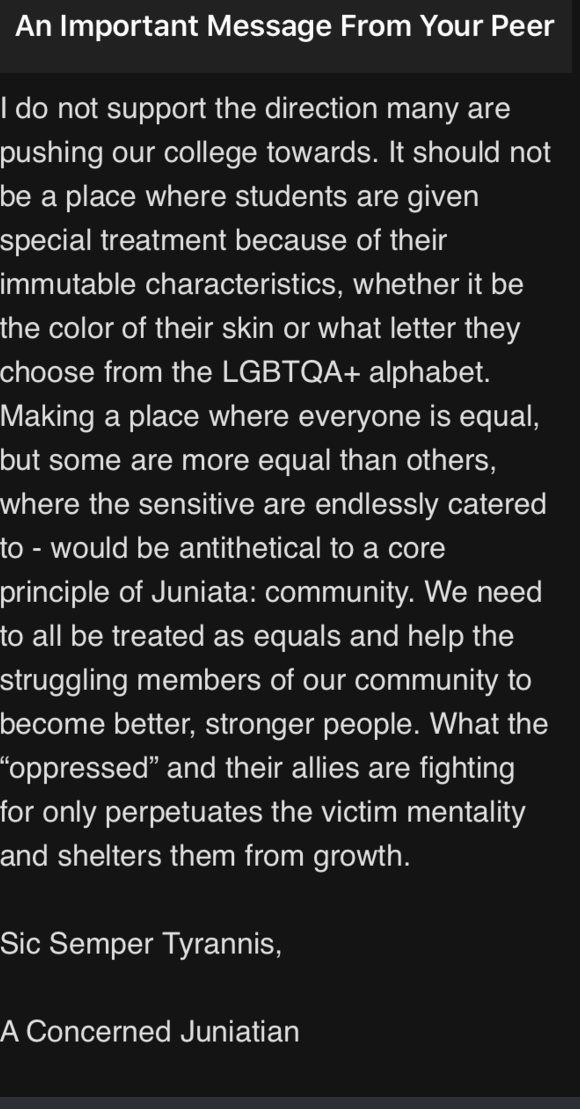
The “Concerned Juniatian” was a student named Colin Daly. This was the very end of a much longer screed (You can read the whole, very long letter here) that the Juniatia College student sent to his campus community anonymously. Juniata is a small Pennsylvania liberal arts college affiliated with the Church of the Brethren, a Christian denomination. It is also apparently devoid of respect for such values as free speech, individuality, and dissent.
Daly, a senior, wrote the email without including his name but accidentally “left identifying information on the system he used to distribute his post to all of Juniata’s email accounts,” according to PennLive.
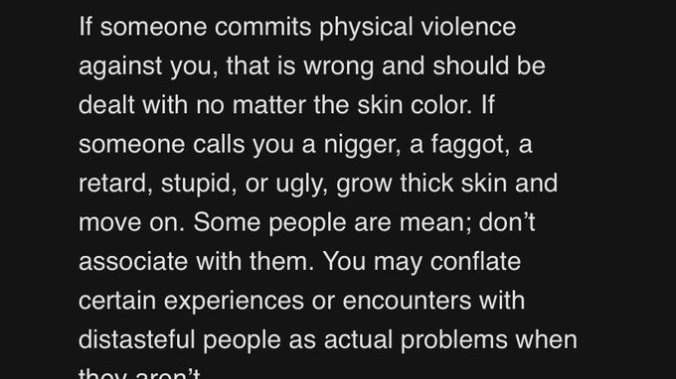
Before it identified Daly as the author, the college’s President James Troha wrote in a statement that the email contained “slurs, hateful language, and intimations of violence directed at members of our community on the basis of their identity.” There is no threat of any kind in the letter, and the “slurs” are words referred to as slurs, not used as slurs. Here’s the section of the letter I assume Troha is referring to:
I’d like to see Daly sue Troha for libel; I think he’d have a strong case.
The next day, after it was determined that Daly was the author, the college released a new statement. claiming that “law enforcement agencies are continuing their own investigations of the matter,” and suggesting that the letter’s author student may have broken state and federal laws.
That’s some education students at Juniata are getting. Continue reading →
I’ll begin with the ethics conclusion, and show how we get there.
If your organization, institution, or nation owes its existence to an individual that hindsight-wielding critics want to erase, your choice is to tell them to get lost while continuing to officially recognize the debt such organization, institution, or nation owes to that individual, or to dissolve the entity. Recognizing in some form the fact that a founder has blemishes on his or her past may be justified and practical. Continuing to benefit from that founder’s actions while metaphorically kicking him or her in the teeth, however, is unethical and, in fact, despicable.
Thus we arrive at the current controversy at the Asian Art Museum in San Francisco. The focus of the mess is the bust of Adrian Brundage you see above. Brundage is most remembered as the long-time (twenty years) President of the International Olympic Committee (IOC), and most reviled for his decision not to cancel the Munich Games in 1972 after the terrorist attack on the Israeli team in 1972. (I agreed with him then, incidentally, and still believe that he was correct, and courageous, in his decision.) Brundage also, however, created the Asian Art Museum, which is the centerpiece of San Francisco’s Civic Center Plaza, and which Brundage gave to the city in 1966 to house his fabulous personal collection of approximately 8,000 art pieces.
The New York Times story about the emerging controversy at the museum begins, “For 48 years, visitors to this city’s Asian Art Museum have had to pass the bust of Avery Brundage.” That’s right, they “had” to pass that bust because what they were coming to see belonged to Avery Brundage, the museum’s collection was his gift, and it was and is appropriate for that to be respected and acknowledged.
Given an opportunity by the zeitgeist of the George Floyd Freakout, however, the museum’s director and chief executive, Jay Xu, announced to a meeting of the board and commissioners in June that he was having Brundage’s bust removed. There are two reasons given in the article. One is that Brundage was accused of being a Nazi sympathizer and anti-Semitic (with the decision not to stop the 1972 Olympics being cited as a prime piece of evidence for the latter), and that the museum he created “presents Asian art from a mostly white perspective.”
As for the last complaint, I will characterize it this way: it’s racism, pure and straight.
The George Floyd Freakout is being used to justify a national effort to “Get whitey,” and this disgusting outbreak of anti-white hatred (that so many white Americans are accepting with the meek submission and hollowed out character of post rats-in-his-face Winston Smith) will not end until sufficient numbers of the rational label it what it is: opportunistic hate and racism.
The museum presents Asian art from a “mostly white perspective” because the museum’s collection was originally created by a collector of Asian Art who was white. That does not justify an indictment of the collection, and if an Asian-American wants to establish a museum that reflects Asian art from a mostly Asian-American perspective—not an Asian perspective now, be consistent, you racists!—then that Asian-American is welcome to spend millions on his or her own collection, give it to the city, and see if anybody wants to see it. Continue reading →