Ethics Outburst, 7/15/2020: An Execution, An Exoneration, A “Never Mind!” And More Freakouts…

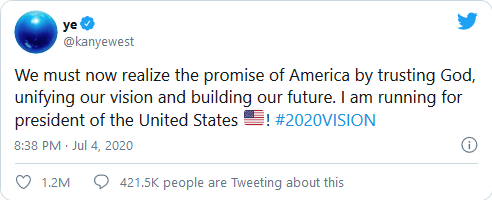
1. Least surprising ethics revelation of the day: Kanye West is an asshole.  After posting this,

..sending the news media into a frenzy, setting off speculation about how much of the crucial black vote his candidacy might siphon off from Joe Biden, exciting all of those who inexplicably take the man seriously after ample evidence over the years that he is emotionally unstable, West has decided a mere eleven days later that he doesn’t want to run after all. His organization had hired 180 people who trusted him.

If there is a more irresponsible celebrity alive, I don’t want to know about him. Continue reading →

My Georgetown Diploma Joins My Harvard Diploma In Facing The Wall In Shame

Georgetown has apparently programmed its victims of a liberal education to not only believe in the suppression of free speech and dissent from the majority, but to engage in it. Nice.

By the way, Georgetown, the backs of Harvard’s diplomas are much more attractive than the backs of yours.

Georgetown University junior Billy Torgerson received a formal condemnation from  the Georgetown University Student Association as well as a call for the college to investigate him for “bias” based on a column, “A Nation Of Virtuous Individuals,” that he authored and posted on his own website.

That’s all you need to know, really. It is none of the Student Association’s business what a Georgetown student posts online on his own forum. The principle articulated in the recent Supreme Court case B.L v. Mahanoy Area School District holds even if the action of a student group doesn’t strictly constitute what the opinion prohibits. This is chilling free speech.

Torgerson’s primary “crime” seems to be that he opposes another recent SCOTUS ruling,  Bostock v. Clayton County, which extended protections under Title VII of the Civil Rights Act of 1964 to transgender individuals.  I think he’s wrong, but Torgerson’s position is similar to that of the  three dissenting judges  and many conservative analysts. And it doesn’t matter if he’s wrong. He has every right to state his opinion without being punished. Continue reading →

Ethics Dunce: Gary Garrels

The carnage of the George Floyd Terror, aka George Floyd Freakout, aka George Floyd Ethics Train Wreck, claimed another victim yesterday, and Ethics Alarms is designating him the Ethics Dunce. We really need a new category for people like Gary Gerrels, the now ex-senior curator of painting and sculpture at the San Francisco Museum of Modern Art (SFMOMA). Placed in a position where he could take a strong  position against unhinged woke bullying, when every element of common sense, integrity, fairness and reality was aligned in his favor, he prostrated himself to the mob. “Ethics Coward,” perhaps? “Ethics Weenie”? “Ethics Fool”? “Useful Ethics Idiot”?

Garrels  triggered the process of his cancellation by concluding a presentation on how to diversify the museum’s holdings by saying, “don’t worry, we will definitely still continue to collect white artists.” In a ZOOM meeting of museum employees, Garrels  voiced a similar position, saying  that the museum could not avoid collecting the work of white men, which he described as “reverse discrimination.” Shortly thereafter employees created and began signing an online petition demanding that he leave the museum.
Continue reading →

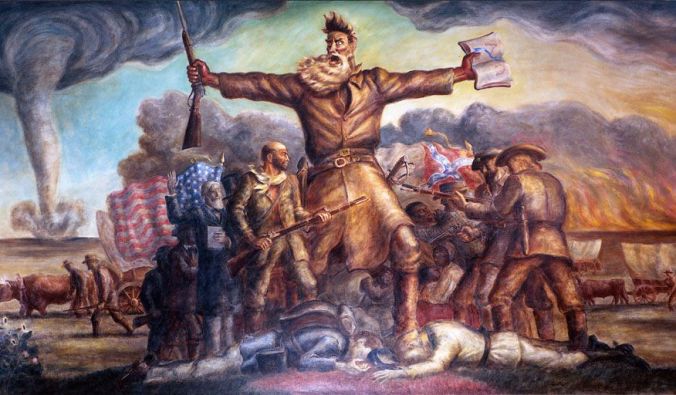
In Defense Of The Terrorist: Clarence Darrow Eulogy For John Brown

In the ongoing debate here regarding what constitutes a great American—sparked by reader valkygrrl’s guest post on the topic as well as the President’s recent remarks at Mount Rushmore, the question of whether abolitionist John Brown belongs has been the most contentious. I don’t believe that one can ethically assign a murderer and law-breaker (and unraveling fanatic) like Brown to the “great American” category,  but a figure unquestionably smarter than I whom I believe unquestionably was  one of the greatest Americans did, and his argument deserves attention and thought. That figure is Clarence Darrow.

Brown was much admired by Darrow’s iconoclast father, Amirus Darrow, and his mother was an anti-slavery activist, turning the Darrow home into a stop on the Underground Railroad.  Born in 1857, Darrow was too young to remember the pre-Civil War period, and Brown was hanged in 1859. Nonetheless, the admiration for Brown was passed on from father to son, and there are moments in Darrow’s career where his actions seemed consistent with Brown’s philosophy of the ends justifying the means when the stakes were important enough, notably the conduct that almost got him disbarred and imprisoned for jury tampering. (Darrow was guilty, but was acquitted because he had a great defense attorney—Clarence Darrow.)

John Brown was a hero of Darrow’s , who didn’t have many: the abolitionist, Voltaire, and his friend and mentor John Peter Altgeld were about it, as far as I can tell. Periodically, on the anniversary of Brown’s birthday (May 8), Darrow would give a speech eulogizing Brown to a progressive group. Its final sentence is the most quoted:

The radical of today is the conservative of tomorrow, and other martyrs take up the work through other nights, and the dumb and stupid world plants its weary feet upon the slippery sand, soaked by their blood, and the world moves on.

Incredibly, Darrow’s John Brown Eulogy is impossible to find on the web now; I have no idea why. (Enter that sentence in Google, and what pops up is…me!) Thus I am  reproducing Darrow’s speech here, for two purposes: first, to let you consider Clarence Darrow ‘s argument for why we should honor John Brown, and second, to have an online home for it.

It is not the whole speech, but my own shortened and edited version. I am still hunting for the whole document in a form I can post (I have it in several books), and when I find it, I’ll substitute the complete version for this: Continue reading →

Ethics Hero: New York Times Editor Bari Weiss

I supposed that should have read “former New York Times editor Bari Weiss.” Until her resignation today,  from 2017 to 2020, Weiss was the staff editor for the opinion section of the The New York Times.

Her letter of resignation to the Times publisher is here.  It is beyond excellent, beyond brave, beyond important.  It is breathtaking.

She writes in part,

I joined the paper with gratitude and optimism three years ago. I was hired with the goal of bringing in voices that would not otherwise appear in your pages: first-time writers, centrists, conservatives and others who would not naturally think of The Times as their home. The reason for this effort was clear: The paper’s failure to anticipate the outcome of the 2016 election meant that it didn’t have a firm grasp of the country it covers…

But the lessons that ought to have followed the election—lessons about the importance of understanding other Americans, the necessity of resisting tribalism, and the centrality of the free exchange of ideas to a democratic society—have not been learned. Instead, a new consensus has emerged in the press, but perhaps especially at this paper: that truth isn’t a process of collective discovery, but an orthodoxy already known to an enlightened few whose job is to inform everyone else…

Stories are chosen and told in a way to satisfy the narrowest of audiences, rather than to allow a curious public to read about the world and then draw their own conclusions. I was always taught that journalists were charged with writing the first rough draft of history. Now, history itself is one more ephemeral thing molded to fit the needs of a predetermined narrative. Continue reading →

Regarding “Athlete A”….[Corrected!]

“Athlete A,” the Netflix documentary that tells the awful story of USA Gymnastics doctor Larry Nassar’s decades of sexually abusing young female gymnasts—perhaps as many as 500 of them—, how he was allowed to continue his crimes after complaints from parents and others, and the young women who finally sent him to prison with their testimony, is both disturbing and depressing. I watched it last night with my wife, who was horrified that she didn’t know the Nassar story.

Ethics Alarms wasn’t as much help as it should have been. Its first full post about the scandal was this one, which, in grand Ethics Alarms tradition, slammed the ethics of the judge who sentenced Nasser to 60 years in prison, essentially a “Stop making me defend Dr. Nasser!” post. I’ll stand by that post forever, but it didn’t help readers who are link averse to know the full extent of Nasser’s sick hobby of plunging his fingers and hands into the vaginas and anuses of trusting young girls while telling them that it was “therapy.”

The second full post, in August of last year,  was more informative regarding Nasser, but again, it was about the aftermath of his crimes, not the crimes themselves. That post  focused on the the Senate hearings following the July 30 release of the report of an 18-month Senate investigation  that found that the U.S. Olympic Committee and others failed to protect young female athletes from Nasser’s probing hands, detailing “widespread failure by the U.S. Olympic and Paralympic Committee (the “Committee”) and other institutions to keep athletes safe.”  Then there was this: Continue reading →

Guest Post: Who Are The Greatest Americans?

by Valkygrrl

[Introduction: Ethics Alarms opined that the President’s proposed “Garden of American Heroes” was badly conceived, and his initial nominations for inclusion proved the point. Mercurial commenter Valkygrrl  took the initiative to devise a process for Ethics Alarms readers to compile a better list, and also to organize the results, which I found fascinating. Any further reactions will be confined to the comments.]

The Rules:

1: No presidents, always some controversy, we have other ways of honoring them.
2: Any person who held office must be chosen for something they did outside of said office, no honoring for using the mechanisms of the state no matter how beneficial to society.
3: No Confederates (obvious divisiveness.)
4: You may have only one living person on your list.
5: Your list must be made in good faith. You may not choose anyone you believe will upset or anger me; no “owning the libs”. Honest mistakes accepted.
6: Do not remove someone from your list because they were mentioned by someone else. I want to see if we can find some consensus. That means people Trump or Jack mentioned are allowed.

Here’s the list of nominees as submitted by participants (editorial descriptions mine);

Marian Anderson: Singer, Civil rights activist, Medal of Freedom recipient.

Neil Armstrong: Aviator, Astronaut, First human to set foot on Luna

Isaac Asimov: Teacher, Author of the Foundation series; Seven-time Hugo Award winner (Plus one Retro-Hugo awarded in 2016), Democratic party activist, serial sexual harasser

Irving Berlin: Composer of famous patriotic music

John Brown: Hero, undaunted, true and brave, And Kansas knows his valor when he fought her rights to save; Now, tho the grass grows green above his grave. Popular legend holds that his soul continues to march.

John Moses Browning: Industrialist, Firearms designer.

George Carlin: Humorist, Mentor to time-traveling Gen-Xers.

Andrew Carnegie: Industrialist, Philanthropist, Union buster.

Joshua L. Chamberlain: Union General, Medal of Honor recipient.

Meriwether Lewis  and  William Clark: Explorers, Naturalists. Two very different people presumably nominated for a single achievement alone. Clark was a bit of a bastard.

Samuel Colt: Firearms manufacturer, used assembly line principals before Henry Ford.

Clarence Darrow : Country lawyer, Civil libertarian, Attention whore, Cigar aficionado. Continue reading →

Morning Ethics Warm-Up, 7/11/2020: Still Crazy After All These Posts

1. Atticus, Aaron and Alexander. Today, July 11, was a crucial date in history for two great Americans, now in danger of being canceled by the ignorant woke. One cancellee was a real man, Founder Alexander Hamilton; the other is fictional, Atticus Finch. Both have been pronounced wanting in character of late because they did not manage to discern in their eras the full extent of the necessary racial equities Americans have largely come to understand today, with the benefit of decades more of debate and experience than Finch, and with a 250 years advantage over Hamilton.

In Finch’s case, this is his “birthday”:  on July 11, 1960,  34-year-old novelist  Harper Lee published her first, and except for a rejected “sequel” to  “Mockingbird” published later under ethically dubious circumstances, her only, novel.  Fortunately for Atticus, the version of the Depression Era small town Alabama lawyer that most Americans know is the film’s, where he is played by Gregory Peck as a pure idealist without any of the alleged flaws—like saying that it is wrong to assume that racists can’t still be good people—that the novel’s Atticus is condemned for today. (The multiple Atticus problem is discussed here.)

While Atticus Finch was “born” on this date, Alexander Hamilton died, perhaps by bravely but naively exhibiting ethical character while at the mercy of a man whose ethics were elusive at best, Aaron Burr, who fatally shot the nation’s first Secretary of the Treasury in a duel this day in 1804.

The adversaries met at 7 a.m. at the dueling grounds near Weehawken, New Jersey on the same spot where Hamilton’s son had died defending his father’s honor in 1801. (The concept of karma was apparently unknown in 1804.)  According to Hamilton’s “second,” Hamilton deliberately fired his weapon into the air rather than at Burr (Burr’s second claimed that Hamilton fired at Burr and missed) , whereupon Burr, who had the second shot,  killed  Hamilton by sending a bullet through his stomach into his spine. Hamilton died the next day.

If you think politics are crazy now, consider: Hamilton’s death was the direct result of his publicly attacking and demeaning Burr for years (“I feel it is a religious duty to oppose his career,” he once wrote). Hamilton also was instrumental in blocking Burr from becoming President in the ridiculous election of 1800, when a quirk in the election rules threatened to allow the sociopathic Vice-Presidential candidate  to defeat his running mate, Thomas Jefferson. Continue reading →

Unethical Quote Of The Year: House Speaker Nancy Pelosi

“People will do what they do.”

—-Speaker of the House Nancy Pelosi  yesterday, following being  asked at a press conference about her reaction to the statue of Christopher Columbus being torn down and dumped in the Bay by the usual gang of vandals and anarchists who are symbolically tearing down the United States and Western civilization, as well as its values.

I am serious about this being the Unethical Quote of the Year. I can’t imagine a worse one, once Pelosi’s status as the third ranking official in the United States Government and the leader of the Democratic Party is taken into consideration. This would be a morally, legally and ethically bankrupt statement if it came from a sociopathic teenager. Coming from a leader who people follow and trust, it is infinitely worse. Such an attitude strikes at the soul of civilized society. “They just do what they do” is a line from  “Jurassic Park,” as the paleontologist, Dr. Grant (Sam Neill) explains to the children that dinosaurs aren’t good or bad, they are just animals that “do what they do.”

But they were animals. Continue reading →

Facts Don’t Matter: Academic Research Undergoes The Ultimate Integrity Meltdown

Heather MacDonald, whose Congressional testimony Ethics Alarms noted here, writes in the Wall Street Journal,

The Proceedings of the National Academy of Sciences is a peer-reviewed journal that claims to publish “only the highest quality scientific research.” Now, the authors of a 2019 PNAS article are disowning their research simply because I cited it.

Psychologists Joseph Cesario of Michigan State and David Johnson of the University of Maryland analyzed 917 fatal police shootings of civilians from 2015 to test whether the race of the officer or the civilian predicted fatal police shootings. Neither did. Once “race specific rates of violent crime” are taken into account, the authors found, there are no disparities among those fatally shot by the police. These findings accord with decades of research showing that civilian behavior is the greatest influence on police behavior.

In September 2019, I cited the article’s finding in congressional testimony. I also referred to it in a City Journal article, in which I noted that two Princeton political scientists, Dean Knox and Jonathan Mummolo, had challenged the study design. Messrs. Cesario and Johnson stood by their findings. Even under the study design proposed by Messrs. Knox and Mummolo, they wrote, there is again “no significant evidence of anti-black disparity in the likelihood of being fatally shot by the police.”

My June 3 Journal op-ed quoted the PNAS article’s conclusion verbatim. It set off a firestorm at Michigan State. The university’s Graduate Employees Union pressured the MSU press office to apologize for the “harm it caused” by mentioning my article in a newsletter. The union targeted physicist Steve Hsu, who had approved funding for Mr. Cesario’s research. MSU sacked Mr. Hsu from his administrative position. PNAS editorialized that Messrs. Cesario and Johnson had “poorly framed” their article—the one that got through the journal’s three levels of editorial and peer review.

Mr. Cesario told this page that Mr. Hsu’s dismissal could narrow the “kinds of topics people can talk about, or what kinds of conclusions people can come to.” Now he and Mr. Johnson have themselves jeopardized the possibility of politically neutral scholarship. On Monday they retracted their paper. They say they stand behind its conclusion and statistical approach but complain about its “misuse,” specifically mentioning my op-eds.

The authors don’t say how I misused their work.

In a move redolent of Soviet-style retroactive censorship, Michigan State University deleted its press release promoting the study, which had said in part, Continue reading →