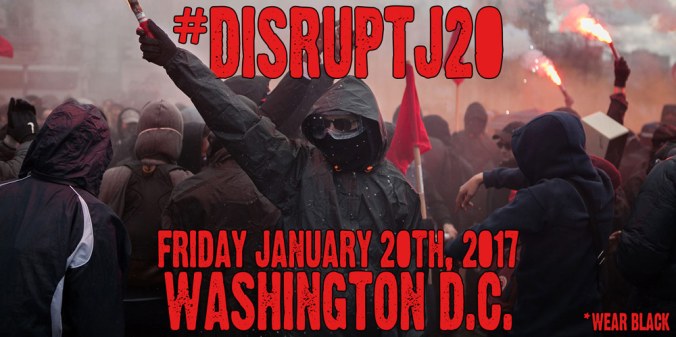
“We are not in favor of a peaceful transition of power, and we need to stop it.”
—Legba Carrefour, one of the organizers of DisruptJ20, a group working with Black Lives Matter and other protest groups to disrupt the Inauguration with demonstrations, predawn blockades and efforts to interfere with inaugural balls in the evening.
“We want to shut down the inauguration. We want to see a seething rebellion develop in this city and across the country.”
—David Thurston, another DisruptJ20 leader.
This is, increasingly, the face of the political Left in 2017 America. These two are a bit more radical, self-righteous, undemocratic and extreme than the Democratic Party and its allies in academia and journalism, but not as much as one would think, or hope.
A significant number of progressives and Democrats have completely lost their minds, as well as their common sense, during the still rolling 2016 Post Election Train Wreck. At least Thurston and Carrefour are honest and straightforward about wanting to undermine the democratic process and to justify a coup solely on the basis that their candidate did not prevail. Democrats, progressives, academics and pundits are advocating or encouraging the same thing, but are less direct about it.
Every few days, often every day, bring new examples. I don’t just mean certified left-wing crazies like Michael Moore, who says we have to find some way to stop Trump from taking the office he was duly elected to, or Rosie O’Donnell, whose status as an idiot would normally make me hesitate to cite her except that ABC News gave her a forum as a pundit on “The View” for a few years, who says that Trump should be “arrested.” When did any conservative, libertarian, or Republican not residing in a padded room advocate that a Democratic President-Elect should be forceably prevented from taking office?
I know, I know: Trump is special. Trump justifies suspending ethics. The New York Times Rule.
About a week ago, another Hollywood video led by Sally Field demanded that Congress “stop” Trump, without really knowing what they will be stopping. The video is pure fear-mongering without substance, calling Trump “racist, sexist, anti-immigrant, anti-worker, anti-Muslim, anti-Semitic, anti-environmental…” Of course, the same people were part of a loud group of indignant Democrats who maintained for eight years that for Congress to deny the wishes of a President was akin to racism and treason. The previous video, that one headed by fake President Martin Sheen, made the historically stupid argument that Electors were supposed to have the power to veto the will of the people, at least when Democrats lose. That worked well…as as it deserved to.
Yesterday, over at The Hill, an assistant professor of government in American University’s School of Public Affairs was given a forum to make the batty argument that Russia’s hacking and leaking e-mails that exposed some of the filthy under-belly of the Clinton machine and the Democrats mandate cancelling the results of the election and holding a new one. Now, it would be a slightly less batty argument (but batty still), to call for a re-vote if damaging information was uncovered after an election that the winner withheld from the public, like, say, the fact that the IRS was sabotaging conservative groups to keep them from participating in civic discourse, or that the President lied to pass Obamacare, or that the Democratic Senate leader deliberately lied to smear the losing candidate….like in 2012. This guy (his name is Chris Edelson, and I am officially ashamed to have once been on an American University faculty with him) so hates Trump that he advocates causing a Constitutional crisis because damning information about the corruption of Clinton and the Democrats enlightened the public so they could, if they chose, use it to cast an informed vote. Cant have that.
Worse still was the jaw-dropping argument by liberal columnist Richard Cohen a few days ago, in a screed titled, “How to Remove Trump From Office.” Like all of the Left’s suddenly revolution-minded, Cohen begins with a list of Trump’s failings and character deficits, asserting that he is not fit to be President. Boy, when did the concept of “an election” become so alien to the Left? I happen to agree with Cohen about Trump completely, but see, Richard, it is the voters, not us, who get to decide who is fit to lead the country. If you argue that your opinion should prevail over theirs, you are not a supporter of the Constitution, or democracy. You are an elitist autocrat, tending to totalitarianism.
You, and people like you, scare me a lot more than Donald Trump.
So what is Cohen’s brilliant plan for reversing the will of the people?
Under the 25th Amendment to the Constitution, the vice president, together with a “majority of either the principal officers of the executive departments or of such other body as Congress may by law provide” can remove the president for being “unable to discharge the powers and duties of his office.” No doubt the mere mention of incapacitation would summon a horde of lawyers to Washington to contest it or the meaning of every term. But it is plain that the 25th Amendment does give a role to Cabinet members that is not generally considered when they are up for confirmation. This time, however, they should all be asked whether they are aware of the 25th Amendment and, if need be, whether they would be willing to implement it.
This is so ignorant, so foolish, so intellectually dishonest and so manifestly illegal that I still can’t believe that it isn’t some kind of a terrible joke.
Cohen has readers who trust him and his judgment:it is a betrayal to misuse his influence to propose nonsense like this. The 25th Amendment is entirely there to deal with actual disability, as when Ronald Reagan was shot, when Woodrow Wilson was incapacitated by a stroke, or Eisenhower had a heart attack. There is no ambiguity, in either the Amendment’s wording or the legislative record. “Unable to discharge the powers and duties of his office” cannot be tortured into meaning “not what Richard Cohen, Hollywood, Harry Reid and Rosie O’Donnell believe is a qualified President.”
But such is the current ugly derangement on the Left, and if it does not diminish public respect and trust of Democratic Party further—make that even further—I will be surprised.
_________________
Source: Yahoo!