I must confess, if you had told me even ten years ago that this was possible in the U.S., I would have laughed heartily. I certainly underestimated the damage to American culture about to be wreaked by the Democratic Party’s open borders lunacy.
[Johnny Mathisfinally announced his retirement this year—he’s only 90. His has been one of the most recognizable, enjoyable, seductive voices in American popular music for almost 70 years. My college room mate always had his records on hand to create the proper mood for his dates. An old time crooner’s chances of being remembered rests now on whether there is a Christmas standard he can be associated with. Johnny’s best shots are “It’s Beginning to Lot Like Christmas,” and “We Need a Little Christmas” from “Mame.” He sings all the others beautifully too, but they are taken.]
I was informed by a fellow Christmas movie fan that it is almost impossible to watch the original “Miracle on 34th Street” film on streaming services or the networks. They prefer to show the various remakes, all inferior in every way. What made director-writer George Seaton‘s movie (it won him an Oscar) so superb in addition to the casting, his straight-forward style and his obvious love of Christmas is that it instantly felt perfect despite its many suspension of disbelief challenges. Why do they feel this film has to be remade? Is it the lack of color? (“Miracle on 34th Street” was one of the first movies Ted Turner colorizes, and that version is unwatchable.)
As I’ve stated here before I believed in Santa Claus until I was 12. I didn’t want to give the fantasy up: I loved magic, and my parents always tried to make the season magical. My late wife Grace and I tried to do the same with Grant, now “Samantha,” but he was a non-believer by the third grade. Is there anything more joyful to see than the look on a child’s face as he or she wakes up to find what Santa has delivered? Will anything feel that wonderful again?
“Miracle on 34th Street” is an ethics movie in many ways. The movie is about the importance of believing in good things, hopeful things, even impossible things. The movie reminds us that wonderful things can happen even when they seem impossible, and that life is better when we believe that every day of our lives. I’m engaged in that right now: all of 2025 has required it. I’ve had serious injuries, successes, new projects and setbacks. My father taught me to be ready for the worst but to never to give up on the best.
One thing this film does well is to concentrate on the secular holiday without any allusions to the religious holy day, but not being obnoxious about it. “It’s a Wonderful Life” also straddles the line very cleverly: it begins in heaven, after all. All the “A Christmas Carol” films include Bob Cratchit telling his wife that Tiny Tim mused about how his disability reminded people of Jesus’s miracles at Christmastime, and that’s Dickens’ only reference to Jesus in his story.
On the offensive side is the Rankin-Bass animated “Rudolph the Red-Nosed Reindeer”—I can’t believe they still show that thing—when the “stormy Christmas Eve” causes Santa to decide to “cancel Christmas.” I’d say that’s above Santa’s pay grade, wouldn’t you agree? It also suggests that Christmas is only about gifts and children. (Do parents today explain that the singing snowman who narrates the story is based on, and looks like) the real person who also sings the most memorable songs? They should. Burl Ives had a fascinating life and a varied career, and those kids will probably be hearing him sing “Have a Holly Jolly Christmas” for the rest of theirs.
Interestingly, all of the perennial Christmas movies have been made into stage musicals of varying success—“White Christmas,” “It’s a Wonderful Life,” “A Christmas Story,” “Elf”—- but “Miracle on 34th Street” flopped so badly when Meredith Willson [“The Music Man”] adapted it as “Here’s Love” on Broadway that nobody has tried again. The show included the song, “It’s Beginning to Look a Lot Like Christmas,” which Willson wrote long before the show was assembled. But as with all the movie remakes, the show missed Edmund Gwynn, the best Kris Kringle of them all. He was a distinguished classical actor until that movie: he complained that after the film he wasn’t allowed to get rid of his bushy white beard and was type-cast as jolly old men.
I decided to post the Companion earlier this year; I also was moved by the fact that a number of EA readers had sought out the 2024 version today. When I’ve posted it on Christmas Eve, it has lacked views for the obvious reasons.
The 2025 companion reflects some additional thoughts upon my re-watching “Miracle on 34th Street” last week—I even took notes. Mostly, I though about how important the holiday, the stories, the music, the movies and what they signify taken as a whole is to our nation, our society and our culture. Thus it was that I decided that here was a good place to re-post “Christmas, the Ethical Holiday” Besides, I need to read it myself.
Christmas: the Ethical Holiday
Benjamin Franklin recognized the importance of regularly focusing one’s attention on ethical conduct rather than the usual non-ethical goals, needs, desires and impulses that usually occupy the thoughts of even the most virtuous among us. He suggested that every morning an individual should challenge himself to do good during the day. In the 21st century psychologists call this “priming,” a form of beneficial self-brain-washing that plants the seeds of future choices.
The Christmas season operates as an effective form of mass population priming, using tradition, lore, music, poetry, ritual, literature, art and entertainment to celebrate basic ethical virtues and exemplary conduct toward other human beings. Kindness, love, forgiveness, empathy, generosity, charity, sacrifice, selflessness, respect, caring, peacefulness…all of these are part of the message of Christmas, which has become more universal and influential in its societal and behavioral importance than its religious origins could have ever accomplished alone. Secular and cultural contributions have greatly strengthened the ethical lessons of Christmas. “It’s A Wonderful Life” urges us to value our ability to enrich the lives of others, and to appreciate the way they enrich ours. “A Christmas Story” reminds us to make childhood a magical time when wishes can come true. O. Henry’s story “The Gift of the Magi” proves that it is not the value of gifts, but the love that motivates them that truly matters. Most powerful of all, Charles Dickens’ “A Christmas Carol” teaches that the admirable conduct the spirit of the season can inspire need not be short-lived, and that if we use Christmas properly, as Ben Franklin used his morning exhortation to good conduct, it can make all of us better, happier, more virtuous human beings.
At this point in civilization, the religious context of Christmas almost does more harm than good. Though the day chosen to celebrate Jesus of Nazareth’s birthday has been spectacularly successful in promoting the ethical and moral ideals he taught, the idea that Christmas is indistinguishable from the religion he founded has made it the object of yearly controversy, as if celebrating Christmas is an affront to other faiths.
This is a tragedy, because every human being, regardless of religious belief, can benefit from a culture-wide exhortation to be good and to do good. “Happy Holidays!”—the bland, generic, careful greeting of those afraid to offend those who should not be offended—does nothing to spur us toward love, kindness, peace and empathy. “Merry Christmas!” does.
This is not just a religious holiday; it is the culture-wide ethical holiday, the time when everything should be aligned to remind us to take stock of our lives, think about everyone else who lives on earth with us, and to try to live for others as well as ourselves. Christians should be proud that their religion gave such a valuable gift to humanity, and non-Christians should be eager to accept that gift, with thanks.
It is foolish and self-destructive for there to be a “war on Christmas.” Charles Dickens understood. There is hardly a word about religion anywhere in his story. There doesn’t need to be. Christmas is the ethical holiday. Christians and non-Christians can celebrate it or not as they choose, but whether they do or not, the Christmas season is more important than any one religion, even the one that gives the holiday its name.
Christmas is important because it primes us to be good, be better, be more ethical, for the rest of the year. There should be nothing controversial about that.
Catherine Almonte Da Costa resigned from her post as NYC Mayor-elect Zohran Mamdani’s director of appointments. The Anti-Defamation League dug up comments she made as a teenager that registered as anti-Semitic; this happened just a day after Mamdani announced her appointment. Da Costa, 33 (above) is married to a deputy city comptroller, and he is, ironically enough, Jewish. When she authored the social media posts in question, however, she wasn’t married and couldn’t imagine that her dumb posts would come back to sideline her career.
“Money hungry Jews smh,” she wrote in one 2011 post, when she was 18, using the abbreviation for “shaking my head.” “Far Rockaway train is the Jew train,” she wrote in another post. “I spoke with the mayor-elect this afternoon, apologized, and expressed my deep regret for my past statements,” Da Costa said in her resignation statement. “These statements are not indicative of who I am. As the mother of Jewish children, I feel a profound sense of sadness and remorse at the harm these words have caused. As this has become a distraction from the work at hand, I have offered my resignation.”
Long-time readers here may remember Ethics Alarms posts about the “Hader Gotcha,” named for a young Major League Baseball pitcher of note (he’s still pretty good) who was forced to grovel an abject apology for tweeting offensive things when he was in high school that almost nobody read. I wrote in one of the early EA posts on the phenomenon,
I began by titling this depressing post “Incompetent Elected Official of the Month: President Trump,” but that seemed inadequate somehow. Maybe there’s no heading that could adequately express what an awful week the President had, how it was entirely unnecessary, how all of his deep political wounds were self-inflicted (okay, his clueless Chief of Staff helped), how much harm it did to his administration, influence and prospects of success, and how much he helped the Axis of Unethical Conduct when without his assistance the serious news would have had it staggering. <Breathe, Jack, breathe!>
EA covered three of the epic fiascos, but now I have to cover the fourth. The others were, in chronological order,
1. Trump’s petty, cruel, stupid attack on beloved director Rob Reiner immediately after he and his wives were stabbed to death by their son. I believe that his infamous Truth Social post may prove to be the tipping point in his administration. Recall that the Bush II Presidency was sent into a death spiral even before the 2008 economic crash because he was vacation when Hurricane Katrina struck New Orleans and flew over the devastation. Then the inept Democratic mayor of the city, with help from Kanye West, successfully created the narrative that Bush shrugged off the disaster because he “didn’t care about black people.”
3. Trump allows his hand-picked Kennedy Center board to add the President’s name to the landmark, launched as a memorial to President Kennedy in the wake of his nation-shattering assassination, and to quickly plaster it on the front of the building. This was so stupid and gratuitous that I don’t want to think about it, but it sure gave my Trump Deranged theater friends on Facebook ammunition.
I’ve got four posts up today, and I’m tired, but I can’t resist this one…
Outgoing D.C. Police Chief Pamela Smith decided to show what she was made of as she spoke as the honoree in a good-bye ceremony yesterday. The House Committee on Oversight and Government Reform had accused her of manipulating data to make it seem that crime has decreased in the District of Columbia when it had not. She could have stuck around, of course, until the final numbers were in, but instead she decided that she would leave her post “to be with her family.” That’s always a good dodge when you’re being investigated. In her farewell speech, she played the God card (she’s also a reverend at a Baptist church in D.C.), then the “haters” card, and finally the “it’s not my fault” card. Wait: are the statistics correct, or are they wrong? Smith’s argument somehow came out, “The statistics were accurate, but if they’re not, somebody else rigged them!”
That’s accountability, D.C. Government style!
“How dare you? How dare you attack my integrity? Attack my character? You don’t know who I belong to!” she said. Wait, what does THAT mean?
I’m surprised she didn’t ask if she could cook his little girl’s bunny too, like Glenn Close did in “Fatal Attraction.”
It amazed me that someone like this reads a NYT column called “The Ethicist.” She’s sounds like she’s never heard of the concept. She writes,
Last summer, I was dating a man in our weekender community outside New York City who seemed like a wonderful guy. A month after we became intimate, he told me that he was married but that he had been separated from his wife for a year. He explained that the reason he has not gotten a divorce is that she has cancer and is on his health insurance. He said she had just had surgery and was recovering. Naturally I felt compassion and said I wouldn’t push him. Eventually, I ended the relationship, because I started feeling I wasn’t getting the full story. When I mentioned our relationship to a friend who also knows him, I learned that my instincts were correct. Apparently, he is very much still with his wife, and she is healthy. I am so shocked by this. Should I contact his wife and let her know this is what he is doing and saying? Given that they are both journalists, I would think veracity would be a priority.
Translation:“I hate this lying bastard and want to hurt him, and his wife too. That’s OK, right?”
Uh. no. I haven’t even read The Ethicist’s answer, but Prof. Appiah, for all his faults and weaknesses, surely can get this one right. Let’s see…
“My understanding was that independent agencies exist because Congress has decided that some issues, some matters, some areas should be handled in this way by non-partisan experts, that Congress is saying that expertise matters — with respect to aspects of the economy, and transportation, and the various independent agencies that we have. So, having a president come in and fire all the scientists, and the doctors, and the economists, and the PhDs, and replacing them with loyalists and people who don’t know anything, is actually not in the best interest of the citizens of the United States.”
—-Justice Ketanji Brown Jackson, making the case for a technocracy that directly contradicts the structure of government dictated by that U.S. Constitution thingy, in her questioning of U.S. Solicitor General D. John Sauer during this week’s oral argument in “United States v. Slaughter”.
As Professor Turley archly comments in his post on Jackson’s classically totalitarian belief that the proletariat can’t be trusted and must be guided by supposedly wise and beneficent “experts” (like her), “Jackson simply brushed aside the fact that the president is given authority to execute the laws and that the executive branch is established under the Constitution…The use of “real-world consequences” seems to overwhelm any true separation-of-powers protections for presidents against the administrative state. It also allows the Court to delve into effective policy or legislative impacts in support of the expert class over what are framed as ignorant or vengeful presidents.”
To state what should be obvious about the so-called “expert class,” they have proven themselves to be very partisan and therefore not sufficiently trustworthy for Congress to bestow on them “independence” from Presidential oversight within the Executive Branch. We have seen that experts like university professors and scholars are overwhelmingly biased and partisan, that scientists are biased and partisan, that doctors, lawyers, economists, psychologists, judges and, yes, ethicists are biased partisan. The concept of the non-partisan, independent expert is a convenient ideology-driven mythology, and anyone paying attention to what we have witnessed in our country, society, and culture over the past couple of decades has to admit that it is as believable as Santa Claus.
Let me add in closing that the arrogance and smug entitlement that radiates from Jackson’s “people who don’t know anything” is staggering, obnoxious, and ironic. She’s a Supreme Court Justice and apparently doesn’t know what the Constitution means…
If you can watch Democratic Senator Tammy Duckworth in that CNN segment without your head exploding at the 3:43 mark, you are a better man than I am, Gunga Din.
After stating that the the so called “double-tap” bombing of alleged Venezuelan drug-smugglers was a war crime and murder, Duckworth is asked by Dana Bash, inadvertently practicing journalism, whether the Senator in fact knows what the hell she is ranting about, and gets the equivalent of “no,” “I just know what I’ve read online” and “I only know what I read in the newspapers.”
What Duckworth answered can be fairly translated as “I don’t really know anything the average channel-surfing short-order cook knows about this, and maybe less only I just tuned in to MSNBC, but I’m a Democrat, we have to criticize anything the Trump administration does, and I’ve got some talking points that my staffer was emailed from the DNC—maybe the same ones you were sent, Dana—and I’m just going from those.”
Duckworth was on CNN to discuss the incident as a purported expert: she’s built her entire political career by relying on her Army National Guard veteran status and losing her legs when her helicopter was hit by a missile during the first Iraq War. It’s an insult to viewers for her to go on the air and accuse the Department of War of “murder” without doing more than checking “what’s available in the media,” whatever that means in her case. I bet she got a summary of “what’s available in the media” and what she “knows” is double hearsay.
If I am asked on a radio show to give my opinion as an ethicist about, say, a law firm firing a member for a social media post denigrating Charlie Kirk and President Trump, I’d better have read the various analyses by my colleagues in the field, looked at the relevant ethics rules and legal ethics opinions, kno what the fired attorney wrote, and be ready to provide some trustworthy analysis other than “I only know what I read on ‘Above the Law.'”
This is the very epitome of political hackery. The Senator goes on CNN with no preparation at all, and spews a predetermined and predictable position because Trump Bad, while not even pretending to have any special insight into what occurred.
Last night I suddenly recalled this speech that I first read when Ed Larson and I were considering what to include in our book, “The Essential Words and Writings of Clarence Darrow.” It seems like an appropriate item to publish today on Ethics Alarms.
I am considerable older than Clarence was when they gave him a gala birthday party in Chicago on April 18, 1918, even if one doesn’t take into consideration the Spanish Flu that was then ravaging populations here and abroad. The average age of mortality for men was about 55 in 1918, so Darrow was past his pull date. I’m almost as far under the 2025 average mortality number for men as Darrow was over his. Darrow, however, made it clear in his speech that he didn’t feel old. Neither do I.
One should note that Darrow, despite issuing his own testimonial, had not yet participated in the three sensational cases upon which his current reputation as the Greatest American Trial Lawyer Ever rests: the Scopes trial, the Sweet case, and the defense of “thrill killers” Leopold and Loeb. His career still had a lot of “kick” left. It is also revealing that Darrow was already considered a major celebrity before his legal exploits shifted into territory that would be mined extensively by books, plays and movies over the next century.
I find it fascinating that Darrow claims to be modest—-he always thought he was the smartest one in the room, because he usually was—and that he claims to despise “moralizing.” Darrow, whose secret weapon in so many of his trails was jury nullification, promoted his vision of right and wrong aggressively and effectively; it was what drew me to Darrow as a student of ethics. The speech is remarkable in how completely Darrow neglects to mention, thank or acknowledge his long-suffering wife Ruby, his virtually abandoned son, or even any friends. Not surprising, however. Darrow was a narcissist. I am not sure that he had any close friends for any length of time, or missed having them.
Darrow didn’t prepare this speech, evidently. It rambles and leaps from topic to topic, but Clarence Darrow rambling is more entertaining and thought-provoking than all but our most brilliant historical figures speaking after days of preparation. By today’s standards the speech is far too long, but these were times before attention span had been decimated by modern media, the speeding up of life and inferior education. And this was a lawyer who once won a case with a twelve-hour closing argument. Guests at the party probably weren’t even squirming in their chairs.
Darrow (he hated being called Clarence) was by all accounts a riveting speaker, and that certainly helped. As you will see, he also was incapable of speaking for long without uttering a memorable quip or a trenchant observation.
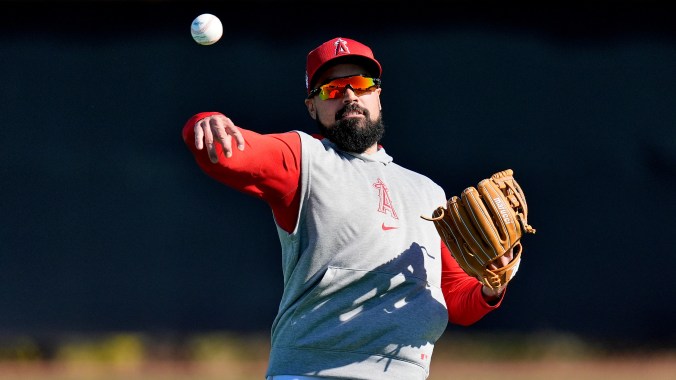
The Los Angeles Angels (it’s a baseball team. Sheesh…) are in talks with long-time disappointment third baseman Anthony Rendon about buying out the final year of his contract. Rendon wants to retire, but doesn’t want to forfeit the final year, $38 million bucks of it in his seven-year, $245 million long-time contract that has become an albatross for the Angels and a bonanza for him. Rendon spent the entire 2025 season recovering from hip surgery, as was typical of his Angels tenure. He was paid all the same.
The 35-year-old has been limited to playing in only 205 of a potential 648 games since 2020, due to injuries to his left groin, left knee, left hamstring, left shin, left oblique, lower back, both wrists and both hips. He has never played as many as 60 games in any of the four 162 game seasons. When Rendon was able to play, he wasn’t very good. The Angels had made Rendon the game’s highest-paid third baseman in December 2019, whereupon he performed well in the pandemic-shortened 2020 MLB season (which I don’t think counts) and that was the end of his productivity.
Rendon has famously stated that he doesn’t really like baseball, he just happened to be good at it. It’s just a job to him, not a passionate pursuit that he cares about; he doesn’t care about the accolades or attention either. Did his lack of passion contribute to his failure to suit up and take the field because of all the injuries? Nobody can say.





 Ethics Alarms