I would call this ad “brain dead,” but that would, perhaps, be in bad taste. Still, the wilful disregard by the NFL and its sponsors—and the public, of course—of the increasingly undeniable evidence that football kills brains is an ethics black hole.
Did Kellogg’s not read this (and similar reports)…?
Athletes who began playing tackle football before the age of 12 had more behavioral and cognitive problems later in life than those who started playing after they turned 12, a new study released on Tuesday showed. The findings, from a long-term study conducted by researchers at Boston University, are likely to add to the debate over when, or even if, children should be allowed to begin playing tackle football.
The results of the study by researchers at Boston University, published in the journal Nature’s Translational Psychiatry, was based on a sample of 214 former players, with an average age of 51. Of those, 43 played through high school, 103 played through college and the remaining 68 played in the N.F.L.
In phone interviews and online surveys, the researchers found that players in all three groups who participated in youth football before the age of 12 had a twofold “risk of problems with behavioral regulation, apathy and executive function” and a threefold risk of “clinically elevated depression scores.”
Oh, never mind, spoilsports! This NFL play-off time! De-FENCE! De-FENCE! Let’s give support to those irresponsible parents who send their kids out to scramble their gray matter and get that CTE started! Let’s encourage those potential NFL dementia victims with a heart warming vignette about a Dad urging his young son to “Give it your best!’ prompting the lad to run roaring into combat, perhaps even to cripple someone else.
1 Whew! This guy was almost on the Supreme Court! Retired Harvard Law School Constitutional law prof Lawrence Tribe. whose recent misadventures on Twitter have become the cause of mirth and dismay in the legal world, tweeted this:
The premise of the 2015 post “A Nation of Assholes” was that a President Donald Trump’s crudeness, incivility and boorishness would permanently degrade the culture through the influence the office of the Presidency traditionally has on the young. Bill Clinton, for example, made blow-jobs cool to high school students. This, Ethics Alarms held, was alone good reason to defeat him. However, I did not see his influence affecting the likes of Larry Tribe, as well as Trump’s adult adversaries in academia, the news media, and the Democratic Party, all of whom have allowed their own discourse to head into Tarentinoville because of Trump Derangement. This, in turn—you morons!-–minimizes and normalizes Trump’s vulgarity.
The President has not, unlike Tom Perez, Senator Kamala Harris and others, used any vulgar words in his public utterances or tweets. The infamous “shithouse” line was used, if it was used, in a private meeting, whereupon CNN took it into the living rooms of America an estimated 200 times.
And by the way, Professor, #SchumerShutdown is accurate, and TrumpShitdown isn’t even clever unless one is about 11.
2. And speaking of assholes… Bill Maher had a blinding moment of clarity, and ranted this yesterday on his HBO show (I have to rely on Ann Althouse for this quote, because I would no more watch Bill Maher than I would chew off my foot):
“I’m down with #MeToo. I’m not down with #MeCarthyism. Something is way off when Senator Kirsten Gillibrand can go unchallenged saying ‘when we start having to talk about the differences between sexual assault and sexual harassment and unwanted groping, you are having the wrong conversation.’ Can’t we just be having an additional conversation? Can we only have one thought now? I get it that Al Franken had to become roadkill on The Zero Tolerance Highway — a highway, it seems, only Democrats have to drive on — but do liberals really want to become The Distinction Deniers, the people who can’t tell or don’t want to see a difference between an assault in a van and a backrub by the watercooler? Masturbation is normal and healthy. But not in the park. Giving up on the idea that even bad things have degrees? That is as dumb as embracing the idea of ‘alternative facts.’ I get it when Trump’s side doesn’t want to talk. He only knows 88 words. But we are supposed to be The Conversation People. Justice requires weighing things. That’s why Lady Justice is holding a scale, not a sawed-off shotgun. Senator Gillibrand went on to say, ‘You need to draw a line in the sand and say none of it is okay.’ Yes. Agreed. But we can’t walk and chew gum anymore? We can’t agree that groping and rape are both unacceptable and one is worse?…”
Not quite Ethics Hero material, but for a hero of the young Left to make this point can’t be anything but good. Maher isn’t really a progressive, and he’s certainly no feminist (Does Proudly Promiscuous Bill fear the knock on his own door from #MeToo in the middle of the night? I’d bet on it…); he’s a self-serving libertarian who hates Republicans. Nevertheless, he knows, as my father would say, which side of the bread his butter is on, so for him to challenge the witch hunters is, for him, principled and courageous. Quick observations:
Did Senator Gillibrand really say that?
Why did Senator Franken have to become roadkill, Bill? Because those wild-eyed progressives you pander to are ruthless and obsessed, that’s why.
Bill’s periodic virtue-signals during his rant are obvious and undermine the force of his message. “A highway, it seems, only Democrats have to drive on”—what does that mean, exactly? That Republicans should have to drive on the same highway Bill is condemning? No, that makes no sense. That Democrats are being absurd, and Republicans are being reasonable? No, Bill doesn’t want to say that. What then? Oh, Bill has no idea, he just knows that if it sounds like Republican-bashing, that’s good enough for his typical, half-stoned fans.
I am about to add the “alternative facts” jibe to my list of misleading comments that I am pledged to correct every time I hear it. This was a live TV gaffe, not by the President but by Kellyanne Conway. Repeating it ad nauseum as if it was an official statement of policy is a lazy cheap shot at this point.
In Althouse’s comments, someone claims that Maher’s reference to “88 words” was a coded reference to Trump being a Nazi (H is the 8th letter, so “Heil Hitler” is “88”) Is Maher really that slimy?
3. Why would it be wrong to use the death penalty on the Turpins? My position on capital punishment is that it is an essential tool for society to establish what it regards as the worst possible violations of societal and cultural standards, the crimes that civilization must reject in the strongest possible terms if it is to survive. Treason, terrorism, mass and serial murder, and kidnapping children for ransom are reasonable crimes to ethically justify death by execution. What David Allen Turpin and Louise Anna Turpin reportedly did to their 13 children is arguably as bad or worse than any of these. We just don’t have a name for the crime. It would have to be some combination of torture, imprisonment, child abuse, depravity, and sadism–and even that doesn’t describe it.
I believe the nation, our jurisprudence and civilization would benefit if what the Turpins did henceforth was punishable by death, even if, as I hope, the opportunity to use the law never occurs. Unfortunately, there is no law on the books now to permit killing them.
1 Derangement test! As I write this, Washington, D.C. is on high anxiety alert over whether there will be a government shutdown due to Senate Democrats staging a tantrum over DACA. Previous shutdowns, stupid all, and all ultimately a disaster for the party that triggered them, the Republicans, at least involved a dispute over the budget, which we call a “nexus.” In this one, however, the triggering party is the Democrats, who are grandstanding to their increasingly radical base, declaring the interests of about 800,000 illegal immigrants as a higher priority than the interests of the law-abiding citizens of this country who are not obsessed with “Think of the children!” and the imaginary right of foreigners to cross into the country illegally and stay here as long as they don’t rape someone and blow their “good illegal immigrant” status.
Essentially the Democratic leadership has decided to test the question of how many Americans have had their brains and values scrambled by the emotion-based pro-illegal immigration argument battered into their heads by the progressive/maintsteam news media coalition. Oh…there’s also their collateral justification of “We can’t make a deal with the President because he used a bad word in a private meeting, or so some say.”
Since both Nancy Pelosi and Senate Minority Leader Chuck Schumer have their unequivocal condemnation of the very same tactic they are now engaging in on videotape, they must really be convinced that social justice warrior cant now infests the population. Well, maybe they are right. Maybe they aren’t as incompetent as I think they are, and their flip-flop won’t strike anyone else as cynical and proof of an integrity deficit.
If a party is successful, even once, using this extortion tactic to pass legislation, then the legislative process will have officially collapsed. Democrats—this shut-down is a unilateral offense, not another “everyone is to blame” fiasco—signaled their emergence as a protest organization rather than a responsible party in 2016 when they held a sit-down strike in the House to try to force the unconstitutional measure of banning gun ownership for citizens placed without due process on FBI no-fly lists. If Republicans allow such a tactic to succeed now, however, they will share the Ethics Dunce honors.
And, of course, will use the tactic themselves when the time is ripe.
Let’s see if sufficient numbers of Democrats have their brain cells and values in sufficient good health to tell their representative that those DACA kids have their sentimental support, but not THAT much support, you idiots, don’t be ridiculous!
1 Priorities, priorities…Rep. John Lewis (D-Ga) has made his career out of the fact that he was an associate of Dr. King during the civil rights movement. On Sunday’s”This Week” on ABC’, Lewis said on he would not vote for legislation that prevents a government shutdown if it did not first resolve the Deferred Action for Childhood Arrivals program. “I, for one, will not vote on government funding until we get a deal for DACA,” the alleged icon said.
That’s right: Lewis, and presumably many of his colleagues, would waste millions of dollars and interfere with life and daily needs of American citizens to obtain a path to citizenship for 800,000 currently illegal residents, and create a permanent incentive for foreign citizens to break our laws so they can get their kids an entitlement. It’s more important to give illegal residents what they have no right to have, then to ensure legal citizens what their taxes pay for. This is the unethical result when ideology takes precedence over common sense.
2. Fake news also takes precedence, apparently. “Trump’s Words Eclipsing Deal For Dreamers” reads the above-the-fold headline on today’s New York Times. There are many other similar headlines on display. If, in fact, it is true that the President’s (alleged, disputed, reported initially via hearsay, denied by the speaker, and intentionally misrepresented by critics even if the alleged version is accepted) words have a decisive impact on a DACA deal, then the DACA adherents were posturing all along. What difference does it make to DACA what the President says off-the cuff in a private meeting? Apparently it is more important to Democrats and the “resistance” to denigrate the President than to accomplish substantive policy goals. Good to know.
UPDATE: I just read the opinion of conservative blogger Liz Shield after I wrote this. She said,
My position on sh!ithole-gate is this: It’s not appropriate for the President of the United States use this kind of language. Now, this was a private meeting and perhaps Trump did not think the Democrats would sabotage the DACA negotiations and, in this regard, Trump is terribly naive. There will be no good faith discussions on any policy because the policy of the Democrats is that Trump must FAIL, even at the expense of the Democrat constituencies they claim to be fighting so hard for. That is their position and I hope the president gets hip to this soon. Instead, the conversation we are having is not about policy but rather that Trump is a RACIST. Which is, coincidentally, the sole platform held by his political enemies.
Pretty much. The last sentence is unfair, though: their platform is that the President is a racist, senile, crazy, stupid, a Nazi, a traitor, a liar, a sexual predator and not really President. Continue reading →
1 A solution to a perpetual problem. I do the mandatory introduction to legal ethics for two jurisdictions. Both are early in the morning,and both have courts monitoring them, insisting that to get credit, attendees must be present for every second of the course. The problem: late arrivals. One of my jurisdictions had a tendency to let late-comers in if it’s just a few minutes, but sometimes it gets ridiculous. Once the line is blurred, when does it get hard again? I have sen the administrators tell a lawyer that she is absolutely the last one who will get a break, only to see another late comer burst through the door panicked, upset, and with a doozy of an excuse…and then another, and another. This is especially ironic because lawyers are ethically required to be on time to court, or else.
In my other jurisdiction, they deal with the problem by absolute enforcement. 30 seconds late, and you have to come back next month. It doesn’t matter why, it doesn’t matter where the lawyer came from (one had flown in from Seoul and was two minutes late). If you arrive after the doors are closed at 9 am sharp, you can’t get credit. This, as you might imagine, often sparks tantrums, tears, threats, and “Do you know who I am?” One furious attendee actually cast a curse on every bar employee in sight. I’m talking about a real curse, right out of the movies, pointing and chanting. Some months we have had more than ten latecomers in the lobby, acting like an angry mob, and threatening a riot.
This jurisdiction has solved the problem by recently telling all who need the course on the bar website and in email messages that the program begins at 8:30 am, when it really doesn’t. In other words, the solution is a lie: if someone arrives at 8:59, there’s no problem.
Is this ethical?
2. Oh, this was obviously going to be an ethics rain wreck long ago. AG Sessions announced that the Justice Department would not be following the Obama Administration’s policy regarding federal anti-pot laws—which is to say, it would not signal that it wouldn’t enforce the law. As a result, Corey Gardner, Republican Senator from happily stoned Colorado, announced that he would block any appointments to Justice until the Department charged with enforcing laws agrees to stop enforcing laws. What Sessions did is not the draconian reversal it has been represented as by the Angry Trump Hate Mob, Stoner Chapter. Read the order from Sessions here.
Never mind. Following the lead of California, which has officially announced that it will encourage breaches of the immigration laws, now Colorado wants to impede the functioning of national law enforcement to force the federal government to let another state veto drug laws. This is what we call “a dangerous and irresponsible trend.”
3. The Tragedy of Joanie Cunnningham. The New York Times Magazine ended the year with biographical sketches, including the sad story of Erin Moran, aka Joanie Cunningham on “Happy Days,” who died of cancer in 2017. It’s an all-too-typical story of a child star with a dysfunctional family who grew up on a set without ever receiving the parenting and support she needed to be able to become a functioning adult. I knew about Moran’s problems after the show ended; I did not know that her bitterness about her fellow cast members stemmed from her feelings as a child that her TV family was a substitute her real family, and that they failed her. Of course, the Cunninghams, Fonzie, Ralph and Potsie had no duty to become Moran’s surrogate family, but I am not surprised that a child actor would feel this way, especially one who was being neglected and mistreated at home the way Erin Moran apparently was. Interestingly, child actor advocate Paul Petersen has said that his TV mom and dad, Donna Reed and Carl Betz, did act as his surrogate parents in important and beneficial ways.
I continue to believe that using child performers before the age of informed consent is unethical. Continue reading →
1 Enforcing societal standards in the cold. Today, as we ran errands in 13 degree weather and gusting winds to fetch my sick son some chicken soup and DayQuil, my wife witnessed the following episode at the 7-11. With a long line behind him, a man stood at the register meticulously picking lottery numbers. A woman in line confronted him directly, saying, “You came out in this cold just to waste your money on the lottery? You’re sick. Save your money. Be responsible. Get help”
Brava.
Driving home, we saw many parents walking their children to Alexandria schools (which delayed their opening here two hours.) At an intersection near the school across a parking lot from our home, my wife and I saw a young girl, maybe seven or eight, with her father, about to cross the street. The girl had a winter jacket on and a hat, but only thin leggings and—get this—sneakers with no socks. The wind chill outside here is estimated at -4.
We didn’t say anything to the father. Should we have? I think so.
2. More state lottery ethics. Speaking of unethical state lotteries, which could only become ethical if the states eliminated them, you will recall Item #4 in the 12/28/17 warm-up, about how South Carolina had bollixed up its lottery and is deciding whether to stiff the winners, since there were far too many of them thanks to computer programming error. That state needs to follow the ethical example of Connecticut.
After an error was discovered in how the drawing was handled—involving 100,000 tickets—the lottery posted a notice on its official website saying there was indeed a problem with the drawing, and that “due to an error in the range of tickets eligible for the Super Draw drawing, a second drawing will take place shortly. HOLD ALL TICKETS.” Later it announced, through this statement from Interim Lottery President & CEO Chelsea Turner: Continue reading →
1 I believe the correct term is “rude”...Social norms are necessary to maintain ethical standards, and they need to move quickly when conduct begins to resemble the “broken windows” that trigger urban decay. Years ago there was much complaining about solo diners talking on cell phones in restaurants, a gripe based on “ick” and not ethics. A diner’s table is his or her domain, and if one chooses to talk to a friend who is physically present or one who is elsewhere, that’s no other diner’s business unless the conversation breaks the sound barrier. However, walking around a store while having a loud, endless conversation via earpiece and phone is obnoxious in the extreme. That’s a public place, and the market is an important traditional locus for social interaction and community bonding. Technology is creating toxic social habits that are creating isolation and the deterioration in social skills, including basic respect for the human beings with whom we share existence. I almost confronted a young woman at the CVS last night who was cruising the aisles, laughing and dishing with a friend over her phone, sometimes bumping into other shoppers in the process.
I wish I had. Next time.
2. I hadn’t thought of this, but it’s obviously a problem of longstanding. Local school boards are traditional gateways to public service and politics, but the previously typical citizens who become involved often have no experience or understanding regarding the basic ethics principle of public office. In San Antonio, for example, a jury acquitted San Antonio Independent School District trustee Olga Hernandez of conspiracy to commit honest service wire fraud and conspiracy to solicit and accept bribes, the result was dictated by her utter cluelessness rather than any doubts about what she did. Testimony revealed an inner-city school district where vendors and board members developed relationships that created conflicts of interest and compromised judgment. The vendors knew what was going on, but the school board members may not have.
Hernandez, for example, testified that she considered the plane tickets, complimentary hotel stays, jewelry, meals and campaign contributions she received from those connected with a local insurance brokerage firm doing business with the school district as favors and gifts from friends. Coincidentally, none of them had been her friends before she was in a position to help them make money.
The beginning of careers in public service is when ethics training is most crucial, not later. How many school board members are required to attend a basic ethics seminar regarding government ethics? I would love to know. Continue reading →
This has been a terrible year for Ethics Heroes. No, I don’t consider a sexual harassment or sexual abuse victim who comes out and accuses a man ten years after the alleged incident a hero. A hero would risk her own interests and welfare to protect all the potential victims over those ten years, by blowing the whistle before the harm to others, not after it. No, millionaire football players who engage in pointless and incoherent protests to turn what should be a unifying public event into a divisive one aren’t heroes either.
Maybe I need to do a post on all the phony “heroes” of 2017. There were a lot of them.
Cole Hamels, however, is a real ethics hero. The 33-year-old Texas Ranger pitcher and his wife Heidi are donating their 32,000-square-foot mansion and 100 acres of land in southwest Missouri to Camp Barnabas, a charity that provides camps for children with special needs and chronic illnesses. The Hamels’ gift is valued at $9,418,400.
In the statement, the athlete said that he became committed to the mission of Camp Barnabas as he learned about the charity. “Seeing the faces, hearing the laughter, reading the stories of the kids they serve; there is truly nothing like it,” he said. “Barnabas makes dreams come true, and we felt called to help them in a big way.”Continue reading →
Well, this is depressing. Is it too pessimistic? I think so. I hope so.
I wish I knew so.
Here is Michael R.’s Comment of the Day, a trenchant and timely analysis of the underlying factors that culminated in the post, Yes, Catherine Gregory Should Be Fired:
The current Democratic college faculty, journalists, and politicians have shown how dangerous the political correctness of the 80’s and 90’s was. They are the product of that philosophy embraced by the Left and the Democratic Party. People disputed how bad it was at the time, but now we see the true effects of excusing it, ignoring it, and Democrats still voting for the Left. Let’s not pretend they all just became unhinged recently because of Trump’s election. They have been this way for a long time, it is just that people excused it or denied it. Even today, every single person I know who is a Democrat STILL denies the mainstream media has a liberal bias. Why wouldn’t they, it is the same media we had 10 years ago. All the news coverage of George W. Bush was just as unreliable as the current coverage of Trump, they just weren’t as blatant as they are now (remember Dan Rather, remember the NYT and CBS fake news story on election day about weapons of mass destruction?).
In 10 years, hate speech will be illegal and hate speech will be anything the Left doesn’t like. Roughly 60% of college students, in survey after survey, already think it is illegal to express opinions they don’t like. Since about half of college students are Democrats, it suggests that ~100% of the future Democratic voters, representatives, governors, Presidents, and judges, will view it as illegal. Continue reading →
Unless he loses, and then my post, in its entirety, will read, “Good!”
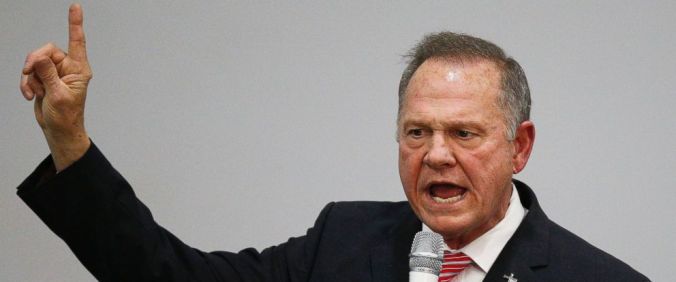
The Republican Party reversed its previously signaled course this week, and appeared to be supporting the Senate candidacy of Roy Moore. This has been greeted by Democrats, the leftward pundits and news media as the equivalent of the GOP endorsing Jeffrey Daumer. “This is the end of the Republican Party!” I have read, in various forms. meanwhile, the predictable feckless Senate Majority Leader Mitch McConnell also reversed himself. Once he said that Moore would not be seated if elected, said he believes Moore’s accusers and called for the candidate to step aside. Now he’s saying it’s up to Alabama voters to decide. “The people of Alabama are going to decide a week from Tuesday who they want to send to the Senate,” McConnell said on CBS’s Face the Nation Sunday. “It’s really up to them. It’s been a pretty robust campaign with a lot of people weighing in. The president and I, of course, supported somebody different earlier in the process. But in the end, the voters of Alabama will make their choice.”
Observations:
The Republican Party had an obligation not to endorse (or run) Moore before a single accusation regarding his fondness for teenage girls surfaced. He was already unfit for office; it wold be unethical to support him if he had the personal life of Pat Boone.
If the party somehow decides that stalking shopping malls for dates and persuading mothers to pimp out 14 year olds was nothing to get upset about in a U.S. Senator, there would still be the fact that Moore doesn’t believe in the rule of law, the Constitution, Equal Justice or the Bill of Rights, and that he’s an anti-gay bigot. These are more disqualifying than any sexual misconduct he engaged in 40 years ago. After all, I strongly suspect that 20-30, maybe more, U. S. Senators have engaged in past sexual misconduct that would make their continued presence in the Senate unpalatable. I don’t think any of them have acted or considered acting as Moore has, repeatedly violating the hierarchy of authority in the government, and arguing that that God has veto power over the Supreme Court. Mike Huckabee, at his worst, has said similar things, but he’s a talking head now; I can’t envision him actually defying a court order.
As I wrote back when the GOP had a chance to refuse to nominate Donald Trump, a political party is charged with maintaining the integrity of the government and our democracy, which means only offering for election candidates for office who are at least minimally qualified and trustworthy. That is a party’s duty: not just to win elections, but to win them with candidates of whom it can be reasonably and objectively said will serve the nation with honor and competence. That can’t be said of Roy Moore, and it never could.
To a great extent, all the focus on his teen dates obscure the real problem with his candidacy. Since a majority of Alabama Republicans don’t believe Moore’s accusers, this has helped him. Continue reading →