Ethics Dunce: The Dr. Seuss Museum

The fanatics who pollute the left end of our political spectrum apparently have no limits to their purges, political correctness tantrums, grandstanding, bullying, and efforts to warp the past, present and future. To fit their rigid view of a “just” culture, they have begun demanding that the cultural landscape must constantly be cleansed; no real or imagined discomfort to sensitive progressive souls can be permitted to survive in art, history, literature or the public square.

Since even their worst excesses are cloaked in self-righteousness and the Saint’s Excuse, what this requires of the rest of us—you know, those who have perspective and proportion, believe in diversity of thought, and object to airbrushing reality out of the nation’s palette—to have the courage and integrity to say, “No.”

Sometimes “Hell no.”

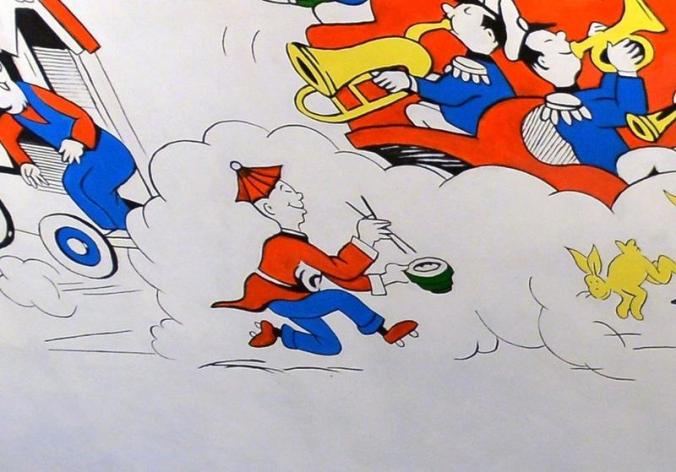
The directors of the new Dr. Seuss Museum in Springfield, Massachusetts lack these and other necessary markers of ethical character and responsible citizenship. Thus when three prominent children’s authors who had been invited to attend the Children’s Literature Festival at the Seuss Museum to be held on October 14 threatened to boycott the event because the above mural, painted to replicate a scene from Dr. Seuss’s “And to Think That I Saw It on Mulberry Street,”  was, they claimed, offensive, the museum cravenly excised that section of the painting.

Mo Willems, Mike Curato and Lisa Yee issued a public letter condemning the drawing as a “jarring racial stereotype… with chopsticks, a pointed hat, and slanted slit eyes.”

“We find this caricature of ‘the Chinaman’ deeply hurtful, and have concerns about children’s exposure to it,” they wrote.

If the directors possessed comment sense, principle or the backbone God gave a guppy, they would have written back,

“We are sorry you cannot attend, and also that you are so enamored of political correctness grandstanding that you would unjustly insult Theodore Geisel, his work, his millions of fans, and this museum by your false and hysterical characterization. We do not engage in censorship here, nor do we accept presentist slurs on past art that involve retroactively applying modern sensibilities or hyper-sensitivities, to classic works that are decades old.”

There is nothing racially jarring about Geisel’s painting of a “Chinaman” except to someone already looking for offense. Dr. Seuss’ drawings can be fairly termed cartoons. The definition of a cartoon is “a simple drawing showing the features of its subjects in a humorously exaggerated way.”  What are these juvenile children book authors asserting…that all cartoons are racially insensitive? That only cartoon of non-whites are offensive?

Let’s look at the offensive figure again: Continue reading

Putting Gun Control In Perspective: The Second Amendment’s Purpose, And How To Protect It

A guest post by texagg04


[The following is a rare guest post. The author is a previous winner of an Ethics Alarms commenter of the year award, which comes with the privilege of a guest post, though no winners have ever cashed their prize in. I decided this effort warranted special status beyond a Comment of the Day, in part because of its length, in part because of its immediacy, and in part because I think it should be read. Only Paul Peterson, the child performer advocate and a personal hero and friend, has been a guest commenter in the past.]

This topic fatigues me every time it arises. Watching the videos of the concert-goers simultaneously brought out two emotions, one of compassion and sympathy for the victims of the crime, and one of sheer “pre-exhaustion” knowing I’d be called upon to rehash all the same, solid arguments to counteract the emotion-driven “do-something-ism.” I’ve resisted wading into the debates because it is all so tiresome, though I have chimed in on occasion. But that doesn’t mean my mind hasn’t been wrestling with this crime, the 2nd Amendment, and the deeper philosophy behind it.

There are a handful of questions this debate inevitably boil down to. I will dispense with any notions that the 2nd Amendment exists for hunting or for fun, though those topics will arise shortly. No, we’ll start off on the honest premise that the 2nd Amendment exists as a democratization of force, where the Constitution, in a sideways manner, supplements the three branched checks-and-balances division of power, with a three tiered “balance of force”, where the National level retained control over the standing army, the States retained control over the Militias (when called out), and the People, armed, represented the lowest rung. And I am of the firm belief that the 2nd Amendment is STILL ultimately essential to liberty.

But that is really the first set of questions that the debate boils down to:

  • Can good modern governments still go bad or can we trust modern republics to not go bad?
  • How does one fix a bad government or a government on the way to becoming bad?
  • Can the citizenry oppose and correct those governments without force or threat of force?

I think that a perusal of the modern history of Western Civilization would tend to show us that yes, governments can most certainly go bad. The blood-letting of Europe from 1917-1945 and the follow-on competition that ended in the early 90s is proof that democracies and republics can flip rapidly into tyrannies. I think a simple survey of contemporary nations will show us that a large number of people are subjugated beneath the yokes of dictatorships. But what of the “good” nations that have disarmed their citizens? They don’t seem to be tyrannical, they seem quite free without a mass of armed citizens forever poised to check them.

I can easily concede that they are relying on the benevolence of their current leadership. It is working fine. For them. Right now.

Still, the essential check on malevolent people with force is the actions benevolent people with force. European nations currently have generally benevolent people with authority over them. We already know, however,  that this condition can change and can change rapidly. The peoples of other nations that descended into t oppression, as their culture and governments changed, thought they also lived in modern enlightened times, where tyrannies couldn’t happen to them. I’m moving to this segue because I think checks on these malign forces aren’t merely internal, but external as well. When the European central powers slipped into malevolent rulership, it was EXTERNAL forces of good that came and broke the dictatorships apart and restored the bad actors to republicanism.

I think a certain amount of “momentum” is maintaining that check on the rise of tyrannies in these disarmed nations with “benevolent” governments. That is, I think there’s still an aura of protection provided by the United States that deters any truly awful government from rising in Europe. Then again, that depends upon the presence of a benevolent people willing to use force to check the rise of a bad government. What then if the United States or other good actors stopped being good? I would submit that, disarmed, the people of Europe would have not one bit of ability to stop the rise of tyranny in their own nations.

So why does the United States seem to keep a government that is mostly good? (and it does, you naysayers) The answer is that it has a perpetual check against its getting out of hand: the armed populace. Does this political check absolutely require violent force or the threat of violent force? What about merely electing good actors to replace bad? What about protesting tyrants when they arise? What about petitioning the government for redress of grievances? What about speaking out freely against the dictators when they rise?

Those are all good measures to take when a citizenry must ensure it is in the right before a society slides past a point from which it cannot return from. All of them, however,  rely upon a generally benevolent government that will pause and consider the grievances listed by its people. History shows that a rising dictatorship  will not care, requiring the people to be more forceful in their demands than mere words can accomplish

Yes: governments, regardless of the advancement of the culture they preside over can still go bad. Yes, there are steps before a government goes bad to rectify the government without violence. No, if the government goes too far, the citizenry cannot fix the problem without violence or threat of violence. And if that the fix cannot come from benevolent outsiders, such as France aiding the colonists in 1776 or the United States and other Allies in World War II, then the citizenry is on its own.  Sans firearms, the citizenry will have little recourse, for tyrants don’t care about protests.

This leads to other questions. Are some cultures content with domineering governments that we would consider overbearing at the cost of our security against tyranny? If so, would it be a solution to our “gun problems” to become more like those cultures? Are some cultures more vibrant and energetic and assertive, in such away that all the positives that derive from that vibrancy and assertiveness are inherently accompanied by a set of negatives such as violence and discontent? If it is necessary to solve the violence and discontent by also throwing out the vibrancy and assertiveness worth the trade off?

I don’t want to dive into this too deeply here. It just seems obvious that our culture promotes assertiveness and vibrancy, which generally inculcates an attitude in its people that the government needs to primarily keep out of our business. That attitude, taken to the extreme, is ultimately manifested in a people that must be armed to check the government, as per the opening paragraphs of this essay. Is the violence we see more often in this nation than in others a negative by-product of assertiveness, ambition or individualism? Now, before our resident Europhiles complain, yes, many Europeans are similar, but in general, (and I’ve been to Europe), I’m not impressed. Make no mistake, they enjoy their culture, I’m not expecting them to change it, I just don’t think it’s a culture we want to adopt here, and it’s certainly not one that is any position to oppose a government that decided to overstep its bounds.

That being said, the violence in our nation, though on average now decreasing, still produces extremely violent acts.

(To be clear, I’m speaking of American culture as those values it has traditionally held to, not the “objective” culture that vast swathes of progressives would love us to morph into, a culture which is essentially European in flavor).

Where these two lines of questions collide—that is, the necessity of the 2nd Amendment, and the mass killings that occur at disturbing frequency—it probably is worth revisiting the concept of “Arms” and the right to bear them. I am certain that the ability of the citizenry to check the government is worth the gun violence in America. But can any real steps be taken to alleviate the scope of the violence when it occurs? Because make no mistake, that’s really all we’re discussing when we discuss disarmament: “Fewer people are killed by a mass murderer with a knife than with a machine gun”. Got it. The dude’s still a mass murderer, and you are only trying to keep the kill count down.

There is something to that logic. Yet even though preservation of life is BUT ONE value among many that our Republic perpetually balances, it really doesn’t possess trump-card power over other values. So, if we are to seek “minimization” of casualties as a goal, it can ONLY be found within a solution that preserves the 2nd Amendment’s goals.

Before proceeding, I’m going to take a moment to rehash an essay that I wrote a while back, which discusses the 2nd Amendment (bolded line was not bolded in original):

““A well regulated Militia, being necessary to the security of a free State, the right of the people to keep and bear Arms, shall not be infringed.”

We know the final clause “the right of the people to keep and bear Arms, shall not be infringed” is, on its face, fairly plain-spoken. That these words are hotly debated is baffling, they seem clear and obvious to me. Certainly, an amount of ambiguity exists about “What did the Founders mean by ‘Arms’”? Other arguments can be made about the meaning of “people”…did the founders mean to speak to a collection of individuals with individual rights or to directly to collection itself. But those ambiguities aside, the clause is concise and clear — the people have a right to bear arms; by extension of the philosophy enshrouded in the Declaration of Independence, it would be a natural right.

A review of contemporary documents would show that the term “keep and bear arms” does apply to individuals separately, that bear arms means to carry and use (for a variety of purposes). If this meaning does apply to individuals, then we have the meaning of the term “people”. As for the Founder’s meaning of “Arms”, that debate can rage on. A reading of the Federalist papers and scant few other documents and understanding them would indicate that the Founders intent in the balance of force is that the common man certainly at a minimum has the right to bear an equal firearm to the standard infantryman. It would seem the heavier weapons were relegated to the control of the separate states and to the national army (although the vagueness of Arms at the time does allow a wider definition – but even I don’t think their vision meant for the private citizen to own a tank or a nuke).

The prior phrase “….A well-regulated Militia, being necessary to the security of a free State..” is where I think the Founders are truly eloquent and packed a ton of meaning into 13 words.

Some would tell us that the strong full time army is enough to secure our country from invaders, therefore a ‘militia’ is no longer necessary, therefore the people no longer need the right to bear arms. But the Founders didn’t say “a military necessary to repel invaders”, they said “security of a free State.”They knew all too well that an unchecked central army can easily secure a State… but they wanted a free State. They knew from firsthand experience that centralized force is the primary tool of tyranny, and that only a heavily armed populace was a check against that.

Alexander Hamilton states in Federalist #29: “but if circumstances should at any time oblige the government to form an army of any magnitude that army can never be formidable to the liberties of the people while there is a large body of citizens, little, if at all, inferior to them in discipline and the use of arms, who stand ready to defend their own rights and those of their fellow-citizens.”

Some would tell us the militias existed because the nation couldn’t fund a large full time military. The Founders didn’t say “…Militia, being necessary to alleviate the financial burden of a large Army, and at which point it becomes financially viable, we will say ‘the Army, being necessary for the security of a free State.”

In the same Federalist Paper, Hamilton does assert that the militia does alleviate the financial and social burden of a large standing army, while immediately following with assertions that even should a large standing army exist, the militia would continue as a check against it.

Some would tell us the Militia was meant to be just a supplement. And, yes, all though that is one role of the Militia, that is not what the clause “being necessary” implies. They knew that a free State CANNOT exist WITHOUT a Militia at all! The phrase doesn’t say “A well regulated Militia, sometimes helps for the security of a free State…”. The Founders distinctly say the Militia is NECESSARY to the security of a free State. Because free States are not just attacked from without, but also from within.

What do we glean simply from “…Militia, being necessary to the security of a free State….”

A) the Founders, based on their experience, knew that security means secure from the outside AND the inside
B) the Founders specified precisely what is being secured…a *free* State
C) the Founders specified a non-military entity known as the “Militia”
D) the Founders didn’t just say the Militia was useful, but NECESSARY
E) the Founders considered that no *free* State can exist without the Militia.

Why all the emphasis on the militia and the citizen soldier versus a standing professional army? What is this “Militia”, what did the Founders mean by “A well regulated Militia…”?

The founders were certainly speaking about an organization of the separate people as a collected entity. But they understood that entity to be composed of everyone (yes, I know women and slaves etc didn’t count, but the spirit of the militia was that it was every individual). This, the collected, yet dispersed, force of *every* individual citizen, was the final force that was meant to be a check against the centralizing forces. A constant reminder to those wishing to impose non-republican and non-democratic will on the people, the militia and the right to bear arms (as individuals part of the whole) was viewed as indispensable to Liberty as the 1st Amendment, and all the others.

Since the earliest definitions of the militia clearly point to the notion that it is the entire body of the people derived from an INNATE duty of all individual citizens to safeguard the liberty of nation, I certainly do not think the National Guard or the Reserves or any of the armed federal agencies are the Militia. The various Acts and Laws forming those entities merely established professional standing armies, while co-opting the term “militia”. The militia – in terms of the necessary civic spirit of a vigorously liberty oriented people in opposition to the slightest pretext of centralizing and freedom-usurping forces – still and must exist.”

Okay, back on track:

I’m loathe to mention any compromises as the Left has demonstrated, for reason that a compromise today will merely be the next point to begin compromising tomorrow.  I think that we can seek some fair solutions to minimizing the casualties wrought by bad actors while still preserving the 2nd Amendment. I won’t call these “common sense” regulations, as I think the term is employed as a dirty trick of the Left to avoid having to make an argument. And fellow Libertarians, follow with me here and don’t get angry, as I’m stifling a certain amount of anger merely pondering this.

Let’s assume a premise, that yes, as Americans we shouldn’t have to be told what we can do with our possessions nor should we have to be told we can’t have something we want. I get it. I get that firearms have traditionally fallen into that category, but I also think that modern generations look at firearms much more differently than the Founders did.

[I feel it: you’re already bristling that I’m about to suggest that indeed, within the category of firearms, there may be more than just machine guns that the government can tell us we don’t need to have.]

Our modern culture has increased the “recreational” aspect of firearms to probably a level that the Founders would have found somewhat…troubling…? I personally don’t think it’s troubling, because MOST people can be trusted to shoot recreationally. But then again, Firearms at their essence are TOOLS of VIOLENCE, originally for sustenance and defense (against Criminals of all types). We have, as a consequence of our material and territorial success, been able to increasingly spend more time shooting for fun, such as targetry or hunting, than we have needed to spend shooting for defense, or for essential sustenance. Nevertheless,  you can’t divorce the modern luxury of shooting from its essential purpose.  Any sport and recreation derived from that purpose still arises from practicing the skills necessary to utilize firearms as a TOOL of VIOLENCE. Though the guns are “fun”, this does mean they are in a different class of “possession” than, say, your car, or your house, or your laptop. It does mean that maybe they need to be thought about as different sort of property, and a kind that  doesn’t get the automatic fruits of liberty pass of “I don’t need the government telling me what I can and cannot have”.

Though the firearms are private possessions and are…kind of fun…we can’t deny that there have to be some limits to firepower and potential destructive force  individual can possess, at without expensive permits and registration: Crew served machine guns…rockets…missiles…grenades… etc. Perhaps even these kinds of “potential casualty” considerations can apply to our small arms as well.

Now that I’ve lost most of my libertarian friends, the few hangers-on can possibly let out a sigh of relief, because the compromises I’m going to suggest are going to be seen partly as grossly stupid by the Left and partly as something that may be workable. Conceded: here must be a balance between the 2nd Amendment and the casualties that can come from misuse of firearms.

First, magazines.

You don’t need a 100 round drum…you don’t need a belt fed bullet backpack. Yes, they are fun. Yes, they support recreationally blazing away a lot of bullets without a reload. And I get it, I know you don’t need someone telling you what you don’t need, but, no, you don’t need them as part of the armed citizenry checking the power of an increasingly tyrannical government, which is the goal of the 2nd Amendment. In fact, I’d submit, you only need what an average infantryman carries: which is 7-10 x 30 round magazines. This will probably cause vapors among the Left who wouldn’t be content with anything more than a 3 or 5 round magazine, while simultaneously causing vapors among  libertarians who don’t want any limitations in this regard.

Tough. Your objections mean neither of you are considering the purpose of the 2nd Amendment. How does one actually enforce a limitation, not merely on magazine capacity, but on total magazines owned? I’m not sure yet, but maybe it’s possible. I’m more certain that magazine capacity CAN be easily limited to 30 round.  I don’t think total magazines owned could ever be limited due to the ubiquity of them across the community, but that may be made moot by a later suggestion.

Rate of fire modifications.

Much has been discussed of “bump firing” or “bump stocks” after the Las Vegas massacre. Yes, they are fun. Yes, they support recreationally blazing away a lot of bullets. And it’s crazy fun. Yes, I know you don’t need someone telling you what you don’t need. But, no, you don’t need modifications that replicate fully automatic firing as part of the armed citizenry checking the power of an increasingly tyrannical government. The primary infantry weapon carried has 2 firing modes: single shot and three round burst (and I only ever heard leaders telling their men to use single shot mode and to make every shot count). If the day ever came that armed insurrection is necessary, it will not consist of Johnny Rambo and his machine gun blazing down uniformed lines of cops; it will consist of many citizens likely with the backing of local or state governments. Those groups of rebels will operate effectively enough with weapons firing at a rate typical of semi-automatic weapons. This will probably piss off the Left, who would rather us be limited to bolt action weapons, this will probably annoy libertarians. But I submit that you aren’t considering the purpose of the 2nd Amendment, and  balancing that purpose against bad people killing a lot of innocent people. I think this would be noticeably easier to enforce than the first  suggestion, certainly there will be ingenious people who will make their own modifications, but it isn’t that simple.

Now it’s time to really piss off some people:

Ammunition possession.

Could there be a way to limit the total amount of ammunition possessed at any one time, without the burdensome “barcoded” ammunition that has been proposed? I don’t know. I do know that you don’t need 10,000 rounds of ammunition stockpiled. Yes, it’s fun. Yes, it supports the recreational ability to burn off rounds all day long without pause. Yes, I know you don’t need someone telling you what you don’t need. But, no, you don’t need enough ammunition to replenish a battalion through several firefights at any one time. I think, during the Founder’s era, anyone, as a member of the militia, would have been expected to have an ample amount of ammunition—for themselves—to last through a sustained firefight. I don’t know the numbers, but my guess is that would range anywhere from 30-60 rounds of ammunition. But those were different weapons and different standards of “firefight”. I could see a modern argument being made that the average soldier would need about 2-3 “battle loads” available…with a battle load being about 210 rounds of ammunition. Could there be a way to limit citizens to possessing at any one time 500-600 rounds of ammunition, without imposing onerous and invasive regulations? If so, then I could support that limitation. So far, I haven’t envisioned such a scheme. If that makes you angry, I don’t think you understand the purpose of the 2nd Amendment.

I do know this much, whatever schemes are in place, I would NEVER support them if they didn’t support anonymity of individual gun owners. With the rabidity of the Left’s hostility to guns, I would never trust a list of gun-owners to be collected anywhere. But, for example, if a limitation were placed on ammunition possession such that individual’s purchases were tracked and summed up, I would expect some sort of system would be in place to protect the identity of the purchaser unless the limit was reached. Maybe every gun owner has a type of license, with a unique identification number, such that, when an ammunition purchase is made, the unique identification number along with quantity of ammunition is passed on to the regulators, but no names are passed on. Unless at some point the unique ID number has associated with it, MORE ammunition that permitted, then that may trigger going down to the ammo supplier and getting the name of the individual (which would be on any receipts) and determining if there is reason to pursue legal measures. Of course, I have no way of figuring out how the ammo purchaser would reduce the number of rounds on their account based on firing them off so that they stay below or at the permitted amount when they purchase new. It might be completely unworkable.

Those are a handful of random brain-stormed ideas regarding the hardware of the 2nd Amendment that might work to protect the purpose of the 2nd Amendment while minimizing the potential casualties wrought by bad actors. Even then, I think the compromises still fall on the side of us just having to accept a certain level of killing as being the price of our freedom. All of the suggestions really unworkable, in which case, I’ll always default closer to the absolutist 2nd Amendment side of the debate every time, because checking the government that is also the world’s last great hope is WORTH IT.

What about the behavioral side of the 2nd Amendment?

As much as “mental health checks” prior to gun ownership sounds good, I don’t think I could get on board. I can foresee a future in which all manner of questions could be asked specifically to deny the maximum amount of people the ability to own firearms. It’s too easy to abuse and too easy to make the questions politically (or even religiously) flavored.

“Do you think the 2nd Amendment’s purpose is for the possible overthrow of the government?”

“Yes”

“You’re a nutjob, license denied”

or

“No”

“Ok, then you don’t need a firearm. Next!”

I think responsible exposure to and education about firearms from an early age IS a key component of people respecting the role of guns in society, and avoiding that dangerous fantasy that they are some sexy way to go out in a blaze of glory. Would mandatory firearms classes in middle school and high school be so bad? I don’t think so. In fact, I don’t think you can be a responsible and complete citizen if you aren’t at least familiar with the function and employment of firearms.

Should gun owners periodically demonstrate safe handling, possession, and use of firearms? Yes. But I can only back such a requirement if anonymity is maintained at the lowest level possible. That is to say, the only people who know you are due for a “firearms test” are the locals. I cannot support this if aggregated lists of gun owners were made state wide, or national.

Beyond these possible measures I have suggested— I’m not even satisfied by them, as they may be oo difficult to enforce or too easy to become tomorrow’s benchmark for the next round of “common sense” compromises leading us ever closer to total confiscation— I doubt there are many others that are enforceable without the country becoming a police state. That we cannot allow. We may have to live with periodic casualties of liberty.
 

Comment Of The Day: “Morning Ethics Warm-Up, 10/3/2017: In the Wake Of Las Vegas…”

Michael R. has been a stand-out commenter at Ethics Alarms since the blog’s inception. He also has been missing in action for more than a year. Thus it was a pleasure not only to see him back on the field of ethics battle, but arriving with a Comment of the Day. Michael takes off from the discussion of the national reaction to Stephen Paddock’s puzzling rampage to examine the state of trust in our society. Here is his Comment of the Day on the post, Morning Ethics Warm-Up, 10/3/2017: In the Wake Of Las Vegas…

I think the worst part of the aftermath of this tragedy is I don’t know who to trust. Should I trust reporting on this event that comes from CBS after their vice president announced on social media that she had no sympathy for the victims because many were Republicans? When President Obama tweeted “A violent felon can buy the exact same weapon over the internet with no background check, no questions asked.” — @POTUS #StopGunViolence”, the media fact-checked this and stated it was ‘mostly true’, so should I trust any of them? What news outlet can I trust to give me a truthful account of what happened?

Should I trust the FBI? James Hodgkinson was a member of numerous anti-Republican newsgroups (like “Terminate the Republican Party”), believed Donald Trump was president because of Russian collusion, took photos of the baseball field after the New York Times published an article on where and when the Congressmen would practice as well as the fact that there would be little security, traveled to the D.C. area and was living out of his van right next to the baseball field for days before the attack, Googled “2017 Republican Convention” hours before the attack, and asked “Is this the Republican or Democratic team?” before firing on the Republican Congressmen. This man shot up a bunch of Congressmen and what did the FBI say about all this? They said that Hodgkinson “…had no target in mind” when he shot them, that they didn’t know who he planned on targeting, and that he may have just “happened upon” the baseball game and “spontaneously” started shooting. Should I trust the FBI on this one? All the information at the beginning of this paragraph was from the FBI and the latter part is the conclusion they drew from the info. The FBI also said they didn’t wiretap Trump Tower, then admitted that they did…at least twice. Continue reading

Comment Of The Day: “Morning Ethics Warm-Up, 10/3/2017: In the Wake Of Las Vegas…”

I would love to post a Comment of the Day by a full-throated and honest advocate of new gun control measures that will “stop gun violence,” but have yet to read one that isn’t a poorly-veiled attack on the Second Amendment. On the other side, we have Rusty Rebar, one of many Second Amendment advocates on various post-Las Vegas Strip massacre threads here, who registered a tough indictment of the “do something!” anti-gun lobby.

Here is his Comment of the Day on the post, Morning Ethics Warm-Up, 10/3/2017: In the Wake Of Las Vegas…

“Hell, the NRA used to support background checks, although they no longer do. What’s changed? Why is there that disconnect?”

I think this is attributable to the gun control crowd. The NRA used to be more conciliatory when it came to “common sense” laws. But the gun control crowd kept pushing and pushing, and the NRA has basically said “not one more inch”. So now, even something that is considered “common sense” to everyone will get no traction, because the gun control crowd kept pushing things.

I have said this before, and will recap here. There is a way to do background checks that will be acceptable, and even preferable, to everyone, but the gun control crowd would never allow it.

First, we need to understand the purpose of a background check is to determine if the person buying the gun is legally eligible to do so, nothing more, nothing less. That is not what gun control proponents want though, they want more, they want a registry of all purchases. That is beyond the scope of a background check. Continue reading

Morning Ethics Warm-Up, 10/5/2017: Stupid Quotes Edition…Plus “Catalexit”

Good Morning!

1 The Las Vegas Strip massacre has triggered so many dumb and unethical quotes flying around on social media and out of the mouths of elected officials that it’s hard to keep up: any of them could sustain a full post.

  • Here’s one from Gloria Steinem, quoted approvingly by a feminist Facebook friend:

“How about we treat every young man who wants to buy a gun like every woman who wants to get an abortion — mandatory 48-hr waiting period, parental permission, a note from his doctor proving he understands what he’s about to do, a video he has to watch about the effects of gun violence, an ultrasound wand up the ass (just because). Let’s close down all but one gun shop in every state and make him travel hundreds of miles, take time off work, and stay overnight in a strange town to get a gun. Make him walk through a gauntlet of people holding photos of loved ones who were shot to death, people who call him a murderer and beg him not to buy a gun.It makes more sense to do this with young men and guns than with women and health care, right? I mean, no woman getting an abortion has killed a room full of people in seconds, right?”

Wow.

First, we learn that no matter what the human tragedy, all some activist can think of is how it can further their own single issue obsession. With Gloria, that single issue abortion, even though there are no helpful or intellectually honest comparisons to be made between guns and abortions. Second, we learn that Gloria never grasped the old “two wrongs don’t make a right” concept.  The various abortion-blocking measures she alludes to are all unethical and unconstitutional interference with a Constitutionally protected right, but she would joyfully inflict them on citizens trying to exercise their rights, because she doesn’t care about those.

  • This one is more surprising and depressing: Matthew Dowd, a regular on ABC’s Sunday morning round-tables with George Stephanopoulos,  meaning that he is presented as competent, historically informed, and trustworthy, actually tweeted,

“2nd amendment was all about having a militia available to protect the government from threat foreign or domestic w/out a standing army.”

This is not just wrong, but spectacularly and inexcusably wrong. Dowd is either lying, ignorant, or unable to process information. His nonsense has been used by anti-gun fanatics for decades, but the Supreme Court and the vast majority of Constitutional scholars reject it, concluding that the Bill of Rights, which all focus on individual rights that cannot be taken away by the government, would not include as #2 provision endorsing militias and nothing more.

The tweet should disqualify him from commenting on any gun policy issues from now until the stars turn cold.

  • I decided that Rep. John Lewis (D-GA) has already been exposed enough on Ethics Alarms this year (as a result of his unethical and divisive boycott of President Trump’s inauguration) that I don’t need to hand him another Ethics Dunce, but this rant delivered during an appearance on MSNBC’s “Hardball” (which network has been more shameless in anti-gun ravings, MSNBC or CNN? Tough call…) is certainly worthy of the award:

“The American people will not stand to see hundreds and thousands of their fellow citizens mowed down because the lack of action on the part of the Congress…We have to do something…The time is always right to do what is right. We waited too long. How many more people will die? Would it be a few hundred? A few thousand? Several thousand? We have to act. We cannot wait.”

This should be enshrined in the “Do something!” Hall of Fame. Lewis never hinted at what exactly will end gun deaths, just that Republicans and the NRA are responsible for not doing it. This is pure demagoguery and designed to mislead and inflame his party’s Second Amendment hating base. “We have to act! We cannot wait!” Continue reading

Assorted Observations On The Sandy Hook Ethics Train Wreck, Las Vegas Strip Edition

  • I was serious about directing anyone seeking ethics commentary in reference to the Las Vegas massacre to all of the posts tagged with the Sandy Hook Ethics Train Wreck tag. So far, there is nothing new being said or proposed, just an unleashing of the same tactics, same fake “facts,” and same rending of garments and tearing of hair, whatever that is. I suppose this is healthy as a cultural release, though not in nay other respect. That tag wasn’t on this basic Ethics Alarms post, however, and it is the starting point for any of my commentary on gun control-related matters. The intentionally stark title: The Inconvenient Truth About The Second Amendment and Freedom: The Deaths Are Worth It.

Oh, hell. I’m just going to re-post it. Be back in a second.

There. It’s up.

  • So much of the blather everywhere is naked virtue signaling. One commenter here who should know better wrote on one of the other posts that I was criticizing those who were decrying gun violence. Who doesn’t decry gun violence? Why is it necessary to proclaim the obvious? Oh, you really are horrified that 59 innocent people were killed and 500 were wounded? What a sensitive person you are! You are so good, I must take your insistence that we have to do something as a substantive contribution to the discussion.

Decrying senseless violence and wanting gut the Bill of Rights in response are not the same thing, not even close. The first is gratuitous and obvious, and the second is emotional and irresponsible.

  • I would not be surprised at all if President Trump further muddled this already incoherent debate by endorsing some new (or old) gun control measures. He would do this, presumably, as he seems to make most decisions, from the gut, or the seat of his pants, or because it seemed like a good idea at the time. The chances that he has thought deeply about the issues involved are nil; the chances that he is familiar with the jurisprudence on the matter is less than nil. It would almost be worth it to watch the reshuffling of loyalties and support among the pundits and commentariat.

Real Nazis, after all, want to confiscate guns.

  • Once again, the NRA is being vilified, with the disgusting “blood on their hands” cry. The NRA isn’t sort of like the ACLU; it’s exactly like the ACLU, but with more integrity. If only the ACLU fought to defend the First Amendment as vigorously as the NRA defends the Second. Organizations that take the extreme position on any of the sections of the Bill of Rights create a necessary counterweight to fanatics who would tear them out of our Constitution and culture.

The NRA is extreme. It has to be extreme. The ACLU isn’t extreme enough, and because it will not take an absolutist stance (Like late SCOTUS justice William O.Douglas, who repeatedly wrote that no restriction on speech was justifiable or Constitutional), it has made itself vulnerable to bias, and harmed its credibility.

  • It is astounding to me—I guess I foolishly expect people to learn—that the eruption on the latest anti-gun fervor is again being led by ignorance, hyperbole and finger-pointing. The argument of  the Federalist essay I posted the link to this morning should be clear as glass: making this a partisan issue guarantees that nothing will get done. Democrats sounding like they are seeking a slippery slope leading to the banning of all firearms guarantees no action whatsoever, dooming even reasonable measures. Forever. Do they really not understand this? Do they really want to try to fix the problem, to the extent it can be fixed? I wonder.

Progressives mostly refuse to read conservative publications like The Federalist. They would rather be pure and stupid than informed and effective.  And this, my friends, is why Donald Trump is on his way to a second term.

  •  The tenor of much of the blather from elected officials and pundits reaffirms my belief that adulthood is a myth.  I keep hearing various versions of the lament, “We can’t let this go on! How can we stop it from happening?”

Continue reading

Ethics Alarms Encore: “The Inconvenient Truth About The Second Amendment and Freedom: The Deaths Are Worth It”

[ I wrote this piece in 2012, in response to the reaction at the time from the Second Amendment-hating Left to the shocking murder-suicide of of the Kansas City Chiefs’ Jovan Belcher. Jason Whitlock, then a thoughtful sports columnist iin KC, wrote a much linked and publicized column calling for private ownership of guns to be banned. I was going to update my post, but decided to just put it up again. Some of it is obviously dated (the reference to juvenile Carl in “The Walking Dead,” for example), but I have re-read it, and would not change a word of its substance.]

The shocking murder-suicide of of the Kansas City Chiefs’ Jovan Belcher has once again unleashed the predictable rants against America’s “culture of guns” and renewed calls for tougher firearms laws. Yes, reasonable restrictions on firearms sales make sense, and the ready availability of guns to the unhinged, criminal and crazy in so many communities is indefensible. Nevertheless, the cries for the banning of hand-guns that follow these periodic and inevitable tragedies are essentially attacks on core national values, and they need to be recognized as such, because the day America decides that its citizens should not have access to guns will also be the day that its core liberties will be in serious peril.

Here is Kansas City sportswriter Jason Whitlock, in the wake of Belcher’s demise:

“Our current gun culture ensures that more and more domestic disputes will end in the ultimate tragedy and that more convenience-store confrontations over loud music coming from a car will leave more teenage boys bloodied and dead. Handguns do not enhance our safety. They exacerbate our flaws, tempt us to escalate arguments, and bait us into embracing confrontation rather than avoiding it… If Jovan Belcher didn’t possess a gun, he and Kasandra Perkins would both be alive today.”

I don’t disagree with a single word of this. Yet everything Whitlock writes about guns can be also said about individual freedom itself. The importance of the U.S. “gun culture” is that it is really individual freedom culture, the conviction, rooted in the nation’s founding, traditions, history and values, that each citizen can and should have the freedom, ability and power to protect himself and his family, to solve his or her problems, and to determine his or her fate, without requiring the permission, leave or assistance of the government. Guns are among the most powerful symbols of that freedom. You can object to it, fight it or hate it, but you cannot deny it. Guns are symbols of individual initiative, self-sufficiency and independence, and a culture that values those things will also value guns, and access to guns.

Whitlock’s statement argues for building a counter-America in which safety, security and risk aversion is valued more than individual freedom. There is no doubt in my mind, and the results of the last election confirm this, that public support for such a counter-America is growing. The government, this segment believes, should be the resource for safety, health, financial well-being, food and shelter. It follows that the government alone should have access to firearms. This requires that we have great trust in central government, a trust that the Founders of the nation clearly did not have, but one that a lot of Americans seem ready to embrace. Giving up the right to own guns and entrusting government, through the police and the military, with the sole power to carry firearms represents a symbolic, core abandonment of the nation’s traditional commitment to personal liberty as more essential than security and safety. I would like to see the advocates of banning firearms admit this, to themselves as well as gun advocates, so the debate over firearms can be transparent and honest. Maybe, as a culture, we are now willing to make that choice. If so, we should make it with our eyes open. Continue reading

Morning Ethics Warm-Up, 10/3/2017: In the Wake Of Las Vegas…

Good Morning.

1 The reaction of the anti-gun forces is so depressingly predictable, the arguments being put forth are so well-worn, the demonization of those who comprehend the importance of the Second Amendment so shameless and the misrepresentations are so familiar. I am considering just ignoring it this time, and referring anyone to the copious essays already written here tagged with Sandy Hook Ethics Train Wreck. Maybe I should just re-publish them after using a search and replace to switch Sandy Hook and New Town with “Las Vegas Strip.”  I’m sure in future months we can look forward to testimony at various legislative hearings by family members of the slain and wounded, as our elected officials, as usual, choose to use emotion, sentiment and grief to ram through legislation that they could not and cannot justify if the public’s attention isn’t distorted. I was on the road most of yesterday: has Hillary shot off her mother yet? Obama? Piers Morgan? Jimmy Kimmel? Diane Feinstein? I honestly haven’t had a chance to check. How quickly did some predictable Ethics Alarms commenters use the tragedy to start attacking gun ownership? By the time I finish the Warm-Up, I’ll probably know. I’ve made a few wagers with myself…

2.  Fake news, hoax postings and irresponsible rumor-mongering was rampant after the shooting. Is there any point in noting that ISIS, with its apparently false claim that this was one of its terror attacks, is unethical?  How about 4chan, which deliberately pinned the crime on the wrong man, and habitually inaccurate conservative websites like The Gateway Pundit, which circulated the lies? Twitter users with the character of poorly raised reptiles also got in on the fun: From the New York Times:

In a telling exchange, Gianluca Mezzofiere of Mashable reached out to the operator of one Twitter account sharing misinformation and reported the following:

Mashable reached out to the troll to ask why he’s spreading misinformation during such a critical time.

“I think you know why,” he replied. “For the retweets :)”

When Mashable pointed out that it’s unethical to spread misinformation when people are desperately looking for their missing family and friends, he just said: “You are right I’m sorry.”

“Jack Sins” said he chose TheReportOfTheWeek (aka Reviewbrah) just because he’s a meme and tweeted Johnny Sins because he “is a living legend.”

Asked whether he’s done it before and whether he’d do it again, he replied:

“Yes and maybe.”

Continue reading

Do Good Friends Let Friends Publish Garbage On Social Media? The Duty to Knock Down Irresponsible Opinions

“Stop quoting Maxine Waters!”

I just arrived at Virginia Beach Double Tree after a four hour plus drive in the dead of night. This gave amble time to obsess to the point of madness on Facebook post I saw from a friend. This is a smart, educated person; published in fact. Yet the post was (I am paraphrasing):

“I don’t understand Republicans. They must prefer Pence to Trump: why won’t the join Democrats in impeaching the orange bastard? I don’t get it.”

This post garnered many likes in the Facebook echo chamber, and several theories.

Now, this is not just an uninformed opinion. It is a dangerous opinion. It misinforms everyone who reads it and who has reason to trust and respect the writer. It is written in complete ignorance of the Constitution, and an irresponsible misinterpretation of what American democracy is.

I shouldn’t have to explain this further, but what the hell: if the Founders intended for our system to be a modified parliamentary arrangement where the public can try to elect a President but if Congress decides it prefers someone else, like the Vice-President, it can veto the election with a sufficient majority, then Madison, Mason et al. would have made that clear. Instead they made it clear that an elected President can only be impeached upon a guilty verdict in a Senate trial for “high crimes and misdemeanors,” which means unequivocal, serious and substantive wrongdoing, usually criminal. Yet a frightening number of progressives, driven to fantasy by listening to irresponsible and incompetent elected demagogues like Maxine Waters, actually embrace an imaginary version of our government that, if real, would render democracy a cruel fraud. Continue reading

Call Me An Alarmist, But This Alarms Me Greatly: The Censorious On-Line Anagram-Maker [UPDATED]

In a recent thread—the context is unimportant—commenter Chris facetiously wrote that “Auntie Yang’s Great Soybean Picnic” is an anagram for “Hitler Did Nothing Wrong.” My mind working the way it works, and being incapable of anagrams myself, I immediately went to an online anagram generator, and typed in “Hitler Did Nothing Wrong.”

The page, Wordplays’ Anagramer, told me that there were no anagrams for that phrase, which is, of course, isn’t true.  [UPDATE: See below] “Auntie Yang’s Great Soybean Picnic” isn’t one of them, but there are thousands, my favorite being (courtesy of a the ethical anagram generator here), “Deriding Hog-thrown Lint.” I always deride hog-thrown lint myself.

I amguessing that the only reason Wordplays refused to give me the anagrams I requested was that it decided that I shouldn’t have the right to even write or think the phrase “Hitler Did Nothing Wrong.” Somewhere in programming their site the social justice warrior totalitarians have decided that “bad words” and “bad ideas” can’t be used or thought about, even in jest. Even in an anagram!

‘First  they came for “Hitler Did Nothing Wrong, ” and I did nothing. Then they came for “Deriding Hog-thrown Lint.”‘

This isn’t funny, this is scary. There is a large and growing segment of the American public, many quite powerful, who believe in social change by constriction of words and thought. They see technology as their ally, and those who run technology companies show every sign of being such.

These are enemies to democracy and our liberties as defined by our Founding documents, our traditions and history.

They aren’t enemies because they block anagrams due to their crippling political correctness and arrogance.  That just means they are silly fools. They are enemies because they don’t think using their power to interfere with the speech and thoughts of others is wrong. They think they are doing good.

And if they can–if we let them—they will warp our culture  using laws, intimidation, indoctrination and, of course, technology until everyone believes that controlling words and thoughts is good.

If you think this is just about anagrams, you’re dangerously naive.

UPDATE: Commenter/Blogger Windypundit, who is surely more savvy in these matters than I am, writes in the comments,

I went over to the Wordplays Anagrammer site to play with it. The thing is, I can’t reproduce your results. When I enter the phrase “Hitler Did Nothing Wrong” it displays hundreds and hundreds of anagrams.

Maybe it was just a glitch? …I thought maybe it didn’t work in some browsers, but it worked in all five I tried.

I don’t know what’s going on. I tried twice, and got a “No anagrams found” message. I will assume that it’s me, not them.

The general position of my post stands, however. Even if the web isn’t censoring anagrams, there is a lot of manipulation going on.

Many thanks to Windypundit for the research and the report.

____________________

Pointer: Chris