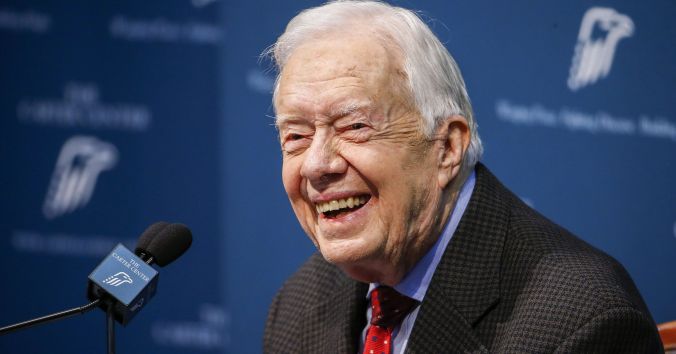
Here is Steve-O-in NJ’s Comment of the Day:
***
Well, I have plenty to say about Carter, and this I will post the moment they announce his death.
I have only very vague recollections of the Carter administration, since I was a kid in single digits at the time. Two things stick out in my memory, though.
One was myself and my brother, also a young kid at the time, bickering in the beltless back seat of a 70s-vintage chartreuse VW beetle while mom sat in line on Paterson Plank Road thirty cars back from the gas station, waiting for gas so scarce it had to be de facto rationed. This car, purchased as a cheap second vehicle (and frequently made fun of by my classmates) had no air conditioning and that line did not move more than five miles an hour, so it was not possible to use the wind to cool off. There was nothing for us kids to do but swelter and nothing for the adults to do but seethe at the fact that Jimmy Carter’s policies regarding the Middle East and the Persian Gulf had landed us in this pickle, and no relief was in sight. The flip side of that was a bitterly cold winter where we set the heat to 65 degrees because that was all we could afford. His answer? Put on a sweater and turn those extra lights off. It’s one thing to try to do more with less in wartime when you face a designated and (hopefully) beatable threat. It’s another to have a diminished lifestyle because the man elected to lead this country was not doing his job anywhere near as well as he could have and should have been.
The other thing that sticks out in my memory was the daily number. No, not the lottery number, we were never fortunate enough to guess that, and not the Sesame Street number of the day either, although for a while that decade that still reached this house on the fat, bunny-eared television in the living room opposite the period covered sofas (featuring a weird pattern of circles in squares in black, off-white, and ginger orange), on which you had to change the seven or so channels manually.
I’m talking about the number that appeared daily behind the anchors on whatever network you got your news on, as they solemnly intoned that today was whatever day it was that the 52 diplomats and other hostages continued to be held in Iran. It ultimately reached 444 days, a full year plus 79 days, counted out day by excruciating day, each of which there was more and more of a feeling that our country, and by extension, we ourselves, could do nothing but wring our hands in anguish and powerlessness. Oh, there was one attempt to rescue them, Operation Eagle Claw, which never even left the staging area due to mechanical issues. Even the withdrawal was a disaster, leaving 5 US airmen and 3 marines dead. It was one of the lowest points in American military history, equaled perhaps only by the failed mission into Bolshevik Russia to kill the Communist serpent in the cradle, of which then-president Wilson said, “the tragedy was that it cost lives even to fail as badly as they did.” It was also the nail that closed the coffin on this utter failure of a presidency. Ironically, Carter has now become the president to escape the actual coffin the longest of any, although the last three presidents to die all made it well into their 90s.
Frankly, he is someone who, under normal circumstances, wouldn’t even have been considered as a candidate, leave alone been elected. He is someone who SHOULDN’T have been considered or elected under ANY circumstances. He was a once-failed, once-elected governor who was supposedly a civil rights idealist, but who tried to please both the civil rights Democrats and the still-powerful old-school southern Democrats. He engaged in symbolic measures like putting up pictures of prominent black Georgians in the state capitol, but opposed race-integration busing and did not hesitate to sign a revised death penalty statute that addressed the then-liberal SCOTUS’ issues with the existing statute in Gregg v. Georgia, which came damn close to throwing the penalty out nationwide. Of course, he later said that he regretted doing that and his position had “evolved,” which is Democrat-speak for flip-flopping. He was not well-known outside of Georgia.
What most folks don’t know is that he made a presidential bid in 1972, trying to use the same triangulation tactics between the civil rights left and more conservative right, that he had used as governor. That bid did not get very far, and the Democratic ticket that year was George McGovern and Thomas Eagleton, which went down in the second biggest defeat the Democratic party suffered in a presidential election, surpassed only by Ronald Reagan’s 49-1 near-clean sweep of the entire country in 1984. Just as John Kasich later planned to do after the catastrophic defeat of the GOP that failed to materialize in 2016, Carter swiftly made a move to “pick up the pieces” and move into the frontrunner slot for 1976. Although he did not succeed in an attempt to become chairman of the Democratic Governors’ Association, he did become chairman of both the Democratic National Committee’s congressional and gubernatorial campaigns. Ironically, he warned AGAINST politicizing the Watergate hearings, but a bit more on that later.
His recognition when he announced his candidacy for president a second time was 2%. The better-known Democrats scoffed and said, “Jimmy who?” Conventional wisdom was that he was a regional candidate who would have limited appeal outside the south. However, Carter had two factors working in his favor in the political perfect storm that was the United States political scene in 1976. One was the aforementioned regionalism. Normally, that would have worked against him, as it would have against any candidate in a country where the Northeast, the South, the Great Plains, the Southwest, and the West Coast were all VERY different in many ways. However, he happened to arrive as a Washington outsider just as the country’s trust of Washington and established politicians, as well as of the GOP, was at arguably the lowest point it ever reached due to Richard Nixon’s unnecessary overreach that led to all that followed. In the wake of Watergate and Gerald Ford’s pardon of Nixon to “close the book” on that episode and move forward, an outsider who promised never to lie to the American people looked like an attractive option. He looked especially so when matched against a man who had never been elected as president or vice-president, whose main act was pardoning Nixon, and whom the media played up as an oafish klutz (when in reality he was a college football all-star AND Phi Beta Kappa) by emphasizing a slip, a golf stroke gone awry, and a tennis serve gone wrong, any of which could have happened to anyone.
Continue reading →










The tricky ethics balancing act engaged in by professional athletes’ agents has been a regular topic of examination here from the very start, particularly the apparent conflicts of interest facing agents who might be inclined to tell a client to take less than the top monetary offer for other factor that might affect a player’s career and enjoyment of life.
I don’t know why you’re paying attention to me, though: Ethics Alarms has a real former player agent among the commentariat, and below are some of his thoughts on Padres star Manny Machado opting out of his contract to seek riches he neither needs nor could possible use.
[Since 77Zommie offered this Comment of the Day, it was reported that Manny has indicated that he is discussing an extension with the Padres, meaning that he’s taking advantage of his contract that allows him to become a free agent after only five years (the contact he signed in 2010 was for ten at 30 million bucks a year) but giving his current team an opportunity to craft a new deal to keep him around. This, after saying he would be going on the open market.]
Here is 77Zoomie’s Comment of the Day on the post, “Baseball Ethics Dunce: San Diego Padres Third Baseman Manny Machado”…
***
A couple of thoughts on this post from the vantage point of a 20-year-plus former National Football League Players’ Association agent.
Most of the younger professional athletes with whom I interacted were fixated solely on money as a marker of professional success. This was especially true for players who came from poor or underprivileged backgrounds where financial success was almost unheard of and any affection directed their way tended to be purely mercenary. This is particularly true of those athletes who were identified as potential superstars early on in middle and high school. Those kids were surrounded by peers, adults, and an army of hangers-on who hoped to make some type of claim in the event the athlete strikes it rich. The culture surrounding many of these future superstars instructs them that without money, they have no respect, few friendships, and little access to members of the opposite sex. In other words, these players come into the professional leagues with a well-developed sense that money is virtually the only way they can define themselves as a success.
This attitude usually starts to change as the player matures after several years in the leagues. He interacts with similarly situated peers, many of whom are older, and understand how fleeting is the fame and how phony are the friendships and romantic relationships that are contingent on his paycheck. At some point, several of my clients came to understand that their professional and personal success involved more than simply being the biggest contract number, as they started to build a network of other players, coaches, sportscasters, and, in unusual cases, former teachers or professors and work toward a post-playing career.
But, as George Costanza frequently said, “ you just can’t help some people.” I had other clients who never got beyond the numbers game and remained unable or unwilling to assess the intangibles that really are the rewards of an athletic career. For those folks, I simply worked to get the best number that I could while trying to inject some sense of reality into their worldview.
There are other factors at work in these situations, as well. My father was an NFL coach from the mid-60s through the early 90s and I had an inside view on how the relationship between the players and their communities changed dramatically as more money moved into professional sports. NFL players were not particularly well-paid through the first two decades of my father’s NFL coaching career. Every one of them had to have some kind of backup employment in the offseason to make ends meet. As a result, players had to integrate Into their communities with jobs and careers that in many cases proved to be more lucrative than football. Considerations of family stability, fan loyalty, and team camaraderie are much more important when you don’t have the financial security to walk away and do nothing else to make a living.
Finally, do not discount the influence of the agent in these negotiations. The only effective marketing tool for professional sports agents is public knowledge of the value of the contracts they negotiate for their clients. The agent will push the player to demand the biggest contract possible, and then push the player to renegotiate if the market changes. An agent who is not doing this consistently will very quickly find himself or herself being undercut by other agents who will reach out to the client to say that money is still on the table that should be in the player’s pocket.
I’m sure there are elements of all of these factors in Machado’s situation.