Comment Of The Day: “Ethics Verdict: “Non-Math Propaganda Does Not Belong In Math Textbooks”

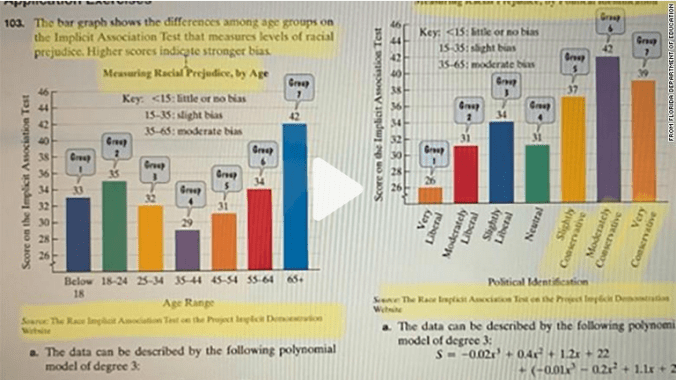
Here are Humble Talent’s observations, a Comment of the Day, regarding the matter of math textbooks and teaching being used as a method to seed “social justice” constructs, which was discussed in the post, Ethics Verdict: Non-Math Propaganda Does Not Belong In Math Textbooks”:

***

What’s been interesting to me recently is the fundamental lack of self awareness exhibited from progressives in these cases.

I get it. They’re bubbled. They do a disproportionate amount of their communication either with people who already think like them or with strangers on platforms that filter their already tilted perspectives through algorithms or self curation. But at some point it beggars belief.

I wrote about CRT last June (https://humbletalent.substack.com/p/critical-race-theory?s=w), and predicted that it would be the issue we’d still be talking about in 2022. It’s a racial issue, which progressives feel very strongly about. It’s an issue where they are wrong, but refuse to reflect on. And it’s an issue with a *very* interested and entrenched demographic involved (parents). Continue reading

Comment Of The Day: “Observations On The Unethical Tweet Of The Month”

Michael West’s Comment of the Day was less a commentary on  a post than an observation triggered by it. There’s been a lot of lawyer-style analysis around here of late, so it’s high time for an engineer’s perspective—in some respects the reverse of the legal problem-solving method–  to be highlighted, in reaction to the post, “Observations On The Unethical Tweet Of The Month.”

***

Science is a wonderful thing. The rise of empiricism as a practiced discipline by professionals from it’s rudimentary roots in ancient philosophy has allowed mankind the ability to learn beyond his superstitious ancestor’s imaginations. And combined with that human imagination – the knowledge gained by science has empowered us to manipulate, to engineer, incredible solutions to direct problems as well as reduce mere inconveniences and discomforts to non-entities.

Scientists and engineers, by merely studying a problem, determining predictable laws that govern the interactions within problems and using that knowledge to develop a solution, opened up the power of man’s intellect.

But therein lies another problem. We think we can engineer, we can manipulate our way to solve everything. We think we’ve studied the factors going into a problem so thoroughly that we know the right solution. I’m an architect, and we have a saying – “A problem thoroughly defined is more that half-solved”. By “defined”, we mean, researched, studied, determined our constraints and our opportunities. Very rapidly, in the design process – the more we spend in studying the problem the more our options are narrowed down to one or two appropriate solutions. Soon, the solution presents itself. Continue reading

Comment Of The Day: “Ethics Quiz: Terms Of Affection And The Second Wife”

I guess I should apologize for using that clip to introduce DaveL’s sensitive and wise Comment of the Day, but I couldn’t resist: just leaped into my head. Otherwise, his superb observations need no introduction.

This is DaveL’s Comment of the Day on the post, “Ethics Quiz: Terms Of Affection And The Second Wife.”

***

I lost my first wife at a young age. She was 30, I was 26, we had been married a little over two years. I’ve since remarried, and have been so for nearly 13 years.

Widowhood seriously messes with people’s heads when it comes to timeless ideas of true love and fidelity. Divorce they can cope with – clearly that person wasn’t “the one”. It “wasn’t meant to be.” The pledge you made to love them for the rest of your life has been ruptured, no more need be said about it. But widowhood, particularly in the young who remarry, screws it all up because they feel they must choose one spouse to be “the one”, the “real” spouse, the “love of one’s life”, and the other one denigrated to understudy status. Continue reading

Comment Of The Day: “First Vice-Presidents And Supreme Court Justices, And Now NFL Offensive Assistant Coaches”

Existentialist warrior and unique Ethics Alarms commenter Extradimensional Cephalopod’s Comment of the Day on the post about the NFL’s requirement that all teams hire a “minority” assistant offensive coach in the pursuit of “diversity, equity and inclusion” marked the first mention here of the Matthew Effect, often loosely summarized to explain why, as the song says, “The rich get richer and the poor get poorer.”

Here it is; the triggering post is “First Vice-Presidents And Supreme Court Justices, And Now NFL Offensive Assistant Coaches.”

***

Although I agree with most of the sentiment, I should clarify something about this point: Jack wrote:

“In other words, they must receive remedial training because they would not have been hired based on their experience or demonstrated skills.”

Highly competitive fields such as sports, entertainment, business…–okay, basically all fields on this inhospitable planet–are subject to the Matthew effect. . With multiple stages of competition, extra opportunities early on lead to exponentially more opportunities at each subsequent stage, due to the greater experience and exposure attracting more mentors and benefactors.

If you’ve read Freakonomics, you may be familiar with how hockey players’ birthdays are all around the same time of year. Based on the birthdate cutoffs for when they started school, they would have been the oldest students and therefore the biggest and strongest, and therefore they received preferential treatment from coaches looking to build competitive teams. Each year their greater experience and skill due to the previous year’s preferential treatment led to more preferential treatment, et cetera. These advantages added up over the years until they became professional athletes.

If we assume that a person’s minority status prevented them from getting any breaks early on, it makes sense that people would want to give them preferential treatment after the fact to make up for it. Those people would not assume that their current lack of skill represents an innate lack of talent. Continue reading

Comment Of The Day: “Now We Have Will Smith’s ‘Real’ Apology”

I have a lot of reactions to mermaidmary99’s Comment of the Day regarding the Will Smith debacle that dominated the past week after it turned into a full-blown Ethics Train Wreck. But her post is provocative, and represents an important perspective. I’ll leave my comments until after she’s had her say.

This is mermaidmary’s Comment of the Day on the post, “Now We Have Will Smith’s ‘Real’ Apology”…

***

I don’t think it’s fair to assume the worst about him.
What he did would take a LOT of time to process.

When one snaps the way he did, it’s not because you had a bad day.
In my experience it’s because of a lot of things which have been buried, denied and all those things were trigged in that moment.

Will is a human being and I think it’s on us to extend a bit of mercy and kindness when we see good actions.

No one knows if the apologized to Chris Rock yet, and I don’t blame him or Chris if they kept it private, for now.

I just think that we could refrain from being so judgemental about every move he makes and if it means he’s sorry or not, or assign motives to everything.

Unless we know for certain, those things are pure speculation.

Why not hope the best?

I am speaking from experience. I am a bit reluctant to share them but I will for the sake of maybe some understanding and mercy being extended his way. Continue reading

Comment Of The Day: “Additional Morning Thoughts: ‘Smith Vs. Rock At The Oscars'”

You never know.

I assumed yesterday that I wouldn’t be writing anything about the Oscars, which have politicized and wokified the ceremony into irrelevance, and here we are with the third Oscars-related post, following my my earlier ones here and here. This, a Comment of the Day by one of Ethics Alarms’ most veteran (and most restrained) commenters, Tim LeVier, is also by far the best, delving fearlessly and perceptively into the ethical issues raised by Will Smith’s astounding physical attack on Chris Rock in front  of the Hollywood glitterati and an American TV audience of diminished but still significant numbers.

Before turning things over to Tim, I will mention here, because I may forget later, that my print version of the New York Times today included a story covering last night’s awards and broadcast that did not mention the Smith-Rock episode at all. How do you explain that? The story included Oscar fashions and the “historic” awards (apparently whoever plays Anita in “West Side Story” must get a statuette); it mentioned the three smug hosts’ infantile “Gay, gay, gay!” chant. But a major star attacking a major comic on stage in an iconic awards ceremony wasn’t deemed by the New York Times as “news.”

What a great newspaper. If anything called for the “Naked Gun” clip, this does...

Now, here is Tim’s Comment of the Day on the post, “Additional Morning Thoughts: ‘Smith Vs. Rock At The Oscars'”….

***

Honestly, I’m more interested in the public reaction than the event itself. People seem to have this immediate need for clear thinking and the next chapter of the story. It’s a problem in our society more commonly referred to as instant gratification. Most of the posts and hot takes are in this vein but with varying objectives.

The pearl clutchers are the worst. “Why didn’t a police officer go an arrest him?” “Why didn’t the show director eject him?” “Why didn’t security intervene?”

Police need a complaint. The director needs time. Security aren’t in on the performance and have a tough time knowing reality from fiction particularly when the assaulted party engages with the assaulter and the assaulter casually moves into position.

It will be interesting to hear from Glenn Wiess the director and any producer about the mental gymnastics they were doing to figure out how to proceed. In the moment, during that commercial break, I’m sure it was “Is everyone cooled down now?” “Can we get through the remainder of the program?” “Am I required to take action?” “What does Chris Rock have to say?”

It was an unprecedented moment for sure and I guarantee there are some figures having discussions this morning on how to treat this going forward. There will be bright line rules put in place for the future. Everyone has now considered this predicament. Should it happen again, that person will be ejected….and then we’ll get to hear about “double standards” and “hypocrisy”. Continue reading

Comment Of The Day: “The Quest For The Perfect IIPTDXTTNMIAFB…”

Ethics Alarms is proud to present as Extradimensional Cephalopod‘s. Comment of the Day to the post, The Quest For The Perfect IIPTDXTTNMIAFB Continues, And Joe May Have Given Us A Winner!

I am always thrilled to have a lot of comment to one of my posts, but there is a definite downside to that: once the number gets much beyond 20, the chances of a comment being read diminishes sharply. The following superb entry on the subject of the relationship between values and bias, in the context of comparing the relative character traits of the current President and the previous one, is as though-provoking and worth reading as anything I have ever written here, and false modesty is not in my tool box.

***

Identifying our values takes place in a vacuum. Ideas first. Judging people comes later, if necessary. All of us here seem to agree that Trump and Biden are pretty bad people, but we’re arguing about what ways they’re bad, and which one is worse? And moreover, we’re judging each other based on differences of interpretation and risk tolerance which we’re treating as objective fact? We can do better than that.

(I’m not a postmodernist; I do believe we can arrive at judgments we all agree on. It’s just that this isn’t the way to do it.)

Trump and Biden represent different collections of risks. Which one we think is the lesser of two evils depends on what risks we think we and the rest of the world are prepared to deal with. The risks we’re comfortable dealing with depend in turn on our experiences and skills, and how we have come to think of society in general. It’s entirely possible that somebody’s risk assessment is more accurate than someone else’s, or they could be equally good or bad.

However, when we need to hash out a choice between two bad options, we’d better bring to the table some plans for how we’re going to handle the consequences of the option we want to pick. That’ll go a long way towards getting people on board. Continue reading

Comment Of The Day: The Alamo, March 4, 1836

I hope a lot of you are enjoying Michael West‘s generous labor of love during the countdown to the Alamo’s fall. It is, as I’ve said here often, one of the most vivid and fascinating of all ethics chapters in U.S. history, and the fact that it is neglected in popular culture and public education to the degree it is disgraceful, like much of this nation’s negligent and cavalier attitude toward history.

I want to apologize to readers and especially Michael for a mistake I have made. One of my sources, echoing others, printed the Mexican dictator’s name as “Santa Ana,” with one “n.” Convinced that I had been perpetrating an error, i began lnocking off the second “n” in Michael’s posts and my own, though I always had assumed that “Anna” was correct.

Well, it was and is correct. His full name is Antonio de Padua María Severino López de Santa Anna y Pérez de Lebrón. Now I have to go back and correct the correction.

Here is Michael’s focus on Day 11 of the siege, March 4, 1836.

***

It was cold that evening that the Mexican Artillerymen of the 1st Brigade under command of General Gaona settled down into their camp somewhere south of modern day Yancey, Texas. They had been on a forced march since late January. The moon was full that evening, perfect for night operations – and despite the Texans being bottled up about 45 miles away, Native American raiders were still a possible threat. Reports had been received that straggling soldiers had been ambushed. Continue reading

Comment Of The Day: “The Supreme Court Reinstated The Death Sentence Of Boston Marathon Bomber Dzhokhar Tsarnaev. Good.”

Certain themes and issues are certain to recur on an ethics blog and never be resolved. Among them are abortion, “hate speech,” illegal immigration, reparations for slavery, drug legalization, gun control, war (HUH! What is is good for?], climate change and capital punishment. From the captain’s chair at Ethics Alarms, some of these seem more difficult than others. Capital punishment is not among them. [Above is the sensational and illegal photo in 1925 of the first woman ever sent to the electric chair as the switch was pulled. Ruth Snyder, a housewife from Queens, New York, took a lover and recruited him in a plot that ended with her husband’s brutal death; a reporter had a secret camera device strapped to his leg. Her story was the basis of many fictionalized versions, including the classic film noirs “Double Indemnity” and “The Postman Always Rings Twice” and the brilliant expressionist stage drama “Machinal” by Sophy Treadwell.]

The recent SCOTUS decision restoring the death penalty sentence to Boston Marathon bomber Dzhokhar Tsarnaev (where it belongs) once again raised this issue, which has been taken up hear often. In Steve-O-in-NJ’s Comment of the Day on that post, he provides fodder for debate within the debate: as he delicately puts it, “how high should the bar be set before someone fries?” Steve offers his top 20.

I’ll play: I believe non-lethal crimes that ruin lives to the magnitude that Bernie Madoff did with his Ponzi scheme ethically support a death sentence. Last week the late investing whiz’s sister and her husband were found dead in an apparent murder-suicide that was probably another consequence of his crime.

Here is Steve-O’s Comment of the  Day on “The Supreme Court Reinstated The Death Sentence Of Boston Marathon Bomber Dzhokhar Tsarnaev. Good.”

***

I read the Bucklew case, where the SCOTUS decided, quite sensibly, that there is no right to a painless execution. What stuck out to me is the penultimate paragraph in Breyer’s dissent, in which he states that as we move forward there may be no constitutional way to implement the death penalty. That, I submit, is one more reason we needed to either get that sixth conservative justice on the Court or get Breyer out of there. Continue reading

Comment Of The Day: The Alamo, March 2, 1836

Michael West has been counting down the days of the Alamo Siege for us, which is generally regarded as beginning on February 3, 1836, and ending on March 6. That makes March 2, yesterday, the 9th day of the iconic historical event. (As Michael reminded us in an earlier post, 1836 was a Leap Year, so there’s an extra day in there.)

Reflecting on The Alamo is always appropriate, but perhaps more this year than usual. The siege of Ukraine has more than a little in common with the desperate stand of the Texans against another ruthless dictator, and the values at stake are the same. Travis, Bowie, Crockett, Dickinson, Bonham and the rest decided to stay and fight for what they believed in and also for those seeking to establish their independence, though they were outnumbered and surrounded. Ukraine’s president, Volodymyr Zelenskyy, resembles the Texas patriots in his determination to stay with his nation’s endangered citizens, because he knows his courage, sacrifice, and likely martyrdom, will be crucial in preserving his nation in the long run.

In many ways Zelenskyy resembles Davey Crockett, a celebrity known for his humor who found himself first thrust into politics and later in deadly fight that required him to rise to new heights of character.

My favorite Alamo history is “Three Roads to the Alamo” by William C. Davis, who makes the case that the mission’s story is a microcosm of the American saga. Each of the three major players in the drama, Travis, Jim Bowie and Crockett, embody an archetype of how the nation came to be. Crockett was the restless pioneer who ventured first into unsettled lands. Bowie, apart from being the bona fide frontier fighter that the public believed Crockett to be, was the land speculator, part of a group that brought business, finance, and corruption to the West. Finally, Travis was the law-maker and politician, who promised to build a civilized structure where families could thrive.

Indeed the Alamo and its participants would support a whole course that would teach young Americans about history, politics, war, human nature, ethics, economics, law and more. Teaching its many complexities and lessons would definitely be more enlightening and productive than focusing on slavery as the defining feature of U.S. culture.

Here’s Michael’s Comment of the Day on Day 9 of the Alamo story...

***

Continue reading