Comment Of The Day: “KABOOM! Rachel Maddow’s ‘Bias Makes You Stupid’ Classic”

jounberger2013 filed a Comment of the Day that helpfully dissects the thinking of journalists who have convinced themselves that what Ethics Alarms properly (constantly, perhaps repetitively) classifies as unprofessional bias is merely rational, compassionate thinking.

Here it is, in response to the post, “KABOOM! Rachel Maddow’s ‘Bias Makes You Stupid’ Classic.”

***

Our Esteemed Ethicist asked, “Is it possible, as I mused in the last post, that these people don’t know they are biased, dishonest, partisan blights on the culture and enemies of a functioning democracy?”

No, they don’t think they are biased. They think they are reasonable, well-informed, and mainstream. That is the scary part, as their mindset is “you’re either with us or you’re against us”. For example, most Ethics Alarmists here know of my incontrovertible and immutable deep love for Rush, the Canadian Triumvirate. There is a certain media person who worked at WMMS in Cleveland, in the 1970s who had the good fortune of receiving their debut album and playing “Working Man” which exploded in Northeast Ohio, setting Rush on the path toward their inevitable and rightful dominion over modern music. In that one instant, she recognized raw talent and what the known universe would (finally) come to realize as their future influence. Prescient she was. Yet, she considers herself a liberal, as evidenced by her blog posts. She is a wonderful person, having met her and spent time with her – she is really bright, highly educated, engaging, and quick-witted.

I have followed her on social media since the early 2000s, and I think I have posted links to her blog on here before, mostly because her posts drive me nuts in that her reasoning and argument are superficial and sophomoric. Yet, I understand where she comes from, and it is this: She thinks that her positions are middle of the road, based in/on compassion and goodwill. How could you argue with that? She doesn’t want anyone to suffer injustice or inequity. She is not evil and does not intend ill will on those who disagree with her. She thinks she is a centrist or moderate because she has redefined her concepts of what “progressive”, leftist, centrist, right-wing, or fascist mean.

Continue reading

Comment Of The Day: “More On The Obama-Springsteen Exchange, Since Apparently Its Significance Isn’t Sinking In…”

Since the mainstream media and the blogosphere seems to be paying little attention, I think Ethics Alarms can be forgiven for doing its best to try to keep what is being buried by apathy above ground a little longer…

Here is Curmie’s Comment of the Day on the post, “More On The Obama-Springsteen Exchange, Since Apparently Its Significance Isn’t Sinking In…”:

***

I suspect there aren’t too many regular readers of this blog who actually lowered their opinion (as opposed to having it confirmed) of Obama and Springsteen as a result of this exchange, but I’m one.

I actually see this as the flip side of some of the antics of James O’Keefe and his lot: that by exaggerating a real problem beyond recognition, he loses the opportunity to actually make an important point. Imagine if instead of the quotation you cite, he’d said “But most of your audiences were primarily white. And they loved Clarence when he was onstage, but if some of them had run into him in a bar [note past tense!], things might have been very different.”

That would be a true statement, worthy of consideration by all of us. No, not all white Springsteen fans, but some; not certainty of the response, but plausibility; and not the n-word, at least spoken aloud–but perhaps a tension, a distancing that ought not to be there and is worthy of addressing.

That Obama, with something of a reputation as a wordsmith, would say something so profoundly stupid and insulting is indeed deeply problematic. Does this one incident legitimately characterize him as an anti-white racist? Perhaps not… but perhaps so.

As for Springsteen–certainly the working class persona he tries to exude felt a lot more authentic back in ’70s, when it was authentic. I haven’t paid a lot of attention to his more recent stuff, but I still consider myself a fan of the music he wrote and performed a generation or so ago. I’m a bigger fan, though, of the late Warren Zevon. In one of my favorite songs of his, we get this:

“They say, ‘Everything’s alright.’
They say, ‘Better days are near.’
They tell us, ‘These are the good times.’
But they don’t live around here.
Billy and Christie don’t,
And Bruce and Patti don’t.
They don’t live around here.”

What Warren said.

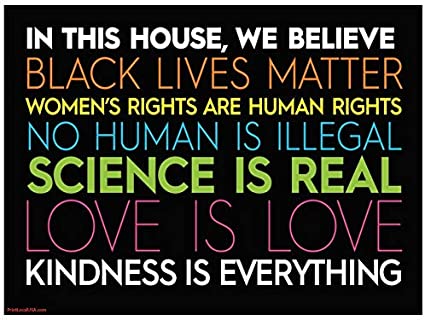
Comment Of The Day: “The New York Times Uses Its Sunday Front Page To Extol Progressive Virtue-Signaling Lawn Signs…”

obxoxious sign

Here is Extradimensional Cephalopod’s Comment of the Day on the post, “The New York Times Uses Its Sunday Front Page To Extol Progressive Virtue-Signaling Lawn Signs…”:

***

Here’s the first problem: with the exception of “kindness is everything,” these statements are vacuous. Each one is trivially true when read as written. For most intents and purposes, nobody in their right mind is going to disagree with the statements’ literal interpretations, even though some of them are normative (subjective value judgments) rather than descriptive (objective observations).

The second problem is that many humans are blurred-brains who haven’t developed the ability to use or recognize critical reasoning, so they skip directly from a vacuous statement to, “and therefore I’m right that we should do this thing, and if you don’t agree then you’re stupid and evil, QED.” Whether or not I agree with their conclusion is irrelevant, because they’ve demonstrated their reasoning process is not to be trusted.

This process is how we get things like moral certitudes and “objective scientific truth.” I need to start giving humans lessons on existential epistemology (and charging for it).

First off, moral certitudes don’t exist, but that’s not the same thing as saying that there is no right or wrong. In place of objective morality, I submit the constructive virtue of ethics, which I approach as follows.

People want things, but physical reality limits our ability to get everyone everything they want. There are different things we can choose to do in response to those limitations, so that more people can get more of what they want. There are also principles that help us make choices that are more constructive for society. When we abide by those principles, the choices we make are not only sustainable over time, but even get more and more of us more and more of what we want. That’s what makes ethics a constructive virtue. The choice isn’t “right or wrong” so much as it’s figuring out which options and principles are most constructive in the short and long terms, by its effects and by the precedent it sets.

Secondly, objective scientific facts are a myth, but that’s not the same thing as saying that all statements are equally true. The process (and mindset) of science is about saying, “We did this experiment and this was the result. Here’s the simplest hypothesis that’s consistent with this result, and here are some other hypotheses which we think are also fairly likely.”

Continue reading

Comment Of The Day: “Comment Of The Day #2: ‘Ethics Quiz: Superman Ethics’”

I know, I know…enough Superman already. What is this, “Seinfeld”? I was fully intending to have a Superman-free zone this weekend, but Steve-O-in NJ’s deft and historically illuminating comment on the second of the four honored comments on the last ethics quiz could not be ignored.

Here is his Comment of the Day on Steve Witherspoon’s Comment of the Day on “Ethics Quiz: Superman Ethics”

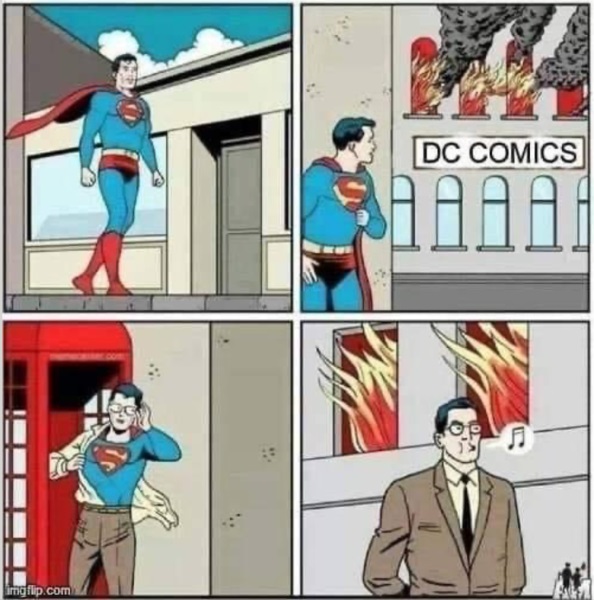
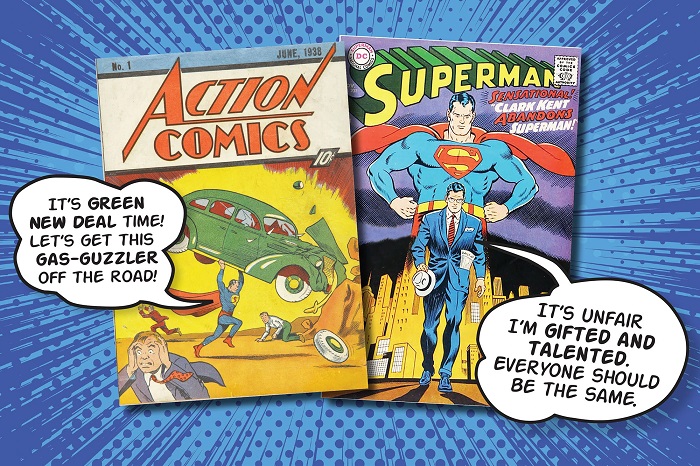
I think it shouldn’t be lost on folks here that Superman first appeared in Action Comics No. 1 in 1938. He came to be during the Depression, when this country was at its lowest and believing in itself the least. He was the creation of two aspiring Jewish writers named Jerry Siegel and Joe Shuster, who first conceived of him as a mind-reading, super-strong, and bald (!) villain given his powers by an experimental drug in a 1932 story called “Reign of the Supermen.” It wasn’t until 1935 that Superman became a hero and acquired his now well-known background, cape, and uniform. They had really wanted to get published in the comics pages as a strip, but when they kept getting turned down, eventually they signed away the rights to Jack Liebowitz, who had just formed Detective Comics, which would later become simply “DC” (although Detective Comics would continue to be published as a title and a year later Batman would debut there, but that’s another story). At least they’d finally see Superman published.

The rest, as they say, is history. However, Superman has, at least to some degree, always been an idealized “man of his times.” In the first few issues he was actually a bit of a smart aleck, and at one point anti-industrialist. Among other things, at one point he but two munitions manufacturers out of business, blaming them for war (THAT vanished with the coming of WW2). A real shocker was early on when he confronted a woman who had murdered someone. She drew a gun on him, whereupon he crushed the barrel out of shape, grabbed her hand, and asked her if she would surrender, “or shall I give you a taste of how that gun felt when I applied the pressure?” She of course surrendered, ruefully admitting that she would get the chair for the murder. Superman pitilessly replied, “you should have thought of that before you took a human life.” Obviously this would not fly now. It gets better when the character takes to radio in 1940, with a slightly modified origin story where he ages on the journey to Earth from Krypton and steps fully formed from the spacecraft, including being able to speak English. At one point he goes to confront a villain at his home, but finds only his Filipino houseboy, who of course speaks with a very exaggerated accent. He proceeds to intimidate him physically, and warn him, including a mild ethnic slur, that if he’s lied to him he’ll come back and kill him.

Continue reading

Comment Of The Day #4 on “Ethics Quiz: Superman Ethics”

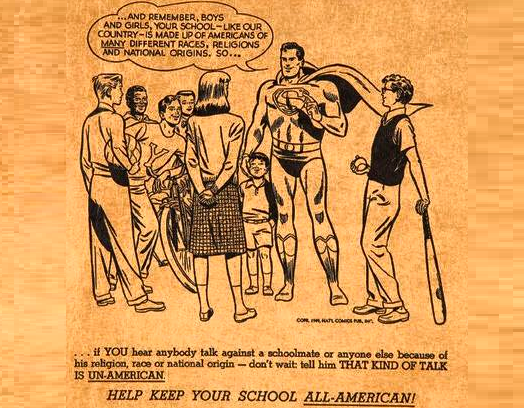
Superman all-American

This, a Comment of the Day by Humble Talent, is the 4th of four fascinating and varied Comments of the Day that arrived quickly after I posted the ethics quiz about the evolving Superman mission statement. Now he’s not fighting for “the American way,” but for ” a “better tomorrow,” which is even more vague than “the American way.” (Consider the positions the far Left advocacy group People for the American Way has promoted.)

The four neatly explain why I made this episode in the culture wars (or was it?) an ethics quiz in the first place. I am pulled to both polls: the “Why should we care about the updating of a motto that is as corny as it comes relating to a comic book character whose importance is historical rather than current when it will have no effect on anything?” reaction, expressed in varying ways by Curmie and Humble, and the “This is part of the death of a thousand cuts being inflicted upon national pride and American exceptionalism by those who don’t like what the United States of America stands for and want to reject the Founders’ vision and the values that have served this nation and its citizens so well” response, represented here in differing shades by A.M. Golden and Steve Witherspoon (and in an upcoming Comment of the Day on Steve’s comment by Steve-O-in NJ).

My analysis is that yes, sometimes, as Dr. Freud would have said if he was a Superman fan, a comic book slogan is just a comic book slogan. I am fairly certain that’s how the soulless DC Comics honchos look at it; that’s how they have looked at everything else. “Gee, how can we get some more publicity and compete with Marvel comics, which everyone thinks is cooler? Let’s kill Superman! Let’s put him in a black and gray costume! Let’s make Ma and Pa Kent young again! Let’s have Superman fight Batman, as ridiculous as that is. Let’s make Superman’s son gay! Let’s make Lois mutate into a Squid-Woman!”

OK, they haven’t done that yet, but I wouldn’t put it past them. Superman’s mission was arguably the last remaining part of his classic intro that wasn’t already retired as outdated. “Faster than a speeding bullet…more powerful than a locomotive…able to leap tall buildings at a single bound”—that one’s great and nostalgic, but I haven’t seen a trace of it in decades. The same goes for the wonderful, “Look! Up in the sky! It’s a bird…it’s a plane…it’s SUPERMAN!” At least Superman’s motto is surviving in some form…not that I care. I watched the first Christopher Reeve “Superman” movie and admired the funky, “He can fly!” poetic section as a brave innovation, but the climax where Supie reversed time by making the world spin backwards was one of the most insulting things I’ve ever had rammed into my eyes by a major film, and that was the end of movies with Superman in them for me. And yet…

As I have discussed on Ethics Alarms before, there is a crucial difference between introducing something new and changing something. When a company (or a government) changes something that is already in place, it signals, intentionally or not, that what was in place was wrong, and had to be replaced. That may not be the intent, but that is what it does. The effect may be subliminal, but the change also can be exploited by those who believe that what what has been removed was wrong. It’s a victory for them.

I will give the international corporation that owns the copyright to Superman the benefit of the doubt and assume that its decision was based solely on seeking better penetration in international markets and pandering to the young, who are more likely to assume “a better tomorrow” means defeating climate change, ending “social injustice,” achieving world peace and generally making John Lennon’s twaddle come true. That’s good old fashioned capitalism, as well as classic marketing: appeal to the idiots out there, because their money is as good as anyone else’s.

However, at a time in our history where the foundations of American values are under coordinated attack and the public’s appreciation of its nation’s immense contributions to humanity and the world is being undermined, the symbolic import of stripping fighting for “the American way” from an American hero’s goals should not be ignored, and cannot be credibly denied. DC has allied its iconic character with those who want to dishonor Thomas Jefferson, replace the National Anthem and cripple the Bill of Rights. That’s how it will be seen, and perception, in this case, is reality. The United States needs all the allies of liberty it can get, and that means this is no time for Superman to go woke.

The change was irresponsible and disloyal.

That’s where I come out on the quiz. Now here is Humble Talent’s answer, his Comment of the Day on “Ethics Quiz: Superman Ethics”:

***

I think that we are rapidly falling into a trap, and that it’s in our best interests not to take the bait.

Continue reading

Comment Of The Day (#3) On “Ethics Quiz: Superman Ethics”

Curmie adds a characteristically restrained and nuanced reaction to testerday’s surprisingly provocative Thics Alarms quiz asking DC Comics changing Superman’s mission statement by substituting “a better tomorrow” for “the American way.” Here is his Comment of the Day, the third of four, to “Ethics Quiz: Superman Ethics.” (I hate the scansion too, Curmie.)

***

To the extent that I care at all about Superman, which hasn’t been a lot in over half a century, I’m actually rather ambivalent about this.

Indeed, I rather think we’re about to see a test case of the dictum attributed to P.T. Barnum: that there is no such thing as bad publicity.

Taking a step back from jingoistic propaganda is hardly an embrace of totalitarianism. The line apparently was introduced during WWII, and the most famous (to me, at least) iteration is the one linked by Steve-O: the TV show which aired in the Cold War era. We don’t live in those worlds anymore. And certainly the folks who run the franchise have the right to do what they want. (New Coke, anyone?) Similarly, consumers can go elsewhere, and the colorist who resigned in protest is free both to do so and indeed to grandstand about it.

On the other hand, I go back to my debate team days and remember that the presumption always rests with the status quo. Is there a significant reason to make the change? Not that I can see.

More importantly, the literary/dramatic critic in me doesn’t like the new slogan’s scansion.

Is there anything wrong with making the change? Sure. Is there a concomitant upside? Maybe. Would I have done it? Also maybe, but probably not.

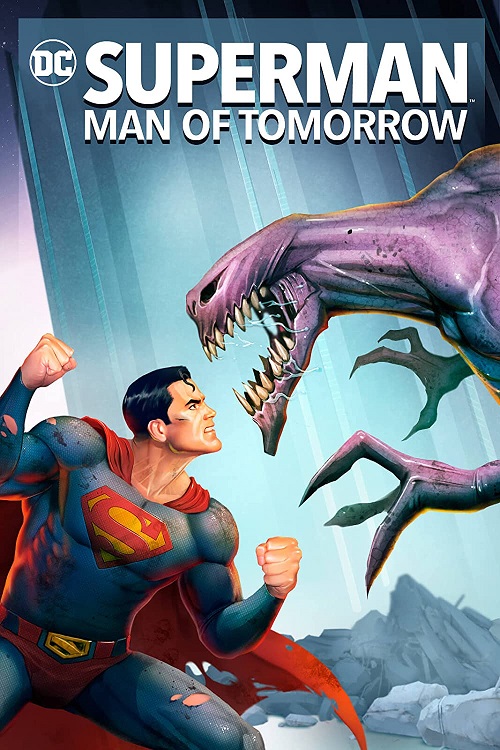
Comment Of The Day #2: “Ethics Quiz: Superman Ethics”

Superman of Tomorrow

Steve Witherspoon is the author of the second (of 4!) Comment of the Day reacting to the query as to whether changing Superman’s motto to seeking “a better tomorrow” without any American reference is unethical, as in irresponsible, or disrespectful, or un-American. Here is his intense reaction to “Ethics Quiz: Superman Ethics”:

***

“If thought corrupts language, language can also corrupt thought.” George Orwell, 1984

Propaganda, that’s what Orwell was talking about.

Superman’s motto change; “Truth, Justice, and the American way” vs “Truth, Justice, and a better tomorrow.”.

“Is there anything wrong with DC making the Superman motto change?”

In keeping with what I wrote yesterday that “our society and culture has dramatically changed in the 21st century” I’m going to approach this from a changing cultural viewpoint.

Looking at Superman as a idealisticº cultural icon¹ (that’s what the character is) the answer to the question “is there anything wrong with DC making the Superman motto change” has to be no. The fact that they are changing the motto is signature significant, in that this single act is so remarkable that it has predictive and analytical value showing us how much our culture has actually changed and the act should not be dismissed as statistically insignificant. The Superman comic strip and its motto had an underlying theme that was pure propaganda² and that was to promote the American way of life as good, a huge cross section of our culture has moved away from that idealistic view of America and it’s inevitable that as the culture shifts away from American idealism that new propaganda will replace the old. Out with the old, in with the new.

SPECIAL NOTE: I think it’s very significant that we’re this invested in the motto of a comic strip character that was literally the purveyor of idealistic American propaganda.

All that said…

Continue reading

Comment Of The Day #1: “Ethics Quiz: Superman Ethics”

WokeSuperman-HP

Well, once again my assessment of what post will generate the most provocative discussion was dead wrong. There were at least four Comment of the Day-worthy responses on the post regarding D.C. Comics’ decision to remove a dedication to the “American Way” from Kal-El’s creed. I’m going to post them all, and I think I’ll leave my own position until after the last one.

First up is A.M. Golden’s Comment of the Day on the post, “Ethics Quiz: Superman Ethics”:

***

Full disclosure. I love Superman. Since I was a kid, no fictional character has ever supplanted the Man of Steel in my heart. I’ve met several actors from various Superman television shows and films, I’ve been to the Superman Celebration in Metropolis, IL many times. His goodness, his sense of justice, his love for his adopted home, who wouldn’t cheer Superman?

I haven’t read Superman comics in years, though. I can’t keep up with the post-crisis (1980’s revamp) universe and I wouldn’t be able to wrap my mind around Lois Lane and Clark Kent being married anyway. I watched one episode of the new TV series “Superman and Lois” before quitting in annoyance.

Clearly their motivation is more leftist indoctrination. Climate change and illegal immigration are becoming bulwarks of the left and, if Superman battles on behalf of that type of activism, the way he battled the Klan back in the day, it carries weight. Making John Kent bisexual is pure pandering.

But changing the motto is a kick in the face to American ideals. Superman is an American hero. This is another attempt to downgrade American ideals in the minds of readers. A better tomorrow? What’s that? It’s not a tomorrow (or a world) we can all agree on, that’s for sure. Instead of fighting the Klan, he will fight so-called White Nationalists who protest CRT at school board meetings. A better world in the mind of a woke corporation is not something I want Superman taking a part in creating.

That’s unethical.

Comment Of The Day: “Ethics Quiz: The Dying Patient’s Denial”

Unlabeled pills

The Ethics Quiz last week about the ethical propriety of doctor telling a dying man in denial that he had only a brief time to live sparked many excellent comments, but none better than that of comment wars veteran Dwayne N Zechman.

Here is his Comment of the Day on the post, “Ethics Quiz: The Dying Patient’s Denial”:

***

oh . . . Oh . . . OH . . . this one is such an easy call for me that it makes me want to scream.

A Doctor’s Lie Almost Killed Me

A few notes:
– When I was born my mother was already older than was considered advisable to have children at the time.
– I have two older brothers, but I was my mother’s fourth pregnancy. The third ended in miscarriage.
– Because of the various conditions in play and from the examinations and tests they performed, the doctors predicted (incorrectly) that I would be born brain-damaged and mentally retarded and (correctly) that I would be born with life-threatening birth defects.
– Because of the above, the doctor encouraged my parents to abort the pregnancy.

Continue reading

Comment Of The Day: “The Facebook Whistleblower Thinks That The U.S. Needs More Censorship”

Little introduction is needed for this typically well-reasoned and clearly expressed Comment of the Day on the post, “The Facebook “Whistleblower” Thinks That The U.S. Needs More Censorship” by Extradimensional Cephalopod, except “Here you go…”

***

“So… it seems the Progressives have decided that Facebook needs to do something, and they’re basing everything on that. They’re not looking at all their options.

“The problem as they have described it is, “kids on social media are exposed to information which harms their mental well-being,” but they are only looking at options that involve putting rules and responsibilities on the social media companies.

“What’s wrong with this picture? Well, it ignores the responsibilities of the parent, the child, and the people who put harmful content on the internet in the first place. It ignores the question of how we can fill social media with edifying content instead (because that content is out there–there’s people on Instagram trying to help with body image problems), and the question of how the parent and child can work together to find that content (or just build a life outside of social media) while rejecting harmful content.

“The fundamental liability involved here is stagnation: known motivational limits. People build habits and addictions to things on the internet, because the internet is a source of instant gratification. This phenomenon is a manifestation of decadence: underregulated stagnation.

Continue reading