Unethical Quote Of The Week: Nautika Harris

miami-teen-home-intruder

“You have to look at it from every child’s point of view that was raised in the hood. You have to understand … how he gonna get his money to have clothes to go to school? You have to look at it from his point of view.”

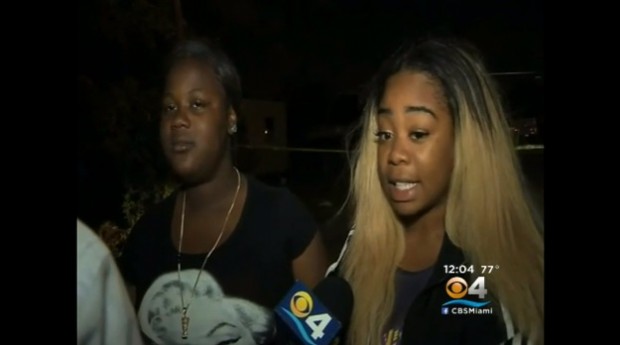
Nautika Harris (above, right), the cousin of a 17-year-old teen shot dead by a 54-year-old Miami woman as he tried to exit her home, which he had entered to burglarize.

Miami-Dade police say that Trevon Johnson, 17, burglarized the home of a 54-year-old old woman last week.

She was not in the house when the break-in occurred, but after being alerted by her surveillance system, she rushed home and found Johnson climbing out of a window. She shot him dead, and his relatives are outraged.

“I don’t care if she have her gun license or any of that. That is way beyond the law … way beyond,” Johnson’s cousin Nautika Harris told local radio station WFOR. “He was not supposed to die like this. He had a future ahead of him. Trevon had goals … he was a funny guy, very big on education, loved learning.”

And loved burglary, apparently. Continue reading

More “Anti-Trump Sunday”… A New Ethics Alarms Feature: “Unethical Donald Trump Quote Of The Day”

Trump can't say if anything's "wrong" with these people because he's never met them....

Trump can’t say if anything’s “wrong” with these people because he’s never met them….

Trump is averaging at least one outrageous, unethical statement a day. Either they show incompetence, or they are irresponsible, or they are uncivil, or they are lies, or they show disrespect for the office he is seeking, U.S. citizens and the nation, or all of these.

It’s rather hard to quote The Donald, since he rambles, free associates, and generally talks like someone who is tripping. In this case, one must look at the entire exchange holistically.

CNN’s Jake Tapper asked Trump this morning if he would disavow the endorsement of white supremacist and former KKK leader David Duke,or that of “other white supremacists.”

Trump claimed that he has been living in a cave (Everyone has heard of Duke): “I don’t know anything about David Duke. I don’t know anything about what you are even talking about with white supremacy or white supremacists. So, I don’t know. I mean, did he endorse me or what’s going on? Because I know nothing about David Duke, I know nothing about white supremacists. And so, you are asking me a question that I’m supposed to be talking about people that I know nothing about.”

Tapper obviously didn’t believe that Trump knows nothing about white supremacists, nor do I.  He asked again: “Would you just say, unequivocally, you condemn them and you don’t want their support?” Continue reading

Comment of the Day: “Unethical High School Assembly Video Of…What? The Month? The Year? Eternity?”

race

I must admit: I thought the “unequal opportunity race” video that was the subject of my post to be so outrageously simplistic, exaggerated, insulting to white Americans and discouraging to minority Americans that nobody would defend it. The lively debate that the post sparked proved that the white privilege deflection has seeped into mainstream thinking far more than I had previously understood, and that the position the progressive movement wants to communicate to African Americans is that absent aggressive, government-executed hobbling of present day white citizens as they pursue their own ambitions and dreams, and opportunities for their children, black Americans are doomed to comparative failure, cursed to be victims of traps, gaping craters and metaphorical sharks.

Late in the debate, commenter Chris Bentley, himself an African American, provided a different perspective in two long posts. I am combining them as his Comment of the Day, on the post ,Unethical High School Assembly Video Of…What? The Month? The Year? Eternity?.

To which I say b.s. (as a black man). I have no doubt, no doubt whatsoever, that I have succeeded (and failed at times) solely based on my merit, talents, and desire. I have not been unemployed for even a second, since the age of 18 (I am 37). I have applied to many, many jobs that I have desired, and been hired for many of those jobs. I have been accepted and attended 8 (8!) different colleges, earning 3 different degrees. I have spent the last 20 years working in education, from ECE to college, and spent 3 years as a preschool director (a black male preschool director is about as rare as a unicorn that poops gold).

None of this is meant to be taken as bragging, as my story is no more successful than anyone else on this blog. Nor am I more successful then any average black man, who grew up with loving, educated parents, who forced me to have a good head on my shoulders, taught me the importance of education, and did not teach me to be distrustful of whites, or to blame shift my failures elsewhere. I find it patronizing to be told that individual merit is not enough for me to succeed, when compared to whites; that if I truly want to compete on an even playing field, I need those same whites to level the field.

No. I. Don’t.

Continue reading

Comment of the Day (1): “Ethics Observations On Beyonce’s Super Bowl 50 Halftime Performance”

Civil-Rts-March-womwn

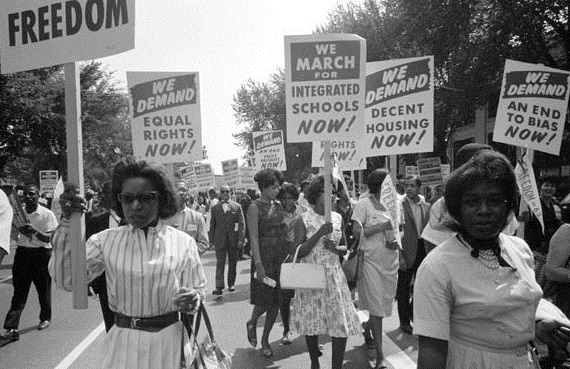
Late last night produced not one but two clear-cut Comments of the Day. This is the first; another will be along any minute now.

Responding to the post about Beyonce’s use of the Super Bowl halftime show to glamorize black liberation politics, Isaac argued that while the violent and loud radicals and revolutionaries get all the headlines, it is the quiet, law abiding, dedicated “squares”—haven’t heard that word for a long time!—that get the job done. This is essentially the opposite of Clarence Darrow’s conviction that it is the law-breaking revolutionaries who cut through the Gordian Knot of the unacceptable status quo. The man he extolled in a speech making that case was murderer and terrorist John Brown—who would have loved the Black Panthers. [I was just now trying to give you a link to Darrow’s amazing speech about Brown, and can’t find one. Shame on you, Internet! It’s in my book, though…you can get a used one for less than 3 bucks…]

Here is Isaac’s Comment of the Day on the post, Ethics Observations On Beyonce’s Super Bowl 50 Halftime Performance:

The bogus assumption often made is that the hippy/counterculture movement somehow brought about civil rights, since those two things happened at roughly the same time. This is wrong and those people should feel bad. It was decades of hard work by a whole lot of “squares” and a lot of stoically religious people, and the type of nonviolent and extremely effective form of resistance and racial healing preached by Dr. King that got the job done, at great personal cost. The stoner crowd and the violent, revolutionary factions like the Black Panthers were almost entirely counterproductive, but a lot sexier. So they are the ones romanticized today. Beyonce isn’t going to do a nostalgic dance number with Black women dressed as Baptists in flowery hats.

Continue reading

Comment of the Day: “KABOOM! The School System ‘Applauds The Efforts Of Students Who Act In Good Faith…'”

This is an appropriate illustration for this Comment of the Day.  You'll see...

This is an appropriate illustration for this Comment of the Day. You’ll see…

The post about the middle-schooler suspended for rushing to the aid of a stricken classmate inspired a wide range of fascinating commentary, and also generated a tangential thread, as essays here often do. This one involved some commenters challenging my assertion that the ungrammatical quote from the young hero spoke to a school system that was better at no-tolerance discipline than it was at education, and that students not conditioned to view double negatives as poor communication were being handicapped by incompetent teaching. Into the fray jumped the always provocative Extradimensional Cephalopod, who walloped the debate with one of his trademark, long-form expositions on linguistic matters.

Here is his Comment of the Day on the post, “KABOOM! The School System “Applauds The Efforts Of Students Who Act In Good Faith To Assist Others In Times Of Need” And Is Therefore Exacting Punishment So They Know Never To Do It Again.”

I agree that not all languages are created equal. Effective communication requires a few subordinate skills based on semantics (navigating within a paradigm) and empathy (shifting between paradigms). One such skill is translation, the ability to convey a set of ideas to someone who has an unfamiliar paradigm and to understand ideas they express in that paradigm. Another is background, the ability to recognize semantic cues (e.g. grammar and etiquette) and use them to create a desired impression on someone else, which is necessary to smoothly blend in with one’s surroundings, putting others at ease by appearing to be similar to them. People need to develop the power of communication in order to interact with others, and therefore regardless of how they prefer to speak, they need to be able to shift to different methods of speaking depending on the context in which they find themselves. That is the virtue of linguistic descriptivism: “When in Rome, do as the Romans do.” Or, as my grandfather likes to say, “…as the Romanians do.”

That said, linguistic prescriptivism has virtues of its own, when correctly employed, which is rare. Language is important because it is based on semantics, which is the simplification of interactions and which usually brings with it the concept of designating anything as “proper”. Labels and names are not hard limits for thought, but they shape it by making some thoughts easier than others. Any concept for which we have a word becomes easier to think of, because we can call that concept and associated ones readily to mind instead of retrieving each concept individually. It’s the difference between using the word “bird” and describing the animal’s characteristics anew each time you want to talk about it. The latter is possible, but people might have trouble thinking about birds and what they are like.

Continue reading

Comment of the Day: “Ethics Update: The Frontrunners”

Zoltar

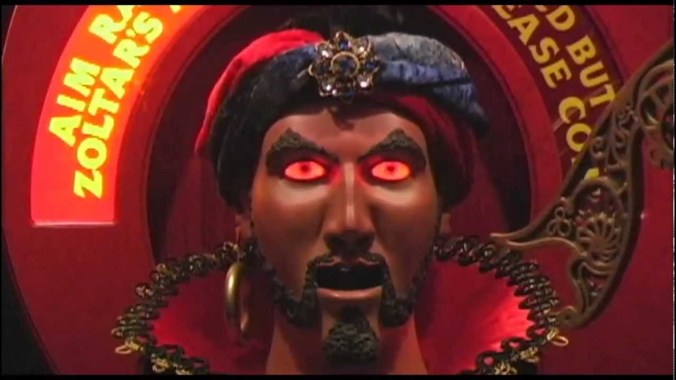
Rising Ethics Alarms comment star Zoltar Speaks! has weighed in with a passionate and perceptive comment inspired my recent overview of the ethical bankruptcy among the public’s current top choices to be our next President. Most commentators, even partisan ones, have become sensitive to what ZS describes, though they describe it in differing ways. Here’s a fascinating post on City Journal, giving Arthur Schlesinger, Jr., Kennedy’s hagiographer and once influential liberal/Democratic historian credit for predicting the phenomenon:

“Both lament and warning, “The Disuniting of America” reflected a Schlesinger disconcerted by the rise, within overwhelmingly liberal academia, of multiculturalism and political correctness, the linked solvents of American identity. …Trump is both a reaction to and expression of liberal delusions. Schlesinger’s fears have largely come to pass; we’ve become what he called a “quarrelsome spatter of enclaves.” Schlesinger was too much a part of the elite to imagine that the class he always thought of as representing the best of the future would come to be despised by a broad swath of Americans for its incompetence and ineffectuality. But what Schlesinger saw on the horizon seems to have arrived, with no sign of abating: we are in the midst of a soft civil war.”

Government, especially democratic government, relies on trust. Nixon and Watergate exacerbated the decline in trust created by the Vietnam War, then Clinton betrayed the dignity and image of his office to make almost any conduct by the President not just imaginable, but defensible. Sam Donaldson famously said that Clinton would have to resign if the allegation about Monica were true, and he had lied. Sam was right under previous rules, and a President who cared more about the country’s trust than himself would have done as Donaldson predicted.

Next came the completely random catastrophe of the tied 2000 election. Democrats, to their undying shame, employed it as a wedge, and to insist that the election had been stolen, a practice I described at the time as picking at the connective threads of the tapestry of our society. 9-11 was used to suggest that our government would murder its own people; Katrina was used to suggest that our government would allow black people to die because they were black. Bush’s administration blundered into a war, and then into a near-depression—in past generations, these would both be attributed to miscalculations.  But the tapestry, as I warned, was unraveling. Now those mistakes were being seen as deliberate, sinister.Then came Obama, once promising hope and harmony, who has deliberately exacerbated divisions and distrust  to build a political firewall around  his own incompetence. Public trust in government, before the Vietnam protests, was at 73%; it is below 25% today. Of course it is. The question is: Now what?

Here is Zoltar Speaks! in his Comment of the Day on the post, Ethics Update: The Frontrunners:

Do you ever get the feeling from the political front-runners in this campaign that this election is primarily being steered towards the elimination of our current political system in favor of something else?

Do you ever get the feeling that illogical social chaos and division among the people is becoming more and more prevalent across the United States and our leaders don’t seem to be spending any of their political capital to slow the trend, instead what we see is rhetoric from our leaders and potential leaders that seems to support illogical social chaos and division among the people?

Continue reading

Comment of the Day: “In Search Of A Tipping Point: Trump, The Microphone, And Thomas Dewey’s Ghost”

Trump mic

Ed Moser, a sound designer, technical director and all-around theater pro (he produced and designed sound for my recent staging of “Twelve Angry Men”…he’s also a friend), enlightens us with some insider observation relevant to Donald Trump’s recent denigration of a sound tech. It also reveals an unattractive side of an earlier GOP presidential candidate. Here is Ed’s Comment of the Day on the post, In Search Of A Tipping Point: Trump, The Microphone, And Thomas Dewey’s Ghost:

I have a friend who engineered the sound for a large church back when McCain was a candidate. He visited the church for a “town meeting”.

My friend locked all the unused gear away, and for the event distributed only freshly batteried hand held wireless mics for the event with screw on caps on the bottom. Such caps are specifically designed to prevent clumsy performers from accidentally touching the controls on the bottom of the mic– where one could turn the mic off, change the battery, or worst of all, change the frequency. Then color coded the mics with bright spike tape, so that while he was at the sound board he could instantly tell which mic/channel he was dealing with.

The plan was for McCain to give a speech, then take questions from the floor. Runners would carry one of three hand helds to the person with the query, so the question could be heard throughout the house. There was a fourth back up.

If all of this sounds pretty standard for people who know what they’re doing and have done many such events before: well, it is.

That evening, during the event, the question and answer session occurs. The first mic, it develops, is dead. A quick check reveals that ALL FOUR are dead. Irked at having to come the the edge of the stage and get close to an actual person to hear an actual question, or perhaps just trying to infuse humor at an awkward moment, McCain points to the back of the house, right at my friend, and says to the crowd, “Fire that guy!”

He gets a laugh. Except from my friend, of course.

Continue reading

Comment Of The Day (2): “The Strange Case Of The Unwanted Triplet”

infant

Beth’s  thoughtful Comment of the Day is only tangentially a comment on the Ethics Alarms post about the surrogate mother who balked at aborting one third of the triplets she was carrying. It was really a comment on a comment made to the author of the previous Comment of the Day on the same post, as J. Jonah Jameson described his own experience as a father who employed a surrogate. JJJ was asked why he chose the expensive and risky surrogate route rather than adoption. That question inspired Beth’s Comment of the Day.

Here it is; I’ll be back at the end.

“Why didn’t you adopt a child that needed a family?”

As a woman who battled infertility in the past, and have many friends who did the same, along with others who intentionally became single parents, used surrogates, or have or are trying to adopt a baby, let me say that this is the absolute worst question you can ever ask somebody going through this process. As you pointed out, you are not trying to be judgmental, but you should never ask this.

Continue reading

Comment of the Day (1), on Surrogate Ethics: “The Strange Case Of The Unwanted Triplet”

surrogate-motherIt’s very thoughtful of Ethics Alarms readers to provide such high level content so I have a chance of completing the 2015 Ethics Alarms Awards before March. I am awash in potential Comments of the Day all of a sudden, and this is the first of nesting COTDs, both inspired by the recent post on the surrogate with gestating triplets who is blocking the attempt of the biological father to abort Eenie, Meenie, or Miney, he doesn’t care which.

New commenter J. Jonah Jameson—presumably not really Peter Parker’s employer—submitted a helpful personal story that puts much of that drama in perspective. Here is his Comment of the Day on the post, The Strange Case Of The Unwanted Triplet:

I am the biological father of a child born of a surrogate mother. I’m sure ResurrectedToday is correct that the father fully knew that there was a chance of triplets. But the surrogate knew the same thing, and I’m almost 100% certain that she agreed in advance that she would have an abortion if the father requested it. (If not, then there are a lot of lawyers, doctors and other professionals who did not do their job.) Either she changed her mind, or she never really intended to abide by that agreement.

I can say a few things about my own experience:

1. There were a lot of people involved in the process: me, the surrogate, the donor, the three lawyers representing us, the doctors, and the psychologists and social workers at the lawyers’ and doctors’ offices. In almost every conversation that I had with any of these people, the subject of multiple births was discussed. Everybody involved understood clearly that there was a very high possibility of twins, triplets or even more.

Continue reading

Comment of the Day: “Comment of the Day: ‘On the Importance Of Christmas To The Culture And Our Nation : An Ethics Alarms Guide'”

Scrooge9

Nesting Comments of the Day again, as Belle’s reflections on how the cultural celebrations of Christmas made her feel “othered” as a child was met with many excellent responses and a lively thread. Pennagain’s (that is to say, the Commenter Previously Known As Penn) comment, however, surpassed tough competition, and thus we have the Comment of the Day on the post, Comment of the Day: “On the Importance Of Christmas To The Culture And Our Nation : An Ethics Alarms Guide”:

First impressions aren’t that easy to shrug off. Belle’s comment that she “was always sure that Ebenezer Scrooge was a commentary on the Jews” reawakened a long dormant spectre of mine. So, Google to the rescue, I went searching for the 65-year-old source and damned if I didn’t find it: My oldest Scrooge image is not from Dickens; it’s from the Rackham illustration of Shylock from Charles and Mary Lamb’s incomparable childrens’ (anyone’s!) introduction to Tales from Shakespeare:

ShylockFiction abounds with misers, a sub-category of villains (often semi-comical: to jeer at), a stock character from Medieval times, especially in children’s stories, who are often more memorable — and way more fun to act out — than are heroes. Miserly villains tend to have the same features and characteristics: mean, suspicious, hoarding good will as well as gold, stooped, narrow-shouldered, and “clay-faced” life-denying penny-pinchers … as is another “Ebenezer” in Stevenson’s “Kidnapped” whose miserliness is ethically and morally beyond villainhood (he changes sides in the middle of a battle), or a father-and-son pair of Chuzzlewits in another Dicken’s classic, or Shylock himself — who has by the end of Scene 1, before he lends the money and (jokingly) adds the “interest” that is the basis of the tragedy, chosen love of money over love of his daughter.

Continue reading