How to Tell Whether A Service Provider Will Cheat You, in One Easy Step!

Call. It won’t do you any good, but do call….

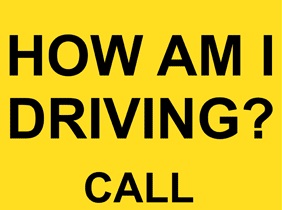
I was waiting at a stop light in the left lane when the light changed, and suddenly the boxy little truck with printing all over it look a sharp left turn from the right lane across mine, narrowly missing my car and requiring me to slam on the brakes. After laying on the horn, I saw that it was a truck for a local cleaning service, and voila! There, on the back door in bold print, was the legend: We care about safe driving! 1-888-555-SAFE. And the vehicle’s number, “515 DI.” For once I could actually use one of those numbers to report a reckless jerk on the road!

I have trouble memorizing numbers, so I repeated the information over and over again, out loud, as I drove home: it helped that the little truck was right in front of me most of the way. I reached home, ran up stairs to my office, wrote down the number to be sure, and dialed it.

It was a fake number. it wasn’t even a disconnected number. It didn’t connect to anything.

Now I’m wondering if any of those “How am I driving?” numbers are real, and I’ll say this: if your phone number is a lie, I’m not letting your employees clean my house, especially if they drive like that.

If only the name of the company had been on the back of the truck.

Never mind, though.

I’m going to find it.

Funny, Clever, Convenient, And Wrong: Housebites

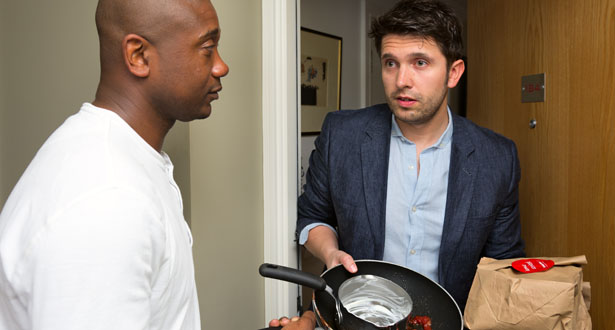
“Your dirty pans, sir…just as you ordered them!”

Normally I wouldn’t post about the practices of a U.K. company, since there are already too many U.S. stories involving ethics for me to keep up with. The innovation added to the world of deception by Housebites, however, has United States written all over it, and I predict it will travel across the pond in about a minute and a half.

The British company will not only cook and deliver a gourmet meal to order for your dinner party or romantic evening…it will deliver dirty pots and pans, to give your claims of hard labor in the kitchen that extra believability. From the company’s press release:

“Housebites.com, the takeaway service that delivers restaurant quality food has today announced a service called ‘pretend you cooked’ that allows customers to pretend they have slaved away at a hot stove more convincingly by delivering dirty pans alongside the food. Cooked by a professional chef and delivered to your door, Housebites main courses cost on average between £10 and £12, and now for an additional £5, customers can request the pans used to cook them for added authenticity. Collection of the pans is then arranged as easily as the original delivery slot.”

How nice. Continue reading

Graduation Ethics: the Cheering Mom and the Jerk’s Advantage

Stipulated: for police to arrest proud South Carolina mother Shannon Cooper for loudly cheering during her daughter’s high school graduation over the weekend  was excessive, unreasonable, and stupid.  The graduation crowd  had been asked to hold their cheering until all students’ names had been called, and warned relatives of the graduates that they would be removed from the facility if they disobeyed the rule. As some parents inevitably do at every graduation, Cooper ignored the reasonable request, but this time, the defiant parent paid a steep price. Police charged her with disorderly conduct and placed her in a detention center.

Let me also make this clear, however: Cooper behaved like a selfish jerk. She is being showered with sympathy now, cast as Innocent Parent Abused For Being Proud of Her Baby, but that’s not who she is. She is the theater audience member who ignores the request to turn off her cell phone, and disrupts the actors and the audience when it rings, and the movie audience member who chats loudly during the show. She is the pet owner who doesn’t clean up after her Great Dane at the dog park. She is the able-bodied shopper who parks in  a handicapped parking space to run into the store “for just a minute.” She is the person who breaks into line, who brings 30 items to the “15 items only” checkout station, who takes more than her share of free food at events. She is, in short, the kind of person who doesn’t believe reasonable rules apply to her, and who constantly challenges the rest of us to “make a big deal” out of relatively minor demonstrations of contempt for everyone she comes into contact with. Continue reading

Ethics Quiz: The Conundrum of the Crushed Crab

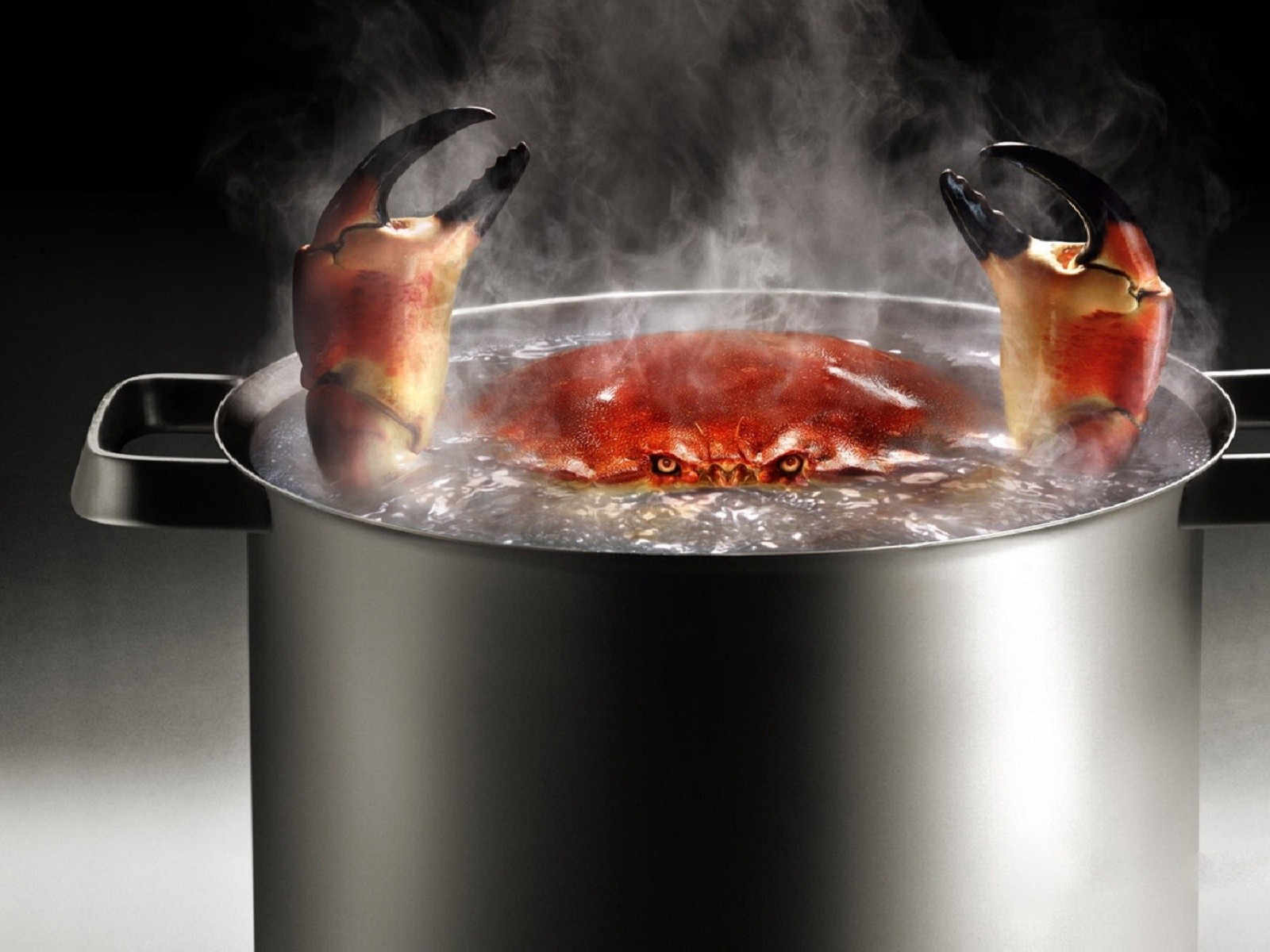
“OH THE HUMANITY! I mean…well, you know what I mean…”

A good friend related this scene on Facebook, and asks if she is losing her mind:

She was shopping at the open air fish market on Maine Avenue in Washington, D.C. when a vendor, whose cart was full of live blue crabs, had an escape attempt. One of the crustaceans made a dash for freedom, only to be squashed by the wheel of the cart.  “I screamed and then burst into tears,” she wrote. “It was awful. I tried to save the little guy.”  Then she realized that people were laughing at the drama, thinking it was a comedy….laughing at the crab getting crushed and at my friend for being upset by it.

She wrote: “Now I know he was destined for a pot of boiling water. But somehow – seeing that little creature getting run over was just too much for me. I know someone was going to eat that crab – but do we have to be cruel?”

Your Post-Mothers Day Ethics Quiz for crab mothers everywhere:

Were the laughers cruel, or merely recognizing a funny scene when they saw one? Continue reading

My Field of Dreams

Yesterday, an Off-Broadway musical closed that I launched on its remarkable run nearly 12 years ago. The show had productions in four states, D.C. and London; it had over 450 performances; it became the cornerstone of one very talented (and very nice) actor’s career, and an important opportunity for several others. It gave a dear friend immense pleasure, satisfaction and recognition in the final decade of his life, and probably saved my theater company from bankruptcy. Most important of all, perhaps, is that it entertained thousands of people. If I got bopped by a trolley tomorrow, the show would undoubtedly stand as one of the major accomplishments of my entire strange, eclectic, under-achieving life.

And yet…feeling good about the unlikely saga of the show, now that it has finally (probably—it has risen from the dead before) seen its last audience, takes considerable effort for me, and has from the beginning. My satisfaction is more intellectual than emotional, because I know that I personally benefited less from the show in tangible ways in proportion to my contribution to it than anyone else involved. Although I restructured the script, re-wrote, added and cut lines, wrote new lyrics to one song and added two others to the show, including the finale, I’m not credited as a co-auther. I own no part of the property, and never received a dime in compensation. Those closely connected with the original production know all of this, but the extent of my role in the creation and success of the show has been invisible to audiences for over a decade. Continue reading

From Massachusetts: Proof That It CAN Happen Here…and Does; That It CAN Happen To You…and Might.

Tortured. At his Special Needs school. By good people like us.

As I recently wrote to a commenter on another post, Ethics Alarms is not intended to catalogue every prominent example of unethical conduct, and not just because attempting to do so would require a fleet of bloggers. If it is discussed here, an incident usually requires some kind of ethical analysis to determine whether it is ethical or not, or has larger cultural or societal significance. That the incident at the center of this post was unethical (as well as illegal), there can be no doubt, and that, ironically, is why it is worthy of special attention. The conduct is self-evidently horrific and beyond justification, and yet it occurred anyway, in a community, state and nation where virtually every sentient citizen over the age of nine would say that it could never happen—not here, not in the United States of America, not in the land of the free and the home of the brave. The fact that it did happen is both a revelation and a warning.

Film footage under seal since 2002 was finally shown in a Massachusetts courtroom this week. The film shows how the staff of a school for special needs students in Canton, Mass., the Judge Rotenberg Center, strapped a disabled 18-year-old student named Andre McCollins to a table and proceeded to torture him, administering 31 jolts of electricity to the screaming boy over a seven hour period. Lawyers defending the school in a lawsuit have claimed that the atrocity was “treatment,” but other evidence indicates that it was punishment—for  McCollins’ defiance of a teacher’s demands that he remove his jacket in class. Continue reading

More Airport Encounters: Saying Thanks To An Accidental Mentor

Better late than never.

I previously wrote about the dilemma of whether to impose on celebrities who you encounter as they engage in the necessities of life (though I did not mention the time I was using a Kennedy Center urinal next to Colonel Sanders). I generally have ambivalence about the situation, but when I saw former Senator Alan Simpson standing at my gate as I disembarked at La Guardia, there was no question in my mind. I crossed over to him immediately, shook his hand, and said thank you.

I owe him, you see. Continue reading

Actor Ethics: Welcome to Colombia!

Yes, Sarah Bernhardt was probably unethical too. Actors!

I just blacklisted an actor, at least as far as my theater company is concerned, and I feel badly about it, because I don’t like banishing artists even when they deserve it. This individual did deserve it, however.

I held auditions a couple of months ago for a very difficult and complex production requiring special talents and a large cast. The turn-out was excellent, and the quality of talent was superb, with the actors obviously excited about the project. Since the script needs to be tailored to individual performers, the fear of an actor dropping out after being cast was especially strong (the maxim in the theater community is “cast early, cast often…”), so I took the unusual step of asking every auditioner who had a good chance of being cast to be honest about their commitment to the show. “If you want to be considered for this project,” I said, “I need to have your assurance that you are serious about it and will not tell me, after we have decided to cast you, that you have changed your mind. The show is like a big jigsaw puzzle, and casting you will affect whether we cast other actors, not just in your role but in roles that interact with yours. And I definitely do not want to cast someone who is going to turn around in a week or a month and say, ‘Sorry, I got a better offer.’ This is a commitment, and if we are committing to you, I need to know that you are committing to us.”

When the offers went out, a few actors nonetheless refused. One had just learned that she needed to seek more lucrative employment because her husband had been laid off; another had union problems. Over the next several months, there was another major loss, as an actress whom I had cast even before auditions—right before the delivery of her first child—told me that parenthood was more involving in reality than she had predicted when she committed to jumping into a major role so soon. I had thought this might happen, and, frankly, now felt that she was making the right decision.  I told her: “As a director, I was happy to let you be irresponsible for the benefit of my show, but as a parent, I’m glad your priorities are straight.”

The other day, however, one of the actors who had gladly accepted a role sent our producer a terse e-mail saying:

“Unfortunately, I can no longer do the show.  Thank you so much for all your help with everything; I’m very sorry for the inconvenience.” Continue reading

Ethics Quote of the Week: George Clooney

“I think it’s a stupid thing. I think it’s stupid for anyone, whether they’re celebrated or not, I don’t believe their 911 calls should be broadcast around the world.” 

"Poor Demi! The public has a right to hear us humiliate her."

—-Actor George Clooney, speaking during Sunday night’s Screen Actors Guild Awards.  He was referring to the release and subsequent airing of a 911 call from a woman summoning rescue workers for actress Demi Moore, who, the caller said, was convulsing and had lapsed into semi-conscious.

Good call, George.

911 calls are considered public, but that doesn’t mean that the public needs or has to hear them, or that sleaze-factories like TMZ should put them online when their only purpose is titillation and to embarrass celebrities. There may be special circumstances that justify making a recording of a 911 call, rather than a  transcript, available to the public, but those should be exceptions. In cases like Moore’s, playing them is unfair and unkind, a clear Golden Rule violation, not that TMZ, or most journalists for that matter, would know about that.

If the media can’t control itself when it comes into possession of a 911 call that will embarrass someone who already has enough problems to deal with, then we need laws to keep 911 calls out of irresponsible hands…in other words, the news media’s hands.
.