Web Ethics Complaint File: Rotten Etiquette in “Etiquette Hell”

The topic: rude behavior in public dining

There is nothing quite as exquisitely frustrating as having one’s commentary misrepresented elsewhere by a sloppy blogger, and then watching the nasty comments pile up by posters who never bother to read the original post. That is what is happening to Ethics Alarms, and thus me, over at an otherwise virtuous site called Etiquette Hell.

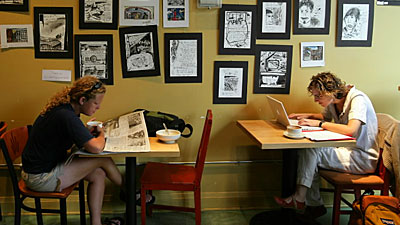
The site, or blog, or forum, or whatever the hell it is commented on the Starbucks post, with the inept headline: “Hogging all the tables in a crowded establishment.” That’s not what the post was about. That is a misrepresentation. The post was specifically about coffee shops that provide free wi-fi, and how customers abuse the privilege and benefit by camping out with their laptops for unreasonable amounts of time,  forcing patrons who need to use the tables for the primary purpose they exist to provide—allowing someone to eat and drink comfortably—to go elsewhere, or to stand. Continue reading

The Starbucks Principles

Hey you squatters! I'm coming over!

The First Starbucks Principle: If you create a free and open public benefit, the use of which is contingent on mutually understood conditions of fairness and reasonableness, eventually the utility of the benefit will be destroyed by individuals who refuse to be either fair or reasonable.

The Second Starbucks Principle: Once this occurs, there will necessarily  be rules and enforcement, conflict leading to consensus and a new social norm, or the elimination of the benefit.

Starbucks is in the midst of the First Starbucks Principle, but the Second is on the way. The nice, absurdly expensive coffee shops that created a culture where coffee-lovers could drink their lattes at leisure while working at their laptops or perusing  books and newspapers, are being choked to death by arrogant and cheapskate squatters who stake out the tables and remain for hours on end, often driving out customers who just want to sit down briefly and sip.

I had read about Starbucks’ New York City shops covering up outlets at the store, limiting the squatters to the battery storage limits of their laptops, a pretty mild reform. Then, last week, I saw the problem up close: a companion and I purchased coffee at a Starbucks clone, Caribou Coffee, and found that every table was occupied by one squatter with a laptop. Out of eight tables, only one had a cup or food of any kind. We had to go outside and find a bench; I guarantee that Caribou lost some business, because I would have purchased another drink. Continue reading

Ethics Quiz: Is It Wrong For A Rescuer To Sue The Victim He Rescued?

"OK, Princess, you'll get my bill for this rescue in five to seven business days."

On March 11, 2009, Mark Kinkaid and David Kelley were riding in Kinkaid’s truck when they saw a detached bumper, headlights and all, lying in the middle of Rt. 23.  Smoke was rising up from the highway embankment,  and the two men concluded that someone was in trouble. The truck stopped, and they got out, hopped a barbed-wire fence, made their way down the steep highway embankment, where they saw a flaming Hummer. Theresa Tanner was trapped inside, screaming for help. They forced their way into the vehicle, pried a door open and pulled Tanner out. She was injured and burned, but after weeks in intensive care, survived.

Now Kinkaid and David Kelley are suing Tanner, claiming that the crash was her fault and that she is liable for the injuries they sustained in rescuing her. They have filed a lawsuit asking for damages of at least $25,000 each. “All I know is that I am not the same man I used to be,” says Kelley, a 39-year-old truck driver and father of five, who says the heavy smoke and fire that day damaged his lungs so that he can’t carry a laundry basket up the three flights of stairs in his home.

The law provides a rationale for such a lawsuit. “The precedent is clear: danger invites rescue … and if you’ve acted recklessly or negligently and someone gets hurt rescuing you, you could be in trouble,” says Stan Darling, a tort law specialist. A well-established principle known as “the Rescue Doctrine” holds that if someone is in peril because of their own negligence or recklessness, an injured rescuer can recover damages if he acted reasonably and can prove that his injuries were caused by the rescue attempt.

That’s the law, however. This is ethics, and your Ethics Quiz today is:

Is it ethical for a rescuer to sue the person he rescued? Continue reading

Comment of the Day: “The Provocative T-Shirt Problem:

"Oh yeah? Well, your good manners and dignity offend ME!"

Sometimes I receive terrific comments to posts via e-mail, and sometimes I decide to make them Comments of the Day. And sometimes I decide to do that and forget, like I did with this comment, from Neil Penny, in response to my July 26 post about Dollywood forcing a patron to cover the mild political message on her T-shirt that “might offend some.” Neil’s comment was about the anecdote included in my post, relating how the dress code at my college was brought down by a concerted effort to comply with its letter rather than its spirit, and how the subsequent loss of decorum in the dining hall was regarded my many students, including me, as a diminishment of the experience.  Here is that lost “Comment of the Day”—my apologies to Neil for the delay: Continue reading

More Advice Column Incompetence: The Case of the Jealous Sister

"My wife is behaving irrationally. Is it me, or might she have a teeny problem of her own?"

Once again an advice columnist’s response has me considering whether there needs to be a standard of malpractice for the profession, especially when desperate, trusting people rely on them in times of crisis. I agree that anyone who is prepared to adopt the recommendations of a stranger that are based on a probably inadequate and incomplete description of a dilemma, especially when the columnist could well be a college intern, the janitor or a lunatic, is in desperate straits indeed.  Still,  if you are going to give advice, it had better meet some bare minimum of competence—even if you are just an intern.

A sad and remorseful man wrote “Annie,” the Boston Globe’s advice maven, about whether there was hope for his marriage, which recently and unexpectedly exploded. Continue reading

My Grudge

Sen. Mitch McConnell (R-Ky) has been in the epicenter of the last-ditch debt ceiling negotiations, and will probably deserve significant credit if the nation’s looming, self-created crisis is averted, if only temporarily. I’m going to have a hard time applauding, however, and not just because I think the entire incident has proven that America’s leadership void in all branches of government is terrifying. I can’t stand Mitch McConnell. I can’t stand to look at him, listen to him or read about him, and for the most unfair of reasons. I have a deep personal grudge against his wife, and its aura is wide and strong enough to engulf the Senator as well.

Back in 1987, McConnell’s wife, Elaine Chao, was a Reagan appointee in the Transportation Department, and I was out of work. Recalling that I had done a lot of work in transportation policy analysis, my former boss of two jobs back, (who is the current President of the U.S. Chamber of Commerce), graciously offered to make some calls on my behalf, and set me up to meet with Chao, a friend of his. The meeting that resulted remains the most humiliating and infuriating business-related experience of my life. Continue reading

Comment of the Day: “Scent Branding, Mind-Control, and Ethics”

Elizabeth was the first one to dive into this murky, interesting, science fiction/ “Brave New World” issue that I examined in  “Scent Branding, Mind-Control, and Ethics,” on a topic that confused me more the longer I considered it. What resulted was unusually long, perhaps accounting for the lack of comments, and Elizabeth’s reaction is long as well, but worth reading. There is something potentially sinister here, or perhaps around the corner—or just in our imagination and fears. Scent manipulation, and all it implies, is in the wilderness of ethics, where human nature, science and commerce meet.

Here is the “Comment of the Day”:

“I agree this is a complicated issue.  As you said, restaurant smells (natural, I assume) tend to make people hungry (or more hungry than they really are), as do waiters with large platters of beautiful food which often encourage patrons order more, different, and perhaps more expensive food than what they may have had in mind.  The goal of the restaurant is to sell food:  if memory serves, it’s only been in the last 20 years or so that restaurants had at least parts of their kitchens open to the dining area so “good smells” could waft out from them.  My memory from childhood of elegant restaurants were the multiple green baize doors that completely closed the kitchen off from the dining room.  So was this change intentional or simply simpler and cheaper as restaurant designs?  I don’t know, but it’s different. Continue reading

Unethical Thought of the Month: Me

Of course,  I am likely to be the only one who can get this “award,” since I am not privy to everyone else’s unethical thoughts. Nonetheless, this was a thought that  deserves a special rebuke, and that raises many questions.

I have always been fascinated by unethical thoughts, because thoughts are not really ethical or unethical. Being ethical often requires transcending our worst instincts and selfish thoughts; one recurring theme in Julian Baggini’s collection of thought experiments, “The Pig That Wants To Be Eaten” is whether a person who automatically does the right thing is more, or possibly less, virtuous than the person who engages in the same conduct despite unethical thoughts that urge him to do otherwise. While some misguided social architects think that the way to a more ethical society is to make unethical thoughts more difficult to have through such measures as censorship and hate crime legislation, that strategy is itself unethical, offending the principle of human autonomy. An evil thought that is recognized as such, rejected and not acted upon has no true ethical implications at all.

Or does it? Continue reading

Unraveling the Ethical Dilemma of the Unappreciated Treasure

“I’m passing this on to you, son. You know how how much I loved old Nibbles.”

As I have mentioned here before, I give ethics advice to inquirers on AllExperts.com, when the rare individual can actually find “ethics” among the categories—it’s buried somewhere under “philosophy,” which is doubtlessly why so many of my questions are from students who want me to write their homework essays for them. (I decline, but a lot of experts on the site don’t. A topic for another time…)

Today I received a question on one of those difficult family problems that any of us could face. The writer’s elderly father, with some ceremony, gave his only son one of the father’s most cherished possessions, something that had sentimental value to the father that far exceeded its monetary value, which was considerable. “I recently moved into an apartment,” the writer explained, “and after rent and bills, I only have about $200 a month to live on.” He said he could barely afford food, and had an urgent need for clothes, shoes, and other essentials, so he sold the heirloom for a pretty penny.

Now his father is heartbroken, and his mother is furious, demanding that he get the heirloom back, or else she won’t speak to him again. He wrote that he was depressed, and doesn’t know what to do. Continue reading

Comment of the Day on “Girl Talk and Bigotry Ethics…”

We had it coming, apparently...

This comment, from new visitor Linda, exemplifies the kind of thinking that too many Americans believe pass for “ethics.”  In response to my post about a Christiane Amanpour-led  panel on her Sunday morning public issues show that celebrated male-bashing and gender bias, Linda’s response is essentially…

1. You “men” have done worse to us.

2. We have the right to get even.

3. You can dish it out but you can’t take it.

4. We have the right to be bigots too.

Indeed women do have the right to be bigots, but journalists like Amanpour abuse their own First Amendment rights when they use the freedom of the press to advance naked bigotry, and women like her panelists disgrace their own principles when they move from seeking fair and equal treatment for themselves to asserting superiority and advocating gender bias. Continue reading