Comment Of The Day: “What’s Going On Here?”: The 8th Grade’s Speaker Of The House Snub”

At 7:23 AM this morning, veteran commenter Pennagain was sufficiently lucid to Penn this helpful commentary and reminiscence regarding civics, education, debate, perspective  and proportionality. I am duly impressed.

Here is Pennagain’s Comment of the Day on yesterday’s post on the significance of middle school students deliberately disrespecting the Speaker of the House, “What’s Going On Here?”: The 8th Grade’s Speaker Of The House Snub”:

I grew up in a thoroughly corrupt local political community (Jersey City, Hudson County, 1940s) where politicians mostly scared the hell out of us kids. They never hid their opinion of children as nuisances (non-voters, non-party-contributors, non-influential: period); as pawns to gain them applause (recipients of school awards or sponsored – not paid for – say, a week at summer camp or a trip to the carnival); as slaves (untipped or unpaid car washers, runners, leaf-rakers, lawn-mowers, paperboys etc.); or as flat out enemies (boys in particular who set off firecrackers or let their dogs loose at a rally or dared put their dirty, sticky hands on our officeholders’ bright black Buicks).

These refugees from Tammany Hall were no more considered respectable, responsible, worthy leaders than Dick Tracy’s B.O. Plenty and the school-age kids knew it. “Boss” (Mayor) Hague (“Listen, here is the law! I am the law!”), who ruled the city directly from 1917 to 1947 and indirectly for at least another 30 years, was universally hated and often feared, second to none in political corruption. Nonetheless, lip service and stiffly polite behavior was the rule in public, if only because parents were the greater examples; and they held the direct punishment power. Possibly, too, much as peer pressure obtained on the playground, children away from school lacked almost all the authority they would obtain in the next decade. We had an allowance if we were lucky, but no real buying power — we were a marketing force only in terms of breakfast cereal and comic books. Even toys and candy remained pretty much classics. Though we were a widely mixed group ethnically, in the classroom or the gym, we had no separate clubs or meeting places for our particular interests. We attended the afterschool activities, sports, religious observations and social functions dictated by our parents (I was treated to a few weeks of ballroom dancing classes one horrid Fall). Aside from running wild virtually unsupervised during any free time — and we found plenty of free time — we heard the opinions of our parents, ministers, teachers, newspaper-reading assignments, and listened with family around mealtimes to whatever was on the radio. Continue reading

How About This Solution: Let’s Move Northwestern University To Portland, Ore, Then Let’s Move Portland Out Of The U.S.

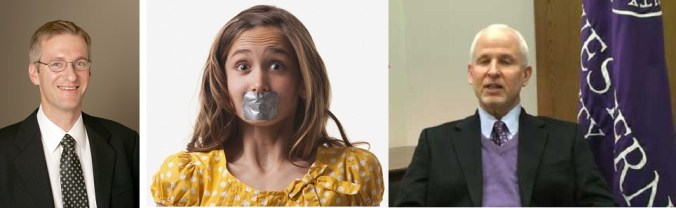
Ethics Dunce doesn’t do justice to Portland’s Mayor Ted Wheeler, nor his city’s residents for electing a First Amendment opponent to lead them. Incompetent Elected Official Of The Month comes closer, but describing mayors who refuse to acknowledge the rights of free speech and freedom of assembly as merely incompetent isn’t strong enough either. They are living

Wheeler (Guess his party!)  has asked federal authorities to cancel two upcoming rallies organized by conservative groups in the wake of the recent incident in which two passengers were fatally stabbed on a commuter train last week after confronting a man shouting anti-Muslim slurs. He wants the feds to revoke the permit for a June 4 “Trump Free Speech Rally” in downtown Portland as well as to refuse the requested  permit for a “March Against Sharia” scheduled for June 10.Wrote the mayor on Facebook yesterday,

“Our city is in mourning, our community’s anger is real, and the timing and subject of these events can only exacerbate an already difficult situation…I urge [the events’ organizers] to ask their supporters to stay away from Portland. There is never a place for bigotry or hatred in our community, and especially not now.”

The ingenuity of anti-speech progressives is impressive, but there is no “city in mourning-anger-timing’ exception to the First Amendment. Citizens of the United States, yes, even in Portland, have a right to make statements that the Anointed Arbiters Of What Is Politically Acceptable—you know, like Wheeler—don’t agree with, even if the AAOWIPAs try the neat trick of calling such  statements “bigotry” and “hatred”, or “hate speech,”  which they continue to claim, in a classic use of the Big Lie method, isn’t protected by the Constitution. It is protected.  As the ACLU of  Oregon said in ringing rebuttal to Wheeler,

“The government cannot revoke or deny a permit based on the viewpoint of the demonstrators. Period. It may be tempting to shut down speech we disagree with, but once we allow the government to decide what we can say, see, or hear, or who we can gather with history shows us that the most marginalized will be disproportionately censored and punished for unpopular speech.”

Oh no, you misunderstand my pure motives! the Mayor protesteth through his office. It is only violence we seek to avoid!

This is another popular anti-speech trick. If leftist thugs threaten violence against non-leftist speech, that’s an excuse to muzzle the non-leftists—Milo, Coulter, Charles Murray, Richard Spencer. As  Reason’s Scott Shackford puts it: Continue reading

“What’s Going On Here?”: The 8th Grade’s Speaker Of The House Snub

It is fair to say that no primary school class of any grade level would have snubbed a Speaker of the House by boycotting a scheduled meeting with him or her ten years ago, twenty years ago or ever. That this happened last week is worth paying heed to, and worthy of careful consideration. It is another symptom of a seriously ill culture, society and democracy.

Half of the D.C. field-tripping 8th grade from South Orange Middle School, about a hundred students, rejected their photo op with Speaker Paul Ryan, and were allowed to wait in the parking lot while Ryan greeted the other half.

What’s going on here?

What’s going on here should be easy to diagnose. The vicious, anti-democratic partyism, partisan incivility and hatred that has poisoned public and private discourse that has moved the United States toward governmental paralysis and the worst societal division since the Civil War is being passed on to the next generation. Anyone who cheers this as a positive development is a lousy, unethical citizen. It’s that simple.

The snub is 100% the product of irresponsible and ignorant parents, aided and abetted by incompetent teachers, seeded by the open warfare and excessive rhetoric of political leaders, though not, ironically enough, by Paul Ryan. Ryan has always comported himself, in this office and his previous one as an ordinary House member, by traditional statesman standards. He is polite and respectful, indeed was too much so  when Joe Biden snorted, rolled his eyes, sneered and interrupted him repeatedly during the 2012 Vice-Presidential debate. Ryan is a gentleman and a professional. He has also dedicated himself to public service and the best interests of his country as he sees it, like all honest elected officials, at great personal sacrifice. As Speaker of the House, a job he did not seek but accepted because he was needed by the institution, Ryan has immense responsibility and daunting challenges. Nobody has to agree with his political views, support his initiatives, or hesitate to criticize, lobby, advocate or vote against what he does or tries to do. Every responsible and civil American, however, should respect him for serving the nation as best he can. As for children, and that is what 8th graders are, they have only one duty: be respectful to the elected leaders of their towns, states and nation. Yes, every single one of those leaders.  Children have neither the standing nor the knowledge nor the wisdom to be otherwise.

Matthew Malespina, one of the grand-standing 8th graders who waited in the bus, was interviewed by ABC about why he snubbed the Speaker of the House. “It’s not just a picture,” the indoctrinated, arrogant kid told the reporter. “It’s being associated with a person who puts his party before his country.”

Gee, I wonder where he learned that empty phrase? What do you mean by this, Michael? Members of both parties belong to them because they believe their party’s governing philosophy is in the interests of the United States. Give me an example of Ryan “putting his party before his country” that doesn’t mean “if Republicans cared about the country, they’d be Democrats.”

Explain the complexities of fixing the evident flaws of Obamacare while not creating unacceptable risks to the health care system. Tell us how you would have negotiated the ethical dilemma of either supporting your party’s Presidential candidate whom you believe to be unqualified, or risking splitting your party and giving control of the government to an opposition party that you believe is pushing the nation in dangerous and untenable directions.

Go ahead, you’re 13, you know everything. What’s your plan? Tell us how you would begin fixing the crumbling infrastructure, a multi-trillion dollar task, without raising taxes to crushing levels or pushing the national debt over the brink. Tell us how the U.S. should help its poorest citizens without making them permanent government sycophants. Tell us how society can take away money earned by corporations and wealthier citizens without destroying the incentive to innovate, take risks, create jobs.

You know nothing. It’s very likely that the parents who have been programming you know nothing as well other than party-fed talking points, but at least they are adults in a democracy, and empowered to be part of government even though our broken news media and education establishment has left them below the minimal level of civic literacy for the process to work as designed.

“The point was, ‘I don’t want to be associated with him, and his policies and what he stands for,'” said Elissa Malespina, Matthew’s mother, a smug hyper-partisan fool who undoubtedly agrees with the attitude of the Georgetown professor who refused to work out in a gym that had a member whose views she found offensive. No, Elissa: a photo is a photo, not an endorsement, just like using the gym didn’t make the professor an honorary white supremacist. But I’m sure you’ve carefully discussed the competing issues of shunning, pluralism, democracy, the political advocacy system, governmental theories, Locke, Rousseau, Jefferson, Hamilton, Burke with your impressionable son, right?

Just kidding. We know what you have been doing since November is telling your child along with anyone else who would listen that Donald Trump is an illegitimate President and anyone who supports him in any way has enlisted in Evil’s Legions, which of course includes the Republican Party and Paul Ryan. Nice work.

It is not damaging enough that progressives are trying to turn the U.S into an ideologically segregated society where citizens of varying opinions can’t work and play civilly together, and where every citizen respects the leaders chosen by our elections, as they must if democracy is to function. They are determined to spread this cultural poison to the next generation before they have the ability to think for themselves.

This is what the conduct of the South Orange Middle School’s 8th grade means, and that’s what’s going on here. It is one more ugly, harmful and perhaps permanent side effect of the “resistance”—including much of the media and Democratic Party—rejecting democratic principles and institutions because they didn’t create the results the Left wanted this time.

Now that’s putting party before country.

“The Keepers,” The Catholic Church, And Bishop Fulton J. Sheen

I began watching Netflix’s new “true crime” series “The Keepers” last night. I may not last through all seven episodes. In addition to the documentary story-telling methodology, which moves at the pace of a slug-race, the story of how unsolved murder of a Baltimore nun might  be part of  (yet another) horrific cover-up by the Catholic Church made me so angry and frustrated that I quit in the middle of the third episode. The series makes the case that the nun, Sister Catherine “Cathy” Cesnik, was killed because she was about  to reveal ongoing sexual abuse of young teenage girls by the priest running the Archbishop Keough High School for girls.

The abuse and the extent of it is not speculation. As in so many other places, the Catholic Church in Baltimore eventually paid millions in damages to multiple victims of multiple predator priests who the Church moved around the  region—so they could molest and assault new victims—rather than handing them over to law enforcement. It is hard to imagine any priest worse than Father Joseph Maskell, however, if even some of the allegations against him are true. Victims say he used student files and illicit police connections to target teenage girls who were already being sexually abused. He manipulated them using a sick combination of religion, guilt, hypnotism and intimidation, sexually abused them, and even delivered some over to members of the Baltimore police department for more abuse.

The documentary focuses on the school’s Class of ’69, though there must have been equally abused girls before and after. The conspiracy of silence began to crack in 1992, when an especially  victimized member of the class suddenly realized that she had repressed memories of horrible experiences, and finally complained to the Baltimore Archdiocese, setting off the kind of despicable Church defensive strategies too familiar to anyone who has seen “Spotlight.”

This documentary isn’t good for my state of mind. It makes me wonder not only if all is lost, but also if all wasn’t lost long ago. I was raised in a largely Catholic community. I am not religious, but as an ethicist I recognize the important, civilizing role religion has played in teaching and enforcing moral principles for the majority of the public for whom ethical analysis is too challenging. Episodes like the Father Maskell scandal raise questions that I rebuke myself for asking, like “How can this be?” “Jane Doe,” the star witness in the documentary, is still a devout Catholic. Her immediate response to every dilemma is to pray. I don’t get it. She was savaged, threatened and abused by a priest that she knows the Church allowed to prey on the vulnerable students entrusted to him. Why would she still trust the Catholic Church?

Why would anyone? Continue reading

When Ethics Alarms Don’t Ring: A Coach With CTE Continues To Allow Young Players To Risk Brain Damage

…but he felt really guilty about it, so that’s OK.

The New York Times had a very strange sports story yesterday. Its subject was the late Don Horton, a prominent assistant coach at Boston College and North Carolina State for nearly 20 years who was diagnosed with Parkinson’s disease but was also experiencing symptoms linked to chronic traumatic encephalopathy, or C.T.E., a degenerative brain disease caused by repeated hits to the head strongly linked to football. The sensitive reporter, Bill Pennington asks,

“Was his deteriorating health, Horton wondered, a consequence of his many years as a football lineman?” Even worse, he worried, was he responsible for exposing hundreds of players to the kind of head trauma now impairing his life? After all, as he had recruited and encouraged scores of athletes to play major college football….There was only one way to be sure if he had C.T.E. His brain would have to be examined post-mortem, the only way to confirm the disease since there is no reliable test for the living. At first Horton balked, but as his cognitive difficulties intensified, he relented and even insisted that the findings of his brain examination be made public.”

The Times article makes this sound like a noble and brave resolution of his crisis of conscience. It was not, however. Having his brain dissected after his death was no sacrifice at all; Horton would be dead, of course.  In the meantime, Horton, despite his symptoms and his wife’s investigation into them, continued sending young men out to get their brains beat in.

We learn,

In 2009, seven years before Horton died, [Horton’s wife] called Chris Nowinski, a co-founder and the chief executive of the Concussion Legacy Foundation, and told him that she thought her husband had C.T.E. She also raised her suspicions with Horton’s doctors, but they said that, even if true, it would not change the course of his treatment.

Horton continued his duties at North Carolina State.

“He never missed a day of work and still produced great offensive linemen,” said Jason Swepson, an assistant coach at North Carolina State at the time. “You could see him struggling sometimes, but he never opened up about it because, I think, he didn’t want to feel like he was letting the group down.”

At home, however, Horton’s illness was leading to a variety of changes, physically and philosophically. His daughters, Libby, 14, and Hadley, 9, had begun playing soccer, but Horton pointedly refused to allow them to head the ball in games or in practices, aware that some studies had linked heading to brain injury.

“Don told them, ‘If I ever see you head the ball, I’ll run onto the field and yank you off myself,’” Maura said.

Although Horton kept his misgivings about football’s potential consequences within his household, he talked about it regularly.

“Don would ask, ‘Are we just carrying this cycle on?’” Maura Horton said. “That was a question I couldn’t answer. But it’s definitely the right question to ask.”

It’s not just the right question to ask, it was a question with an obvious answer, and both Hortons knew it. YES he was just carrying the cycle on. YES, he was continuing to coach college players when he had first-hand, personal knowledge of the horrible fate in store for some or many of them as a result, and said nothing.Was he responsible for exposing hundreds of players to the kind of head trauma now impairing his life?” If he refused to let his daughters head the ball while playing soccer, we know he was responsible, and so did Coach Horton. Was he in denial? Was he willing to let his player risk crippling cognitive impairment because he wouldn’t and couldn’t give up the only job he knew? Why does the Times suggest that there was any question about his culpability or breach of duty?

Continue reading

Comment Of The Day: “Two Public School Educators Duke It Out In Class: What’s Going On Here?”

Recently minted Ethics Alarms participant Ryan Harkins has his first Comment of the Day, and when I read it, I knew it would not be his last. This one does what my favorite comments do: pick up the baton from my original post, and carry it down the track (or, in some cases, throw it into the crowd.) The topic was the classroom fistfight in an Atlanta middle school.

Here is Ryan Harkins’ Comment of the Day on the post,Two Public School Educators Duke It Out In Class: What’s Going On Here?”:

Jack, the only quibble I have is when you say that you don’t care what the fight was about. I think it is important to learn what the fight was about, because then it gets us into the heads of the combatants, and that is what allows us to start the investigation that goes all the way up. The reason I think this requires a little explanation, so please forgive the lengthy rambling to follow.

I have to admit, my bias in this matter comes from dealing with incident investigations at my refinery, and the various training courses we’ve received in how to conduct such investigations. The one that really stands out the most is called “Latent Cause Analysis”, championed by Robert Nelms. The premise is that all incidents, even if we are speaking of a pump aggressively disassembling itself, ultimately are traced back to human causes. In the case of a pump, yes entropy will eventually have its way with the best-built pump in the world, but the reason the pump failed while it was in service causing a major incident is rooted in human causes.

Continue reading

The Good Hoax

Frequent readers here know how much I detest hoaxes, even ones just designed to be funny. News hoaxes are especially vile, as they are often designed to fool people and news outlets. These cause false rumors to spread, and send disinformation through the web and into brains, especially mushy brains. Hoaxes that consist of sufficiently ridiculous components that anyone should know they are not to be believed aren’t really hoaxes at all; they are more akin to satire. They are benign and often illuminating.

What does one make of a hoax that is simultaneously ridiculous and designed to fool people who need to be fooled in the public’s interest? I regard that as an ethical hoax. NYU physicist Alan Sokal designed and pulled off  just such two decades ago, as he described here:

For some years I’ve been troubled by an apparent decline in the standards of intellectual rigor in certain precincts of the American academic humanities. But I’m a mere physicist: if I find myself unable to make head or tail of jouissance and différance, perhaps that just reflects my own inadequacy.

So, to test the prevailing intellectual standards, I decided to try a modest (though admittedly uncontrolled) experiment: Would a leading North American journal of cultural studies… publish an article liberally salted with nonsense if (a) it sounded good and (b) it flattered the editors’ ideological preconceptions?

The answer, sadly, was yes. Despite being salted with copious Authentic Frontier Gibberish like “catastrophe theory, with its dialectical emphases on smoothness/discontinuity and metamorphosis/unfolding, will indubitably play a major role in the future mathematics; but much theoretical work remains to be done before this approach can become a concrete tool of progressive political praxis,”  his article, “Transgressing the Boundaries: Toward a Transformative Hermeneutics of Quantum Gravity,” was peer reviewed and published in the Spring/Summer 1996 issue of Social Text.

Later, Sokal explained his motives:

“While my method was satirical, my motivation is utterly serious. What concerns me is the proliferation, not just of nonsense and sloppy thinking per se, but of a particular kind of nonsense and sloppy thinking: one that denies the existence of objective realities, or (when challenged) admits their existence but downplays their practical relevance….In short, my concern over the spread of subjectivist thinking is both intellectual and political. Intellectually, the problem with such doctrines is that they are false (when not simply meaningless). There is a real world; its properties are not merely social constructions; facts and evidence do matter. What sane person would contend otherwise? And yet, much contemporary academic theorizing consists precisely of attempts to blur these obvious truths — the utter absurdity of it all being concealed through obscure and pretentious language.”

Sokal’s exposé of the sloppiness and lack of rigor in scholarship has spawned followers, as well it should. Using academic studies and papers is the ultimate appeal to authority in social and scientific policy disputes. If the journals that publish them are lazy and biased gate-keepers, they are untrustworthy authorities, which means that they aren’t authorities at all. That makes a Sokal-style hoax, properly and fairly executed, that rarity of rarities, The Good Hoax.

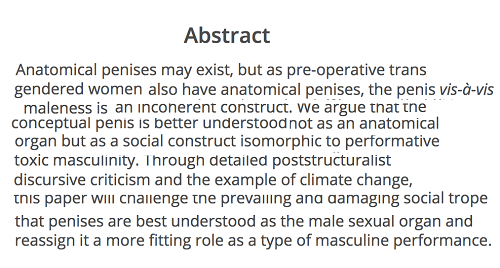
As they explained in the magazine Skeptic, Dr. Peter Bogghosian, a full time faculty member in the Department of Philosophy at Portland State University,  and James Lindsay,  a Phd in mathematics and the author of four books, wrote and submitted the most ridiculous paper they could think of. The title: “The Conceptual Penis as a Social Construct.” Here’s the abstract:

You read that right: the paper argues that penises affect climate change. Behold: Continue reading

Two Public School Educators Duke It Out In Class: What’s Going On Here?

Oops!

I’m sorry! Wrong video.

What I meant to put up was this…

This was a student cell phone video of the fight that broke out, in class, in front of students, at Stone Mountain Middle School in Atlanta, Georgia, last week. The combatants were a  teacher and a paraprofessional, both of whom have  been fired and arrested.

After the fight was finally broken up, students say school officials came into the classroom, went through their cell phones and made them delete any evidence of it.

“Nobody apologized they just came in and were like who videotaped this and stuff like that,” a student said.  “I think they were trying to push it under the rug so nobody would know about it and the school’s reputation wouldn’t be messed up.”

The school issued the usual statements—you can guess what it said, the usual boilerplate about such conduct being unacceptable and not comporting with the school system’s values. I don’t care what it said. Nobody is sure what the fight was about: I don’t care about that either.

What I want to know is the starting point for most ethics analysis: What’s going on here?…or in this case, what the HELL is going on here?

  • I’ve never heard of anything like this happening before. Has it happened before? How can it happen?

How can a school system employ one, never mind two, alleged educational professionals who would be any more likely to behave this way than they would wear an armadillo for a hat?

  • Can the reaching profession, especially in the public schools, nurture any worse professional standards? This is the fabled public school system that Betsy DeVos is called a menace for wanting to over-haul?

I know that it is only one incident, but just as the United Airlines abuse of a passenger it had no right to bump signals that the airline industry’s service standards are spiraling out of control, this horrific display in the Stone Mountain Middle School suggests a sick culture in and outside of education.

  • On my local news channel, they told us that the two pugilists were suspended but were still employed “pending an investigation,” which made me laugh out loud. How about watching the video? Nevertheless, there needs to be an investigation—of the school, the administration, recruitment and hiring practices, management and oversight, the culture of the school system, and more, like where do women in the teaching profession learn to throw punches like that?

Well, from teachers, parents and role models like them, I guess.

Yale’s Bigoted Dean And Pazuzu

I’m generally a Jonathan Turley fan—for one thing, he makes almost as many typos on his blog as I do— but the George Washington Law School constitutional law professor is the master of equivocation, and this often obscures important facts. Writing about Yale’s  Dean June Chu, recently put on leave by the school  for  online posts showing her to be a racist, a bigot and a hypocrite, he writes that she

“has been a successful academic and administrator at Yale University.  However, that stellar record came to a halt — and Chu was put on leave — after it was discovered that she had written reviews on Yelp deemed offensive.” 

“Deemed offensive” is classic Turley mild-speak, and it misleadingly suggests that the Yale dean has been another victim of campus political correctness because someone “deemed” her words “offensive.” Here is a sample of what she wrote on Yelp in various consumer reviews:

  • In a review of a Japanese steakhouse, Chu wrote, “I guess if you were a white person who has no clue what mochi is, this would be fine for you . . . if you are white trash, this is the perfect night out for you!”
  • She  described a theater as having “sketchy crowds (despite it being in new haven)”
  • She said a movie theater  had “barely educated morons trying to manage snack orders for the obese and also try to add $7 plus $7.”
  • Chu said of a fitness employee that “seriously I don’t care if you would ‘lose your job’ (I am sure McDonalds would hire you).”
  • She called another  gym class instructor ” frail and totally out of shape.”

Interestingly and tellingly, these and other nasty posts by Chu were discovered by students after she sent a campus-wide email  in which she proudly announced that she had become “Yelp Elite,” meaning that she had been recognized by Yelp for “well-written reviews, high quality tips, a detailed personal profile, an active voting and complimenting record, and a history of playing well with others.” Some students decided to see what she had written.  That wasn’t an unpredictable response, so Chu obviously didn’t see anything wrong with the attitudes she had projected. Stunned and disillusioned by what they found, the students  circulated some of the most remarkable of her comments. These  sparked anger from Yale students and alumni, who deemed the posts offensive because, Prof Turley, they were offensive. They were arrogant, elitist, classist and racist, reflected poorly on the institution, and  were not the kinds of expression that supported Yale’s trust in her. Continue reading

The Most Unethical Sentencing Fallacy Of All: Lavinia Woodward Gets “The King’s Pass”

Oxford University student Lavinia Woodward, 24,  punched and stabbed her boyfriend in a drunken rage, then hurled a jam jar, a glass and a laptop at him. This, in the U.S., would be called a criminal assault, and maybe even attempted murder.  Ah, but British Judge Ian Pringle knows better. He agrees these acts would normally mean a prison term, but Lavinia is a star student, and wants to be a surgeon. He hinted that he would spare her prison time so that her “extraordinary” talent would not be wasted. As poor Lavinia’s barrister, James Sturman, argued, his client’s dreams of becoming a surgeon would be “almost impossible” if she had to serve time.

Well, we certainly mustn’t jeopardize a violent felon’s dreams.

This kind of reasoning is infused with The King’s Pass, also known as The Star Syndrome, the rationalization making the perverse unethical argument that the more talented, prominent, useful and important to society a miscreant is, the less he or she should be accountable for misconduct that nets lesser lights serious and devastating consequences:

11. The King’s Pass, The Star Syndrome, or “What Will We Do Without Him?”

One will often hear unethical behavior excused because the person involved is so important, so accomplished, and has done such great things for so many people that we should look the other way, just this once. This is a terribly dangerous mindset, because celebrities and powerful public figures come to depend on it. Their achievements, in their own minds and those of their supporters and fans, have earned them a more lenient ethical standard. This pass for bad behavior is as insidious as it is pervasive, and should be recognized and rejected whenever it raises its slimy head.  In fact, the more respectable and accomplished an individual is, the more damage he or she can do through unethical conduct, because such individuals engender great trust. Thus the corrupting influence on the individual of The King’s Pass leads to the corruption of others.

Judge Pringle is taking the King’s Pass/Star Syndrome to a new low: he’s arguing that Lavinia should receive special treatment based on how valuable to society she might be, given enough immunity from the consequences of her own conduct.  Continue reading