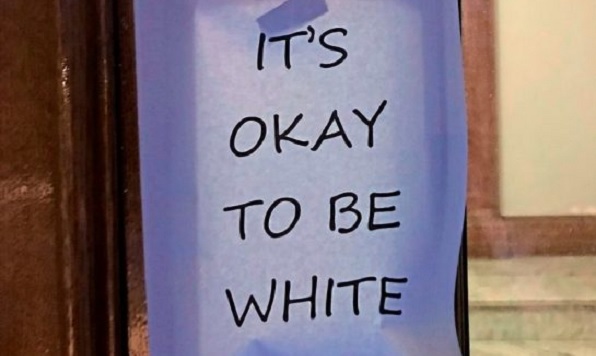
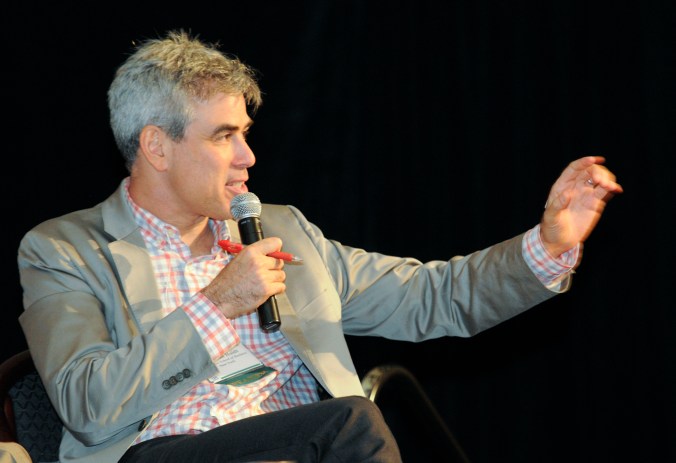
Jonathan Turley is fascinated with the issue of whether faculty members and employees generally should lose their jobs over controversial conduct outside of the workplace, particularly when it involves political speech. “There remains an uncertain line in what language is protected for teachers in their private lives,” the George Washington law professor writes. As I’ve discussed here before, I don’t think it’s nearly as uncertain as Turley does. When a faculty member’s conduct or statements on social media make an objective observer think, “No competent, professional institution would hire someone like this,” it’s bye-bye and don’t let the door hit you on the way out.
Even Turley seems to waver in this ridiculous case.
Gregory’s lawyer, Jon Schoenhorn argues that his client was justified in her actions because Wintrich’s views constitute “hate speech” and his actions “are beyond the First Amendment” in their insults to minorities. This is obviously nonsense, and I would argue it even qualifies as a frivolous and dishonest defense, an ethical violation. Unless the man is complete nitwit, he must know that there is no excluded variety of speech called “hate speech” that the First Amendment doesn’t protect. He’s lying, or he’s too incompetent to be a lawyer. Continue reading →
A recent episode at Fordham illustrates quite effectively the way American society could unravel as a result of a Supreme Court decision supporting the Masterpeice Cakeshop’s claim that its faith-based objection to same sex marriage should justify restricting service to some customers.
Rodrigue’s Coffee House is an off-campus coffee shop run by a student club at Fordham University.
The shop has a “Safer Space Policy” that reads…
“Rodrigue’s strives to be a safer space on Fordham’s campus. For these reasons, consider the following:
Do not make assumptions about someone’s gender, sexuality, race, class, or experiences. Be aware of your own identity, while being considerate of the personhood of your peers. Be mindful of the ways in which your words and actions impact others. Be aware of the boundaries of other’s space, physical or otherwise, and respect their consent. No racism – No sexism – No homophobia. If you feel that someone has transgressed this policy, we want you to feel comfortable confronting them or approaching a member behind the counter, who is available as a resource to assist you.”
This is Authentic Frontier Gibberish and first degree virtue signalling, and could be fairly translated as “We are pompous and oppressive social justice warriors who are intolerant of the views, statements, or opinions of anyone who does not share our rigid and undeniably correct ideology. We hereby declare our right to ostracize such non-conforming individuals on the basis of what we, in our sole discretion, consider hate speech. Fear us.”
Fordham College Republicans visited the coffee shop wearing MAGA hats. Sure, they did this to provoke a response, knowing what the likely reaction would be, much like a gay couple deliberately asking for a wedding cake at a Christian bakery. Memorialized in the video above, the president of the club didn’t disappoint, and angrily ordered the College Republicans to leave the premises.
“This is a community standard—you are wearing hats that completely violate safe space policy. You have to take it off or you have to go…I am protecting my customers,” the president said. Note that she was “protecting” his customers from exposure to the thrice-removed (initials, the phrase “Make America Great Again” which is benign on its face, and its association with the Trump campaign) message on a cap.
“We are your customers, we bought something,” one of the young Republicans replied.
“I don’t want people like you supporting this club… no one here wants people like you supporting our club,” the president answered. “I am giving you five minutes….You are threatening the integrity of our club. This is a community standard—you are wearing hats that completely violate safe space policy. You have to take it off or you have to go.”
When one of the students then asked her to explain what she thinks the MAGA hat stands for, to which she shouted, “Fascism, Nazis! You have three minutes.”
Legally, of course, this conduct is distinguishable from the conduct of the same-sex marriage decrying cakeshop owner. There is no law prohibiting a proprietor from behaving like a vile, intolerant, rude, bigoted asshole, just basic standards of decency. Nor is there a law protecting conservatives from invidious discrimination in public accommodations based on passively displayed political beliefs, although if this kind of thing starts proliferating, there will be.
However, the toxic effects on the culture by the two examples of intolerance and disdain for other citizens and human beings is exactly the same. Each is similarly mean-spirited, each is based on excessive self-righteousness, and each equally harms society, and the nation by elevating tribalism to standard practice. The theory of the coffee shop proprietor, I suppose—that the mere presence of a hat with initials on it is “unsafe” —-is marginally more outrageous and idiotic than the baker’s claim that selling a cake for a wedding he will not attend, is not invited to, that will never impose on his consciousness once the customers walk out the door unless his cake turns out to be poisoned, and that will take place whether he provides the cake or not, is a burden on his religious faith. Marginally. They both constitute unethical mistreatment of other human beings who deserve better, and breaches of the Golden Rule. That in both cases the victims of the unethical conduct may have intentionally presented themselves to be abused does not mitigate the abuse.
I might as well state the obvious, that the members of the intolerant club operating the shop are 100% behind the cause of forcing the cakemaker to sell the gay couple a wedding cake, but believe it is fair and just to refuse to sell Republicans a muffin.
Sometimes I am embarrassed that I even have to write a post. This is one of those times.
If higher education is manufacturing future citizens who think and act like the club president running the coffee shop, then higher education is doing the nation more harm than good.
Luckily, my head already exploded this morning, so this story, from College Fix, did no further damage:
The student newspaper at Evergreen State College has a section in its opinion pages described as “for people of color by people of color.”
“This should be a place where we can be us without it being overshadowed by the dark cloud that is living under white supremacy and having to see things from a white perspective. This is why when we do cover these issues it will be in the context and from the perspective of POC and POC only,” according to the section’s editors as they reintroduced it to readers in September.
The anonymous column, known as “POC Talk,” debuted in the bi-weekly Cooper Point Journal last year and returned this fall to the newspaper’s pages following racial unrest that erupted at the public university this past spring.
“Dear White people, please take a step back, this isn’t brown-people-answer-white-people’s-questions-hour, we’re asking specifically for submissions from POC,” the section’s editors added in their September intro. “As being told no seems to be a difficult concept for some of y’all I await your emails about the Irish, how the term white fragility is mean (great example of white fragility) and how we need to view people through a color-blind lens (just lol). You will 100% not get a response!!!”
I want to hear prominent voices in the black community, Democrats, and progressives, condemning this. Republicans and conservatives can’t because that will mean they are racists.
Is this school receiving federal funds? It shouldn’t be.
Cue the “white racism is different from black racism, which isn’t really racism but a reasonable response to historical and cultural factors” apologists! A white school that dared to have a “white opinions only” section in a school publication would be attacked far and wide as an example of alt-right creep. There is no difference.
1 Actually, it’s a terrible morning. I began what has really been a hideous morning at 5 a.m. with a hacking alert on my computer. I eventually, with the help of some technicians, identified the usernames of 27 hackers who were accessing my data, apparently.
I should have written this before, I guess, but hackers, all of them, every single one no matter what their motives or what they do, are the scum of the earth, ethical black pits, and blight on civilization. Yet the popular culture loves them. There are young hackers, male, female, black, white, Asian, Indian and Hispanic, handicapped hackers…no old hackers,of every type all over the TV fare, usually as part of the heroic team on procedurals. (There are no old hackers.) What power they have! How smart they are! Often they are ex-criminals, who managed to acquire an exciting, lucrative job by displaying their hacking skills to law enforcement in the course of committing crimes. Usually, they are the funny members of the team, or the cute, like Matthew Broderick in “Wargames.” No wonder our young see these shows and think hacking is cool. In “Jurassic Park,” Lexi, the young girl who almost gets her feet bitten off by a raptor, proudly calls herself a hacker.
“Hacker” means asshole, kid.
And I was rooting for the raptor.
2. Marley was dead. One of these days I will have to do an overview of the links to your left. They are there for their value in stimulating ethical thought and discussion, not because some asked for a link exchange. Under the “Inspiration” category—you have to scroll down to see it—is “A Christmas Carol” by Charles Dickens, arguably the best and most accessible ethics story ever written. I have directed four staged readings of the classic and three “radio” versions through the years, and I don’t know a better way to get into the proper frame of mind—an ethical one– for the holiday season.
Last night I watched actor Paul Morella perform his one man “Christmas Carol” at the Olney Theater in Maryland. Paul is a long-time friend and collaborator: he has been playing Clarence Darrow in a one-man show we created together for 17 years, and we launched a continuing legal education seminar about Darrow’s legal ethics at the D.C. Bar this year. If you live in the D.C. Metropolitan area, I can not recommend the Olney show to you more enthusiastically. As Paul points out in his notes, this is how Charles Dickens himself presented the story in front of Victorian audiences, and he did not have the benefit of the evocative sound and light effects Paul employs. Charles was also not in Paul’s league as actor, I bet.
3. One down, 102, 568 to go… Brian Ross went live on ABC last week and announced the fake news story that then-candidate Donald Trump had instructed Michael Flynn to make contact with the Russians, thus triggering a massive stock market sell-off. Seven hours later, ABC sheepishly admitted that it was President-elect”Trump who had made the request of Flynn. ABC News announced last night that Ross would be suspended for four weeks without pay. Said the Disney-owned network:
“It is vital we get the story right and retain the trust we have built with our audience – these are our core principles. We fell far short of that yesterday. Effective immediately, Brian Ross will be suspended for four weeks without pay.”
Observations:
Good.
It would be very good if this became the routine response when a mainstream media reporter misinformed the public through bias, negligence or incompetence.
Raise your hand if you think that this action only occurred because the Dow Jones crashed.
My hand is up.
“Retain the trust we have built with our audience…”What trust? Anyone who trusts the news media after the past two years, not to mention the past ten, is foolish, gullible, or a Democrat.
(Although it was reportedly a rough morning for the former Eleanor Coulouris 67 years ago_)
Or so I was told.
1. It’s NOT okay to be white? CNN Commentator Angela Rye, formerly executive director of the Congressional Black Caucus, told CNN audiences that “white, liberal women” were the cause of the pressure on iconic Michigan Representative John Conyers to resign from Congress. House Minority Leader Nancy Pelosi would have never called for Conyers to resign if it weren’t the other “white, liberal women” pressuring her to do so. Rye, who earlier in the week said that a racist double standards was causing Conyers to be pressured to resign while white Democratic Senator Al Franken was not, said,
“I think Nancy Pelosi made a commitment to the members of the Congressional Black Caucus that she would not call for Conyers resignation before due process was allowed to take place. Now she’s being faced with the pressure of white, liberal women for the most part who have told her she needs to say something different.”
Race-baiting and using racism as an excuse for any criticism of black politicians is still the reflex response of far too many Democrats, in part because they face no consequences for doing so, and because any whites who object are tarred as white supremacists.
Until the news media and progressives have the integrity to treat this tactic for what it is, and as exactly as intolerable as white racism, the nation will continue to split hard along racial lines. I guess that’s what the Left wants.
How can CNN justify continuing to employ a “contributor” like Rye—it has some others, too—who is a stone-cold racist?
How can anyone who abhors racism in all its forms continue to patronize an intentionally racial division-promoting news source that does employ someone like Rye?
Here, for people like Rye—you know, stupid people—are some reasons Al Franken’s situation is distinguishable from that of Conyers: he is thirty years younger and shouldn’t have retired about a decade ago anyway; he, unlike Conyers, hasn’t flatly denied all of the allegations against him as they keep on coming; a Senator resigning is a bigger deal than a Representative resigning; and Nancy Pelosi doesn’t oversee Senate Democrats.
Also there are no reports of Franken habitually meeting with female staffers without his pants on. It’s small thing—well, not that small—but still…
2. No, really, it isn’t OK...In related news,Texas State University student journalist Rudy Martinez wrote an article entitled “Your DNA Is An Abomination”—referring to white DNA, of course—for The University Star, the University of Texas student publication. The piece also advocated the death of whites, which is unpleasantly close to calling for them to be killed. If you think I’m going to point out that any student who wrote this about blacks in a student newspaper would be quickly disciplined, while the newspaper editor responsible for publishing such vile material was hounded of campus, you’re right. If the University of Texas administrators had any integrity, common sense or guts, it would, this is what would happen. At least the president of Texas State, Denise M. Trauth, said that “The column’s central theme was abhorrent and is contrary to the core values of inclusion and unity that our Bobcat students, faculty, and staff hold dear.” That’s nice. Why is Texas State graduating racists? From the column:
“Ontologically speaking, white death will mean liberation for all. Accept this death as the first step toward defining yourself as something other than the oppressor. Until then, remember this: I hate you because you shouldn’t exist. You are both the dominant apparatus on the planet and the void in which all other cultures, upon meeting you, die.”
Denise Cervantes, The University Star’s editor-in-chief, pulled the column and apologized, saying “We acknowledge that the column could have been clearer in its message and that it has caused hurt within our campus community. We apologize and hope that we can move forward to a place of productive dialogue on ways to bring our community together.”
I don’t bother with New York Times op-ed columnist Paul Krugman here, for the most part. He constantly discredits himself by intentionally misleading his gullible readers, hiding the ball, engaging in deceit as an advocacy tool, over-stating and hyping and generally bolstering his progressive opinions with a nauseating combination of intellectual dishonesty, hypocrisy and condescension. I have no patience with such columnists, or any publication that inflicts them on its readers.
A parallel in the sportswriting field is the much lionized Thomas Boswell, a Pulitzer Prize-winning columnist who writes for the Washington Post. Boswell has written several books, and is regarded by many as a deep thinker about baseball. (My wife and I once were friends with a couple that socialized with the Boswells, and invited us to join the four of them for an evening. I told them that I could not stomach being in the same room with the guy.) Many years ago, Boswell was writing about the individual talents of the Boston Red Sox, a topic I know at least as much about as he does. In assessing then-Sox catcher Jason Varitek, Boswell noted that “Tek” led the league in passed balls, leaving the impression that this demonstrated a serious flaw in his catching abilities. But I knew, and more importantly Boswell knew, that the Red Sox had a regular rotation starting pitcher, Tim Wakefield, who was a knuckleballer, and was the only starting pitcher in the league who threw that confounding pitch. If a catcher regularly catches a knuckleball pitcher, he leads the league in passed balls, usually by a large margin. Always. It has nothing to do with how good a catcher he is, and Varitek was a very good catcher. Yet Boswell deliberately cited the statistic without explaining to his readers what it meant in Vartitek’s case. He did this because he was trying to argue that Boston had defensive problems. This is unethical advocacy, and unethical journalism.
After that, I only read Boswell’s columns to document his dishonesty. I was never disappointed. He’s a cheat, relying on the ignorance of his audience to deceive them.
Paul Krugman is like that. After I posted the quote from Jonathan Haidt’s speech in which the professor perfectly described the ideology-driven betrayal of the culture and our democracy by institutions of higher education, I recalled a recent Krugman piece in the Times that I had instantly dismissed as classic deceit. One passage was literally the anti-matter version of Haidt’s hard truth regarding the rot in our colleges, a deliberate lie that denied the existence of the problem in order to further Krugman’s perpetual attack on Republicans and conservatives.
This is longer than the typical featured ethics quote. It comes from NYU Professor of Social Psychology Jonathan Haidt’s 2017 Wriston Lecture to the Manhattan Institute on Nov. 15 , excerpted by the Wall Street Journal.
Today’s identity politics . . . teaches the exact opposite of what we think a liberal arts education should be. When I was at Yale in the 1980s, I was given so many tools for understanding the world. By the time I graduated, I could think about things as a utilitarian or as a Kantian, as a Freudian or a behaviorist, as a computer scientist or as a humanist. I was given many lenses to apply to any given question or problem.
But what do we do now? Many students are given just one lens–power. Here’s your lens, kid. Look at everything through this lens. Everything is about power. Every situation is analyzed in terms of the bad people acting to preserve their power and privilege over the good people. This is not an education. This is induction into a cult. It’s a fundamentalist religion. It’s a paranoid worldview that separates people from each other and sends them down the road to alienation, anxiety and intellectual impotence. . . . Continue reading →
1 Self promotion Dept. I’m going to be back on NPR (WBUR, D.C.) in what I think is a live panel discussion (“Barbershop” is the show—I wonder what a ‘barbershop” is? ) hosted at 5: 30 pm, EST by the estimable Michel Martin. The topic is The Harvey Weinstein Ethics Train Wreck, though that’s not what they’ll be calling it.
2. “For every time, Spin Spin Spin, there is a season..” I may mention this New Republic article, or at least be ready to torch a fellow panelist who cites it favorably. The tortured reasoning of writer David Dayen led him to assert that the “sexual harassment crisis” resulted from ” a broken justice system.” Let me summarize it for you: men harass women in the workplace because it’s too hard to convict people and put them in jail. When did liberals start being the ones who want to dispense with civil rights protections and due process assurances in court?
“But we should identify the real culprit for this state of affairs: the long, slow abandonment of the rule of law in America. The reason adjudicating sexual misconduct claims has been left to the media and the crowd is that people have no expectation that the legal system will adjudicate those claims fairly. How can anyone blame them? They have witnessed endless instances of powerful people, mostly wealthy men, getting away with criminality and deception, in every context imaginable. When you don’t have a working justice system, you get a kind of vigilantism as a result. The problem isn’t the vigilantism—it’s the broken framework that leads desperate people to take matters into their own hands. That powerful people face little sanction for misbehavior is an old story, as true in gender as it is in class. But brazen impunity for the powerful is a hallmark of our era. The worst financial crisis in America in nearly a century led to practically no convictions for those whose actions facilitated the meltdown. The Catholic Church shuttled around sex-abusing priests for decades with little reckoning. Cops shoot black people and go back on the job….”
None of this has much to do with sexual harassment, which isn’t a crime, and the three examples cherry-picked by Dayen don’t support his stated argument. The Wall Street wheeler-dealers operated primarily within loopholes and gray areas in the laws and regulations. There were few convictions because it was hard to prove that laws were broken. When the molesting priests were identified, still living, and in the U.S., many were sent to prison. (That the Catholic Church behaved abysmally doesn’t show that the U.S. justice system is broken, obviously). And “Cops shoot black people and go back on the job” is deceitful, simple-minded agitprop. Colin Kaepernick, is that you?
The article is a desperate and clumsy attempt at ethics jujitsu, with the recent exposure of progressive hypocrites as sexual predators being flipped to pivot to the talking point that “everything is rigged against the poor, blacks and women.” What Dayen ends up arguing is that we need to make it easier to prove criminal guilt when we just know the defendants are bad dudes (white, male and rich) —shouldn’t that be enough?— and all the “beyond a reasonable doubt” stuff should be junked…except when black “non-violent drug offenders” are involved.
3. It’s still illegal. Fark.com called this story “a woman being arrested for mothering while black.” Nice. David Dayen, is that you? Continue reading →
1 Dead Ethics Alarms on the Hill. Just as I cannot conceive of what kind of ethics alarm malfunction allows any man to think that parading his reproductive organs before unconsenting women in a work-related setting is anything but gross and wrong (Charlie Rose???), I cannot comprehend by what tortured logic an elected member of Congress reaches the conclusion that I should pay for his sexual harassment hobby. The latter is the height of arrogance and abuse of the public trust. Yet the Washington Post reported that Congress’s Office of Compliance paid out $17 million for 264 settlements with federal employees over the past 20 years for various violations, including sexual harassment, and now we have at least one name and specifics: John Conyers, the ranking member of the House Committee on the Judiciary. Perfect.
Michigan Rep. John Conyers, a Democrat and the longest-serving member of the House of Representatives, settled a wrongful dismissal complaint in 2015 with a former employee who alleged she was fired because she would not “succumb to [his] sexual advances.”
Documents from the complaint obtained by BuzzFeed News include four signed affidavits, three of which are notarized, from former staff members who allege that Conyers, the ranking Democrat on the powerful House Judiciary Committee, repeatedly made sexual advances to female staff that included requests for sex acts, contacting and transporting other women with whom they believed Conyers was having affairs, caressing their hands sexually, and rubbing their legs and backs in public. Four people involved with the case verified the documents are authentic….The woman who settled with Conyers launched the complaint with the Office of Compliance in 2014, alleging she was fired for refusing his sexual advances, and ended up facing a daunting process that ended with a confidentiality agreement in exchange for a settlement of more than $27,000. Her settlement, however, came from Conyers’ office budget rather than the designated fund for settlements.
Well, this section of the Harvey Weinstein Ethics Train Wreck is doing some good, by throwing some light on this unethical practice. Congressional sexual harassers need to pay their hush money out of their own pockets. That’s the least they can do.
2. Live from New York! It’s Double Standards Live! Although Saturday Night Live did have the integrity to mock alum Al Franken following the Senator’s sexual harassment accusations regarding his conduct when he was just an obnoxious comic, 36 SNL staffers, including original cast members Lorraine Newman and Jane Curtin, felt it was appropriate to release this letter:
SNL Women Offer Solidarity in Support of Al Franken
We feel compelled to stand up for Al Franken, whom we have all had the pleasure of working with over the years on Saturday Night Live (SNL). What Al did was stupid and foolish, and we think it was appropriate for him to apologize to Ms Tweeden, and to the public. In our experience, we know Al as a devoted and dedicated family man, a wonderful comedic performer, and an honorable public servant. That is why we are moved to quickly and directly affirm that after years of working with him, we would like to acknowledge that not one of us ever experienced any inappropriate behavior; and mention our sincere appreciation that he treated each of us with the utmost respect and regard.
We send our support and gratitude to Al and his family this Thanksgiving and holiday season.
Ugh. This is blatant Ethics Accounting, as if the fact that Al was fun to work with has anything to do with his misconduct, or mitigates it in any way:
21. Ethics Accounting, or “I’ve earned this”/ “I made up for that”. You cannot earn the right to act unethically by depositing a lot of ethical deeds in the imaginary ethics bank, nor can unethical conduct be erased by doing good for someone else. The illusion that one can balance the ethics books this way is referred to on the Ethics Alarms blog as “the Ruddigore Fallacy.” Nobody earns the right to be unethical, not even once, no matter how exemplary their conduct. An unethical act is just as unethical, whether it is performed by a saint, a hero, or a villain.
Even more ridiculous is the “he never harassed me!” bit. This is reminiscent of Greta Van Susterin’s embarrassing defense of Roger Ailes, where she “stood up for” her boss and cast skepticism on his accusers because Greta had never been abused. The SNL letter drips with similar skepticism and bias. It is “appropriate” for Al to have apologized—never mind that the apology itself stunk on ice—and Al’s conduct may have been “stupid and foolish,” but come on, it wasn’t the worst thing.
What does standing up “in solidarity” mean, when it is in support of an accused harasser? It means “we don’t believe the victim, and anyway, we like the accused sufficiently that we will give him a pass.” I’m just guessing here, but I bet there are many, many women Harvey Weinstein worked with that he never molested, and that Louis C.K. hasn’t masturbated in front of every women he ever encountered. Those lucky women should sign a letter.
3. ” Gee, you mean I really have to pay it back?” In 19 states, government agencies can seize state-issued professional licenses from residents who default on their educational debts, while South Dakota suspends driver’s licenses for the same provocation. The tone of the New York Times article on the topic is disapproving, even though seven of the 19 states don’t use the laws that allow such suspensions, and the others mostly employ them as threats to get deadbeats to take their responsibilities seriously. Nobody in any of the states loses a license who sets up a payment schedule. Continue reading →
1 And The Harvey Weinstein Ethics Train Wreck rolls on…The Harvey Express ran over several more notables in various ways last week (like Lena Dunham…). Although Senator Al Franken got most of the publicity. One was actor Jeffrey Tambor, the long-time character actor turned star of the streaming show “Transparent,” about a transgender woman. Tambor’s former assistant, eager to pick up her #MeToo brownie points even at the risk of throwing the entire “Transparent” cast and staff out of work (this is another reason why these matters are more ethically handled privately), accused the actor of lewd comments and in one case “pressing up against her.” Now Tambor, and almost certainly the hit show, are, as Jeff Flake would say. “toast.”
“For the past four years, I’ve had the huge privilege — and huge responsibility – of playing Maura Pfefferman, a transgender woman, in a show that I know has had an enormous, positive impact on a community that has been too long dismissed and misunderstood.
I know I haven’t always been the easiest person to work with. I can be volatile and ill-tempered, and too often I express my opinions harshly and without tact. But I have never been a predator — ever.
I am deeply sorry if any action of mine was ever misinterpreted by anyone as being sexually aggressive or if I ever offended or hurt anyone. But the fact is, for all my flaws, I am not a predator and the idea that someone might see me in that way is more distressing than I can express.”
On the Apology Scale, this combines the worst features of a #9, a “non-apology apology,” with #10, an “insincere and dishonest apology,” with some other obnoxious features thrown in for bad taste. Tambor begins by patting himself on the back–-I’m the star, and it hasn’t been easy, but look at all the good I’ve done!—then moves on to Rationalization # 19. The Perfection Diversion: “Nobody’s Perfect!” or “Everybody makes mistakes!”
Next, he engages in deceit, stating that he’s never been a predator, which is like saying he’s never been a race car driver or an antelope. He’s accused of sexual harassment and one incident of sexual assault. What his statement amounts to a non-denial denial: “I never did what she’s accused me of doing more than once!”
Yecchh.
2. “Because sometimes they say yes…” It is no coincidence that Tambor, Franken and Weinstein all come from the performing arts world and all are very homely men. I have observed in my own theater experience that the most aggressive violators of the boundaries of restraint and decorum in interactions with women in a theatrical settings are frequently the guys who are unattractive and feel that it they don’t take chances, they’ll die a virgin. It is astounding how aggressive some of them are, and how resilient they remain after rejection and even physical abuse. If they fail a hundred times and succeed once, that’s positive reinforcement enough. If, through talent, hard work and luck, such individuals reach a level of power in the performing arts profession, sexual harassment is an established behavior pattern that doesn’t set off their ethics alarms at all.
3. It’s NOT OK to be white? Denise Young Smith, Apple’s first vice president of diversity and inclusion and an African-American, was part of a panel discussion on fighting racial injustice eat the One Young World Summit in Bogotá, Colombia. At one point she said,
“Diversity is the human experience. I get a little bit frustrated when diversity or the term diversity is tagged to the people of color, or the women, or the LGBT…there can be 12 white, blue-eyed, blonde men in a room and they’re going to be diverse too because they’re going to bring a different life experience and life perspective to the conversation.”
Apple fired her, six months into her new role after 20 years successfully running Apple’s international Human Resources department. Smith did not have the integrity to stand by her words, and instead tried a desperate Pazuzu grovel, apologizing and saying that her words “were not representative of how I think about diversity.” It didn’t work. Continue reading →