Case Study In Unethical Journalism And The Unethical Editors Who Spawn It: Jezebel and Editor Natasha V C

Natasha. Jezebel must be so proud.

Natasha. Jezebel must be so proud.

It is obvious that the mainstream media is determined to shoot down Wisconsin Governor Scott Walker by any means possible, because Democrats a) hate him to pieces and b) fear him. The primaries aren’t even underway, and they are already outing their own bias with over-heated criticism of his refusing to be drawn into gotcha questions about evolution and President Obama’s religion (to which he gave essentially the same answer as Hillary Clinton did in 2008: he has no way of knowing for sure), dropping subversive reminders that he never got a college degree, and already are breaching Journalism Ethics 101 principles by running bogus accusations without checking the facts. This will continue—it worked with Sarah Palin and Romney, after all—until the American public figures out what’s going on. I’ll try to help the best I can.

New York Times star columnist Gail Collins, who detests Walker with a passion that apparently obliterates all professional ethics, wrote two weeks ago that Walker was responsible for Wisconsin’s 2010 cuts to education, resulting in teacher layoffs. Walker didn’t take office until 2011. The Times retracted—six days later!—but you know how it works, and so does the Times: a fraction of the readers who read the mistake—this was a reckless, biased, embarrassing mistake—see the correction. The Times is better than Fox News…barely. Collins and her editor should have been disciplined.

Then  the progressive feminist website Jezebel printed this:

“Wisconsin Governor Scott Walker’s proposed budget—which would cut $300 million dollars out of the state’s beloved public university system—has a non-fiscal bombshell tucked in between its insane pages.Under Walker’s budget, universities would no longer have to report the number of sexual assaults that take place on a campus to the Department of Justice. Under Walker’s plan, university employees who witness a sexual assault would no longer have to report it.There are no policy recommendations in Walker’s budget how or what would replace these reporting mechanisms. The Governor simply instructs that they should be deleted.

For those of you who are unfamiliar with the bewildering force that is Scott Walker, know this: he is a small-time guy who is having a big-time moment by playing the conservative werewolf, a role Chris Christie and Jeb Bush are so far unwilling to play in their presidential bids.”

[Translation: “Small time” means “no college degree.” Ad hominem, naturally.]

The Daily Beast, which bleeds blue and has its own stable of wildly left-slanting commentators, uncritically picked up the story, as did many others. They kept it around, too, well after this was revealed: Continue reading

The Tangled Ethics of the Down Syndrome Cheerleader

There’s a lot going on here, and I may lack the ethics dexterity, or perhaps the courage, to figure it out.

I learned about the story on CNN this morning, as the newscasters were getting misty-eyed and “Awwing” all over the place. With a lot of fairly disturbing ethics issues rotting on my plate, I was looking for something uplifting to write about. I’m not sure whether this is it or not.

Here is the most recent on-line story about Kory Mitchell, a sophomore on the varsity cheerleading squad for Manitou Springs (Colorado) High School, who was born with Down Syndrome:

DENVER, Colo. – A Colorado teen with Down syndrome has made her dream of competing in a cheerleading competition come true.

Colorado’s 3-A cheerleading champions hail from Manitou Springs. At the top of their pyramid is a teenager who has overcome serious challenges in her life. The countdown is on as thirteen girls get one last practice in at the Colorado School of Mines. In minutes, the Manitou Springs Mustangs huddle will compete against other top teams.

Cheerleaders take center stage showcasing their spirit and synchronicity. The Manitou Springs Mustangs huddle one last time. And for the first time, joining them in competition is 16-year-old Kory Mitchell.

“She is full of life and full of energy and always wants to be a part of everything,” says her mom, Bonnie King, as she watches with pride.

Her daughter has dreamt about being a cheerleader since elementary school. Her mom is emotional.

But learning these already complicated routines is harder for Kory. “It`s just a tough road when you have a differently-abled child. And to see them have a sense of belonging and acceptance is what she wants, of course, is just so beautiful to see it,” mom says.

Kory’s teammates see what’s under the surface. Things like courage, patience and unconditional acceptance.

“She`s pretty spunky. And she`s got some sass. She loves being out there. It`s nice to see her smile and part of the team,” says one of her teammates. Sometimes competitions aren’t about who wins, but a little hardware doesn’t hurt.

Kory accepted the trophy and a hand from her teammates.

“It`s my dream come true. I love my girls a lot. I`m a big fan of cheerleaders,” Kory said.And Kory’s teammates are big fans of her. This was Kory`s first competition, but she has cheered with the team since last year at football and basketball games.

Observations (some of them reluctant): Continue reading

Finalizing The Sadly Useful School Anti-Violence No-Tolerance Insanity Scale

Alas, the deadly pizza gun is only a #5 now...

Alas, the deadly pizza gun is only a #5 now…

In January 2013, I realized I had used “Now this is the worst example of insane no-tolerance school conduct that there can ever be!” multiple times, and that it was time to make some close calls. I asked readers to rank the following real examples of child abuse by schools, in which children of various ages were punished cruelly and excessively for harmless conduct that violated a poorly envisioned no-tolerance rule. This was the list:

1. Biting pizza into the shape of a gun.

2. Pointing a finger in the shape of a gun and saying “Bang!”

3. Threatening to shoot a student with a bubble gun.

4. A deaf child who makes the obvious sign-language symbol for gun,  to “say” his own name, because his first name is “Hunter”

5. Expelling a student and bringing charges of criminal assault for shooting another student with a spitball through a straw

6. Accidentally bringing a paring knife to school in a lunch box

7. Drawing a picture of your father holding a gun

8. Playing with a LEGO figure carrying a LEGO automatic weapon

9. Drawing a picture of a gun

10. Writing a poem about the Newtown shooting.

I  received a lot of responses on the blog, more off-site. I never published the final results, however, which also takes into consideration my own positions. Here, from most defensible to most insane, is the current order, and why each entry landed where it did: Continue reading

Ethics Dunces: The Republican “Base”

National religion

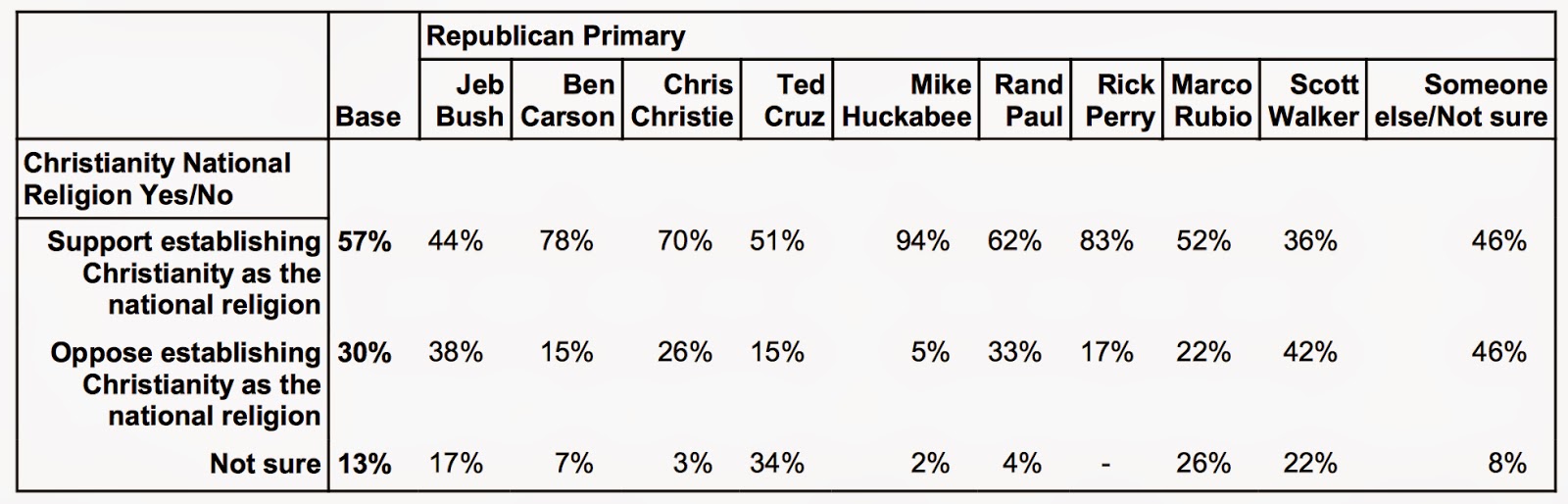
Public Polling Policy surveyed 316 Republican primary voters—the hard core— from February 20th to 22nd to measure their attitudes and policy views, as well as their current preferences for President. The margin of error for the survey is +/- 5.5%. The results are here.

The headlines will be about the candidate rankings, which are meaningless at this point. The valuable revelation, especially for Democrats who want to mercilessly mock their Republican friends, if they have any, and Republicans who want to drown themselves out of hopelessness and shame are…

A. The graphic above, showing that 57% of the Republicans polled want to establish a national religion, Christianity, and

B. The fact that only 37% believe in evolution. Continue reading

Best Ethics Movie Of The Year: “Whiplash”

I doubt that it will win “Best Picture” at the Oscar (though the consensus seems to be that J.K. Simmons, who dominates the film, has “Best Supporting Actor” in the bag), but “Whiplash” is the best film of the year that explores an ethics conundrum of long standing.

Without spoiling the film for those of you—the odds say a majority—who haven’t seen it, let me explain why.

“Whiplash” is ostensibly about a gifted music student’s quest to become not merely a good but a great jazz drummer. On the way, he encounters a fanatic, merciless, manipulative and demanding teacher (Simmons) who sees the young man’s passion and potential and is determined to either make his greatness bloom or break him trying. The movie raises the eternal question of the ethical obligation of the gifted to use their gifts to enrich society, culture and mankind. Arturo Toscanini once berated Bing Crosby for “wasting” his once-in-a-lifetime voice on popular music rather than opera. Is possession of a remarkable ability or talent something that forces the possessor to live an altruistic existence, subordinating his or her own desires to what will most benefit others? Is it unethical to refuse, to choose another path, one that is less daunting, easier, more relaxing, surer, without the stress, without the burden of chasing perfection and extraordinary success? Continue reading

KABOOM! ARGHHH! How Can This Happen In The United States? How Can Any University Think This Is Legal, Fair, Ethical Or Rational? How Can A UNiversity That Acts This Way Be Trusted To Teach Anyone Anything, Other Than How To Be A Fascist?

Thank-you, University of Tulsa...

Thank-you, University of Tulsa…

I really didn’t need another KABOOM! so soon after the last one.

From The Foundation For Individual Rights in Education, with my brainless reactions in bold and brackets:

TU suspended student George “Trey” Barnett last October for three Facebook posts [ It’s unethical and probably illegal to punish Barnett for his own Facebook posts…] published by his husband that criticized another student and two TU faculty members. […but it is beyond belief for the school to punish him for what someone else, regardless of who, posts to his page.] None of the Facebook posts came from Barnett’s account; the statements were posted by his husband, who either tagged Barnett or posted them directly to Barnett’s Facebook page. Barnett’s husband later submitted a sworn affidavit attesting to his sole authorship of the posts. Nevertheless, shortly after TU professor Susan Barrett filed a complaint against Barnett arguing that Barnett could not “avoid responsibility” because someone else was responsible for the posts. [This is Kafaesque. Do these even people know how Facebook works? ] TU Senior Vice Provost Winona Tanaka imposed eight restrictive interim measures against Barnett. The sanctions included suspending his participation in certain courses and activities and even barring him from speaking about certain individuals. [University administrators can not bar whom a citizen may speak to; only judges can do things like that, and only rarely.]

Without affording him the hearing he was entitled to under TU’s University Student Conduct Policies & Procedures, and despite his husband’s affidavit, Tanaka found Barnett responsible for “harassment.” Tanaka also found Barnett guilty of retaliation and violating confidentiality requirements for speaking about the disciplinary charges with his husband—who was also his exculpatory witness. [ What??? WHAT??? Due Process? Rights of the accused? Procedures? Policies? ]

Less than two months before Barnett was set to graduate, Tanaka not only suspended him until at least 2016 but also permanently banned him from receiving a degree in his major even upon his re-enrollment. Barnett was forced to wait two months for TU to respond to his appeal, which the university summarily denied on January 9 without explanation—leaving Barnett unable to earn his theater degree as planned. [ All of this for what someone else wrote on the student’s Facebook page! My key question in ethics scenarios is “What’s going on here?” What’s going on here? I have no idea. An illicit relationship between the apparently fat faculty member Barrett and Tanaka? Insanity?]

…TU has also threatened … its independent student newspaper, The Collegian, which this week reported on Barnett’s suspension and criticized his treatment. The Collegian reports that after contacting TU administrators for comment, student reporters were told by TU’s director of marketing and communications that if “anything that the university deems to be confidential” is “published or shared, (that) could violate university policies.” The university refused to explain what might constitute “confidential” information and, come press time, the journalists were unsure what action the university might take against them. [ OK, let’s just stipulate that the University of Tulsa doesn’t accept the principles underlying the First Amendment. I will await its next abuse of power being aimed at impending worship requirements and a ban on assembly.]

Continue reading

Comment of the Day: “The Eternal Ethics Conflict: Drawing Lines, Enforcing Them”

speed traps

The post generating texagg04‘s (latest) Comment of the Day dealt with the tricky and common ethics problem of enforcing reasonable rules strictly in the face of situations where compassion and sympathy pull us toward leniency, because the penalty for non-compliance seem out of proportion to the transgression. He correctly identified this as a problem involving the Ethics Incompleteness Theorem (or Principle), which is an ethics analysis concept used frequently here, and one of my favorites. The Theorem, as stated in the Ethics Alarms Concepts and Special Tools, a.k.a. “the Rule Book,” holds that…

The human language is not sufficiently precise to define a rule that will work in every instance. There are always anomalies on the periphery of every normative system, no matter how sound or well articulated. If one responds to an anomaly by trying to amend the rule or system to accommodate it, the integrity of the rule or system is disturbed, and perhaps ruined. Yet if one stubbornly applies the rule or system without amendment to the anomaly anyway, one may reach an absurd conclusion or an unjust result. The Ethics Incompleteness Principle suggests that when a system or rule doesn’t seem to work well when applied to an unexpected or unusual situation, the wise response is to abandon the system or rule—in that one anomalous case only— and use  basic ethics principles and analysis to find the best solution. Then return to the system and rules as they were, without altering them to make the treatment of the anomalous situation “consistent.”

No system or rule is going to work equally well with every possible scenario, which is why committing to a single ethical system is folly, and why it is important to keep basic ethical values in mind in case a pre-determined formula for determining what is right breaks down.

 Tex expands the discussion into such areas as test scores, speed limits, and rule-making itself.  Here is his masterful Comment of the Day on the post, The Eternal Ethics Conflict: Drawing Lines, Enforcing Them:
Continue reading

Now THIS Is An Unethical Principal…Ridiculous Too

The principal and her gym

The principal

Principal Jazmine Santiago heads PS 269 in Flatbush, New York, a troubled elementary school where last year only 16 percent of the students passed state English exams and only 12 percent passed math. Yet she used scarce school funds to install her own private gym on the third floor, complete with a bench press, pull-up bar, treadmill, elliptical machine and thigh exerciser.

Questioned about the gym by her staff, Santiago claimed she allowed older students to use the equipment. That would be the K through 5 school’s eleven-year-olds, most of whom are under five feet tall. The adult-sized exercise gear in the principal’s work-out palace would be almost impossible, not to mention dangerous, for children to use.

Santiago has had her job for four years and now makes $124,319 annually. Jonathan Turley notes that since the gym is technically a school improvement and not personal enrichment, she has avoided criminal liability. Well, that’s nice. She is still spectacularly unethical: selfish, irresponsible, incompetent, unfair, wasteful, untrustworthy.

State Department of Education spokesman Harry Hartfield said the matter of the principal and her private gym will be investigated. It shouldn’t take long: the photo above should tell them everything they need to know.

______________

Pointer: Res Ipsa Loquitur

Facts: New York Post

Speech And Thought Control At CUNY

The minds of your children aren't safe at CUNY, but your penguins might enjoy it there...

The minds of your children aren’t safe at CUNY, but your penguins might enjoy it there…

A responsible parent has an ethical duty to pull their child out of any university that does  something like this.

From The College Fix:

“Effective Spring 2015, the (graduate center’s) policy is to eliminate the use of gendered salutations and references in correspondence to students, prospective students, and third parties,” Louise Lennihan, interim provost, states to employees in a recent memo. “Accordingly, Mr. and Ms. should be omitted from salutations.” Lennihan instructs staffers to interpret the new policy “as broadly as possible,” that it applies to “all types of correspondence, such as: all parts of any letter including address and salutation, mailing labels, bills or invoices, and any other forms or reports,” states the memo, a copy of which was provided to The College Fix by school spokeswoman Tanya Domi. Rather than using “Mr.” or “Ms.,” staff are instructed to refer to students by his or her full name. The policy will “ensure a respectful, welcoming, and gender-inclusive learning environment … [and] accommodate properly the diverse population of current and prospective students,” Lennihan states in the memo.

Now, I almost never use these salutations any more. “Mr.” has always seemed pompous to me, and now it reminds me of the New York Times with its tradition of calling the President “Mr. Obama.” (Over the weekend, the Times garnered guffaws for calling Wisconsin Governor Scott Walker “Mr. Scott” throughout an op-ed. Nice editing there). “Miss” seems condescending, “Mrs.” is a minefield, and “Ms.” sounds ugly while being both dated and unwelcome from some women. (Once I called a women “Ms.” and she barked at me, “Do I look like a dyke to you???”) And I hate being called Mister myself. All of the is irrelevant, It is not any university’s business to enact speech codes, banned words, or other undemocratic and ideologically driven attempts at censorship and speech control. Speech control is thought control, and thought control is indoctrination. Continue reading

No More And The Ethics Of Awareness

NO-MORE-MUG-11ozI was aware of the flimsiness of No More, the NFL’s designated mouth piece to show that it cares about domestic violence, when I recently reviewed the Super Bowl ads. It wasn’t the place to raise the issue, but now Deadspin writer Diana Moskovitz had done so in explosive fashion, in a piece called “No More, The NFL’s Domestic Violence Partner, Is A Sham.”

I think “sham” is a bit harsh, but her point is well-taken: the organization doesn’t really do anything to stop domestic violence. Its sole goal is to raise awareness of the problem by creating a “brand” that can be plastered on t-shirts, coffee mugs, mouse pads, stickers and tote bags. Oh—there’s also a pledge you can take. That’s about it. If you expected that the organization giving us the frightening ad featuring the terrified woman calling 911 was more than this, I guess “sham” may be fair. “Scam” may even be fair.

As Moslkovitz explains with barely restrained anger, No More is all about PR and feeling virtuous. It was inspired by the AIDS ribbons, which in turn were inspired by the yellow ribbons people wore to show support for the Iranian hostages in 1979, which in turn were inspired by…a Tony Orlando and Dawn song. As with Michelle Obama’s hashtag appeal to brutal Nigerian terrorists, none of these symbolic efforts are substantive, but they do make the good, caring people who perform them feel like they are solving a problem. Of course, they aren’t. Moskovitz:

“You know why they are doing this? Because it works. Because it makes money. Because we love pretending to care, especially when a brand makes it easier for us to do by removing all the pain, horror, darkness, and self-reflection and turning concern for others into products—preferably ones that can be worn. Do those teenage boys wearing “I Heart Boobies” really care about breast cancer? Probably not, but at least they’re thinking about it, right? And even if they don’t think about it, they generated money (a nickel on the dollar, maybe, but better than nothing) for a good cause!

This is how low our standards are. Gesture toward a good cause and you’re practically unassailable. No More gave Goodell and the NFL a cheap and perfect way out of a public relations disaster and we shouldn’t be surprised. We do the exact same thing every day when we throw on our Toms, our pink baseball hats, and our latest rubber bracelet of choice, shopping our way into another day with pure hearts and clean consciences.”

Continue reading