Comment Of The Day: “Depressing Ethics Notes From The Education Apocalypse, Part I”

In his Comment of the Day on today’s post about various graduation-related ethics stories, JutGory provides a veritable feast of delicious ethics morsels. It all began when he sent me an email suggesting as an ethics quiz candidate the story involving the student who had ChatGPT write the speech he submitted for approval to high school officials, intending all the while to sandbag them and deliver a different speech he knew they would never approve. I gratefully used the item but not as a quiz, judging it too easy: the Ethics Alarms position would be that using artificial intelligence to write anything one is supposed to write unassisted is unethical. Jut followed up with this COTD teeming with related ethics conundrums.

***

When I submitted #4, I asked if it might be an ethics quiz whether using ChatGPT to write the address.

You asked if I was being tongue in cheek.

The answer was not entirely. When I sent the e-mail, I had not finished thinking about the issues. Here were things I was mulling over:

1) Having AI write a speech for you is not as bad as a lawyer using it to write a brief.

2) It is certainly not as bad as the bait and switch in the other ethics breach he committed.

3) It was still deceptive to propose a speech you had no intention of giving; so was the wrong thing committed in the proposal of the speech, or in the drafting itself, or both?

4) It would not be plagiarism to give the speech because you are not really copying anyone.

5) This reminded me of the ownership issue of the photo taken by the monkey (you covered this); if you put in the parameters to ChatGPT, how much of the product can you claim as your own (because ChatGPT can’t really copyright it (Can it? Does it?)?

6) It also reminded me of the artist who entered an AI painting into a competition (again, covered here) and there were no restrictions on such submissions in the contest.

After I sent the e-mail, I concluded it was wrong but primarily based upon the dishonesty. Actually using ChatGPT to draft an address raises some of these other issues and the answer fits somewhere in the middle of that mess that I laid out.

Follow up question: would it be even worse if he had ChatGPT draft his negative address, as well? Does he get any credit for actually writing the address he gave? (That’s a little tongue in cheek, but still an appropriate question in this context.)

___________________

I’m baaaack….to offer my answers to the (let’s see) eight enumerated issues and the two follow-up questions at the end:

1. Rationalization #22.

2. Ditto.

3. Using any speech to deceive was the ethical breach, regardless of how it was written.

4. I agree. It’s not plagiarism, just as submitting a paper sold by a term paper mill isn’t plagiarism.

5. I expect this issue to be litigated sooner or later.

6. I wrote about that one, too. In that case, the program used can fairly be called just an artist’s tool, absent either a rule that prohibited it, though an ethical entrant would have checked with organizers before submitting the art for a prize. In this case, there is no question (is there?) that the student knew a speech written by a bot would be rejected.

7. No. The substituted speech was unethical from the first word: it couldn’t be made more or less unethical by the means of its production. I suppose the content could have made the speech more unethical, if, say, it were obscene or racist, or revealed national security secrets.

8. No. You don’t get credit for not doing something unethical.
Depressing Ethics Notes From The Education Apocalypse, Part 2: “Gee, I Wonder Why Kids Today Are So Anxious And Depressed…”

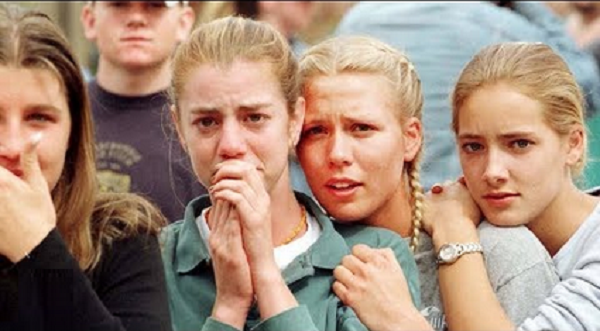
An elementary school in the Dallas Independent School District sent students home last week with a faux “Winnie the Pooh” book titled “Stay Safe.” “If danger is near, do not fear,” the book reads in part. “Hide like Pooh does until the police appear.” The distribution of the book, which came with no warning to parents or instruction or explanation from the school district, coincided with the May 24 anniversary of the Uvalde school shooting (where it was the police who hid like Winnie).

In a statement last week, the school district explained that the book was sent to student homes “so parents could discuss with their children how to stay safe” in dangerous situations at schools, such as a shooting. The district admitted that it should have given parents guidance about the book. “We work every day to prevent school shootings by dealing with online threats and by hardening our schools,” the email stated. “Recently a booklet was sent home so parents could discuss with their children how to stay safe in such cases. Unfortunately, we did not provide parents any guide or context. We apologize for the confusion and are thankful to parents who reached out to assist us in being better partners.”

Continue reading →

Depressing Ethics Notes From The Education Apocalypse, Part I: Graduation Follies

Let’s begin with the first of four troubling graduation tales, this one involving the rampant narcissism that social media and the popular culture imparts on our youth, aided and abetted by educational professionals.

Above is a newly-minted University of Arizona grad, known online as “Rachel Davenpole,” who donned a pair of see-through platform heels and a red thong to pose in a stripper-style split on a pole she had erected on campus for the task. Her erudite response to social media critics who found her photos inappropriate was was: “Graduated Magna Cum Laude (3.8 GPA) and received over $40,000 in scholarships … let’s get u a mirror so we can see who this tweets about babes.” Her non-sequitur defense was sufficient to inspire the New York Post—there are some good reasons why the rest of the media doubted you on Hunter’s laptop, guys—into giving Rachel even more of the publicity she craves with a news story.

Now watch Rachel be shocked when the employer who hires her for her first adult job thinks sexual harassment is appropriate…

Next, there is Marlin High School near Waco, Texas. According to a statement posted to Facebook, it has postponed its graduation after just five of 33 seniors could meet the requirements for graduation because of grades or attendance problems. The school says it will reschedule the graduation until June so students will have more time to qualify. But the problem isn’t the students, is it? Here’s a chance to re-post one of my favorite Charles Addams cartoons:

Continue reading →

The DeSantis Announcement Incompetence: This Is What Happens When No One On Your Staff—Or You—Knows Their Presidential History

Yes, the Twitter announcement was a mess, but that’s not what bothered me. What bothered me was this, five minutes and 46 seconds into Gov. Ron DeSantis’s long-awaited entry into the race for the White House…

(05:46)
We must return normalcy to our communities. America’s a sovereign country. Our borders must be respected. We cannot have foreigners pouring into our country illegally by the millions. We cannot allow drug cartels to poison our population with fentanyl. Public deserves safe communities and law and order must be maintained in American cities. We can’t have inmates running the asylum, and we must reject attacks on the men and women of law enforcement.

Normalcy??? The word was invented by then U.S. Senator Warren G. Harding when he ran for President in 1920. (The proper word was and is “normality.”) “Back to Normalcy” became his campaign slogan and is forever associated with Harding, who won election easily and went on to be regarded as one the nation’s worst Presidents, though historians are grudgingly coming to accept that he wasn’t a bad as his racist predecessor, Woodrow Wilson.

Continue reading →

The Problem Isn’t The Poem But The School And The Teachers Who Would Teach It

Poet Amanda Gorman’s interminable poem “The Hill We Climb,” read by the poetess at Joe Biden’s Inauguration, has apparently been removed from the curriculum of elementary schools in Miami-Dade County, Florida as inappropriate for grade-schoolers. It took an objection from a single parent to get the job done, which the mainstream media thinks is significant—you know, a single complaint is enough to “ban” literature. It is significant, but not in the way they think. It is significant because it shows how few parents are actively engaged in their children’s education and properly on the look-out for political indoctrination in the schools.

The poem is inappropriate for sixth grade and under even if it were taught competently and objectively. I could see the thing being used productively in high school, for example to teach what agitprop is, how events are framed differently by various political factions, or to show what bad poetry is. Unfortunately, using “The Hill We Climb” appropriately requires a level of skill and objectivity most teachers lack, and a degree of trust today’s teaching profession doesn’t deserve.

Now here is the poem:

Continue reading →

Comment of the Day: “Another “Great Stupid” Milestone: Mayor Adams’ Plan To Stop Shoplifting”

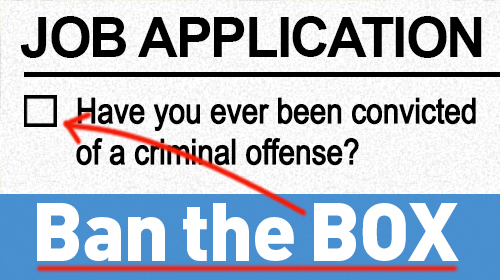
An April 28 post on “Homeroom,” the official blog of the Department of Education (ED) called on schools to remove the criminal background question from admissions. The post exhorted “institutions across the country” to “re-examine their admissions and student service policies and holistically determine how they can better serve and support current and formerly incarcerated students.” We call on you to ban the box,” it concluded.

“Ban the box” refers to a campaign started by the civil rights group “All of Us or None” in 2004. “The campaign challenges the stereotypes of people with conviction histories by asking employers to choose their best candidates based on job skills and qualifications, not past convictions,” the campaign’s website explains. The fallacy of that characterization should be apparent: it assumes that a criminal conviction doesn’t reveal anything about an individual’s character, ethics, trustworthiness or values, as if committing a crime is just something that happens to people, like catching the flu. On the other side of the argument is the principle that a citizen can “pay his or her debt to society,” and once that debt is paid, the metaphorical slate is cleared.

Ryan Harkins wrestles with these issues in his Comment of the Day on the post, “Another “Great Stupid” Milestone: Mayor Adams’ Plan To Stop Shoplifting”:

***

One thing that seems to be a common theme in decriminalization is the notion that people will just do the right thing if their situations weren’t dire. If people are shoplifting, it isn’t because they think they deserve stuff for free, or get a thrill out of thieving, or think theft is no big deal. No, they have to be shoplifting because that is the only way to acquire what they need. If they can just be shown there are alternatives, if they can just be instructed in the right behavior, and perhaps even the circumstances that is forcing them to steal are mitigated, that’s the true means of decreasing crime. Surely the last thing we want to do is give someone a black mark that will just make his circumstances worse and thereby drive him into even more crime, because then he really doesn’t have any choice but to shoplift. Who would give him the time of day if people knew he had a criminal record?

Continue reading →

Ethics Observations On The Shemy Schembechler Firing

What a mess.

Glenn ‘Shemy’ Schembechler, son of legendary Wolverines football coach Bo Schembechler, the winningest coach in Michigan football history who took the Wolverines to 10 Rose Bowls, was was hired as the University of Michigan’s assistant director of recruiting on May 17. Three says later he was fired (well, “forced to resign”). His demise was caused by his habit of “liking” controversial tweets on Twitter.

A statement from the school attributed Schembechler’s forced resignation to social media activity that “caused concern and pain for individuals in our community.” Here’s one of those “liked tweets,” in a Twitter tiff over a quote from Thomas Sowell:

Ethics Observations:

Continue reading →

Comment Of The Day: “Wait! Is THIS Peak Stupid In The Age Of The Great Stupid?”

Yesterday’s post about the theology PhD student telling a congregation that Jesus was transsexual based on artist renditions of him was calculated to trigger lively responses, and indeed it has. CD-VAPatriot is one of the Ethics Alarms readers who doesn’t comment often but is always sharp and provocative when she does, and this Comment of the Day is another example. (I have recently figured out that EA has a lot of female participants here. Good.)

Here is CD-VAPatriot‘s Comment of the Day on the post, “Wait! Is THIS Peak Stupid In The Age Of The Great Stupid?” …

* * *

I’m often left speechless by Woke World, but this one takes the cake. I’m physically sickened by this claim.

I have no problem with the LGBTQ crowd, although when their group constantly holds their needs/wants/ideals over the importance of everyone and everything else, it becomes an issue. As for the trans community, I feel very sorry for those adults who believe they were born the wrong gender. I feel that this conviction comes from the mind of someone who is mentally ill. Mutilating healthy body parts, removing healthy organs, using heavy duty medications one’s body doesn’t actually need is considered Xenomelia (Body Integrity Dysphoria)…which is classified as a mental illness. I consider transgenders in this category. My heart breaks for someone in that much pain. I believe that someone suffering from such a serious illness should be treated with complete compassion.

Continue reading →

A Hanlon’s Razor Challenge: Is The Decline Of History Literacy Among U.S. Students Due To Malice Or Incompetence?

[I apologize for using that Sam Cooke song to introduce this topic, as it is lazy and obvious, but 1) we don’t hear enough of Sam Cooke, one of the many great voices of the Fifties, and 2) I’ll always take a video over a picture, and I’ll always choose a song over just words.]

The National Assessment of Educational Progress (NAEP) released last week showed that about 40% of eighth graders scored below the basic level in U.S. history in 2022, compared to 34% in 2018. Only 13% of students performed at or above the “proficient” level in U.S. history. In addition, Eighth graders’ average civic scores decreased by 2-points compared to 2018, the NAEP results show. They are comparable to results from 1998, which is the first assessment year for civics under the current framework.

Why this should surprise anyone is a mystery. Although the decline is being attributed to the pandemic and the beyond idiotic (but politically unavoidable) lockdown, it has been clear for years that indoctrination according to partisan and woke agenda items had taken priority over teaching history and civics as the teaching ranks have become increasingly populated by ideologues and proto-Marxists who themselves don’t know much about history. It is deemed more important today to teach children that they are either the victims of systemic racism or complicit in it as well as the complex joys of alternate sexual orientations rather than the content of the Constitution, the U.S. role in winning World War II, or the issues underlying the Civil War.

Continue reading →

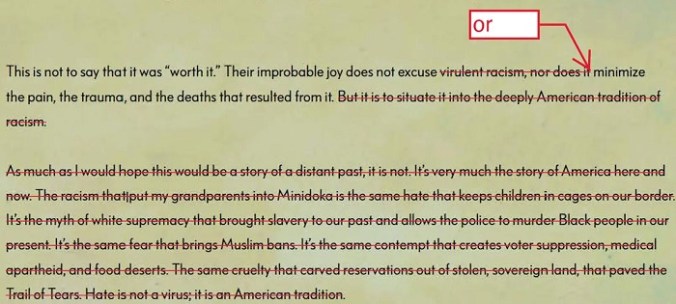
Scholastic Was Right To Ask A Children’s Book Author To Edit Her Anti-American Introduction, But Nobody Will Admit It

Maggie Tokuda-Hall was indignant when Scholastic, a publishing giant that distributes books and resources to 90% of the nation’s schools, offered, to license her book, “Love in the Library,” but only on the condition that she edit her author’s note as indicated above. She went public with her accusations that this was an example of unconscionable capitulation to right-wing efforts to “censor” books in school libraries, and now Scholastic is groveling for forgiveness after ” an outcry among children’s book authors,” while several authors and educators consulted by Scholastic condemned the company’s actions, and demanded an overhaul of the editorial process.

Of course, this is an issue being engaged with by only one side of the political divide, whose analysis is wildly skewed by fealty to political correctness and the anti-American movement in public education, fueled in part by children’s book authors (see above) and industry consultants (see above). The New York Times’ “news report” on the matter is, predictably, completely biased, framing what should be an issue stuffed with legitimate arguments on both sides to one where the rights and wrongs of the episode have already been settled by the demands of Leftist orthodoxy. The headline, as is often the case in the Times, frames the story dishonestly: “Asked to Delete References to Racism From Her Book, an Author Refused.”

The author, a Japanese-America, quickly plays her own race-card, telling the Times, “We all see what’s happening with this rising culture of book bans. If we all know that the largest children’s publisher in the country, the one with the most access to schools, is capitulating behind closed doors and asking authors to change their works to accommodate those kinds of demands, there’s no way you as a marginalized author can find an audience.”

Sure there is. Write children’s books that don’t seek to indoctrinate kids and that don’t try to reduce complex historical events to simplistic and misleading narratives.

Continue reading →