Trump and Turkey [CORRECTED]

None of this is impeachable, but it’s certainly inexplicable.

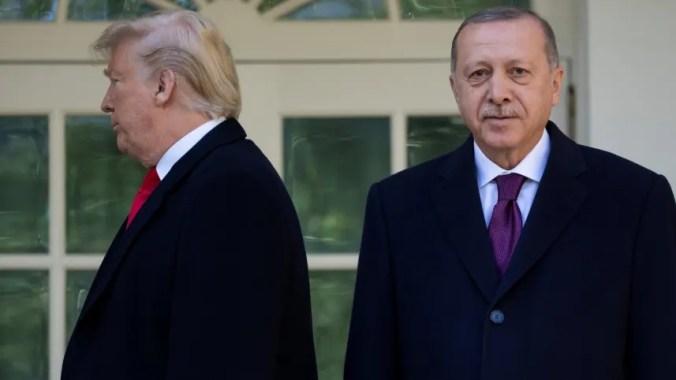
President Trump’s conduct and rhetoric regarding Turkey and its autocratic ruler  appear to be incompetent and irresponsible. In November, the President said he was a “great fan” of Turkish President Tayyip Erdogan. Since Erdrogan’s regime has been notable for its restrictions and attacks on basic civil rights, such praise is certain to stir the embers of the “Trump is a secret fascist dictator just waiting for his chance” narrative. Maybe that’s the idea, and this is more intentional trolling; who knows? Does Trump play three dimensional chess? Does he just say stuff without thinking, and then backtrack just as quickly?

Over recent months, the President also sided with Erdogan in rejecting Congress’s bi-partisan resolution officially labeling  the Ottoman Empire’s massacre of an estimated 1.5 million Armenians in 1915 as genocide. Turkey’s official position has been that the deaths were a product of war, and not illegal. Trump called it  “one of the worst mass atrocities of the 20th century” on Armenian Remembrance Day, and after the Senate passed its side of the resolution,  State Department spokeswoman Morgan Ortagus said in a statement,“The position of the Administration has not changed…Our views are reflected in the President’s definitive statement in April.”

It is worth noting, since the anti-Trump media won’t tell you, that the ‘horrible but not genocide’ approach follows decades of US policy designed to avoid angering Turkey, a NATO ally. Former President Barack Obama also did not refer to the killings as “genocide” during his tenure. Continue reading

Comment Of The Day: “From ‘The Ethicist’: Revealing The Real Bigots Among Us”

A.M. Golden asks, in his Comment of the Day, “When did Americans start thinking that destroying someone and/or that person’s livelihood is acceptable behavior when it comes to a difference in opinion?” It is an issue also raised in the previous COTD, considering the mall Santa fired after someone complained about his Facebook post showing him as the Jolly Old Elf, but wearing a red MAGA cap. A.M. understands that this is not an idle question, but an important one that raises vital concerns about the erosion of core American values, the public’s belief in our founding documents, and the acceptance of the ethical standard of reciprocity.

Here is A.M.’s Comment of the Day on the post, “From The Ethicist: Revealing The Real Bigots Among Us.”

When did Americans start thinking that destroying someone and/or that person’s livelihood is acceptable behavior when it comes to a difference in opinion?

This goes far beyond boycotts to allow blacks to sit at the front of the bus or at lunch counters. This goes well beyond punishing companies for dangerous or illegal practices that have harmed customers. It goes against the heart of what it means to be an American. Too often, we are told that opinions have consequences. Sure, they do. They always have. Doesn’t it seem, though, that the consequences have become far more ominous than they used to be?

I have never understood ideological boycotts. I remember the Disney boycotts of the ’90s when people with too much time on their hands began seeing obscene Easter Eggs in the new animated films. When gays started congregating at Disney parks on certain days, the company was castigated for not warning people ahead of time that it was Gay Day, despite its protests that Disney had no sponsored days for any groups at its parks.

I thought the whole thing was silly then and it’s still silly.

While in college, I worked at a McDonald’s restaurant. One day, sitting in church, a woman pressed a news article into my hands that reported on health benefits being extended to same-sex partners at McDonald’s corporate offices (I didn’t have health benefits myself at the store where I worked).

I gave her a funny look as if to say, “What am I supposed to do with this?”. She whispered, “Well, you WORK there!” Continue reading

The Cowardly Courage of Tulsi Gabbard

Rep. Tulsi Gabbard, the Hawaii Congresswoman who is engaged in a quixotic effort to win the Democratic nomination for President from the relative center, became the fourth House Democrat not to vote for both articles of impeachment, instead voting “present.” Here is her statement explaining the non- vote:

Throughout my life, whether through serving in the military or in Congress, I’ve always worked to do what is in the best interests of our country. Not what’s best for me politically or what’s best for my political party. I have always put our country first. One may not always agree with my decision, but everyone should know that I will always do what I believe to be right for the country that I love. After doing my due diligence in reviewing the 658-page impeachment report, I came to the conclusion that I could not in good conscience vote either yes or no.

I am standing in the center and have decided to vote Present. I could not in good conscience vote against impeachment because I believe President Trump is guilty of wrongdoing.

I also could not in good conscience vote for impeachment because removal of a sitting President must not be the culmination of a partisan process, fueled by tribal animosities that have so gravely divided our country. When I cast my vote in support of the impeachment inquiry nearly three months ago, I said that in order to maintain the integrity of this solemn undertaking, it must not be a partisan endeavor. Tragically, that’s what it has been.

On the one side — The president’s defenders insist that he has done nothing wrong. They agree with the absurd proclamation that his conduct was “perfect.” They have abdicated their responsibility to exercise legitimate oversight, and instead blindly do the bidding of their party’s leader.

On the other side — The president’s opponents insist that if we do not impeach, our country will collapse into dictatorship. All but explicitly, they accuse him of treason. Such extreme rhetoric was never conducive to an impartial fact-finding process.

The Founders of our country made clear their concerns about impeachment being a purely partisan exercise. In the Federalist Papers, Alexander Hamilton warned against any impeachment that would merely “connect itself with the pre-existing factions,” and “enlist all their animosities, partialities, influence, and interest on one side or on the other.” In such cases, he said, “there will always be the greatest danger that the decision will be regulated more by the comparative strength of parties, than by the real demonstrations of innocence or guilt.”

Donald Trump has violated public trust. Congress must be unequivocal in denouncing the president’s misconduct and stand up for the American people and our democracy. To this end, I have introduced a censure resolution that will send a strong message to this president and future presidents that their abuses of power will not go unchecked, while leaving the question of removing Trump from office to the voters to decide.

I am confident that the American people will decide to deliver a resounding rebuke of President Trump’s innumerable improprieties and abuses. And they will express that judgment at the ballot box. That is the way real and lasting change has always occurred in this great country: through the forcefully expressed will of the people.

A house divided cannot stand. And today we are divided. Fragmentation and polarity are ripping our country apart. This breaks my heart, and breaks the hearts of all patriotic Americans, whether we are Democrats, Republicans, or Independents.

So today, I come before you to make a stand for the center, to appeal to all of you to bridge our differences and stand up for the American people.

My vote today is a vote for much needed reconciliation and hope that together we can heal our country. Let’s work side-by-side, seeking common ground, to usher in a bright future for the American people and our nation.

If you expect Ethics Alarms to award Gabbard an Ethics Hero designation for such equivocation, you don’t know me very well yet. Continue reading

Cancel Culture Ethics: Two Gaffes, Two Polls

Chuck Bonniwell and Julie Hayden, a husband and wife team, co-hosted the “Chuck and Julie “show  on KNUS AM TalkRadio in Denver. Riffing about the impeachment this week, Bonniwell said,  “All right, here, a little after 1:30, talking about the never-ending impeachment of Donald Trump. Then he added, chuckling, ” You know, you wish for a nice school shooting to interrupt the impeachment news….”  Julie quickly jumped in, saying, “No! No! Don’t even — don’t even say tha!. No, don’t even say that! Don’t call us. Chuck didn’t say that!”Still laughing,  Bonniwell tried a save, finishing his handing sentence with “in which no one would be hurt.”

Jason Salzman of the Colorado Times Recorder, who said that after hearing Hayden’s plea for listeners not to call their complaints about her husband’s joke, he “called anyway.” Sandy Phillips, who lost her daughter in the Aurora theater shooting, posted on Twitter: “This guy should be fired. Total ignorance. Shootings hurt us all … just ask witnesses and first responders. You don’t have to be shot to be wounded.”

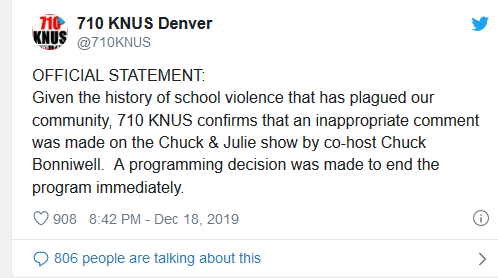
Bonniwell isued an apology the next evening after 24 hours of criticism on the “Chuck & Julie” Twitter feed, saying,  “I made an inappropriate comment meant as a joke. I’m sorry it was not received that way.”  Too late. KNUS fired Chuck and Julie later that evening:

Was this a fair decision?

I’m not sure it was. As I have held here on other occasions, those who take extemporaneously for a living, especially when they are expected to be amusing, are constantly walking a high wire. Occasional gaffes, including moments when certain metaphorical landmines are tread-upon or lines are crossed, are inevitable, and the more creative and bold the talent, the more likely such events are. A no-tolerance policy is unreasonable, and it is virtually always the ethical approach to treat the first such error with a warning or punishment short of dismissal. Virtually, because there may always be single gaffes that are so terrible and potentially destructive to the talent’s employer that firing is the only response.

Thus the question here is whether Chuck Bonniwell’s comment falls in the latter category. My view si that it does not: Continue reading

“Nah, There’s No Mainstream Media Bias!” Holiday Edition

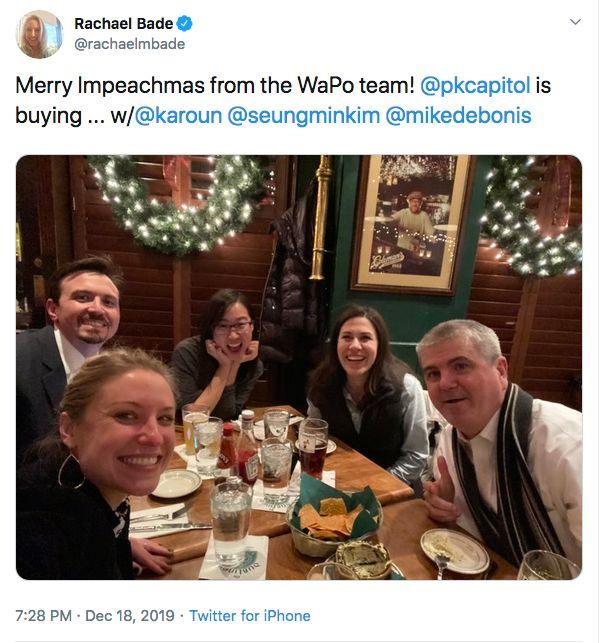
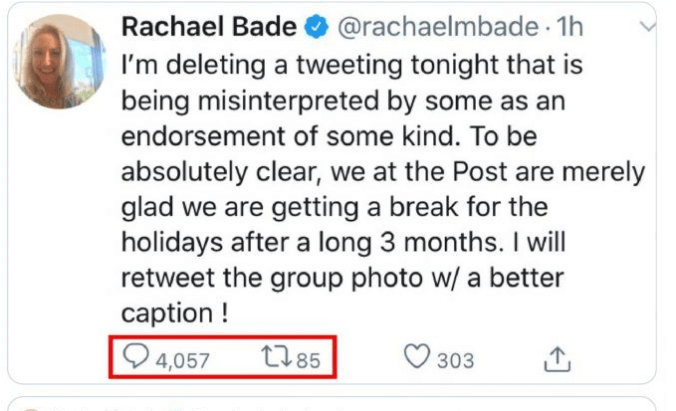
Oops! Let the mask slip a bit too much there! After hearing from her editors or others in the Post offices that it was poor PR to proclaim the fact that the paper’s staff was cheering, high-fiving and otherwise rejoicing to celebrate their not insubstantial role in provoking a destructive and unjustified Presidential impeachment, Blade solemnly tweeted,

Right.

Too late.

A University Demonizes Diversity Of Thought

The headline in the New York Times last month read, “Indiana University Admits That Professor’s Views Are Vile, And That It Can’t Fire Him.” Nice. First, another party can’t “admit” someone else’s opinions are vile, as if there is a universal standard for “vile.”  Second, the headline assumes that the professor is the villain in this controversy, but then, that’s the Times for you: taking sides instead of reporting the facts.

I apologize for missing this chapter in the ongoing effort to intimidate and persecute anyone whose views do not align neatly with the mandated progressive orthodoxy.  The Times piece in question is dated November 23; not only was that my wedding anniversary, but I was also on an ethics training road trip without a functioning laptop. (I have one now.) I’m pretty sure I would have perceived the need for Ethics Alarms to bring some fairness to the assault on Professor Eric Rasmusen, though, as you will see, he is very capable of defending himself, if he could get a fair hearing (or reading).

The reason he can’t is because the news media has already decided that he should be shunned, as students try to run him out of academia and the marketplace of ideas.

To be clear, Professor Rasmusen is the victim of unethical conduct here, not the perpetrator of it. His “crime,” and it is not supposed to be a crime in the United States or academia, is asserting non-conforming views on his personal blog.  The news media framed the story to undermine Rasmusen by stating as fact that he “used his social media accounts to denigrate women, people of color and gay men.” That is a false and unfair characterization, Rasmusen uses his blog and social media accounts to cover a wide range of topics, often brilliantly, from the perspective of a Christian conservative. Continue reading

Ethics Round-Up, 12/18/2019: The Day Before An Invasive Procedure Edition [UPDATED]

Yuck.

Even the satisfaction of knowing that the President reads Ethics Alarms, or at least thinks like I do…wait, that came out wrong. Anyway, today I expect to be uncomfortable, hungry and distracted, so who knows what might appear here today?

You were warned.

1. The Ethics Quote of the Day comes from ex-Marine and TV talk show host Montel Williams (who was very nice to me when I was on his show), on the “scandal” of some cadets flashing the dreaded “OK” sign during the Army-Navy Game:


“Both West Point and Annapolis are investigating, and it strikes me as defamatory that some in the media have branded these young people as racists without a shred of evidence. I understand that a handful of racists (perhaps living in their parents’ basements) attempted to co-opt the ‘OK’ sign as a symbol of white power … but that is not evidence that these kids were motivated by racial animus. We owe these young people, who had the courage to sign up to be part of the 1% who defend this democracy, better than this,”

I would say that we owe them better than even investigating such trivia. A ambiguous gestures are ambiguous, and no student, in a military academy or anywhere else  should have to defend or explain them. The students are entitled to the benefit of the doubt.  As with the “It’s OK to be White,” flyers, the rational, responsible approach by administrators is to ignore them, rather than to make a scandal out of nothing.

When will we see the first “It’s OK to make the OK sign” flyers? Heck, I may put some up myself…

2. Nah, there’s no progressive “war on Christmas,’ and there’s no mainstream media bias, either. And CNN’s Brian Stelter isn’t the most incompetent and absurd “media critic” since the term was coined! Imagine: Stelter asked on Twitter,

“Justice Neil Gorsuch is on “Fox & Friends” right now. The Q: How is it appropriate for a Supreme Court justice to try to goose sales of his three-month-old book by chatting on one of the most partisan shows on TV?”

More “Q’s”: Would it be appropriate for Gorsuch to chat on another network, like, say, CNN? Would “wtachdog” Stelter bitch about that? What does the level of partisanship of a show have to do with whether a Supreme Court Justice should appear there? Is there any rule or precedent holding that it is unethical for a sitting Justice to promote a book? (I’ll answer that one: no.)

Stelter’s whining wasn’t close to the most contrived objection to Gorsuch’s visit to the Fox and Friends couch, though. This was: Continue reading

Impeachment Ethics Update, Holiday Edition, Part Two: The President’s Letter

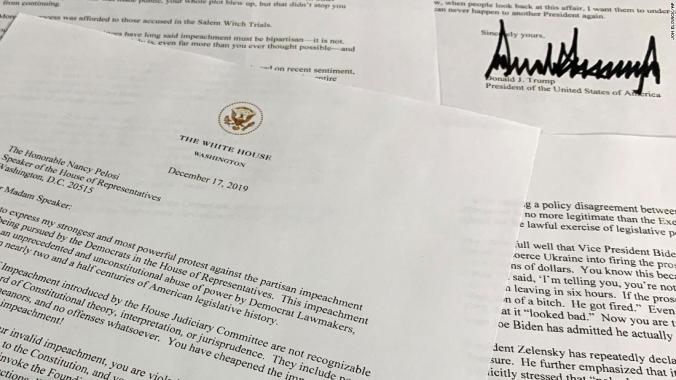
The President’s epic and historic letter to Speaker Pelosi on the eve of the vote to impeach him is nothing if not audacious and to someone who has been making many of the same points the President’s letter does, satisfying. I bet Bill Clinton wishes he had thought of it, except that he had a problem Trump does not: Clinton had in fact committed felonies by lying under oath, something a President must not do. (As I said at the time, without ever hearing a satisfactory rebuttal, if a lawyer would be disbarred for such conduct, as Clinton essentially was—he was forced to quit the Arkansas bar before he was fired from it—how can a President be held to a lower standard?).As President Trump’s letter correctly states, “The Articles of Impeachment introduced by the House Judiciary Committee are not recognizable under any standard of Constitutional theory, interpretation, or jurisprudence. They include no crimes, no misdemeanors, and no offenses whatsoever.”

Well, they are recognizable under some bad and dangerous Constitutional theories, many of which have advocates in the House and among the “resistance” punditry. For example, even now, prominent Democratic House leader Maxine  Waters admits that she has no facts to back up her conviction that the President had a deal with Putin, she’s just sure he did. Waters said she was “ready to talk about” impeachment in February 2017, three weeks after Trump was sworn into office.Her theory later became that an opposing party House majority could impeach a President at will, and didn’t need any reasons other than as assertion that he was “unfit.”

That appears to be what Nancy Pelosi allowed her team to settle on, lacking anything better.

Naturally, the letter has prompted the Democratic Party/”resistance”/mainstream media coup team (what Ethics Alarms calls “The Axis of Unethical Conduct,” or AUC) to have a collective head-explosion orgy. The mainstream print media would not even report on the letter  fairly, in most cases not giving readers the chance to make their own assessment and publishing it with “factchecks” attached, many if not most of which were just partisan spin as rebuttals. For example, in the New York Times version, the section I quoted above was linked to this: “The articles charge Mr. Trump with abuse of power and obstruction of Congress. But an impeachable offense does not have to be a specific crime.” Well…

  • That’s an opinion, not fact. Every previous impeachment has involved a specific crime.
  • As Prof. Dershowitz pointed out, the “obstruction of Congress” referred to in the Articles of Impeachment  cannot be called misconduct, since the Supreme Court has deemed the President’s power in this regard an open question until they rule on it—next June.
  • As Jonathan Turley (and Trump) pointed out, “abuse of power” is too subjective a standard to use as an excuse for impeachment.

Characteristically, as we have seen the past three years, the attacks on the letter have focused on style at least as much as substance. (On substance, however, the letter is difficult to rebut.)

On yesterday’s CNN Newsroom,  the spectacularly hypocritical John Avlon (who once pretended to lead a “no labels” movement as a neutral non-partisan) claimed  that the President’s letter  would cause Republican Senators to raise questions about his “mental state.”  This is rich: Impeachment Plan S is blowing up in Democrats’ faces, so Avlon pivots to good old, evergreen, Plan E : ”Trump is mentally ill so this should trigger the 25th Amendment.”

Yeah, boy, putting out that letter laying out exactly what the impeachment is in language anyone can understand was crazy.

Avlon’s foolishness does raise a question: did the President really write the letter himself? I doubt it. I think someone–Steven Miller has been mentioned as a prime suspect—did an excellent job channeling the President’s unique style and tone, but the letter is too well constructed to be Trump’s alone. Hey, John: if someone else authors a letter for the President that he signs, and you think it’s an “unhinged rant”  and “the definition of not presidential,” does that mean he’s crazy? Can you delegate crazy?

As with so much that has gone before, the President has triggered his foes into broadcasting their own derangement.

A typical, measured, lawyer-checked, restrained Presidential letter would be far less effective. Ann Althouse figured this out, writing, Continue reading

From “The Ethicist”: Revealing The Real Bigots Among Us

, aka “The Ethicist,” apparently received two inquiries last week from what I fear are typical New York Times readers: self-righteous, progressive, and totalitarian at heart. As usually is the case, “The Ethicist’s” answers were competent. I’m not really concerned with his answers, though they were too timid and pandered to people who needed to be metaphorically slapped in the face. It’s the questions that are really ominous.

Inquirer #1 wanted to know what to “do” about her landlady, whom she and her partner “have come to believe that she harbors significant racial and gender biases.” She continued,

When units in our building come up for rent, she often asks  [us] to recommend friends, and over the years a number of our friends have lived here. I value being able to extend what really is an extremely good financial deal to friends who would really benefit from it, but am deeply uncomfortable about the fact that, in doing so, I am enabling her racism and sexism. Is there an ethical solution here? I wish I could report her to some sort of city housing authority (we are in Los Angeles), but I doubt I have any legal recourse as I’m not an aggrieved party and my belief in her biases is based on casual observations and overheard comments. I can’t point to a particular incident. I feel guilty for not wanting to recommend the place, as I know so many friends who could use the financial break, but I also feel like it’s harder and harder to justify “helping” her in any way.

The woman has not observed any incidents of racism or sexism, but she wants to “report” the landlady, who has apparently always treated her well. Inquirer #1 has decided that it’s unethical to “help” such a person because that would be “enabling” her evil ways, whatever they are. Basically, she feels that she is justified in punishing her landlady for not embracing her views, the “right” ones. Continue reading

Final ‘Week Before Christmas’ Ethics Shopping, 12/16/2019: Joy, Obama, And JPMorgan

Inspiring Christmas lyrics of the week:

Oh, the world is your snowball, see how it grows
That’s how it goes, whenever it snows
The world is your snowball just for a song
Get out and roll it along

1. That this kind of thing could happen at a major bank in 2019 is inexplicable and disgusting. Jimmy Kennedy, a nine-year NFL veteran,  earned $13 million during his nine-year career and had been told that he would be accepted as a “private client” at JPMorgan Chase, an elite designation with perks like travel discounts, exclusive event invitations and better deals on loans. When he went to  his local JPMorgan branch in Arizona to determine why he had not been accepted into the cataegory, he was told by his representative, who is black, “You’re bigger than the average person, period. And you’re also an African-American. We’re in Arizona. I don’t have to tell you about what the demographics are in Arizona. They don’t see people like you a lot.”

Kennedy recorded the conversation, and after pulling most of his money out of JPMorgan,  complained to the bank as well as an industry watchdog agency. The bank sent him a letter saying, “You stated that Mr. Belton informed you that our firm was prejudiced against you and intimidated by you because of your race. We found no evidence to substantiate your allegations.”

He also sent the recording to the New York Times, which wrote about Kennedy’s experience. A few days later, Jamie Dimon, the chairman and chief executive of JPMorgan Chase, sent a memo telling employees that such behavior “does not reflect who we are as a company and how we serve our clients and communities every day.”

That’s the Pazuzu Excuse: “It wasn’t me!” Sorry, chief, but if you have employees treating African Americans like Kennedy was treated, that is who you are as a company, and as CEO, you’re responsible. Continue reading