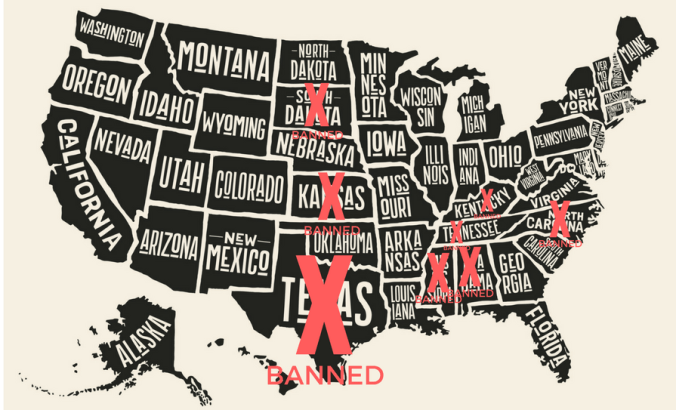
Recently various states have decided to punish their fellow members of the United States of America for daring to adopt laws of which they do not approve. The method: bans on government employees traveling to those states on business and the state dime, with the hope that the state’s lead will discourage private travel as well.Why are they doing this? Oh, many reasons, I suppose, all of them insufficient to justify the conduct, which is unethical.
Some of the state legislators who pass these bans, and the governors who sign them, want to place economic sanctions on the other states, even if the effects are limited. After all, they can’t stop the citizens of the states from traveling, only government employees. But pressure is pressure, and the limited measures are an attempt to meddle in the democracy of those other bad states. Another reason is virtue-signalling, as a state seeks to show that it supports a group that is politically strong in that region against another state’s policies that displease it. A third reason is the related motive of grandstanding. Finally, a state might use a travel ban to strike back at another state that is banning state travel there. An eye for an eye, a voucher for a voucher.
Yes, this will end well.
I wish I didn’t have to say this, because I know everyone thinks I pick on liberals, progressives and Democrats, but it’s the Democratic majority states that are using this weapon, especially…well, can you guess? Oh, come on, guess. Yes, the major offender is California. Others are New York, Minnesota, and Washington state.
“Our country has made great strides in dismantling prejudicial laws that have deprived too many of our fellow Americans of their precious rights,” says the public statement of California’s Attorney General Xavier Becerra of California, who has been instrumental in getting the Golden State to limit trips to Alabama, Kansas, Kentucky, Mississippi, North Carolina, South Dakota, Tennessee and Texas. You know, those conservative bad places, where people with sub-normal IQ’s cling to their guns and Bibles. His quote is a classic of arrogant, doctrinaire, narrow-minded, elitist self-righteousness. Continue reading →
“California and New York will become the first states to allow illegal immigrants to practice law and be sworn in as lawyers. In so doing, they will grant the privilege of upholding the law and defending the U.S. Constitution to people who have intentionally violated the rules, and who have no right whatsoever to be here.”
This is a fair and objective description. I detest conservative radio talk show host Micheal Savage, who wrote a right wing attack tome called “Liberalism is a Mental Disorder” just as I detest that title, and the approach to civil discourse and political disagreements that goes with it. (Ann Coulter preaches the same message, but is funnier when she does it.) However, when I read about things like this, I feel a magnetic pull to the position. In 2013, Governor Brown signed into law a provision allowing illegal immigrants to be awarded licenses to practice law in the state California. At the same time as he vetoed nother bill passed by his reliably wacko legislature that would have allowed those who would not obey the nation’s immigration laws to be eligible to serve on juries, and thus pass judgment on the alleged crimes of U.S. citizens. Ponder that contrast for a minute, and see if your head explodes. Brown had a convoluted explanation for the seeming contradiction, but what he was doing was obvious: he was pandering to illegals and their supporters. Serving on juries is an obligation of citizenship that citizens find onerous: telling illegals that they didn’t have to meet this obligation while still harvesting citizenship benefits was a welcome decision.
“I am not surprised by this turn of events, just made nauseous by it. I almost closed comments for this post. If I really have to explain to someone why those who have never taken affirmative steps to become citizens in this country should not be allowed to practice its laws after years of being in defiance of its laws, I’m not sure its worth the effort.”
I find myself annoyed at the groundswell of good wishes for John McCain after his diagnosis of glioblastoma…McCain is a war criminal and, more to the point. someone who as a politician has championed horrifying actions and been lousy on state commitment to public health…But ultimately what troubles me is the urge to send such well wishes to an utter stranger as it reinforces the notion that some lives are more important than others. There are lots of people with glioblastoma and who have died from it (including my mother twenty years ago)….
—San Diego State University Political Science Professor Jonathan Graubart on Facebook, prompting some calls for him to be fired, and others on campus to second his opinion.
Is this an Ethics Quote or an Unethical Quote? I could call it an Ethics Quote because it raises many ethical issues, and mere statements of opinions, even stupid and vicious ones, are not usually unethical in themselves. This quote strongly suggests that the speaker is unethical in than one respect; it is also, at very least, irresponsible in its context, which is that he is a teacher, and represents the institution.
Jonathan Turley flagged this episode, as he reliably does any time a professor comes under fire for controversial speech. As always, he supports his fellow academic:
“Graubart’s comments are hurtful and hateful. It is a reflection of the incivility that has taken hold of our social and political dialogue. It is always sad to see a fellow academic rush to the bottom of our national discourse. However, we have free speech and academic freedom to protect unpopular, not popular, speech. Popular speech does not need protection. Graubart is expressing his deep political and social viewpoint on social media. He should be able to do that just as his critics have a right to denounce his views.”
San Diego State University is a government institution, and thus subject to the First Amendment, in addition to the principles of academic freedom. However, even a state institution has a right to protect itself from harm. This isn’t just political speech; it is bona fideasshole speech, signaling that the speaker is not a trustworthy teacher, and that any school that would have someone this intolerant, doctrinaire, vile and contemptuous of kindness and compassion educating, aka indoctrinating students isn’t trustworthy either. Universities, public or not, should be able to insist on a minimal level of professionalism from faculty in their public behavior and pronouncements so the institution isn’t permanently discredited, embarrassed, and harmed.
My old friend Mark drops in to comment just a few times a year, but always delivers his trademark optimism, fairness, and perception. When he talks, I learned early on in our relationship, attention should be paid.. His was one of several excellent comments on the horrific episode in Cocoa Beach, where five teens stood by watching a handicapped man drown, and seemed to enjoy the sight mightily as they recorded his death on their cell phones. In response to another commenter’s query, “Are “kids” that are so disconnected that they’d do something of that magnitude rehabilitatable?”, Mark leaped k took the discussion to a related topic that I had found myself thinking about a lot while I was trapped in a lobby and two airports yesterday with nothing to do but wait and silently curse. What are electronic devices and social media obsession doing to our social skills and ability to relate to the world? At what point to we start sounding the ethics alarms…or the societal survival alarms? [ I’m going to include the last part of Mark’s earlier comment on the story, because it is a helpful introduction to the rest.]
…The natural human reaction to observe has been enhanced by our ability to record, and it now seems to be the first response in almost every situation – the more harrowing the better. I’m sure there is some personal thrill involved in being able to post the result, garnering comments and ego-gratifying oohs and aahs.
The situation in Florida is only the most horrible of them, right up there with the guy who posted pictures of himself with the corpse of his step-father, whom he had just murdered. Like everything else, this is a tiny part of a much bigger picture of who we are becoming as a culture. The 21st century ability to remain safely behind a screen while still feeling a full participant in life (Internet commenting a prime example) frees us of the necessary empathy (or simply humanity) to come from behind that screen to behave in ways that might be heroic or even civil. I have little difficulty seeing that behavior manifesting in children raised viewing life through a cell phone.
The much larger question – at least for me – remains “Am I my brother’s keeper?” It’s a nagging question, versions of which swirl in and around almost all the major political issues of our day and, now, into our personal dealings with one another. It is always there, but we come up with more and novel ways to avoid actually answering or acting on it. Clearly, it never occurred to these boys. Cain didn’t want to answer the question. And, I suspect, neither do we.
***
I carry two cell phones, absolute wonders of technology, which remain in my briefcase most of the time although I’ll take one of them with me to a picture-taking occasion. My friends grit their teeth at receiving responses to texts that are weeks old. My relationship with my cellphone(s) was cemented when I had the opportunity to whale watch off of Maui. I realized that I was so concerned about my precious iThing getting wet or falling into the water that I wasn’t watching the whales. I put the phone away and decided that watching the real world with both eyes was more interesting and that’s what I try to do. I hope sincerely that that attitude would ensure that I offer whatever aid I can in a dire situation rather than wondering what it will look like on Facebook later on. Continue reading →
…and gee, it’s good to be back home! You have no idea how good it is.
1. ARRRGH! I returned to Ethics Alarms with 6 pending comments, and I want to apologize profusely for the back-up, especially to poor Paul Schlecht, whose avatar inexplicably makes WordPress hold every single one of his comments in moderation until I rescue it. Only one post got up yesterday, and that was a close call: I was in resort/airport/travel Hell yesterday in Daytona Beach, then Charlotte, pretty much from the moment I got my wake-up call at 6 AM to when my plane finally arrived at D.C.’s Reagan National Airport at just short of 1 am. today.
At least my law firm retreat seminar on legal ethics and technology was lively, but now I am way behind on posts, and also not exactly at the top of my game. Again, my apologies to all. And I’ve got to get a new laptop without a jumping cursor and that doesn’t crash my browser every 20 minutes or so.
2. I mentioned last week that the New York Times Sunday Review section is a weekly exercise in anti-President Trump porn. I couldn’t find a Sunday Times yesterday, so as a test, I’m going to open the copy my wife saved for me and look at the section now.
Let’s see…well the above the fold story is a feature about “why women aren’t CEOs.” The anti-Trump shot doesn’t come until the last paragraph, where the author, Susan Chira, couldn’t help herself from quoting Hillary Clinton as she blamed misogyny for her defeat. The Deplorables, you know. The second story on the front page is a mocking piece by a British historian, about a new Trump Doctrine, but with the term in scare quotes. How dare the President stand up for Western Civilization, we are asked to consider? This author, Stephen Wertheim, claims that the Trump administration’s problems with Iran, North Korea and China are based in racism and religious bias. (Obama’s problems with the same nations were, presumably, based on a sincere concern for peace.) The essay is also fairly anti-American, but concludes with the insult that the problem with the President isn’t so much what he does as who he is.
This is essentially the argument of “the resistance.” You know. Bigotry.
Let’s see—that piece took up all of page two, so we move on to page three. Two op-eds are there, one again mocking the ex-press secretary Sean Spicer, which the Times editorial board had already done, and the other, by Frank Bruni, attacking Jared Kushner. It closes with this, in part:
His counsel to Trump has been flawed, to say the least. He reportedly lobbied for the firing of James Comey, which didn’t turn out so well….I hear that he feels persecuted. Wronged. In that regard, too, he’s like his father-in-law, though Trump wears his self-pity, fury and ruthlessness right out front, for the whole world to see.
This is the company line. Actually, firing Comey turned out spectacularly well: the President was able to get rid of a highly placed leaker who had proven himself incompetent and untrustworthy. Bruni and the Times feel it was a mistake because the completely legal, appropriate, indeed overdue dismissal brought down the ire of the news media determined to get rid of the President. Message: When will you learn that we call the shots, you fool?
In fact, the President and his entire family have been persecuted by the Times from the very beginning, in obvious contrast to the news media’s disgusting fawning over the Clintons and Obamas, and even their chilly respect for the Bushes.
On to page four! Oh! Here’s a cartoon of the President as Donald Duck, and an op-ed by a New York City mother about how embarrassing it is to have a toddler who–The Horror!—likes the President of the United States! Beneath that screed, with a picture of Don, Jr., is an op-ed attacking another member of the President’s family in a piece about “men who never grow up.” The Trump boys are lumped in with Billy Bush, Ryan Lochte (the moronic Olympic swimmer), the fortunate college rapist Brock Turner, and the police officers who shot Tamir Rice! Funny, the nation’s most prominent perpetual adolescent, who embarrassed the whole nation by using the White House as his passion pit, is never mentioned.
The non-Trump stories then take over for a few pages, and we’re finally at the editorial page. Two of the three editorials attack the President’s policies as the embodiment of evil: one condemns the very concept of the Election Integrity Commission— did you know that trying to find out how much actual voter fraud there is constitutes voter suppression?—and the other uses the President’s border wall plan as a prop to level general insults. The rest of that page is devoted to a special selection of Letters to the Editor critical of…Donald Trump! Every one, all ten. You’re right, NYT, the paper doesn’t reflect this opinion thoroughly enough. On the facing page, two of the three op-eds consist of more Trump bashing. Maureen Dowd is one, but to be fair, all she does is level snark at everyone. The other is a second attack on Jared Kushner, because one per section is not enough.
The total: Nine Trump-hate pieces, plus ten anti-Trump letters, and not a single supportive word, balanced analysis, or defense. And the Sunday Review section is like this every week.
3. I can’t believe I’m writing this. The Discovery Channel’s always idiotic and often misleading “Shark Week” told audiences that Olympic Gold Medal swimmer Michael Phelps would be racing a Great White Shark in the ocean. Admittedly, most potential viewers should be smart enough to figure out that there had to be a catch (no pun intended) despite the misleading title “Phelps vs. Shark: Great Gold vs Great White.” They should be, but we know they aren’t, based on the other stupid shows they fall for on the network, and also because there have been three “Sharknado” movies with a fourth on the way. That Discovery Channel title is a lie: Phelps never was in the water with a shark; he never saw a shark; he never raced a shark. He “raced’ a computer-generated shark that was put into the film after Phelps was safe and dry. Some of Phelps’ gullible fans are annoyed.
They should be. On the other hand, they are morons. The entire exercise should have taken about 6 seconds, the amount of time it takes to say “White sharks swim faster than humans, even Olympic champions. Bye.” Continue reading →
1. Not a single comment on yesterday’s sole warm-up topic, the propriety of complimenting someone’s physical appearance or features? That’s fascinating.
2. I had to wrestle my fingers to the ground yesterday to avoid writing a full post on this editorial by the New York Times editors. I know everyone is sick of Ethics Alarms pointing out the relentless, unprofessional anti-Trump bias in the news media, because I’m sick of writing about it. This may have been a new low, however. In the wake of Sean Spicer’s resignation as White House press secretary, the Times unleashed the equivalent of a mean playground taunt. To read it, one would never guess that the Times had ever experienced any other press secretaries, especially President Obama’s trio of Robert Gibbs, Jay Carney and Josh Earnest , who were uniformly dishonest with disgraceful regularity. Spicer was a “four Pinocchio” spokesman? The standrad term her for Obama’s press lackies was “paid liars,” and the description was fair. Yet the Times didn’t greet the news of any of their withdrawals for the post with “Nyah nyah nyah you suck!” editorials, because the New York Times accepted that President’s lies and deceptions as designed for the greater good.
Of course, it was exactly this unethical journalistic bias that caused Spicer to adopt the attitude that most prompted the Times to attack him personally on his way out the door. He believed that journalists who don’t behave like journalists need not he respected as journalists, and he was absolutely correct in this. Indeed, no newspaper that isn’t able to discern that an editorial like the one yesterday regrading Spicer makes it look like a partisan hackery shop should be respected at all. Spicer was a really bad spokesman—inarticulate, inept, dishonest and not very bright. Nonetheless, he was trying to do a difficult job, did his best, and was no more nor less awful at it than all but a few Presidential press secretaries over the last half century or so. Only Spicer, however, was deemed deserving of such insults at the end, not even Ron Ziegler, Nixon’s complicit press secretary who looked and sounded like a half-successful laboratory clone of his boss. That is because the Times’ editorial was personal, based on emotion and anger, and an ethics alarms void.
3. This story from Canada reads like it was designed to illustrate the folly of giving government more power over our lives rather than less. Continue reading →
This happens some times: I announce a Comment of the Day, I’m delayed in posting it, and because the comment was so provocative, it attracts equally excellent comments. This time I’m going to eschew the awkward “Comment of the Day: Comment of the Day on the Comment of the Day route, and link the comments up in sequence, beginning with the initial COTD by valentine0486.
Here are sequential Comments of the Day on the Ethics Quiz, “The Low IQ Parents.” I’ve learned a lot already. The whole comment thread is excellent and you should read it; I’m starting ats valentine0486’s COTD
I worked for two years with developmentally disabled individuals within the range of these two people. And, as much as it is sad and as much as I generally don’t like it when government makes these decisions, I am absolutely 100% certain that none of the individuals I worked for could properly raise children. As such, the state’s actions here are ethical, if the reasoning is somewhat dubious.
Let me share with you just some brief highlights of my time working with this segment of the population. I will abbreviate their names, so as to protect their identities. Please note that all of these individuals had higher IQs than Amy, and they may have all been tested as higher than Eric Continue reading →
Now and then I see or read about something that seems too trivial for a post, but it gnaws on me and torments me, and I worry that, like Lewis Black’s famous over-heard “if it wasn’t for my horse, I wouldn’t have spent that year in college,” it will fester and eventually kill me. I’m going to launch a new category for these things, the Popeye, in honor of the gruff spinach-eating sailor’s quote that signaled a fight was coming, “That’s all I can stands, cuz I can’t stands no more!”
“But even if Mr. Sessions remains in his job, the relationship between him and Mr. Trump — the Alabama lawyer and the Queens real estate developer, an odd couple bound by a shared conviction that illegal immigration is destroying America — is unlikely to ever be the same, according to a half-dozen people close to Mr. Trump.”
Wait—when did Sessions or the President express the “conviction” that ” illegal immigration is destroying America”? I googled the phrase. Few references came up, but over half of those that weren’t quotes of this article came from pro-illegal immigrant sources, as their exaggerated characterization of what illegal immigration critics say or think. It is a false representation, explicitly designed to make such critics appear hysterical and foolish. Continue reading →
I detest bad leadership. I’ve studied leaders since I was 11, and studied management since I was 19. Incompetent leadership and inept management cripples business, the arts, sports, education, government, civilization, the world. I seldom see as horrible an example of both as in the case of President Trump’s verbal tirades against his own Attorney General,Jeff Sessions, first to Republican Senators at a White House dinner on this week, and later in an interview with the New York Times. Sessions responded to his boss’s disgraceful behavior by saying that he intended to serve “as long as that is appropriate.”
The only reason it would be appropriate for anyone to work for a leader, executive, manager or supervisor who treats subordinates this was is patriotism. The nation has to be managed; the government has to function. Other than that, no one with honor, self-respect or a sense of responsibility should voluntarily subject themselves to the kind of abuse this President offers. Reportedly the President insists on loyalty, but loyalty has to be minimally reciprocal. Criticizing a subordinate in public, as with the press, or in private, behind that subordinate’s back, is the equivalent of sin for any leader. It is cowardly. It’s unfair and disrespectful. It is irresponsible, incompetent and stupid, stupid stupid. Continue reading →
Brilliant! One simply cannot make a more deceitful statement–literally true, designed to deceive, leading listeners to a false conclusion if they don’t parse the words with care.
Yes, this surpasses Bill Clinton’s deceit classic, “I did not have sexual relations with that woman.” (Oral sex isn’t “sexual relations” in Bill’s view, so he wasn’t lying. Right.) Bill only was deceiving in one respect. O.J. pulls a hat trick:
1. “I’m in no danger to pull a gun on anybody.”
True! The Juice’s weapons of choice are big knives.
2. “I’ve never been accused of it.”
Also true. O.J. has been accused of murder, but not of pulling guns on people.
3. “Nobody has ever accused me of pulling any weapon on them.”
That’s indisputable fact. Nicole and Ron could and would have accused him of pulling a knife on them, if they had survived the attack.