Ethics Hero: H&S Bakery Co-Owner Chuck Paterakis

The inexcusable 1-95 mass traffic jam in Northern Virginia this week produced at least one Ethics Hero, and it sure wasn’t Virginia Gov. Ralph Northam.

Casey Holihan and her husband John Noe, stranded on Interstate 95 along with countless other Virginia motorists, had an inspiration at around hour 16 hours when they spotted a Schmidt Baking Company truck ahead of themon the morning of January 3. The couple were very hungry, for it had been approximately 37 hours since they had any food. So they decided to call Schmidt Baking Company in Baltimore to make a plea for charity and kindness, and to ask if the company would share its bread with the marooned and starving. People had been trapped on I-95 for close to 24 hours, and the couple could hear children crying in other cars. Noe reached the customer service line for the bakery and left their phone number with a representative along with their tale of woe (Fortunately, this was not CVS.)

Continue reading

Ethics Hero: Sixth Grader Davyon Johnson

This story out of Muskeegee County, Oklahoma, seems too good to be true. I hope it is true. It is a measure of how much distrust the news media has engendered that such a story is impossible to accept without doubt today. Here, however, is the story we are being told.

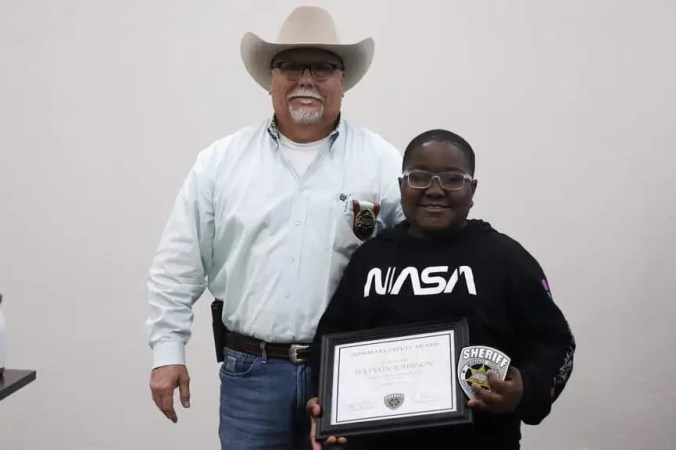
Davyon Johnson, 11 years-old, was near the water fountain at his school on December 9 when he heard a seventh-grade boy gasp, “I’m choking! I’m choking!” The kid had used his mouth to open a water bottle and the cap had popped down his throat.  Davyon, who had learned  the Heimlich maneuver off of YouTube (his uncle is an emergency med tech, which Dayvon says he also aspires to be), began applying it to the older boy. On the third squeeze to the boy’s abdomen, the cap flew out.

Later that evening, when his mother was driving with Davyon on the way to an evening church service, the car passed a house that had some smoke billowing out of it. Ms. Johnson says that Davyon persuaded her to turn the vehicle around and check. They saw small fire near the back of the house, and cars outside that indicated that there might be people in the house who may not have been aware of the fire. Davyon’s mom honked her horn and called 911. Davyon got out of the car and knocked on the door.

Five people in the house stepped outside; they had not been aware of the fire. They ran, leaving an elderly woman with a walker struggling to leave the burning home on her own. (Nice.)  Davyon helped her along and led her to the truck that the rest had climbed into.

When he was 8 years old, Davyon said later, he watched his father enter a burning apartment complex to make sure everyone was safe.  Davyon’s father  died last summer.

The Muskogee Police Department and Muskogee County Sheriff’s Office presented Davyon with a certificate on December 15 in recognition of his big day of community service. According to media accounts, the boy claims to not understand why everyone is making such a big deal over him doing what he calls “the right thing.” ‘I don’t want everyone to pay attention to me. I kind of did what I was supposed to do,” he was quoted as telling a teacher.

Here’s the kicker, which depending on how cynical you have become, will either get you choked up or make you thing, “Oh, come on!” The New York Times reports that Davyon doesn’t tell people about his recent burst of heroism unless he’s asked, and even then relates a simple, straightforward account.

“But there was one person he did want to tell,” says the Times. “One morning this month, he put on his sneakers and gray hoodie and went to the cemetery to see his father. He squatted, picked at the dirt and started to tell the stories, beginning with the scene at the water fountain.”

Luckily, a newspaper photographer just happened to be passing by…

__________________________

Source: New York Times

H Jackson Browne And “Life’s Little Instruction Book”

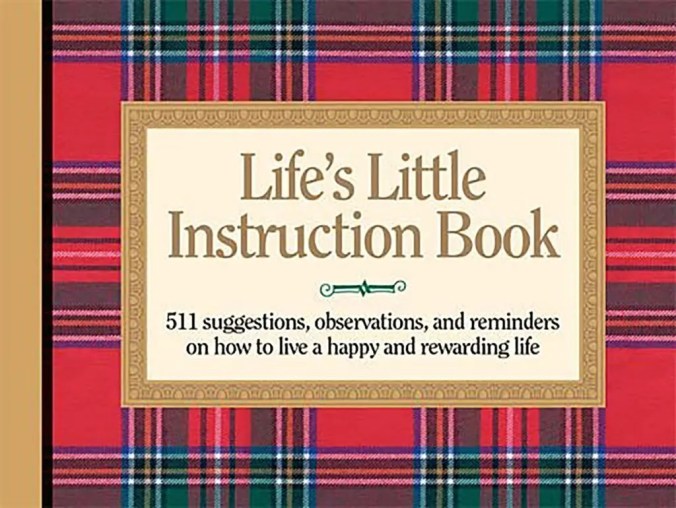
In 1991, H. Jackson Brown Jr. hit the best seller lists with a humble tome called “Life’s Little Instruction Book.” It consisted of 511 pieces of advice, common sense, traditional wisdom and best practices in life, adapted from a hand-written 32 page guide he handed to his son when he went off to college. “This is what your dad knows about living a rewarding life,” Brown told his son. He had tried his hand at authorship with two earlier books of fatherly advice, but decided that his latest approach had more promise.

It sure did. Re-tooled and expanded into “Life’s Little Instruction Book,” it was a bestseller for years, much imitated, and a contribution both to Brown’s fame and financial well-being and the nation’s healthy ethics alarms. By 1997, the book had sold about seven million copies, and it was translated into 33 languages

The book is all about ethics, though not explicitly. Even the corniest of the entries are based in ethical principles. “Resist the temptation” just means to keep your ethics alarms functioning and not let them be silenced by non-ethical considerations. #34, “At meetings, resist turning around to see who has just arrived late,” is a Golden Rule application; #22, “Learn three clean jokes,”is a subtle way to remind us to not allow incivility to become a habit.  “Avoid sarcastic remarks,” # 81, is no more than a caution against being a habitual jerk. #89, “Don’t let anyone ever see you tipsy” is a call for dignity and decorum. #254, “Learn to show cheerfulness, even when you don’t feel like it,” is a reminder that being a responsible member of society means not allowing your own feelings to undermine your group’s spirit. “Overtip breakfast waitresses”  was #7, a call for generosity and gratitude. #144, much ridiculed at the time, is “Take someone bowling.” It just means be kind, and to reach out to someone who might be lonely.

Ethics is never considered cool, and efforts to encourage good behavior is typically mocked. Journalists and critics mostly ridiculed “Life’s Little Instruction Book” as collection of naive nostrums unrelated to the real world. Pittsburgh Post-Gazette columnist Brian O’Neill wrote, in a typical reaction, that the book was “designed to teach nothing but how to part with $5.95.”

In truth, what Brown’s book most resembled was  “110 Rules of  Civility & Decent Behavior in Company and Conversation,” which our first President was forced to commit to memory by his father. Those rules served George well, and had a major impact on the degree to which he was trusted by the infamously competitive and back-stabbing Founders. Pretty much all of George’s guidelines turn up in various forms in the “Instruction Book;” I have often wondered if Brown ever read them. His book also has one advantage over the “110 Rules”: it isn’t interrupted with archaic howlers like George’s #13:

 Kill no vermin, or fleas, lice, ticks, etc. in the sight of others; if you see any filth or thick spittle put your foot dexterously upon it; if it be upon the clothes of your companions, put it off privately, and if it be upon your own clothes, return thanks to him who puts it off.

Continue reading

Ethics Hero: Twitter

twitter4

Ethics Alarms has honored some unlikely people as Ethics Heroes—Bill Clinton, Bill Maher, and Terry McAuliffe, for example. Twitter nabbing the distinction may be a record for cognitive dissonance, though. It is an unethical company, with a platform that does more damage than good. And yet…

Twitter announced that it was expanding its private information policy to forbid posting the ” media of private individuals without the permission of the person(s) depicted.

Good.

Not that this policy is remotely possible to enforce; it isn’t. “When we are notified by individuals depicted, or by an authorized representative, that they did not consent to having their private image or video shared, we will remove it,” Twitter explains. “This policy is not applicable to media featuring public figures or individuals when media and accompanying tweet text are shared in the public interest or add value to public discourse.”

Yes, the policy goes well beyond any legal restrictions: that’s what makes it ethical rather than compliant. What is ethically admirable about the rule is that it calls attention to an ethical violation so common that few think it is a violation at all. When I allow a friend to take a photo of me, that is consent for that friend to make and have a copy of my likeness. It is not consent for my likeness to be circulated to the world on social media, included in facial recognition databases, be manipulated digitally to embarrass or humiliate me, or any other purpose. No law will help me claim that I did not consent to circulation of my likeness, which is why Naked Teachers have a problem. The law assumes that such use can and should be anticipated when I let myself be photographed. That, however, is a legal fiction. I have seen, online, photos of me when I wasn’t aware that I was in the picture. I hate photos of me.

Continue reading

The New York Times Has An Outbreak Of Integrity In The Midst Of Its Progressive Bias Fever!

books

The Times has compiled its list of the “best books of the last 125 years” as part of the celebration of the 125th anniversary of its Book Review Sunday supplement. Readers are invited to vote for their favorite on the list of twenty-five.

Here is the list:

Continue reading

A Rittenhouse Verdict Inventory Of Ethics Heroes, Dunces, Villains And Fools, Part I: Not Many Heroes

We should condition ourselves to cherish those public events that lure so many into definitively exposing their character, values and acumen for all to see. The Jacob Blake shooting, the subsequent demonstration and rioting, and the Kyle Rittenhouse trial, all intertwined, constituted such opportunities.

There are very few organizations, publications and individuals who will leave the stage in this annoying act in The Great Stupid drama deserving the designation of Ethics Hero. Rittenhouse certainly doesn’t, and thus the misguided pundits, politicians and others calling him that are dolts. He might be called brave, but bravery without good judgment, skill and experience too often leads to disaster, as it did in this tragedy.

Among the easily identified heroes are, first by several laps, the jury. I thought it was possible that, like the Chauvin jury, the twelve citizens might yield to the unethical public pressure being placed on them and refuse to see the reasonable doubt that made a conviction of Rittenhouse unjust as a matter of law, once the non-felony charges were dismissed. They didn’t yield, and delivered the fair and correct verdict despite irresponsible statements by elected officials who should know better, a less than sterling performance by Rittenhouse’s defense, credible threats of rioting in their community if they refused to follow the Black Lives Matter/Antifa script, and legitimate concerns about their own safety. Continue reading

Did A Defendant’s Lawyer In The Arbery Trial “Cross A Line”?

Nothing thrills the soul of this ethicist more than a terrific legal ethics controversy leaping off the page in his morning newspaper on a Saturday morning. Better still, it involved, not the Kyle Rittenhouse trial but that other trial, the one really involving racist vigilantes—the trial of the three white men who shot black jogger Ahmaud Arbery as they attempted to make a “citizen’s arrest.”

Kevin Gough, the lawyer who represents William Bryan, one of the three men accused of murdering Arbery, asked Judge Timothy R. Walmsley to ban “high-profile members of the African American community” from the Brunswick, Georgia courtroom. The lawyer argued that the presence of the Rev. Al Sharpton at the trial last week could be “intimidating” to jurors. “We don’t want any more Black pastors coming in here,” Gough said.

The New York Times this morning headlined its story in the print edition “Cantankerous Lawyer At Arbery Trial Crossed Over A Line, Critics Say.” (The online edition’s version is bit more restrained: “Lawyer for Man Accused of Killing Ahmaud Arbery Draws Scrutiny.”) Of course, all lawyers for defendants in high-profile cases draw scrutiny. Fake news!) Interestingly but hardly surprisingly, the Times print headline is misleading. What “critics” say Gough crossed a line? Well, that would be Al Sharpton and another black pastor. The word “critics” implies objective observors who are disinterested parties. But that’s the Times these days. Sad, really.

Then the Times spends the rest of the piece, 21 paragraphs worth, telling readers what a loose cannon Gough is. Does the article ever bother to explain the legal, ethical and factual justifications for Gough’s request? Not at all. That’s not just sad, that’s journalism malpractice. Incompetence or deliberate disinformation? It’s Hanlon’s Razor time!

Continue reading

Ethics Pre-Daylight Losing Time Fallback, 11/6/202: So?…Go!…Oops! And More

Fall back

At this point in U.S. history, there is no justification whatsoever for not having daylight savings time year-round. The failure of Congress to kill Ben Franklin’s anachronistic brainstorm is pure cowardice and incompetence.

1. So? The NRA Foundation has twice paid attorney David Kopel, a Second Amendment activist, to write pro-gun rights amicus briefs in Supreme Court cases, according to a hacked document released last week. Since 2019, Kopel has submitted two briefs backing an NRA affiliate in cases before the court, including one involving New York’s ban on carrying licensed guns in public. The briefs did not disclose the source of funding, which is being condemned as unethical by the news media and the usual NRA bashers. “Attorneys who author these briefs must disclose whether they’ve taken money from either side to deliver a filing,” one source says.

Well, first of all, an amicus brief succeeds or fails based on its arguments, and who writes it or funds it should be irrelevant. This would be, at worst, a technical violation. However, the applicable rule in the SCOTUS amicus brief memo does not support the description above. “Rule 37.6 Disclosures” states,

“The first footnote on the first page of text of an amicus brief must include certain disclosures concerning contributions to the brief….It should indicate whether counsel for a party authored the brief in whole or in part and whether such counsel or a party made a monetary contribution intended to fund the preparation or submission of the brief. It should also identify every person other than the amicus, its members or counsel, who made such a monetary contribution; the Clerk’s Office views it as better practice to state explicitly that no such contributions were made if this is in fact true.”

This is astoundingly sloppy drafting, especially for the Supreme Court. “Must” and “should” are terms of art. “Must,” like “shall,” means some action is mandatory; “should” means that something is best practice, but not absolutely required. When two “shoulds” follow a “must,” it is impossible to determine what’s mandatory and what isn’t.

Continue reading

Ethics Hero: Defeated Virginia Gubernatorial Candidate Terry McAuliffe (D)

Terry M

Well, that was unexpected!

After McAuliffe made an appearance before the already deflating crowd of supporters and staffers on Election Night, only acknowledging the ominous news of a persistent Youngkin advantage by saying that “every vote” should be counted, the news media assumed that the close Hillary Clinton ally was planning a long battle over a close result if he lost the election. “His speech was notable for what he didn’t say,” one commentator said at about 10 pm. But by the early hours of the morning all outlets had declared Glenn Youngkin, the Republican who McAuliffe’s campaign had tried to brand as a racist and a Donald Trump clone, was the upset winner of the governor’s race, with not enough uncounted votes available to give McAuliffe the win he once assumed was “in the bag.”

McAuliffe defied expectations by conceding, quickly and graciously, the old fashioned way. His statement, issued early on in the morning after what must have been a crushing defeat, read,

“While last night we came up short, I am proud that we spent this campaign fighting for the values we so deeply believe in. We must protect Virginia’s great public schools and invest in our students. We must protect affordable health care coverage, raise the minimum wage faster, and expand paid leave so working families have a fighting shot. We must protect voting rights, protect a woman’s right to choose, and, above all else, we must protect our democracy. While there will be setbacks along the way, I am confident that the long term path of Virginia is toward inclusion, openness and tolerance for all.

“Congratulations to Governor-Elect Glenn Youngkin on his victory. I hope Virginians will join me in wishing the best to him and his family.“I would like to thank my wife Dorothy, my family, and my incredible campaign team for their tireless efforts and dedication over these past eleven months. And to all of my supporters across Virginia who knocked on millions of doors, made countless phone calls, and talked to their family, friends and neighbors: I am eternally grateful that you joined me on this journey to move Virginia forward.

“Serving as Virginia’s 72nd governor was the highest honor of my life, and I will never stop fighting to make our Commonwealth stronger and brighter for all.”

Continue reading

Oh, Fine: Now I Have To Revise My Harvard Reunion Boycott Letter…

MacBeth in Stride

…by adding yet another reason for my absence. Harvard is practicing straight-up segregation. It really is. But it’s OK, see, because only non-black people are being discriminated against. This is the quality of reasoning at Harvard in the 21st Century.

“Macbeth in Stride” is currently being performed by the American Repertory Theater at Harvard University’s Loeb Drama Center, near Harvard Square. This adaptation of the Shakespeare tragedy includes modern music and a version of Lady Macbeth as an “ambitious black woman” to elevate “black female power, femininity, and desire.” <YAWN!> When I see Orson Welles in Hell, remind me to thank him for inflicting on the culture an endless parade of Shakespeare updates with lazy and facile political metaphors, all executed by adapters and directors less talented than he was.

But I digress. For the reason I will have to add to my report of protest is this: Harvard’s major theater on campus has decided that we white folk aren’t welcome to one performance. From the show’s webpage,

We have designated this performance to be an exclusive space for Black-identifying audience members. For our non-Black allies, we appreciate your support in making this a completely Black-identifying evening. We invite you to join us at another performance during the run.

The production is under the auspices of Harvard’s theater department, and the race-segregated performance is on campus, in a university building and held under the college’s banner. This astounding example of direct racial bias must have been approved by Harvard itself.

Continue reading