The Presley Pritchard Saga, Continued: No, There Is No “Too Sexy Firefighter Principle,” And Evergreen Fire Rescue Messed With The Wrong Woman

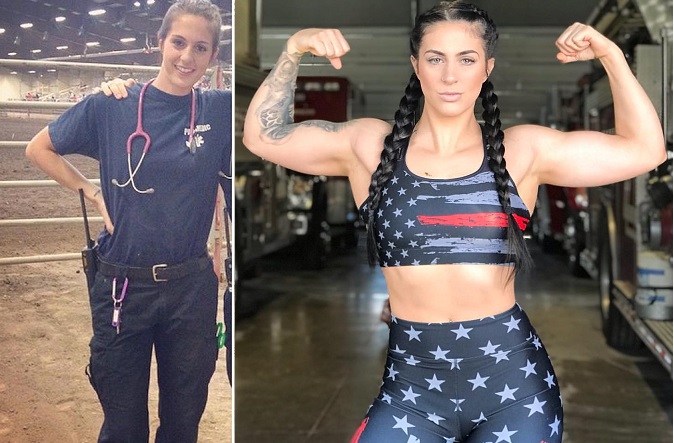
I wondered why a July 6 2019 Ethics Hero post was suddenly getting  lots of visits. The reason was disappointing: Presley Prichard, the inspiring paramedic who built herself up from a slim, 120 pound paramedic into a160 pound athlete so she could meet the strength and fitness requirements to achieve her life goal of being a firefighter — “This is how female empowerment is supposed to work” I wrote, saluting her determination—

—was fired by Evergreen Fire Rescue in Flathead County, Montana  for posting provocative photographs of herself on Instagram. Continue reading →

To Paraphrase George M. Cohan: “My Wife Thanks You, My Blog Thanks You, And I Thank You.”

To our surprise and delight, we just had delivered to our door, fresh from Conklyn’s Florists, a beautiful  mixed bouquet in a lovely glass vase. The card attached reads,

“Dear Mrs. Marshall, Get well absolutely as soon as possible.

[Other Bill] and the rest of the Ethics Alarms Commentariat

This was so kind and unexpected. None of my 420 Facebook friends (and relatives!) were so moved (then again, most of them hate me.) My wife was stunned, and is very grateful. (She would have applauded, but she only has one functioning arm.)

She says:  “This is very much appreciated. It cheers me up a little, something Jack has failed at completely. It is also a relief to be able to look at the beautiful flowers instead of my black-and blue face. And the vase is especially welcome, as a one armed flower arranger is like a one -armed paper-hanger, and Jack is no help at all.”

The ethics value here is generosity and kindness.

Thanks, Bill, and thanks everyone.

Saturday Ethics Warm-Up, 1/11/2020: Epstein And Facebook And Barr, Oh My!

It’s Thaturday!

Time, once again, to salute the courage of Karen Carpenter’s much less talented brother Richard, who nonetheless had the courage to offer, as his only notable solo offering for the Carpenters, a song that highlighted his speech impediment. Why did he do this? We’ll never know.

And yes, I have “The Wizard of Oz” on the brain. It was so much better when that wonderful movie was only on TV once  a year: then it was special. Now, especially over the holidays (and what it has to do with Christmas, I don’t know) I had to repeatedly change channels to avoid it. Well, after Judy sang “Over the Rainbow, anyway…

1. Is it really so unreasonable and a “right wing conspiracy theory” to wonder about how Jeffrey Epstein, who could have implicated such powerful people as Bill Clinton and Prince Andrew in criminal activities, ended up dead in his cell?

The latest forehead-slapping development: The video  made outside of Jeffrey Epstein’s Manhattan jail cell when during his failed suicide attempt seemed to be missing, and even possibly destroyed. The jailhouse video turned up, however, muting suspicions about whether Epstein’s successful  suicide at the Metropolitan Correctional Center wasn’t something more sinister.  Prosecutors confirmed that the video had been saved. This week, however,  prosecutors revealed that the jail staff  had preserved video from the wrong jail cell, and the Epstein footage no longer existed.

Meanwhile, two guards who were on duty when  Epstein killed himself are being charged with falsifying records and conspiracy. The guards surfed the internet and dozed instead of checking on the prisoner every half-hour, as they were required to do.

Conspiracy or not, this is epic incompetence, and rather convenient incompetence at that. Hanlon’s Razor, however, applies. I guess.

My only other observation is that government efficiency and job performance is obviously so reliable that I don’t know why Bernie Sanders isn’t running away with the Democratic nomination race. Of course we should put government employees in charge of our lives. It’s a no-brainer. Continue reading →

Proposition: Nike Should Fire Colin Kaepernick And Be Severely Punished by Consumers For Promoting This Hateful Idiot As A Hero And Role Model

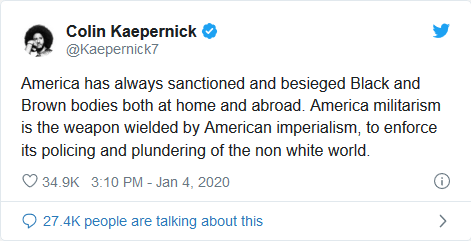
Colin Kaepernick was metaphorically taking a knee on Twitter yesterday. He wrote, referring to the killing of Qassem Soleimani,

…and later…

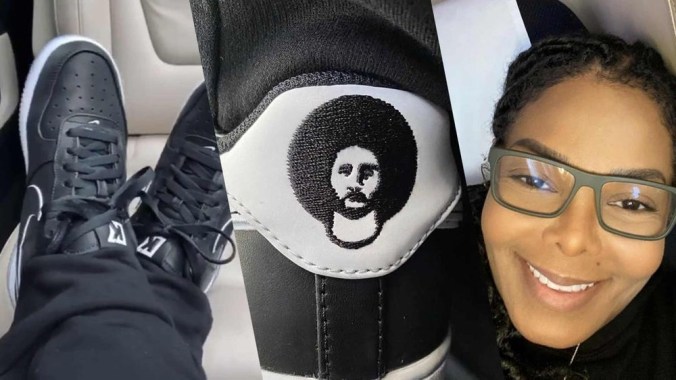
Kaepernick’s words and conduct mark him as a narcissistic, ignorant, America-hating, race-baiting idiot. That’s what he is, other than a washed-up pro athlete whose erudition began and ended with a fake college degree (his major, amusingly, was business management) while he prepared to play pro football. His irresponsible kneeling stunt cost the NFL millions, launched multiple divisive offspring, denigrated the nation and its police, and accomplished nothing positive, in large part because it was incoherent.

Never mind: Nike, exhibiting the amoral and ethics-free motivations that have long characterized most corporations, pandered to the woke, hateful and dumb by making Kaepenick the face of its latest “Just do it!” campaign, a 30 year old slogan that was always stupid, even by corporate slogan standards. Admittedly, a stupid slogan is a good bet to appeal to the people who will pay ridiculous amounts of money for sneakers, but even so: Just do what? Just jump out a window? Just set your face on fire? Just sexually assault that attractive woman at work? Just shoot off your mouth about matters you are painfully ill-informed about? Continue reading →

Ethics Hero: Frances Arnold

I’m sure there are a lot of people doing ethical things and not  trying to deliberately make me embarrassed to be a member of the human race—just not on social media, and not in the news. And there is Frances Arnold.

She is an American chemical engineer and the Linus Pauling Professor of Chemical Engineering, Bioengineering and Biochemistry at  Caltech. Professor Arnold was awarded the Nobel Prize in Chemistry in 2018 for pioneering the use of directed evolution to engineer enzymes. “Directed evolution” is a method used in protein engineering that mimics the process of natural selection to steer proteins or nucleic acids toward a user-defined goal. You know..this:

She had published a  paper on enzymatic synthesis of beta-lactams in May 2019 in the Science journal. When she discovered recently that her research could not be replicated, however, Arnold repudiated her own paper, and pronounced it the product of shoddy research.

“For my first work-related tweet of 2020, I am totally bummed to announce that we have retracted last year’s paper on enzymatic synthesis of beta-lactams. The work has not been reproducible,” she posted on Twitter. “It is painful to admit, but important to do so. I apologize to all. I was a bit busy when this was submitted, and did not do my job well.”

A short, clear, Level I apology, and it is refreshing to know that there are scientific geniuses who use the word “bummed,” and who do not write like Timnit Gebru.

On one hand, I wonder if it is easier for a Nobel winner to admit something like this. On the other, I am certain that the more eminent a scientist is, the harder it is to reveal a serious error. No matter how one looks at it, Professor Arnold exhibited integrity, honesty, humility and courage, may have done as much for science by showing how an ethical scientist handles an error as she did with her work on directed evolution.

I would be more certain about that if I understood what the hell directed evolution was.

_________________________________________

Use this link if you are sharing on Facebook: https://twitter.com/CaptCompliance/status/1213583009942622208

Ethics Heroes: The Appeals Court For The Commonwealth Of Massachusetts

I am not honoring the appeals court that just upheld the lower court judgment in my favor in a two-year old (and probably not over yet) frivolous lawsuit against my for defamation by an angry ex-Ethics Alarms commenter. The court’s decision rejecting the plaintiff’s appeal was dictated by precedent and black letter law, as was the decision in the original case. It took no special courage or integrity to hold so, and in fact any other result would have evinced rank incompetence.

No, I am awarding the court Ethics Hero status after receiving today its  published opinion in case n. 18-p-1605, where the judgement of the lower court judge was affirmed. It is officially a summary decision, and thus not binding precedent, since the usual details a full appellate opinion would contain are missing. However, in the eight page opinion affirming the lower court dismissal of the complaint, the judges are impressively restrained, respectful, and thorough. They manage this despite the fact that the lawsuit was doomed from the beginning, without merit or law on its side. The persistence of the plaintiff has wasted taxpayer money (and mine) and occupied time the judges needed to address more serious and legitimate matters.

Nonetheless, the fact that a pro se litigant is able to receive more than perfunctory handling of even a complaint this misbegotten and trivial speaks well for our system, and very well for the judges. Despite all the attacks claiming that our system only caring about ‘justice for the rich,” a pro se litigant seeking justice (as he saw it) and using confused, garbled and outrageously long documents to that end,  cannot deny that his case and arguments were ignored. He lacked the financial resources to hire a lawyer to pursue them (though I wonder if any lawyer would have accepted the representation) and represented himself—rather badly, but still, he took his best shot. Continue reading →

“Nah, There’s No Mainstream Media Bias!” Holiday Edition

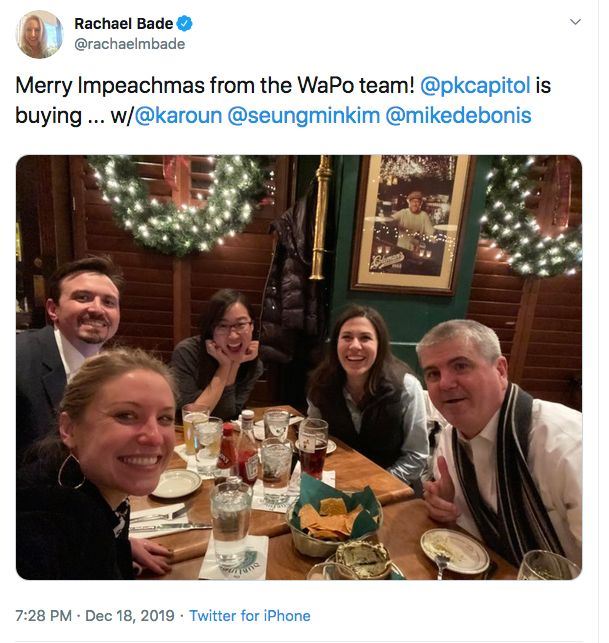
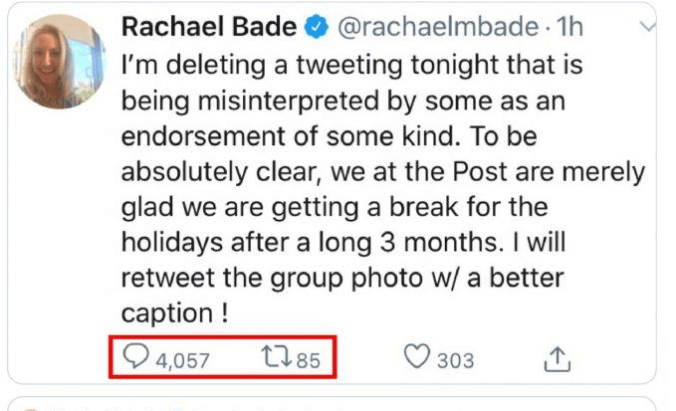
Oops! Let the mask slip a bit too much there! After hearing from her editors or others in the Post offices that it was poor PR to proclaim the fact that the paper’s staff was cheering, high-fiving and otherwise rejoicing to celebrate their not insubstantial role in provoking a destructive and unjustified Presidential impeachment, Blade solemnly tweeted,

Right.

Too late.

Saturday Morning Ethics Warm-Up. 12/14/19: Insulting George Washington And Other Annoyances

Good Morning!

1. Now THIS ia an abuse of power! It sure looks as if outgoing Kentucky governor Matt Bevin—he’s a Republican, remember— has decided to take revenge on the state that narrowly defeated him for re-election. Right before he moved out of the Governor’s Mansion, Bevin issued 428 pardons and commutations, often without apparent regard to who or what he was pardoning. He pardoned a man convicted of homicide, after the murderer’s  family raised more than $20,000  to help Bevin pay off a debt owed from his previous gubernatorial campaign.  That wasn’t the only murderer Kentucky got back in its Christmas stocking; there were more, like the man who paid to have his business partner killed, and  another who killed his parents.. Bevin released a man convicted of raping a child.

While many of the pardons issued did involve cases where there were allegations of  sloppy police work and injustice, many did not. Bevin pardoned  Dayton Ross Jones, who pleaded guilty to the 2014 sexual assault of a 15-year-old boy, for example. That crime was captured on video and shared on social media. Jones was sentenced to 15 years in prison in 2016. Now he’s out.

“A young man was attacked, was violated, it was filmed, it was sent out to different people at his school,” Kentucky’s new governor, Andy Beshear said. “It was one of the worst crimes that we have seen. I fully disagree with that pardon. It is a shame and its wrong.”

But there isn’t a thing he or Kentucky citizens can do about it.

2. Let’s ask Chris Wallace about this sterling example of fair and balanced journalism...I know that Ethics Alarms has documented over many years what a partisan, biased, incompetent and dishonest hack Chris Cillizza is, so this is hardly news. Still, he has a job at CNN, which allows him to inflict his hackery on the public. An ethical news organization wouldn’t keep someone like Cillizza around., but as James Earl Jones used to say, “This is CNN.” The disturbing part is that he’s far from the worst hack on its payroll.

A Monmouth University poll this week claimed that Republican voters believed that George Washington was a better President than Donald Trump by only a 44%-37% margin. (Remember: polls.)  Cillizza said that fact that 37% of Republican respondents chose Trump over Washington provides “a useful way into understanding just how rote the fealty is to Trump within the ranks of the Republican Party at the moment.”

Let me just interject here that almost no Americans could tell you anything about George Washington’s terms in office other than the fact that he was the first President. (This is another reason to watch “John Adams.”)

While implying that Republicans are ignorant morons, however, Cillizza neglected to mention another alleged result of the poll: Democratic voters said former President Barack Obama was a better President than George an embarrassing 63%-29% margin. Continue reading →

Conclusion To The Written Statement of Prof. Jonathan Turley: “The Impeachment Inquiry Into President Donald J. Trump: The Constitutional Basis For Presidential Impeachment”

Jonathan Turley ended his epic testimony before the House Judiciary Committee with a flourish. His whole statement was remarkable, leaving no reasonable argument for impeachment standing—but then the now-insatiable desire to undo the 2016 election has never been rational, and it has relied, despicably, on the historical and legal ignorance of the vast majority of the American people. Turley provided an opportunity for responsible citizens to educate themselves: his language was easy and clear, and there were no pompous or especially academic turns of phrase. Nonetheless, few will read or watch the whole thing, allowing the news media, which has exceeded all previous villainy in this three-year long fiasco, to distort and minimize his patriotic achievement. To the degree that they succeed, it is do the detriment of the nation, and its future. Somehow, Turley makes this clear as well, yet does so without the kind of alienating condemnation that I, in his position, would be unable to resist.

No doubt about it, the professor is a far better scholar and advocate than I am, and a brilliantly talented teacher as well. Still, he made me feel good about the analysis I have been presenting here since 2016. I have studied Presidential history for a shockingly long time; I know my impeachment history well, and observed two of the three previous inquiries up close, live and carefully. I have been certain, certain, from the beginning that what we have seen here is an unprecedented crypto-coup, for virtually all the reasons Professor Turley explains. I’m glad to have the legal authority and the meticulous tracking of where the inquisition ran off the rails, but Turley validated the analysis I have  given readers here. That came as a relief and a confirmation.

It was naturally a special pleasure that the professor ended his testimony by referencing the scene in the video above, from “A Man for All Seasons,” my favorite ethics moment in any movie, and the clip most often used on Ethics Alarms. He also referenced the story of the Republican Senators who turned on their party and voted to acquit President Andrew Johnson, for me the most memorable chapter of “Profiles in Courage,” the book that introduced me to the topic of ethics when I was 12 years old. Turley quotes one of the Senators who was only slightly mentioned by credited author John Fitzgerald Kennedy, but it’s a stirring quote, and damn any politician or citizen who ignores its message.

Lyman Trumbull (R- Ill.) explained fateful decision to vote against Johnson’s impeachment this way:

“Once set the example of impeaching a President for what, when the excitement of the hour shall have subsided, will be regarded as insufficient causes … no future President will be safe who happens to differ with the majority of the House and two-thirds of the Senate …I tremble for the future of my country. I cannot be an instrument to produce such a result; and at the hazard of the ties even of friendship and affection, till calmer times shall do justice to my motives, no alternative is left me…”

Those who endanger the future of my country because of their unrestained anger, hate, confirmation bias, partisan loyalty, prejudice, need to conform, and yes, ignorance and their lack of education, are contemptible. Those who lead them in pursuit of power are worse.

[Turley’s entire statement, with footnotes, is here. The Ethics Alarms edited version is here (Part I); here (PartII); here (Part III); here (Part IV), and here (Part V.) The video is here.]

***

V. CONCLUSION

Allow me to be candid in my closing remarks. I get it. You are mad. The President is mad. My Democratic friends are mad. My Republican friends are mad. My wife is mad. My kids are mad. Even my dog is mad . . . and Luna is a golden doodle and they are never mad. We are all mad and where has it taken us? Will a slipshod impeachment make us less mad or will it only give an invitation for the madness to follow in every future administration?

That is why this is wrong. It is not wrong because President Trump is right. His call was anything but “perfect” and his reference to the Bidens was highly inappropriate. It is not wrong because the House has no legitimate reason to investigate the Ukrainian controversy. The use of military aid for a quid pro quo to investigate one’s political opponent, if proven, can be an impeachable offense.

It is not wrong because we are in an election year. There is no good time for an impeachment, but this process concerns the constitutional right to hold office in this term, not the next.

No, it is wrong because this is not how an American president should be impeached. For two years, members of this Committee have declared that criminal and impeachable acts were established for everything from treason to conspiracy to obstruction. However, no action was taken to impeach. Suddenly, just a few weeks ago, the House announced it would begin an impeachment inquiry and push for a final vote in just a matter of weeks. To do so, the House Intelligence Committee declared that it would not subpoena a host of witnesses who have direct knowledge of any quid pro quo. Instead, it will proceed on a record composed of a relatively small number of witnesses with largely second-hand knowledge of the position. The only three direct conversations with President Trump do not contain a statement of a quid pro quo and two expressly deny such a pre-condition. The House has offered compelling arguments why those two calls can be discounted by the fact that President Trump had knowledge of the underlying whistleblower complaint. However, this does not change the fact that it is moving forward based on conjecture, assuming what the evidence would show if there existed the time or inclination to establish it. The military aid was released after a delay that the witnesses described as “not uncommon” for this or prior Administrations. This is not a case of the unknowable. It is a case of the peripheral. The House testimony is replete with references to witnesses like John Bolton, Rudy Giuliani, and Mike Mulvaney who clearly hold material information.

To impeach a president on such a record would be to expose every future president to the same type of inchoate impeachment. Continue reading →

Written Statement of Prof. Jonathan Turley: “The Impeachment Inquiry Into President Donald J. Trump: The Constitutional Basis For Presidential Impeachment” [PART V]

Note the date…

In his final section before concluding, Professor Turley covers other theories being floated as justification for impeachment, and finds them startlingly weak and contrived.

The Hill has Turley’s lament regarding the  the Alliance of Unethical Conduct’s attacks on his thorough and objective dismantling of their coup efforts. (The AUC—that’s the Ethics Alarm shorthand for the Democratic Party-“resistance”-mainstream media alliance to remove Trump from office by any means possible, not Turley’s.)  He writes,

Despite 52 pages of my detailed testimony, more than twice the length of all the other witnesses combined, on the cases and history of impeachment, [Washington Post columnist Dana Milbank] described it as being “primarily emotional and political.” Milbank claimed that I contradicted my testimony in a 2013 hearing when I presented “exactly the opposite case against President Obama” by saying “it would be ‘very dangerous’ to the balance of powers not to hold Obama accountable for assuming powers ‘very similar’ to the ‘right of the king’ to essentially stand above the law.”

But I was not speaking of an impeachment then. It was a discussion of the separation of powers and the need for Congress to fight against unilateral executive actions, the very issue that Democrats raise against Trump. I did not call for Obama to be impeached….

In my testimony Wednesday, I stated repeatedly [as I stated in my testimony during the Clinton impeachment] that a president can be impeached for noncriminal acts…. My objection is not that you cannot impeach Trump for abuse of power but that this record is comparably thin compared to past impeachments…. … Democrats have argued that they do not actually have to prove the elements of crimes…. In the Clinton impeachment, the crime was clearly established and widely recognized…. [W]e are lowering impeachment standards to fit a paucity of evidence and an abundance of anger…. 

Writes Ann Althouse in a post yesterday, “it seems to me that the real impeachable offense has always been that Donald Trump got himself elected.”

I wish Prof. Turley had dealt with that, the real justification, in their minds, for the House’s impeachment push.

Back to the professor:

C.  Extortion.

 As noted earlier, extortion and bribery cases share a common law lineage. Under laws like the Hobbs Act, prosecutors can allege different forms of extortion. The classic form of extortion is coercive extortion to secure property “by violence, force, or fear.”85 Even if one were to claim the loss of military aid could instill fear in a country, that is obviously not a case of coercive extortion as that crime has previously been defined.

Instead, it would presumably be alleged as extortion “under color of official right.” Clearly, both forms of extortion have a coercive element, but the suggestion is that Trump was “trying to extort” the Ukrainians by withholding aid until they agreed to open investigations. The problem is that this allegation is no closer to the actual crime of extortion than it is to its close cousin bribery. The Hobbs Act defines extortion as “the obtaining of property from another, with his consent, induced by wrongful use of actual or threatened force, violence, or fear or under color of official right.”87

As shown in cases like United States v. Silver, extortion is subject to the same limiting definition as bribery and resulted in a similar overturning of convictions. Another obvious threshold problem is defining an investigation into alleged corruption as “property.” Blackstone described a broad definition of extortion in early English law as “an abuse of public, justice which consists in an officer’s unlawfully taking, by colour of his office, from any man, any money or thing of value, that is not due him, or more than is due, or before it is due.”89 The use of anything “of value” today would be instantly rejected. Extortion cases involve tangible property, not possible political advantage.90 In this case, Trump asked for cooperation with the Justice Department in its investigation into the origins of the FBI investigation on the 2016 election. As noted before, that would make a poor basis for any criminal or impeachment theory. The Biden investigation may have tangible political benefits, but it is not a form of property. Indeed, Trump did not know when such an investigation would be completed or what it might find. Thus, the request was for an investigation that might not even benefit Trump.

The theory advanced for impeachment bears a close similarity to one of the extortion theories in United States v. Blagojevich where the Seventh Circuit overturned an extortion conviction based on the Governor of Illinois, Rod Blagojevich, pressuring then Sen. Barack Obama to make him a cabinet member or help arrange for a high- paying job in exchange for Blagojevich appointing a friend of Obama’s to a vacant Senate seat. The prosecutors argued such a favor was property for the purposes of extortion. The court dismissed the notion, stating “The President-elect did not have aproperty interest in any Cabinet job, so an attempt to get him to appoint a particular person to the Cabinet is not an attempt to secure ‘property’ from the President (or the citizenry at large).”’ In the recent hearings, witnesses spoke of the desire for “deliverables” sought with the aid. Whatever those “deliverables” may have been, they were not property as defined for the purposes of extortion any more than the “logrolling” rejected in Blagojevich.

There is one other aspect of the Blagojevich opinion worth noting. As I discussed earlier, the fact that the military aid was required to be obligated by the end of September weakens the allegation of bribery. Witnesses called before the House Intelligence Committee testified that delays were common, but that aid had to be released by September 30th. It was released on September 11th. The ability to deny the aid, or to even withhold it past September 30th is questionable and could have been challenged in court. The status of the funds also undermines the expansive claims on what constitutes an “official right” or “property”:

“The indictment charged Blagojevich with the ‘color of official right’ version of extortion, but none of the evidence suggests that Blagojevich claimed to have an ‘official right’ to a job in the Cabinet. He did have an ‘official right’ to appoint a new Senator, but unless a position in the Cabinet is ‘property’ from the President’s perspective, then seeking it does not amount to extortion. Yet a political office belongs to the people, not to the incumbent (or to someone hankering after the position). Cleveland v. United States, 531 U.S. 12 (2000), holds that state and municipal licenses, and similar documents, are not ‘property’ in the hands of a  public  agency. That’s equally true of public positions. The President-elect did not have a property interest in any Cabinet job, so an attempt to get him to appoint a particular person to the Cabinet is not an attempt to secure ‘property’ from the President (or the citizenry at large).”

A request for an investigation in another country or the release of money already authorized for Ukraine are even more far afield from the property concepts addressed by the Seventh Circuit.

The obvious flaws in the extortion theory were also made plain by the Supreme Court in Sekhar v. United States, where the defendant sent emails threatening to reveal embarrassing personal information to the New York State Comptroller’s general counsel in order to secure the investment of pension funds with the defendant. In an argument analogous to the current claims, the prosecutors suggested political or administrative support was a form of intangible property. As in McDonnell, the Court was unanimous in rejecting the “absurd” definition of property. The Court was highly dismissive of such convenient linguistic arguments and noted that “shifting and imprecise characterization of

the alleged property at issue betrays the weakness of its case.”94 It concluded that “[a]dopting the Government’s theory here would not only make nonsense of words; it would collapse the longstanding distinction between extortion and coercion and ignore Congress’s choice to penalize one but not the other. That we cannot do.”95 Nor should Congress. Much like such expansive interpretations would be “absurd” for citizens in criminal cases, it would be equally absurd in impeachment cases.

To define a request of this kind as extortion would again convert much of politics into a criminal enterprise. Indeed, much of politics is the leveraging of aid or subsidies or grants for votes and support. In Blagojevich, the court dismissed such “logrolling” as the basis for extortion since it is “a common exercise.” If anything of political value is now the subject of the Hobbs Act, the challenge in Washington would not be defining what extortion is, but what it is not.

D.  Campaign Finance Violation

Some individuals have claimed that the request for investigations also constitutes a felony violation of the election finance laws. Given the clear language of that law and the controlling case law, there are no good-faith grounds for such an argument. To put it simply, this dog won’t hunt as either a criminal or impeachment matter. U.S.C. section 30121 of Title 52 states: “It shall be unlawful for a foreign national, directly or indirectly, to make a contribution or donation of money or other thing of value, or to make an express or implied promise to make a contribution or donation, in connection with a federal, state, or local election.”

On first blush, federal election laws would seem to offer more flexibility to the House since the Federal Election Commission has adopted a broad interpretation of what can constitute a “thing of value” as a contribution. The Commission states “’Anything of value’ includes all ‘in-kind contributions,’ defined as ‘the provision of any goods or services without charge or at a charge that is less than the usual and normal charge for such goods or services.’” However, the Justice Department already reviewed the call and correctly concluded it was not a federal election violation. This determination was made by the prosecutors who make the decisions on whether to bring such cases. The Justice Department concluded that the call did not involve a request for a “thing of value” under the federal law. Congress would be alleging a crime that has been declared not to be a crime by career prosecutors. Such a decision would highlight the danger of claiming criminal acts, while insisting that impeachment does not require actual crimes. The “close enough for impeachment” argument will only undermine the legitimacy of the impeachment process, particularly if dependent on an election fraud allegation that itself is based on a demonstrably slipshod theory. Continue reading →