Sunday Morning Ethics Warm-Up After The Red Sox Complete An Unprecedented Late Inning Comeback In The World Series HAHAHAHAHA!, 10/28/18: Obama’s “Norms”, Goodbye Apu, #MeToo Hypocrisy, And “Roshomon,” Chicago-Style

Focus, Jack, focus!

1. Not the World Series, ETHICS! And speaking of ethics…

  • What kind of lie is this? Rich Hill, the Dodgers starting pitcher last night who almost unhittable, said in an interview that he “liked” his team’s chances of winning the Series despite being behind 3 games to 1. World Series history and basic math says that the chances are “slim.” He likes the slim chances? Does he really like them? Does he believe liking them means they are more likely to break his way?

Is he just lying to buck up his team and its fans, when he really doesn’t “like” the chances at all, not being, you know, an idiot? Does that make it a “good lie”?

  • The Fox World Series broadcast team of Joe Buck and John Smoltz is incompetent. In a potentially game-changing play in which the Boston catcher’s throw attempting to complete a home-to-first double-play sailed past first, allowing the game’s first run to score, the two alleged experts said that there was no interference. Wrong. There was interference, and it was obvious: Bellinger, the Dodgers runner, was on the infield grass rather than the yard-wide running lane to the right of the baseline, which exists precisely for plays like that, when the catcher needs a lane to throw unimpeded to first base to get the out.  It should have been called runner’s interference, completing a double-play and ending the inning without a run scoring. Instead, the run scored on the errant throw from Boston catcher Vasquez, and the next batter, Yasiel Puig, hit a three-run homer to give L.A. a 4-0 lead. There was no discussion of the rules and issues involved.

But after the game, over at the MLB cable channel, former Yankees manager Joe Girardi and baseball analyst Harold Reynolds graphically illustrated that the interference should have been called. This is what the Fox broadcasters are paid for: to explain the nuances of the rules and the game to the average World Series viewer, whose baseball acumen is rudimentary. The umpires missed the play, even though as Reynold pointed out, it was called many times during the season. Umpires are reluctant to call interference of any kind during the post-season, because it’s messy, and guarantees controversy and an on-field arguments.

  • For an unusual first ball ceremony, former Red Sox-Oakland Hall of Fame pitcher Dennis Eckersley (Now an ace Boston TV color man, known New England-wide as “Eck”) threw a pitch to ex-Dodgers catcher Steve Yeager as Kirk Gibson stood in the batters box. Gibson, you should recall, hit the famous “The Natural” home run off Eckersley to win Game #1 of the 1988 World Series, after limping to the plate as a pinch-hitter in the bottom of the 9th inning. How many ex-players would voluntarily re-enact their worst moment on the field on national TV? Imagine Ralph Branca throwing a ceremonial first pitch to Bobby Thompson.

Eck personifies humility and exemplary sportsmanship.

  • Trump Tweets, Baseball Division. This made me laugh out loud, I have to admit. During the game, the President criticized Dodgers manager Dave Roberts decision to replace Hill with his first baseball tweet:

“It is amazing how a manager takes out a pitcher who is loose & dominating through almost 7 innings, Rich Hill of Dodgers, and brings in nervous reliever(s) who get shellacked. 4 run lead gone. Managers do it all the time, big mistake!”

I wish the President would confine all of his tweeting to second-guessing managers and coaches. It’s obnoxious, but harmless. Dodgers manager Dave Roberts, presented with the tweet during his post-game press conference, handed it ethically and well. Steely-faced, he asked, “The President said that?” and responded, sufficiently respectfully, “I’m happy he was tuning in and watching the game. I don’t know how many Dodgers games he’s watched. I don’t think he was privy to the conversation. That’s one man’s opinion.”  Roberts was referring to the fact that Hill told him that he might be getting fatigued. Nonetheless, lots of people other than the President questioned Robert’s decision.

It is pure hindsight bias, of course, as well as consequentialism. If the Dodger bullpen had held a late-inning  4-run lead as every previous World Series bullpen had, nobody would be criticizing Roberts.

2. The confiscated handicapped van. [Pointer: Michael Ejercito] Andrea Santiago’s $15,000 van with a customized wheelchair lift was confiscated  by the City of Chicago as an abandoned vehicle. She has polio and multiple sclerosis, and the family claims the vehicle was parked legally and obviously not abandoned. This is a Roshomon situation, for the accounts of the city and the family are irreconcilable. Chicago’s Department of Streets & Sanitation sent this statement: Continue reading
Ethics Hero: Red Sox Rightfielder Mookie Betts

I guess in fairness I owe the Red Sox this one, after yesterday’s post.

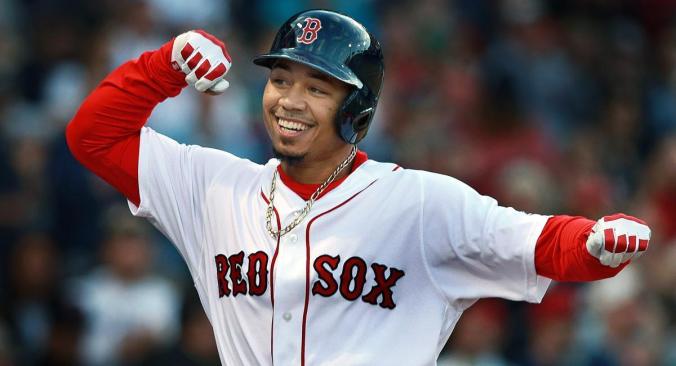
Mookie Betts, the young Red Sox star widely assumed to be the American League MVP once the votes are tallied, had three hits in Game 2 of the World Series this week, and after the game, joined his cousin delivering food to the homeless outside the Boston Public Library. Betts did not summon reporters and photographers to the scene, in the immortal tradition of Babe Ruth, who always seemed to have a scribe nearby when he promised a sick kid at the hospital a home run that day. In the Boston tradition of Ted Williams, who regularly visited juvenile cancer patients without fanfare, Mookie did his charity work anonymously, wearing a hoodie so he would not be recognized. Someone recognized him nonetheless—this was Boston, after all, and Mookie is especially recognizable, so the local media got the story anyway.

Mookie seems too good to be true: he’s always modest and humble, he’s polite, he’s astoundingly talented, he’s nice, and he’s so  cute. I’m afraid to hope he’ll stay that way; Boston has had other lovable young stars who gradually became insufferable as their fame and paychecks increased (see Clemens, Roger). Mookie seems like the real thing, but you never know. For now, at least, he’s a terrific role model, not just for young baseball fans, but for other players and celebrities, present and future.


Ethics Dunces: The Boston Red Sox

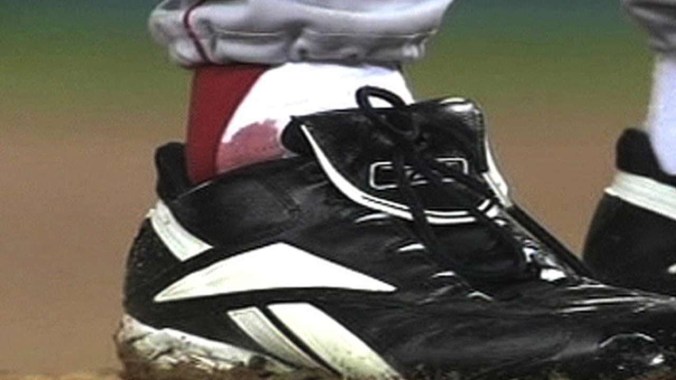
The bloody sock…

(Never let it be said again that I allow my personal biases to affect my ethics criticism….)

Last night, the Boston Red Sox had the ceremonial first pitch of Game #2 of the World Series thrown en masse by seven members of the 2004 World Series winning Sox, the team that ended Boston’s  86 year World Series championship drought, forever banishing the franchise’s reputation as the team that could never quite manage to win the final game. David Ortiz, Pedro Martinez, Tim Wakefield, Jason Varitek, Kevin Millar, Keith Foulk and Alan Embree received the cheers of the crowd, but perhaps the biggest symbol of the team’s achievement of all, pitcher Curt Schilling, was absent. Schilling was the warrior who started two crucial games (One on the way to beating the Yankees in the league championship series, and another against St. Louis in the World series), winning both, with his ankle tendon crudely stitched to his skin to keep it stable, as blood seeped into his sock for all to see. It is one of the great moments of on-field sacrifice and heroism in baseball history.

How could they snub Schilling, of all players? Was he invited? “Nope,” he tweeted to a fan who asked during the game. “No worrries though, great to see @45PedroMartinez, @davidortiz and @KMillar15  though.”  “Oh,” he added, “and I get to keep my 3 rings and 3 trophies, so it’s all good.”

Not really. Schilling was obviously insulted, and should have been. “Were my feelings hurt? In one sense, yes, not being able to be on the field with the men who I will always share …2004  with and not being able to once again thank the folks who paid for the tickets and whose lives changed with ours sucks,” Schilling  posted on Facebook today.

The team, through a spokeswoman, denied an intentional snub. “The ceremonial first pitch started with a couple of 2004 guys and then grew organically as we learned of other ’04 players who were planning to be at the ballpark for Game 2. There was no blanket invite to the entire team,” she said, “and no slight intended to anyone not included.”

What utter BS. Continue reading

Future Ethics News From The 2018 World Series

Bulletin: When the opposing teams are announced before Game #1 of the 2018 World Series tomorrow night, the manager of the National League Champion Los Angeles Dodgers, Dave Roberts, will receive a loud standing ovation from the capacity Fenway Park crowd as he walks out to the third baseline.

There is no question about this. Anyone who knows Boston, Fenway, Red Sox tradition or the team’s fan culture has any doubts: it is a sure thing. That ethical gesture of gratitude and respect is as certain as the tide coming in on Cape Cod’s Wellfleet beaches, or the leaves turning gold in Concord this Fall. Red Sox fans have always maintained the tradition of recognizing excellence from opposing players, but the gesture and salute tomorrow goes far beyond that. For it was Dave Roberts, then a reserve pinch-running specialist in the twilight of his career and playing his only season with Boston—and only a couple months of that season at that—who was sent in to run for Kevin Millar, who had walked  in the bottom of the 9th inning of the potential elimination game in the 2004 ALCS.

The hated New York Yankees were leading the best of seven series three games to none, and no team in baseball history had ever come back from such a deficit to win. Pitching was Yankee closer Mariano Rivera, probably the greatest relief pitcher of all time. Everyone knew that Roberts had entered the game for one reason: to steal second base and set up the possible game tying run. And he did it—it was a close play, but he made it, and seconds latter, Red Sox batter Bill Mueller singled him home to tie the score. David Ortiz won the game with a home run in extra innings, and the Red Sox went on from there to sweep New York, and the St. Louis Cardinals in the 2004 World Series as well. The team’s storied 86 year World Series drought was finally over, along with it the Curse of the Bambino, Pesky holding the ball, Lonborg facing Gibson on two days rest, Ed Armbrister getting away with blocking Fisk’s throw to second, Bucky %!^$! Dent’s cheap homer, the ball rolling under Buckner’s legs, Grady Little’s Great Choke, and more, as they all faded into irrelevancy like a long, horrible nightmare. Continue reading

Late Night Ethics Refresher, 10/20/18: Bad Art And Baseball Roshomon

Having a nice weekend?

Literally nothing can spoil my mood now that the Red Sox are going to the World Series…and playing the Dodgers.

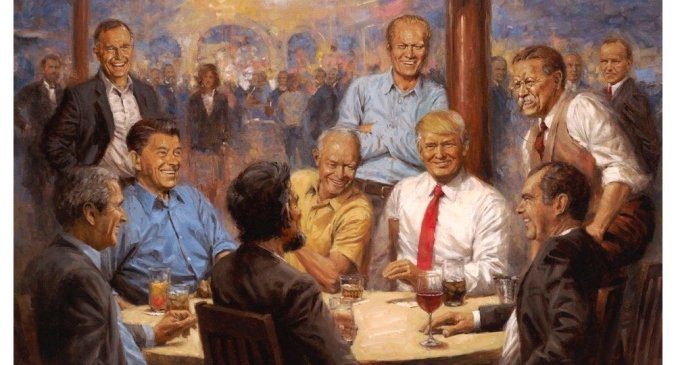
1. White House art ethics? I’ve been wanting to post about this all week.  Here is the painting President Trump has hung in the White House:

I love it. It makes me smile every time I see it. But because there is nothing President Trump could do that the news media and the “resistance” wouldn’t mark as shameful; and scandalous, he is actually being attacked for his choice of art.

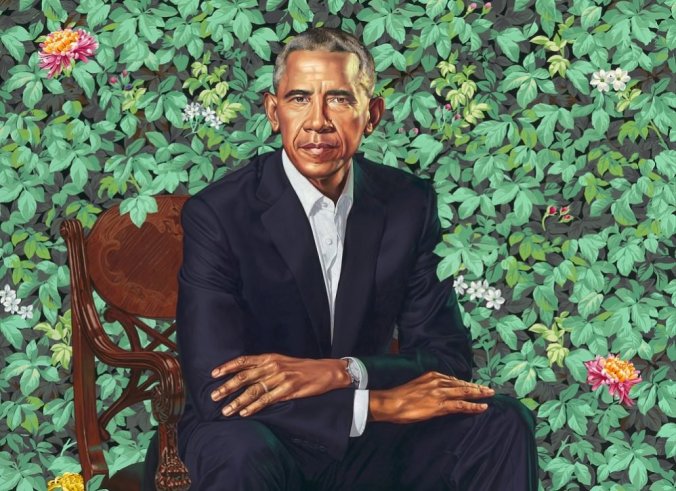
Well, to hell with them, which I’m sure is Trump’s attitude. Sure it’s a tacky painting; I’m pretty sure the artist knows that, and doesn’t care. Called “The Republican Club,” it is the work of Missouri artist Andy Thomas. Trump is President and for at least four years he’s living in the White House: he can put up whatever art he likes. If it makes him smile like it does me, then that’s a good enough reason to hang it. It’s bad art, but so was Obama’s official portrait showing him being slowly devoured by plants with the sperm on his face, and that one didn’t make anyone smile, except the artist.


By the way, CNN displays its ignorance by writing that “Chester Arthur, Rutherford B. Hayes and James Garfield are presumably in the crowd, but impossible to identify.” I could identify Arthur easily. Can you? Garfield, Hayes, and Benjamin Harrison, whom CNN’s reporter apparently never heard of, were all similarly bearded, and there are two bearded faces near Arthur that could be two of them. I can’t find McKinley anywhere, so maybe the artist was minimizing the presence of the murdered Presidents—given the tenor of Democratic rhetoric,  that might be prudent—which means the bearded figures are Hayes and Harrison. Also missing is the only impeached Republican President, Andrew Johnson. Yeah, poor Andy would be a skunk at the picnic too. Continue reading

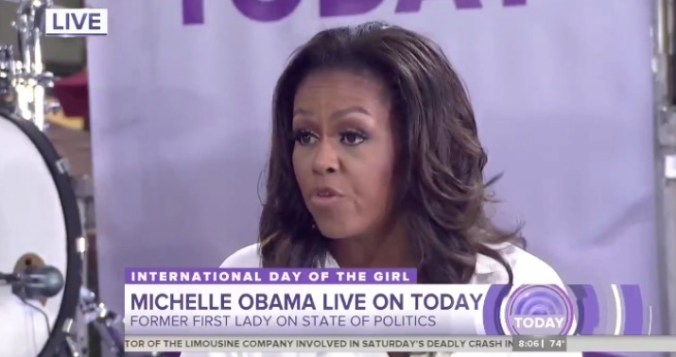
Ethics Hero: Michelle Obama

Like it or not, Michelle Obama has established herself as a cultural role model, and millions of American respect her statements and opinions and take them to heart. As clearly contrary to reality as  her now-famous “When the go low, we go high” remark was—its is difficult to remember the last time the Democratic leadership “went high”—the statement would have been an ethical one if it were true, and was still arguably aspirational, unless regards it as cynical public deception.

(Which, I confess, I have…)

This week, as important voices in her party increasingly courted hate, anger and violence among members of the public in the wake of Operation Smear Kavanaugh failing so spectacularly, the former First Lady refused to encourage the mob, and told the Today Show,

“Fear is not … a proper motivator. Hope wins out, and if you think about how you want your kids to be raised, how you want them to think about life and their opportunities, do you want them afraid of their neighbors? Do you want them angry? Do you want them vengeful?…Which motto do you want them to live by? And I have to think about that as a mother.”

Continue reading

Your Tuesday Evening Brett Kavanaugh Nomination Ethics Train Wreck Report

I. Let’s give a whole car to USC.

Nearly 100 students  attended a rally at noon on Monday demanding a tenured professor be fired after he sent a reply-all email last Thursday to the student body noting that “accusers sometimes lie.”

Professor James Moore, a tenured professor at the University of Southern California, replied to a campus wide email fatuously demanding that students  “Believe Survivors” on the day of Christine Ford’s testimony with a reply-all message that…

“If the day comes you are accused of some crime or tort of which you are not guilty, and you find your peers automatically believing your accuser, I expect you find yourself a stronger proponent of due process than you are now.”

For a teacher, this was a responsible and important point to make. It is also undeniable, except in dishonesty, ignorance and hysteria. So what was the campus response?  Hundreds of  emails from “concerned” students and alumni condemning the engineering professor. USC students Audrey Mechling and Joelle Montier  organized a Facebook rally against him, entitled “Times Up for James Moore.” Nearly 100 students gathered to shout, “Times Up, No Moore!” The crowd then paraded its bias and ignorance, and marched  to the office of Dean Jack Knott. He, of course…

...sided with the protesters...

“What [Professor Moore] sent was extremely inappropriate, hurtful, insensitive. We are going to try to do everything we can to try to create a better school, to educate the faculty,” said Dean Knott to the crowd. “This is going to be a multi-pronged effort. We are going to have a faculty meeting later this week around implicit bias, sensitivity towards [sexual assault]….”

That’s academia today! At Georgetown, a professor tweets that white males should be killed and castrated, and the administrators shrug and say she has a right to her opinion. AT USC, a professor corrects  indefensible cant that rejects basic ethical and judicial principles, and a dean says that he must be punished.

People actually pay to send their children to be warped by these places.

II. Let’s always believe survivors who know how to beat lie detectors.

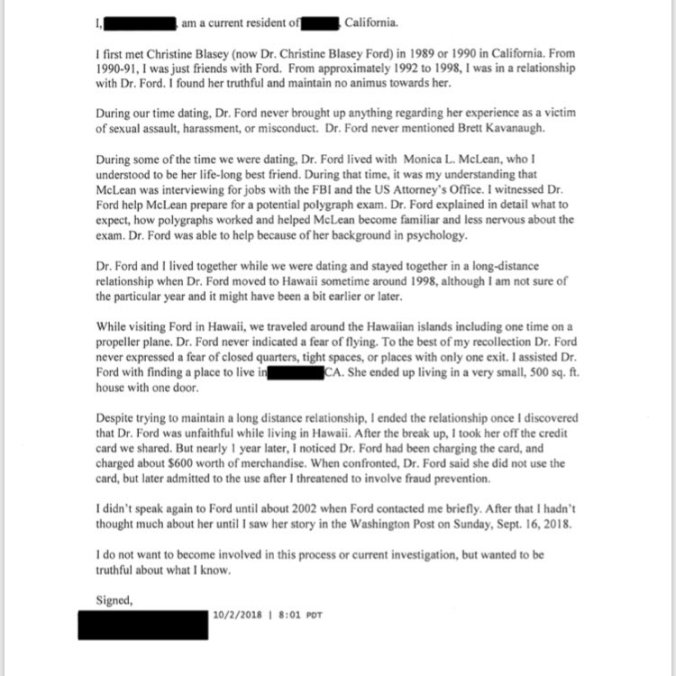
The fact that Dr. Ford had been declared “truthful” in her polygraph test was always one of the worst reasons to believe her, but now that test throws legitimate suspicion on her account. The machines are notoriously unreliable, but the argument was that the fact that Ford was eager to take the test indicated her confidence in her account. Today, Fox News received this letter from a man who claims to be Ford’s ex-boyfriend:

Of course, it could be completely innocent that a woman who suddenly dredged up a forgotten alleged incident just in time to use it to derail the confirmation of a SCOTUS nominee her party opposes and submitted to a lie detector test as evidence of her veracity considered herself an expert on beating lie detector tests.

III. Ethics Hero meets Ethics Dunce Continue reading

Your Mid-Day Brett Kavanaugh Nomination Ethics Train Wreck Update

It’s kind of like following O.J. slow-mo escape, but more interminable, and lot more ominous...

I. No, Matt Damon is not a hypocrite because he mocked Brett Kavanaugh on SNL.

Why is this so hard to grasp for those not in show-biz? Actors act. They don’t have to believe in or live by what their roles stand for? Damon said earlier last December, speaking of the situation where he was falsely accused of harassment or sexual abuse…

“If you make the same claim to me today. it would be scorched-earth. I don’t care if it would cost me $10 million in court for 10 years, you are not taking my name from me, you are not taking my name and reputation from me, I’ve worked too hard for it, I’ve earned it, you can’t just blow me up like that.”

Now conservative pundits are writing that Damon is a sell-out and a hypocrite for helping a TV satire show attack Kavanaugh for standing up for his name and reputation. Morons. Damon didn’t write that script, and very few actors, especially fading, aging leading men like Damon, can afford to demand that they personally agree with the vehicles they appear in or the characters they play. Even actors who have the money and clout to do that usually kill their careers. [See: Foster, Jody; Clooney, George; et al.] Continue reading

Ethics Morning Sickness, 9/29/2018: The Ford-Kavanaugh Hearing Hangover

According to several sources, Republicans not only have the votes to confirm Brett Kananaugh,  a couple of Democrats may even join their ranks. If true, that’s amazing, and also the most encouraging piece of news I’ve heard since Aaron Judge went on the Disabled List.

I don’t have any special fondness for Brett Kavanaugh, and I have no stake in his confirmation. All I have ever cared about is having outstanding, smart, analytical judges on the Supreme Court. I was thrilled when President Obama nominated Elena Kagan, who fits that description; depressed when he appointed touchy-feely mediocrity Sotamayor, lowering the quality of judicial talent so he could check off a diversity box, but then, that’s Obama. Justices like Blackmun, Souter and Kennedy, all appointed to skirt controversy rather than to ensure a competent Court, do subtle, long-lasting damage to our laws. Aggressive, thoughtful, brilliant jurists like Scalia and Ginsberg keep the third branch of government strong. Kavanaugh is undeniably the kind of qualified, experienced judge who has always been routinely confirmed by the Senate regardless of the President nominating him or his party affiliation. What the Democrats and their allies among activist and the news media have done to Brett Kavanaugh is more than wrong; it is very dangerous, and threatens further the basic comity and respect without which no democracy can function. The treatment of Kavanaugh, which I have discussed in detail elsewhere—the demonizing, the fear-mongering, the character assassination, based purely on an unremarkable judicial philosophy—continues down a slippery slope, already greased by “the resistance,”  that ends in civil war.  The Democrats will only turn away from this disastrous path when they conclude that it won’t work, that the American public rejects “the ends justify the means” as an operating strategy. There are signs that the Democratic Senators televised conduct during the Kavanaugh hearings may be a tipping point. I hope so. I’ll believe it when I see it.

Nothing much has changed in my assessment since I wrote this post ten days ago. I still don’t believe or disbelieve Ford or Kavanaugh. There is no basis on which to believe either of them, but the accuser has the burden of proof, and as was true ten days ago, she can’t meet it and didn’t meet it. Nobody confirms her account. She cannot provide specifics, even as to where the alleged attack occurred, who held the party where it allegedly occurred, or an exact date, making investigation nearly impossible. Her parents, who are alive, have not confirmed her account; apparently she didn’t even tell them about the incident. Her testimony was convincing. So was Kavanaugh’s. Those who say “they believe” either party might as well have a “Bias has made me stupid” sign on top of their head. In yesterday’s New York Times, a full page ad listed thousands of names of men proclaiming “We believe Anita Hill. We also believe Charistine Blasey Ford.” All they are doing is virtue signaling for their pals, proclaiming their partisan affiliation (believing Ford is required to save abortion, and depending on which hysterical activist or pundit you listen to, female suffrage, gay marriage and the continued abolition of slavery), and or proving that they lack the power of critical thought.

I’ll have to sort through all of the logical fallacies used against Kavanaugh later: I’m sure a new rationalization for the list or twelve is in there. For example, I have been told and read that women believe Ford because they know other victims of sexual assault who never reported it. But that doesn’t justify believing Ford! It indicates that the fact that she waited all this time, until evidence was gone and memories faded, to suddenly make her accusation when it was most politically useful to her party doesn’t prove she isn’t telling the truth, but it doesn’t make it any more likely that she is, either. A commenter yesterday suggested that there should be more sympathy and accommodation for victims who are afraid to come forward soon after a sexual assault. “I would like to remind you that women often are not able to speak out against harassment until long after the fact because they are afraid and unable,” she wrote. I replied,

Then they lose their chance. There are a lot of things in life like that. If I’m reluctant to speak up and challenge a mob harassing a US Senator while he’s dining with my family, I can’t wait 20 years and do it then, can I? If you are afraid to report a community criminal when you have evidence against him because you’re afraid to snitch, it’s no mitigation to report the evidence after more people have been hurt because of your delay. How about women who don’t stop their boyfriends from sexually molesting their children because they are afraid? Is it acceptable that they wait until the Statute of Limitations has run, the damage has been done, and the kids are grown and molesting children themselves before they speak up?

You don’t have to remind me of the dilemma. I’m sorry, but I am really sick of this argument…It’s an excuse and a rationalization. It makes fairness and due process impossible, and it allows false accusers to manipulate others. Three decades? Holding a complaint until the exact moment when it can’t be defended against AND will do the most damage?

It’s explainable, perhaps, but it isn’t ethically excusable.

Continue reading

Ethics Hero: Kwame Anthony Appiah, a.k.a. “The Ethicist”

In the past, I mostly visited the New York Times Magazine “The Ethicist” column to take issue with the succession of ethics amateurs and ethicist wannabes the Times employed as its ethics advice columnist. Once Kwame Anthony Appiah took over, this wasn’t as much fun, and I admit I don’t even check the column that often. Appiah is a real ethicist, and knows what he’s doing. I sometimes disagree with his conclusions, but he reaches them using valid ethical analysis, and seldom employs bias or rationalizations.

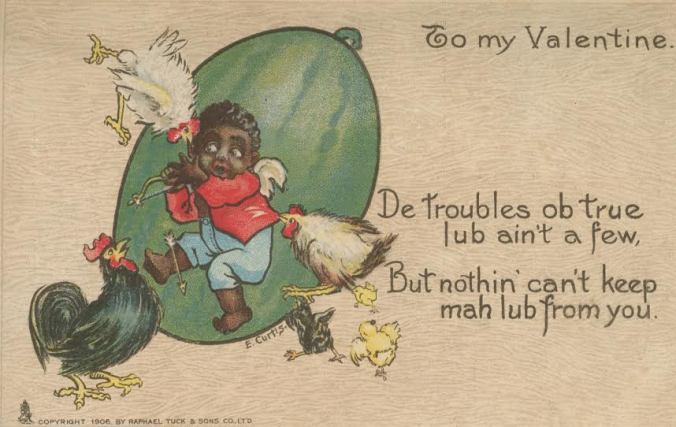
A recent column, however, deserves special praise. The inquirer asked what the ethical course would be to handle historical artifacts that reflected racist attitudes and artwork, like the card pictured above. The writer concluded her question…

I offered it to the National Museum of African American History and Culture in Washington. I never heard from them, so it moved with us. My husband thinks I should throw it away, but that feels wrong. I feel it is history that we should acknowledge, however painful and wrong. Your thoughts?

“The Ethicist’s” response is note-perfect, even with my intentional omission of its best and most surprising section. I’m doing this so you will hit the link and read the full column. Appiah wrote in part,

I am not a fan of the intentional destruction of historical artifacts….It’s a familiar thought that we need to understand our past, not least in order to help us avoid repeating the worst aspects of it. So your impulse to offer this souvenir card to a museum seems right. Of course, the sort of document you describe is well represented in collections already, and this may be why you didn’t hear back. But who knows whether there isn’t something about it that a historian might find useful in unpacking some detail of the history of American racial attitudes?

So if you think this card does have historical value, and you can’t readily find an interested archive or scholar, you could just put it up for sale on eBay, say, where it will join a large assemblage of racist artifacts. You can’t guarantee that you’ll approve of the motives of the buyer, but someone who is willing to pay for it is most likely to preserve it.

Given that your motives are honorable, I don’t share your worry about profiting from the sale. Selling an image isn’t endorsing its message. And my guess is that most contemporary collectors of such items aren’t motivated by racism. Still, if you want to avoid profiting, there’s an easy solution. Just send the proceeds to the National Museum of African American History and Culture. That’s an offer they won’t turn down. Continue reading