“It is almost unbelievable how ignorant and ill-educated America’s college students are. They are well below average in every material way. For all my life I have been an advocate for higher education, but I have reluctantly come to the conclusion that college is generally a mistake, as young people are mostly misinformed there, rather than educated. There are a few technical fields–medicine, engineering, possibly law–where such education is actually useful. Otherwise, we and our young people would be better off if they eschewed institutions like Colgate in favor of trade and technical schools, or immediate entry into the labor market. They couldn’t possibly do worse than to pursue the typical four-year liberal arts degree.”
—-Attorney-blogger John Hinderaker, in a Powerline post about thehostile treatment conservative author Heather McDonald received from Colgate students when she was invited to speak there.
The reason this seems almost unbelievable to Hinderaker, and the reason I chose this as an ethics quote, is that his painful conclusion that nobody wants to admit is true. I don’t want to admit it, and I was becoming convinced of this decades ago, when I was part of the administration of Georgetown Law Center and discovered that we had Yale graduates who couldn’t write a coherent sentence, and later, when I had Stanford interns who thought Jane Fonda was an aerobics instructor and who looked at me blankly when I mentioned the 1968 Democratic National Convention, and still later, when a smart young woman who had graduated from Hofsta didn’t know who Jackie Robinson was, and when a Skadden Arps attorney with a Cornell degree guessed that the Civil War was fought sometime in the 1930s.
This is why I was not disappointed when my son, scion of a family with three Harvard graduates and a career Harvard employee, announced that he saw no point in going to college. Continue reading →
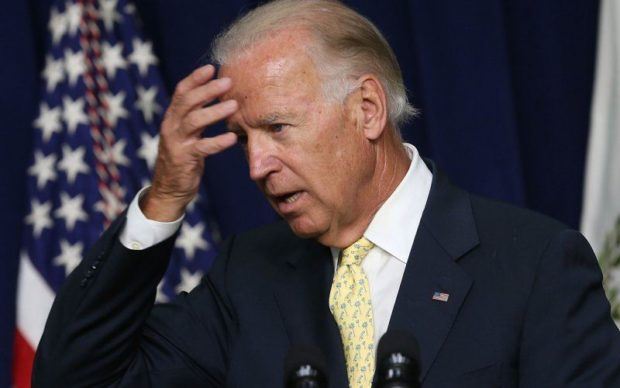
“My name’s Joe Biden, I’m a Democratic candidate for the United States senate—if you like what you see, help out, if not, vote for the other Biden”
Democratic candidate and gaffe grandmaster Joe Biden, speaking today, before tonight’s South Carolina debate, to a South Carolina campaign crowd.
It isn’t that Biden’s statement has anything to do with ethics, whatever he was saying. It’s that his bizarre pronouncement raises an immediate ethics issue. If we were playing “Ethics Password,” the announcer would say in hushed tones, “The password is fairness.” What is fair to Biden here, and how can I get past my biases to decide? I have believed for more than a decade that Biden is an idiot-savant with surprising political skills; I don’t believe you can say ridiculous and nonsensical things as often as he has for so long and not be inherently untrustworthy and more than a little addled. I also have found his demeanor, appearance and increasing tendency to speak in gibberish of late evidence of precipitously declining faculties from a height that was never all that impressive to begin with.
And yet I am in favor of giving any politician, disk jockey or improv comic the benefit of the doubt, because I know the perils of speaking extemporaneously from first-hand experience. Thus the question is, how eager should we be to shrug off this latest jaw-dropper from Biden as the natural and forgivable result of flying around the country and its inevitable “If this is Tuesday, it must be Saginaw” confusion? Is it just a particularly egregious example of wacky old Joe being wacky old Joe, and thus an occurrence where the Julie Principle is in play, or, in the worst case, is this latest head-scratcher so close to the former VP showing up nude with a duck on his head that an intervention is called for?
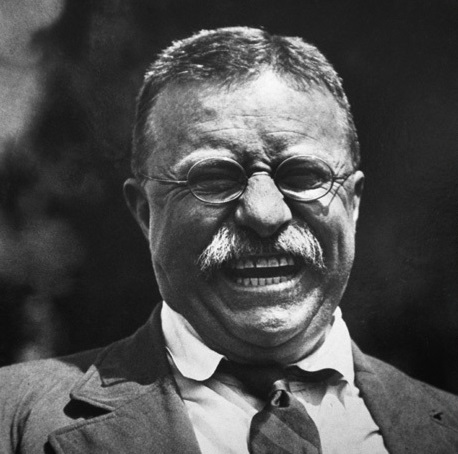
Theodore Roosevelt wasn’t still President when he gave his speech, “Citizenship In A Republic”, at the Sorbonne, in Paris, France on April 23,, 1910. He was a President, though, and getting ready to run for the office again; moreover, you can have a speech be any more pure Teddy than this one.
It is his most quoted speech as well as the one which describes his essence. I wonder if President Trump has read it? Teddy wouldn’t approve of Trump, I think, but he would have to admire the President’s determination to spit in the eyes of his critics, and “whose face is marred by dust and sweat and blood; who strives valiantly; who errs, who comes short again and again, because there is no effort without error and shortcoming; but who does actually strive to do the deeds; who knows great enthusiasms, the great devotions; who spends himself in a worthy cause; who at the best knows in the end the triumph of high achievement, and who at the worst, if he fails, at least fails while daring greatly, so that his place shall never be with those cold and timid souls who neither know victory nor defeat.”
That describes Donald Trump these past three years as much as any President, including Teddy Roosevelt.
Strange and impressive associations rise in the mind of a man from the New World who speaks before this august body in this ancient institution of learning. Before his eyes pass the shadows of mighty kings and war-like nobles, of great masters of law and theology; through the shining dust of the dead centuries he sees crowded figures that tell of the power and learning and splendor of times gone by; and he sees also the innumerable host of humble students to whom clerkship meant emancipation, to whom it was well-nigh the only outlet from the dark thraldom of the Middle Ages.
This was the most famous university of mediaeval Europe at a time when no one dreamed that there was a New World to discover. Its services to the cause of human knowledge already stretched far back into the remote past at a time when my forefathers, three centuries ago, were among the sparse bands of traders, ploughmen, wood-choppers, and fisherfolk who, in hard struggle with the iron unfriendliness of the Indian-haunted land, were laying the foundations of what has now become the giant republic of the West. To conquer a continent, to tame the shaggy roughness of wild nature, means grim warfare; and the generations engaged in it cannot keep, still less add to, the stores of garnered wisdom which where once theirs, and which are still in the hands of their brethren who dwell in the old land. To conquer the wilderness means to wrest victory from the same hostile forces with which mankind struggled on the immemorial infancy of our race. The primaeval conditions must be met by the primaeval qualities which are incompatible with the retention of much that has been painfully acquired by humanity as through the ages it has striven upward toward civilization. In conditions so primitive there can be but a primitive culture. At first only the rudest school can be established, for no others would meet the needs of the hard-driven, sinewy folk who thrust forward the frontier in the teeth of savage men and savage nature; and many years elapse before any of these schools can develop into seats of higher learning and broader culture.
The pioneer days pass; the stump-dotted clearings expand into vast stretches of fertile farm land; the stockaded clusters of log cabins change into towns; the hunters of game, the fellers of trees, the rude frontier traders and tillers of the soil, the men who wander all their lives long through the wilderness as the heralds and harbingers of an oncoming civilization, themselves vanish before the civilization for which they have prepared the way. The children of their successors and supplanters, and then their children and their children and children’s children, change and develop with extraordinary rapidity. The conditions accentuate vices and virtues, energy and ruthlessness, all the good qualities and all the defects of an intense individualism, self-reliant, self-centered, far more conscious of its rights than of its duties, and blind to its own shortcomings. To the hard materialism of the frontier days succeeds the hard materialism of an industrialism even more intense and absorbing than that of the older nations; although these themselves have likewise already entered on the age of a complex and predominantly industrial civilization. Continue reading →
In some ways, Jack Kennedy was the anti-matter Donald Trump.
He unified the country with optimistic words and soaring idealism, and was treated by the media and much of the public as if appearances and substance were the same thing. Like Trump, he was rich and the son of a ruthless business man; unlike with our current President, few seemed to care. JFK was young and vigorous (or as he would say, “vigahrous”), and nobody accused him of hyperbole and lies. The press loved him; his press conferences were all laughs and smiles. Yet Kennedy was every bit the narcisisist that Donald Trump is, and at least as much of a misogynist. He engaged in open nepotism, having his brother as his Attorney General and chief advisor, but nobody suggested he was hving incestuous relations with Bobby. Both had glamorous wives, but while Melania has been effectively banned from the covers of women’s magazines, Jackie was on a cover every month, if not every week. Kennedy committed impeachable offenses, like having a secret sexual liaison with an Israeli spy (and Mafia moll), but it was Trump who was impeached. Meanwhile, President Trump’s accomplishments in his first term far exceed those of Kennedy, who also managed to prompt East Germany to erect the Berlin Wall, and to nearly trigger World War III.
His inaugural address, however, marked his Presidency as the gateway to a new era, when anything was possible. Kennedy was not a great orator—all the Kennedys had and have a tendency to shout—but he was a a passionate one, and he had charisma, that indefinable magic that makes strangers love and trust a politician. Though he had barely received 50% of the votes in the 1960 election, nearly seventy-five percent of Americans expressed approval of President Kennedy after this speech.
Mostly crafted by Kennedy aide Ted Sorenson, it is undeniably a masterpiece.
Vice President Johnson, Mr. Speaker, Mr. Chief Justice, President Eisenhower, Vice President Nixon, President Truman, Reverend Clergy, fellow citizens:
We observe today not a victory of party but a celebration of freedom–symbolizing an end as well as a beginning–signifying renewal as well as change. For I have sworn before you and Almighty God the same solemn oath our forbears prescribed nearly a century and three-quarters ago.
The world is very different now. For man holds in his mortal hands the power to abolish all forms of human poverty and all forms of human life. And yet the same revolutionary beliefs for which our forebears fought are still at issue around the globe–the belief that the rights of man come not from the generosity of the state but from the hand of God.
We dare not forget today that we are the heirs of that first revolution. Let the word go forth from this time and place, to friend and foe alike, that the torch has been passed to a new generation of Americans–born in this century, tempered by war, disciplined by a hard and bitter peace, proud of our ancient heritage–and unwilling to witness or permit the slow undoing of those human rights to which this nation has always been committed, and to which we are committed today at home and around the world.
Let every nation know, whether it wishes us well or ill, that we shall pay any price, bear any burden, meet any hardship, support any friend, oppose any foe to assure the survival and the success of liberty.
This much we pledge–and more.
To those old allies whose cultural and spiritual origins we share, we pledge the loyalty of faithful friends. United there is little we cannot do in a host of cooperative ventures. Divided there is little we can do–for we dare not meet a powerful challenge at odds and split asunder.
To those new states whom we welcome to the ranks of the free, we pledge our word that one form of colonial control shall not have passed away merely to be replaced by a far more iron tyranny. We shall not always expect to find them supporting our view. But we shall always hope to find them strongly supporting their own freedom–and to remember that, in the past, those who foolishly sought power by riding the back of the tiger ended up inside.
To those people in the huts and villages of half the globe struggling to break the bonds of mass misery, we pledge our best efforts to help them help themselves, for whatever period is required–not because the communists may be doing it, not because we seek their votes, but because it is right. If a free society cannot help the many who are poor, it cannot save the few who are rich.
To our sister republics south of our border, we offer a special pledge–to convert our good words into good deeds–in a new alliance for progress–to assist free men and free governments in casting off the chains of poverty. But this peaceful revolution of hope cannot become the prey of hostile powers. Let all our neighbors know that we shall join with them to oppose aggression or subversion anywhere in the Americas. And let every other power know that this Hemisphere intends to remain the master of its own house. Continue reading →
“Last night on CNN, Bernie Sanders called me a political hack.“That’s exactly who the fuck I am! I am a political hack! I am not an ideologue. I am not a purist. He thinks it’s a pejorative. I kinda like it! At least I’m not a communist!”
Political consultant and long-time Clinton acolyte James Carville on Snapchat with former CNN reporter Peter Hamby.
You have to love this. Yes, I think it’s a remarkably ethical statement from Carville. He is, unlike so many of his fellow operatives and strategists, not pretending to be someone and something he isn’t. He has delivered welcome honesty where we almost never receive it. Carville is loyal to those who pay him, like a lawyer, like lobbyists, like so many members of Congress. His candor also solved the long-time mystery (to some) of how the supposedly progressive Clintonista could be happily married to Mary Matalin, a prominent Republican strategist and mouthpiece. Now we know: he and she are true soul mates in cynical Washington. Their mutual missions are facilitating political warfare and skulduggery, for pieces of silver. The honesty is so refreshing!
And Bernie is a Communist. The public needs to know it, and cheers to Carville for ripping off the bandaid.
What student “Auntie Ezine” said—that’s her Twitter handle; her real name is unknown so far—was this:
“If y’all didn’t know this is the [Multicultural Student Center], and frankly there’s just too many white people in here, and this is a space for people of color. So just be really cognizant of the space that you’re taking up. Because it does make some of us [people of color] uncomfortable when we see too many white people in here. It’s only been open for four days, and frankly there’s the whole university for a lot of y’all to be at, and there’s very few spaces for us. So keep that in mind. Thank-you.”
First, the important question: what the hell is a “pony soldier”? The answer is “nobody knows.” Nor does anyone know why this insult, epithet, whatever it is, leapt into Joe’s mind, but then it’s Joe Biden. Who can say what vestigial RNA from his prospector ancestors are knocking around in Biden’s gray matter? He thinks “malarkey” is hip slang; I’m waiting for him to start shouting “By crackie!, “Jumpin’ Jehoshaphat!” and “Tarnation!”
I found a website that attributed “pony soldier” to a John Wayne movie—no, you morons, the Duke’s movie was “The Horse Soldiers.” “Pony Soldier” is a forgettable 1952 Western starring Tyrone Power. Nobody, but nobody, quotes Tyrone Power movies, and Power had as much business starring in a Western as David Niven. So it looks like this is just a spontaneous nonsense insult, like in “A Few Good Men” when Tom Cruise shouts, “You’re a lousy fucking softball player, Jack!” at Kevin Bacon after an argument that has nothing to do with softball.
Now on to the incident itself. Today Biden was handshaking and chatting at a pre-New Hampshire primary stop in Hampton. A woman asked him,“How do you explain the performance in Iowa and why should the voters believe that you can win a national election?”
It’s a fair question, since the only reason on God’s green earth that anyone would seriously consider a doddering, blathering, fading and rapidly aging old pol like Biden as a rational nominee is that he would be preferable to the Doomsday Meteor.
“You ever been to a caucus?” Biden replied. When the voter said she had, Biden snapped, “No you haven’t. You’re a lying dog-faced pony soldier!” Continue reading →
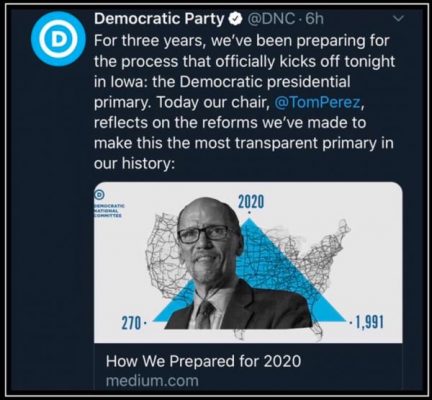
“You see what they are doing? They’re blaming Iowa. It’s not the fault of the Democratic Party. It’s Iowa’s fault. After the citizens of Iowa put up with all that interaction with candidates swarming the state for the past year (and more) and after they showed up for this elaborate nighttime gathering in groups in gyms and showing support with their bodies, they are blamed for the screw-up of the party!”
Iconoclastic blogger Ann Althouse, reacting to the Democratic Party’s attempts to mitigate the Iowa Caucuses debacle.
At least they aren’t blaming it all on Trump. Yet.
The other blame-shifting I’m seeing is: The computers did it. There was an app and it somehow caused all the trouble. Reminiscent of Hillary’s wipe-it-with-a-cloth computer problems. I really don’t want to hear excuses that have to do with computers getting things wrong. This cannot have been a complicated app, and the backup was to use the phones, yet they want to blame the phone lines too! It’s just not credible.”
What triggered Althouse were Washington Post headlines telling her that
Sen. Dick Durbin said it was time to end the Iowa caucuses and that Howard Dean said that Iowa should no longer lead the primary parade.
What I especially like about Ann is that her academic detachment allows her to focus on aspects of an issue that most analysts miss because they care about the results more than she does. This talent is annoying when it results in her going off on tangents about how a particular word is used in a quote or article–she’s been obsessed with the word “garnered” for a couple of weeks now—but this is an example of her picking up on an ethics issue that nobody else, including me, was mentioning: the avoidance of accountability.
I was shocked when I woke up this morning after sleeping in—bad night—to see that the results of the Caucus still hadn’t been announced. It’s a massive embarrassment for the party, and again—commenter Michael West disagrees with me on this, but I’ll double down now—it is bad for everyone, not just Democrats. Ann was focusing on this as well, I think.
The Iowa Caucuses have long been celebrated as old fashioned democracy in action: citizens meeting in firehouse hall and churches, debating, making their preferences known. I come from Arlington, Massachusetts, the largest municipality in the nation that still uses the town meeting system of governance. Local and regional democracy, though the Left increasingly derides it in its quest for global government, is the heart of American values. This kind of breakdown, catalyzed by inflicting technology on a system that has worked just fine without it, undermines public trust in our institutions.
That is dangerous.
Moreover, it is in everyone’s interests, in a two party system, for both parties to find the best possible candidate. This was a point I kept making in 2016. For either party’s system to blow up increases the likelihood that chaos will taint the process, and cause unforeseen and unintended results—as it did the last time.
“Trump could offer Alaska to the Russians in exchange for support in the next election, or decide to move to Mar-A-Lago permanently and leave Jared Kushner to run the country, delegating to him the decision whether they go to war.”
—Lead House Impeachment Manager CongressmanAdam Schiff of California during closing arguments in the Senate impeachment trial Monday, bringing unconscionable partisan fear-mongering and anti-Trump hysteria to a new low.
Res ipsa loquitur.
And failure to recognize Schiff as an unprincipled and shameless buffoon is a symptom of Stage 5 Trump Derangement.
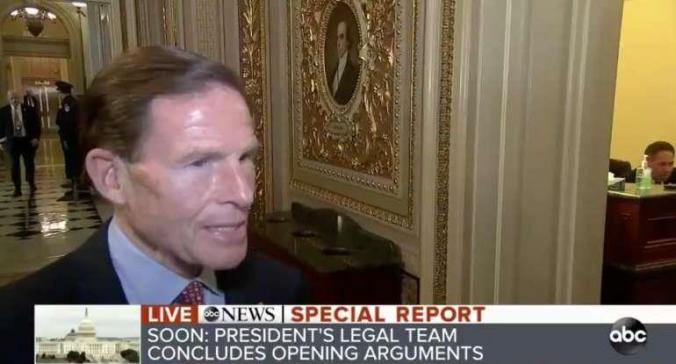
“It was a fact-free summation of a case bereft of evidence – we need the evidence. We need the witnesses and documents.”
—-Democratic Senator Richard Blumenthal, commenting on C-Span regarding the Trump defense lawyers’ presentation.
I suppose this isn’t so much of an unethical quote as a quote that reveals one’s own unethical conduct by accurately stating the facts. Yet Blumenthal doesn’t seem to realize that what he just admitted proves that this benighted impeachment sham is as I and others described it to be from the start: a case bereft of evidence.