Morning Ethics Warm-Up, 4/4/2018: Baseball Lies, A Presidential High Crime, And A Judge Makes A Panty Raid


Wake Up!

1 Fake history, baseball style. Broadcasts of Red Sox games from Fenway Park in Boston refer to “the Pesky Pole,” the official name of the tall, yellow foul pole in right field. It is named in honer of the late Johnny Pesky, who also is honored in a statue outside the park—it featured him and his team mates and longtime friends, Ted Williams, Dom DiMaggio, and Bobby Doerr. Pesky, with a couple of brief interruptions,was a Red Sox lifer, beginning with his 1942 rookie season, and ending with his death several years ago as an honorary coach. In between, he was Sox minor league manager, the big team’s manager, a hitting coach and a broadcaster.

The Pesky Pole got its name because the notoriously power-free shortstop reputedly hit several of the few he managed to slug in his career by knocking a pitch  around the marker, which arose from  what is now the shortest foul line in baseball. The  low Fenway right field fence veers sharply out from there to over 400 feet, so such homers are considered, and indeed are, lucky flukes. During his brief and undistinguished tenure as a Red Sox radio color man, former Red Sox pitching ace Mel Parnell repeatedly told the story about how Johnny won a game for Mel in 1948 with a pole-shot. This tale led directly to the team officially naming the pole on September 27, 2006, on Pesky’s 87th birthday, with a commemorative plaque placed at its base and everything.

Afterwards, and not before, someone actually checked the game records. Pesky never hit the home run  described by Parnell. He only hit six home runs in Fenway at all, and nobody knows how many hit the pole, looped around the pole, or even went to right field. (Pop-ups hit by Punch-and-Judy hitting shortstops sometimes landed in the screen over the left field wall for home runs, as the cursed Bucky Dent can attest.) Nevertheless, the fake history is in place: the Pesky Pole is named that because Johnny Pesky hit a famous home run off of it, or was famous for looping cheap homers around it, or something.

Baseball excels at creating fake history, the most notable being represented by the locale of its Hall of Fame, in Cooperstown, New York. When the museum was envisioned, the accepted story about the game’s origin was the Union general Abner Doubleday invented the sport in 1839 and organized the first game in Cooperstown. After the construction was underway,  research suggested that everything about the Doubleday tale was rumor and myth, but baseball and the museum’s management, in one of the all-time classic examples of adopting the philosophy of the newspaper editor in “The Man Who Shot Liberty Valence,” went to great lengths to keep the original story before the public. Eventually some hard evidence surfaced suggesting that the game was invented by Alexander Cartwright, who was eventually inducted into the Hall as the game’s creator, while Doubleday is not. Nonetheless, the myth survives. Major League Baseball Commissioner Bud Selig, for example,  said in 2010 that “I really believe that Abner Doubleday is the ‘Father of Baseball.'” This is the equivalent of saying that one believes in the Easter Bunny.

Selig was later inducted into the Hall of Fame.

2.Believe it or Not! I would support impeaching  President Trump for his tweeting attacks against Amazon. This is such an abuse of Presidential power that it demands at least a Congressional reprimand or sanction. Amazon lost $53 billion in market value in the wake of the tweets, meaning that investors, retirees, and ordinary Americans lost wealth as well. It is unconscionable for a President of the United States to deliberately target a company, just as it is wrong for a President to punch down at a private citizen, but the consequences of doing what Trump has done to Amazon is far, far worse. The Wall Street Journal suggested in an editorial that if the attack on Amazon was politically motivated because Amazon mogul Jeff Bezos owns the Washington Post, impeachment would be justified. Yes, that would be even worse, but it is not an essential element of this “high crime.” The President of the United States must not abuse his power by intentionally harming lawful businesses.

The foolish resistance is so focused on trying to impeach Trump based on exotic laws and imaginary conspiracies that it doesn’t see the real thing when it’s right in front of its face, and the anti-Trump media has so destroyed its credibility by embracing ridiculous impeachment theories that a valid one will just look like more of the same. Continue reading →

Review: Ethics Alarms Concepts And Special Terms

Recently updating the Ethics Alarms list of concepts and frequently used terms reminded me that I had been meaning to post them for review and assistance to those relatively new here. Of course, the link has always been right there at the top of the home page, but I have this sneaking suspicion that it isn’t visited very often.  Here, then, is the up-to-date list.

CONCEPTS

Non-Ethical Considerations: Defined above, non-ethical considerations are important because they are often the powerful impediments to ethical conduct, and the cause of many conflicts of interest. Non-ethical considerations are many and diverse, and include:

  • The need and desire for shelter, health, wealth, fame, security, self-esteem, reputation, power, professional advancement, comfort, love, sex, praise, credit, appreciation, affection, or satisfaction
  • The desire for the health, comfort, safety, welfare and happiness for one’s family, loved ones, friends, colleagues, an co-workers
  • The pursuit of vengeance or retribution
  • Hunger, lust, pain, ambition, prejudice, bias, hatred, laziness, fatigue, disgust, anger, fear
  • …and many more

Ethical Dilemma: This is an ethical problem in which the ethical choice involves ignoring a powerful non-ethical consideration. Do the right thing, but lose your job, a friend, a lover, or an opportunity for advancement. A non-ethical consideration can be powerful and important enough to justify choosing it over the strict ethical action.

Ethical Conflict: When two ethical principles demand opposite results in the same situation, this is an ethical conflict. Solving ethical conflicts may require establishing a hierarchy or priority of ethical principles, or examining the situation through another ethical system.

Ethical Gray Area: Gray areas are situations and problems that don’t fit neatly into any existing mode of ethical analysis. In some cases, there may even be a dispute regarding whether ethics is involved.

Reciprocity: The ethical system embodied by The Golden Rule, and given slightly different form in other religions and philosophies. It is a straight-forward way of judging conduct affecting others by putting oneself in the position of those affected. Reciprocity should always be available in any ethical analysis, but it is frequently too simple to be helpful in complex ethical situations with multiple competing interests.

Absolutism: Absolutist systems do not permit any exception to certain ethical principles. The champion of all absolutists, philosopher Immanuel Kant, declared that the ethical act was one that the actor was willing to have stand as a universal principle.

One principle of absolutism is that human beings can never be harmed for any objective, no matter how otherwise worthwhile. Absolutism has the advantage of making tough ethical calls seem easy, and the disadvantage of making debate impossible. One sees absolutism reflected today in the controversies over war, torture, abortion, cloning, and capital punishment.

Utilitarianism: Utilitarianism accepts the existence of ethical conflicts and the legitimacy of some ethical dilemmas, and proposes ethical analysis based on the question, “Which act will result in the greatest good for the greatest number of people?’ It entails the balancing of greater and lesser goods, and is useful for unraveling complex ethical problems. Its drawback, or trap, is that utilitarianism can slide into “The ends justify the means” without some application of absolutist and reciprocity principles.

Consequentialism: In formal ethics, utilitarian schools of philosophy are sometimes lumped together as “consequentialism,” in that the ethical decision-making is based on seeking the best result. Here we just uses the above term, utilitarianism.  Consequentialsm, in contrast, is the flawed belief that the rightness or wrongness, or even wisdom, of chosen conduct is measures by its actual results rather than its intended results. If “if all worked out for the best,” in other words, the conduct that created the desirable result most have been ethical, whatever its intent or however the conduct was determined to be necessary or desirable. This is a fallacy.

Cognitive Dissonance:
Cognitive dissonance is a psychological phenomenon first identified by Leon Festinger. It occurs when there is a discrepancy between what a person believes, knows and values, and persuasive information that calls these into question. The discrepancy causes psychological discomfort, and the mind adjusts to reduce the discrepancy. In ethics, cognitive dissonance is important in its ability to alter values, such as when an admired celebrity embraces behavior that his or her admirers deplore. Their dissonance will often result in changing their attitudes toward the behavior. Dissonance also leads to rationalizations of unethical conduct, as when the appeal and potential benefits of a large amount of money makes unethical actions to acquire it seem less objectionable than if they were applied to smaller amounts.

Moral Luck: The common situation where an unethical act is only discovered, noticed, or deemed worthy of condemnation due to unpredictable occurrences that come as a result of the act or that affect its consequences. Moral luck is the difference, for example, between two mildly intoxicated drivers, one of whom arrives home without incident, while the other has an unwary child dash in front of his automobile, leading to a fatal accident that he couldn’t have avoided if completely sober. Yet the unlucky driver will be a pariah in the community, while the more fortunate driver goes on with his life.

SPECIAL TERMS USED ON ETHICS ALARMS

Continue reading →

Morning Ethics Warm-Up, 4/2/2018: The Unreliable Authorities Edition

Good morning!

1.  Another baseball ethics dispute! This is an exciting time of changes in the traditional wisdom of how to play Major League Baseball, all sparked by that new ethics bugaboo, Big Data. Now that so many aspects of the game can be measured and analyzed, tradition and assumptions rarely challenged are now under fire. One massive shift is, ironically, in the matter of shifts, radical defensive alignments in which players are not fielding their normal positions, but rather are places where computer spray charts for each batter suggest that the likelihood of fielding a ball is highest.  This can mean anything from one lonely fielder on the left side of the infield, or four outfielders.

Shifts are not new, but they used to be used on a handful of super-sluggers with dead-pull propensities, notably Ted Williams, who famously refused to bunt for easy hits to the unoccupied side of the field, and instead usually tried to hit through or over the shift. It has been estimated that the Williams Shift, combined with the player’s infamous stubbornness, cost him many points off of his lifetime batting average, especially since Williams defeating the shift by bunting might have discouraged its use.

But he was Ted Williams, the second greatest hitter of all time.  The question of whether lesser batters should bunt against shifts, for now many teams shift against everyone, has an easy answer: Of course they should.

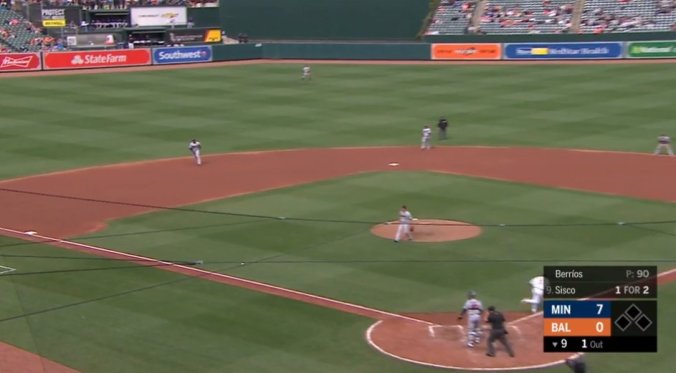
In yesterday’s Twins-Orioles game, Twins starter Jose Berrios had  a one-hit shutout in the ninth inning. leading with one out and no runners on base. O’s rookie catcher Chance Sisco came to the plate—he has my favorite baseball name this season–and the Twins put on a shift like the one Ted Williams despised:

So, knowing he wasn’t Ted Williams and also knowing that in baseball even seven run leads aren’t a sure thing, Chance dropped down a bunt to the left side for a single. Berrios then walked two batter Davis and Manny Machado to load the bases, but finished his shutout by getting the next two outs without further disruptions.

After the game, the Twins players questioned the ethics of Sisco’s hit. Berrios said, “I just know it’s not good for baseball [to bunt] in that situation. That’s it.” Twins outfielder Eddie Rosario said, “Nobody liked that. No, no, no. That’s not a good play.” Second baseman Brian Dozier added, “Obviously, we’re not a fan of it. He’s a young kid. I could’ve said something at second base but they have tremendous veteran leadership over there. I’m sure they’ll address that. It’s all about learning. You learn up here.”

When do you “learn” not to try to win the game and get on base? For Sisco, a rookie, sending the message that shifting against him is a bad risk also is a wise career move. There is a long-standing, and stupid, unwritten rule in baseball that it is “bush league” to try to break up a no-hitter with a bunt, but extending that dubious logic to a mere shutout breaks the Stupid Meter.

2. Coffee is good for you, but be worried when you drink it. Continuing its rapid devolution into Bizarro World, just as increasing scientific evidence suggest that coffee is good for you, California is demanding that it carry a tobacco-like warning label. Last week a judge ruled that Starbucks and  other coffee companies in California must carry a cancer warning label because of a chemical produced while beans roast has been shown to cause cancer in high doses. California’s Safe Drinking Water and Toxic Enforcement Act  requires companies with more than 10 employees to warn their customers about the presence of carcinogenic and toxic chemicals in their products, even in tiny amounts. Acrylamide, a chemical compound that is produced naturally during the roasting of coffee beans, is on the state’s list of chemicals known to cause cancer or reproductive toxicity. The judge ruled that the coffee company had the burden of proof  to show that acrylamide posed no significant health risk to coffee drinkers, even though there is no evidence that coffee does pose a risk. Continue reading →

Morning Ethics Warm-Up, 3/30/18: Classless


1. Of unethical, and useless, unpaid internships. There is about as a good a summary of what is wrong with unpaid internships at the UConn website as you will find. My only complaint is that the piece, by Henry Zehner, ignores my long-time objection to these positions based on my experiences with various employers who forced me to use out-of-class students in ill-defined roles. (Yes, one of them was the current Secretary of Education.) Zehner mentions that the law requires interns to do substantive work rather than low level office tasks. He doesn’t mention that only the rare intern is able to do tasks “not requiring specialized training.” My experience was that interns usually had negative effects on my time, management and productivity, as I not only had to instruct them, but also often had to re-do whatever work they completed. (Julie and LeeAnn, wherever you are, I don’t mean you.) But as for the young man who was assigned to assemble  my foundation’s annual meeting board books and explained that it took him so long because the “little slips to label the dividers kept falling into the typewriter,” the less said the better.

2. More on the art vs the artist. Last week we discussed the folly of judging art according to the character of the artist, in my post [#3 in a Warm-Up] on the op-ed. “We’ve been too forgiving of unethical artists.”

Here is an example of an artist of disgusting art being found to be disgusting: John Kricfalusi, the creator of the animated “The Ren & Stimpy Show” has been accused by a 37-year old woman of sexually abusing her 20+ years ago, apparently with her consent, but since she was under 18 at the time, such consent is legally meaningless.  So, really, is her late hit, except to gain #MeToo creds. It’s too late to prosecute the cartoonist, and he was remarkably candid about his relationships with teens while he was having them. Kricfalusi had always admitted to his disturbing taste for under-age teenage girls.

Does this old/new information mean that parents should treat “The Ren & Stimpy Show” as taboo, and that channels that feature cartoons should refuse to show it, thus robbing the show’s creator of residuals and income?

No. Kricfalusi’s art has value, if it has value, independent of his own private misconduct. “Lohengrin” is no worse or better because Wagner was a racist and an anti-Semite. The “Alice” books are wonderful, and our culture shouldn’t be robbed of them because Lewis Carroll was creepily obsessed with little girls.

Kricfalusi, for me, is an easy case. I always thought his work was sick and disturbing, and that no parent should allow any child under the age of 13 to watch it. I would feel the same if Kricfalusi was a certified saint. Continue reading →

Morning Ethics Warm-Up, 3/27/18: Redux And Déjà Vu!

Good Morning.

1 Yes, “enemy of the people” is accurate. I searched all over cable and network news this morning to find an outlet that wasn’t dominated by the breaking news that a President-to-be had an adulterous affair with a porn star 12 years ago. I couldn’t find one. The media-wide effort to undermine an elected President and his respect in the nation and the world at a time of great challenges and peril on all fronts is irresponsible, destructive, and demonstrates the collapse of journalism as a bulwark of American democracy.

Journalists don’t have to behave like this: they have chosen to, because they discern that a critical mass of citizens–bad ones–would rather see the President of the United States humiliated and weakened nationally and internationally based on his past than to permit him the same crucial advantage  that every other President since George Washington has been conceded and used. That is the inherent dignity and honor of the office itself. As I wrote here before, almost every President could have been embarrassed in this way, and some far more.  In the past, the public wouldn’t have tolerated it. A full year of “the resistance” and non-stop media attacks made this President uniquely vulnerable to ad hominem attacks, and the only protection left intact between sensational smears and responsible journalism were ethical standards, which is to say, with today’s journalism, nothing at all.

This is no less than a ruthless, ratings- and bias-driven attack on American institutions, and every future President, and the nation, and our democracy, and the world itself, will suffer for it. Ironically, Trump may suffer from it least of all, since no one who supported his candidacy cared about traditional standards regarding who was fit to inherit the legacy of Washington, Lincoln and the rest. Still, this concerted effort to reduce his tenure to endless character assassination does undermine him, and us.

I don’t know what the President meant when he dubbed the news media the “enemy of the people;” he does not use words with anything approaching precision or consistency. I do know what I mean by the phrase, however: an institution that exists to strengthen American democracy has been deliberately engaging in conduct designed to weaken it. That is the conduct of enemies of the people, and that is what the mainstream news media has become.

2. The next Black Lives Matter bandwagon. The news media was also playing tabloid in the Stephon Clark shooting controversy this morning, showing the dead man’s grandmother weeping, asking why he had to die, and asking why the officers couldn’t have shot him “in the arm.” We won’t see a resolution of this case for a long time, but that hasn’t stopped the NAACP, Al Sharpton, Clark’s family and the large number of police-haters on the left from concluding, before any investigation, that he was “murdered.” The family has also hired the same lawyer, Ben Crump, who represented the families of Trayvon Martin and Michael Brown, neither of whom were murdered, and both of whom are still referred to a murder victims on the Black Lives Matter website.

Déjà vu.

In Sacramento, California, on March 18, two officers responded to a radio call regarding a man who was breaking car windows.  The uniformed officers were checking the area on foot when a Sacramento County Sheriff’s Department helicopter pointed them in the direction of a possible suspect, Clark.

He was seen running through a back yard, jumping over a fence, then looking into a car parked in the driveway of what was later revealed to be his grandmother’s house. The officers approached Clark, guns drawn, and ordered him to show them his hands,  a standard command.  Instead Clark ran, with the officers in pursuit. They ordered  Clark to stop, but he ran around the corner of the house and out of the officers’ view. Again the officers followed, then ducked back behind the house, shouting “Show me your hands! Gun!”, then “Show me your hands!” followed immediately by “Gun, gun, gun!” Both officers opened fire, emptying their guns, killing Clark.

Clark had no gun, just a cell phone. The video is inconclusive. Continue reading →

Morning Ethics Warm-Up, 3/26/18: “Baseball Season Begins This Week So Nothing Can Upset Me” Edition

Good morning!

1 A Comment Of The Day. I apologize to Aleksei for not devoting a full post to his excellent commentary, but the posts have been more than a little Parkland Shooting Freak-Out—yes, that is what it is—heavy of late, so I’m highlighting his comment here. I’m also going to torment my temporarily reason-deficient—for that’s what they are—Facebook friends by quoting it.

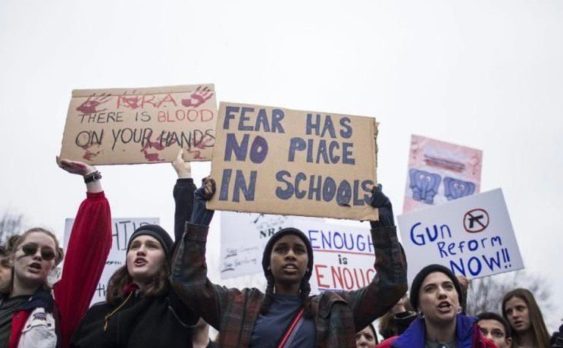
So I went to the Boston “March for our lives” as an educational thing, because I’ve never been to one of these, and I wanted to talk to people about why they were marching. I am on the pro-gun side. The signs they had definitely were variations on what Jack has provided here. The sign with the kid in the subway car, that’s actually the Boston Red Line.

This march was definitely an emotional thing, because of the 10+/- people I spoke with, nobody was very knowledgeable on guns, gun laws, background checks, what is an assault rifle, the failings of government  in the Texas church shooting, the Parkland shooting, etc. On average, older people were more willing to have a longer conversation. On average, younger people were more irritated with me, once I told them what side of the issue I am on. I was polite and respectful, so there was never a brawl or anything.

I talked with the college girls with one of the more egregious signs ( “2nd amendment = white supremacy”) and they gave me the whole systemic racism shtick. They also had NRA = terrorism. They said the NRA buys politicians. I gave a counter example, that Planned Parenthood donates a lot of money too, where I was cut off immediately and told, that’s different, they’re not murderers, and it’s nowhere near what the NRA gives. [ Ethics Alarms note: This is not accurate.] Another woman I talked with, late 20’s maybe, told me how could I look into the eyes of children that are scared for their lives and not do something. I told her that it saddens me that kids are scared, but it saddens me more that the police failed, the school failed, and the FBI failed in Parkland. She didn’t rebut me and I wished her a good day.

I also was surprised when some young people asked me, if I don’t agree with the march, what am I doing here? I told them that this is a free country, I can be here if I want and that I can speak with other fellow Americans, even if we don’t agree on everything. On a positive note, people told me they appreciated my desire to hear the other side and learn more. It was an interesting experience, but like Jack said earlier, it was a “scream at the sky” fest. Also, the chants were boring. “Hey, Hey, NRA, how many kids have you killed today”, “What do we want? Gun Control! When do we want it? Now!”, “No more guns! No more guns!”, and so on and so forth. I want to say there were more women, there were families with children, which also had signs, people from kindergarten age to old age pensioners.

Observations:

  • Bravo for Aleksei, and anyone else who had the patience to do this. My aversion to protests,demonstrations and rock festivals. along with the brian-numb, herd-like vibe the emit. goes back to my teens.  I just couldn’t do what he did.
  • Can’t somebody write some new protest chants? Do the chanters know that recycling Vietnam peace chants just reinforces the belief that this is all generic generational bitching, and more reflex that thoughtful? If I hear “Hey, Hey” in a demonstration, it only  makes me giggle. A friend in college would react to these chants by raising his arm in a protest fist gesture and shouting “Right arm!”
  • Here is another eye-witness report.

Continue reading →

Comment Of The Day: Unethical Website Of The Month, “March For Our Lives” Edition: Change.Org [#1]

Here is JP’s Comment of the Day on the post, Unethical Website Of The Month, “March For Our Lives” Edition: Change.Org:

I have largely been silent on the issue this time around. I have seen nothing that contributes to the debate and thought I had nothing to add since the Vegas incident. Mostly, if someone asks, I just refer them to my earlier points on why banning bump stocks and strengthening the Brady Law  not will not change anything.  However, it seems today my more liberal and conservative friends have been posting quite a bit on the subject and I thought now might be a good time to tackle the issue again by looking at problems on both sides and finding a solution.

First, let’s start with some of the conservative talking points.

  • “If someone is determined to hurt people and commit a felony, what’s to say that they won’t break a law to get their hands on a gun to do it?”

This may be true, but it is doesn’t move the dialogue forward and is often used deceptively. It is basically saying that since criminals don’t obey laws, anyway, why have a law? By this logic, we could apply the following to Trump’s desire to build a wall. Walls have not proven to be effective in stopping people wanting to come in, so why build a wall? I don’t understand why conservatives who use this logic don’t apply it elsewhere. Laws are largely there as deterrents. People will not do something because it is against the law regardless of how pointless they see it (I guess this is why I always get stuck behind that Kia doing 65 on the interstate). A psychologist found that most of the population is motivated to do things by one of two factors: sympathy and empathy. or law and order (I think this sums up the current gun debate).

Second,

  • “Cars kill more people than guns do, yet we don’t ban cars.”

This is a strawman argument, and not even good one. Cars are highly regulated, require an age limit, require a permit of sorts, a registration, require training and safety ((things the left claim to want for guns) and are designed for transportation, not to kill. They can and have been used to kill people, but that is not their primary purpose. In fact, it is a gross misuse of their purpose. The argument falls further apart because while you have a right to a gun, you do not have a right to own a car. The government could decide to remove all cars (for whatever reason); this is an apples to oranges comparison.

Third, Continue reading →

Morning Ethics Warm-Up, 3/24/18: Ethics Musings While Not Marching [UPDATED]

A Good Saturday Morning To All!

[If you had a speech impediment and lisped your “s’s”, would you choose this song as your only solo among the repertoire of your singing group? Why didn’t Karen tell her bother? This has mystified me for decades…]

1  It’s irrational and pointless fury day in D.C. Today hundreds of thousands of intellectually dishonest, ignorant or purely emotional citizens will be doing the equivalent of screaming at the sky to call for “something” to be done about gun violence., because “think of the children.” Yes, I think that’s a fair characterization.

Given the chance to suggest actual measures that would stop the equivalent of the Parkland shooting, one of my usually rational but currently virtue-signalling-to beat-the-band friends really made this pathetic argument in response to a Facebook post that was a shorter, gentler version of what I just posted on Ethics Alarms: ‘Where is your empathy? Would you feel this way if your son had been killed in the Parkland shooting?”

Can you believe that? “How would you feel if you were so emotionally ruined, angry and despairing that you couldn’t think straight?” Why, I believe that I would be so emotionally ruined, angry and despairing that I couldn’t think straight—and thus useless to any serious and objective public policy discussion. As I told my friend, when “Why can’t you be irrationally and emotionally biased like the rest of us?” is your reflex rebuttal, you’ve got nothin.

2. Related: YouTube is banning gun instructional videos. This a part of a growing trend in the online platform world to attempt to constrict information and discourse according to ideology and partisan preferences. There is no more justification for banning how-to videos about guns than there is for banning how-to videos for chain-saws. The social media companies are going to have to be regulated as common carriers, or the right of free speech and access to information will be slowly strangled by these left-wing, high-tech, useful idiots.

3. From the ” Tragic Misunderstandings of the Cognitive Dissonance Scale” files. Lindsay Lohan is the new spokesperson for Lawyer.com. What, O.J. wasn’t available? Continue reading →

Unethical Website Of The Month, “March For Our Lives” Edition: Change.Org

This page, the petition for gun control to “save our children” is what earns the “honor.” I see many Facebook friends, many on whom are genuinely gifted intellectually, surrendering to emotion and signing this junk, as junk it is. The petition neatly encapsulates the serial intellectual dishonestly,  misleading rhetoric and appeal to emotion that we will see bloviated all over the National Mall this weekend: I guess that has some value for historical purposes. Otherwise, it is an engine of ignorance designed to either attract the ignorant, make the less ignorant more so, or deceive.

Let’s look at this mess, shall we?

In the tragic wake of the seventeen lives brutally cut short in Florida, politicians are telling us that now is not the time to talk about guns. March For Our Lives believes the time is now. Created by, inspired by, and led by students across the country, we will no longer risk our lives waiting for someone else to take action to stop the epidemic of mass school shootings that has become all too familiar.

Nobody is saying that “now is not the time to talk about guns.” Who has said that? The statement is straw man. Agreed: now is a good time to talk about anything: guns, pangolins, acne, cabbages and kings. We have a First Amendment as well as a Second, something those Other Civilized Nations that are always being extolled in the gun debate don’t have.

Created by, inspired by, and led by students across the country, we …

Not to be pedantic, but a serious petition should be written by someone  who can speak the language. Signers are created by students? It’s bad enough that they are being led by students, who are after all, students. They do not know enough, either through knowledge or experience, to be seriously participating in a complex policy debate, much less leading it.  “We, the undersigned adults who are duty-bound to be teaching and leading our rising generation, are allowing them to dictate to us.” Good plan. How can anyone sign such a petition and not hide their head under a bag?

…will no longer risk our lives waiting for someone else to take action to stop the epidemic of mass school shootings that has become all too familiar.

This is pure appeal to emotion rather than reality. The existence of the right to own guns no more “risks lives” than the existence of anything else that is dangerous when misused. There are 10.6 deaths per 100,000 U.S. citizens due to guns according to latest statistics, including those of suicides and those killed by law enforcement. Three times that many die in alcohol-related automobile accidents. Nobody argues that we risk our lives because “someone” hasn’t taken “action” (aka, “do something,” “make it go away” “make us feel safe when nobody in a free society is ever safe”, aka. “ban and confiscate guns.”) regarding that risk we accept as part of living in a free society that includes jackasses, fools and criminals, and that’s just one of many.

There is no “epidemic” of school shootings. Students in school are safe; if they don’t feel safe, it’s because of fear -mongering from activists and the news media.

“We support the right of law-abiding Americans to keep and bear arms, as set forth in the United States Constitution.”

No, you obviously don’t. This is a pure lie (or inexcusable stupidity.) A movement called “Never Again” is either lying in its title by implying that any public policy, laws or regulations will guarantee no more gun deaths, in schools or anywhere else, or it is telling us its real purpose in the name, while lying about the movement’s real intent.

Many, many, if not most mass shooters were “law-abiding” until they started shooting. This statement either endorses pre-crime measures, profiling citizens to decide if they are a risk to eventually abuse gun rights—unconstitutional—is magical thinking, or is, again, a lie. The statement—and while it is always a fine time to talk about guns, it is never a fine time to resuscitate this zombie tautology that the NRA has been knocking down for decades—is self-rebutting.  Laws only affect law-abiding people, as long as they obey laws. Restrictive gun laws are violated by criminals, because they don’t obey laws. Nobody has ever explained how a law will not infringe “ the right of law-abiding Americans to keep and bear arms” while somehow keeping the same kinds of arms out of the hands of those who are not law-abiding. This is because it’s impossible.

“But with that right comes responsibility.”

As an ethicist, I object to a cynical use of the language of ethics to deceive, which is what this is. If the topic is responsibility, then we are talking about law-abiding citizens again, as well as ethical ones. They usually don’t use guns irresponsibly, or if they do (like killing themselves), such irresponsible use is not addressed by the measures proposed here. If I am a law-abiding citizen, I won’t be more likely to abuse my gun ownership whether I have had a background check or not. Irresponsible gun ownership includes not keeping guns where children—you know, citizens the age of the people “leading” those who sign the petition—can find them and hurt themselves and others. It includes not learning how to use a gun safely and appropriately. This petition isn’t about promoting responsible gun ownership. It’s about replacing the right to own guns responsibly with the right to own sling-shots.

We call on all the adults in Congress elected to represent us, to pass legislation that will protect and save children from gun violence.

There it is: “Think of the children!” A pure, unadulterated, inexcusable appeal to emotion over facts and reason. Continue reading →

Morning Ethics Warm-Up, 3/22/18: Nanoo Nanoo, And The Oxford Comma

Good Morning!

1 . From the “Oh, Come on!” files. As I have mentioned here several times, Georgetown Law professor Professor Paul Butler decided to ambush me with a cheap shot on NPR last year, interjecting “Oh come on!” as I was explaining how a celebrity or prominent man’s inappropriate sexual advances could be initially welcome to a female subordinate, and then later, after, say, the same celebrity is regarded as toxic by that woman’s peer group, what were originally “welcome” (or not unwelcome) attentions could become retroactively unwelcome, prompting an accusation of sexual harassment. I was 100% correct. Last month, in an email exchange on ten topic with the NPR host, I was told that both she and the professor thought I was making excuses for Donald Trump.

Thus does Trump hate and bias make intelligent discourse increasingly difficult. If I had used Al Franken as my example instead of the President, I presume my commentary would not have been kneecapped. But I digress…

In jaw-dropping revelations in a new book coming out in May, actress Pam Dawber and others describe how co-star Robin Williams often treated her and other actresses on the set of “Mork and Mindy.” The book discusses Williams’ “improvisations”…

[M]any of these additions were sexual and directed at the women in the cast, such as when he goosed the actress who played Mindy’s grandmother with a cane.

[Director Howard] Storm said: ‘I’m standing there watching this and I’m thinking, “oh my god” and I just laughed. I thought she was going to turn and say: “How dare you stick a cane in a woman’s ass?” That sweet old lady.’There was nothing lascivious about it, in his mind. It was just Robin being Robin, and he thought it would be funny. He could get away with murder.’

Other times Williams would grab Dawber’s bottom or her breasts simply because he was ‘bored.’ 

‘He’d be doing a paragraph and in the middle of it he would just turn and grab her ass. Or grab a breast. And we’d start again. I’d say, “Robin, there’s nothing in the script that says you grab Pam’s ass.” And he’d say: “Oh, ok,”‘ Storm added.  

Garry Marshall, the producer of the show, said: ‘He would take all his clothes off, he would be standing there totally naked and she was trying to act. His aim in life was to make Pam Dawber blush.’

But Dawber remained unfazed, she admits: ‘I had the grossest things done to me – by him. And I never took offense. I mean I was flashed, humped, bumped, grabbed. I think he probably did it to a lot of people…but it was so much fun.

‘Somehow he had that magic. If you put it on paper you would be appalled. But somehow he had this guileless little thing that he would do – those sparkly eyes. He’d look at you, really playful, like a puppy, all of a sudden. And then he’d grab your tits and then run away. And somehow he could get away with it. It was the Seventies, after all’.

Wait: if it was the 70’s, does that mean that in the parallel universe where Robin Williams has conquered his demons and is running for the U.S. Senate as a Republican (those parallel universes are funky, let me tell you), Dawber couldn’t come out and destroy his candidacy by describing his outrageous behavior? Does it mean everyone would say that she was being unfair, and that she wouldn’t be lionized as another #MeToo hero?

Continue reading →