Cleavage Etiquette

"FOCUS!"

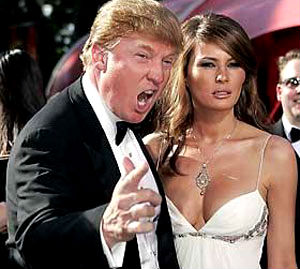
The husband of the President of Finland is being widely ridiculed in the news media after being caught by a journalist’s camera as he plainly ogled the cleavage of  Princess Mary of Denmark and was seemingly caught in the act by the Princess as well. Unfair. He allowed his gaze to linger a bit long, perhaps, and one’s manners are supposed to be somewhat elevated, theoretically, in the presence of royalty, but Pentti Arajarvi was mostly a victim of the sad reality that being discrete, once the primary etiquette requirement of men relentlessly drawn to a woman’s comely assets, is no longer possible in public and often in private as well. President Obama, you will recall, was caught doing a classic male turnaround to catch the spectacle of a perfect female butt passing by.

Even more unfair, and ridiculous, are the opportunistic women’s rights warriors who use such incidents to show how women are still treated as sex objects by men in the workplace and elsewhere. Continue reading

Ethics Alarms Recap: A Long Weekend of Ethics

If the long Presidents Day weekend took you hither and yon and away from ethical dilemmas and controversies, welcome back! Here is what went on here in a lively three days:

Assignment For The Righteous Persecutors of ESPN’s Max Bretos: Learn “The Niggardly Principles”

I'd advise staying away from "niggardly" too, Max.

Ethics Alarms first promulgated the Niggardly Principles in the midst of the so-called Ground Zero Mosque controversy. The Principles are named after the embarrassing controversy that roiled the Washington D.C. government more than a decade ago, in which a supervisor who used the good, old English word “niggardly” meaning “penurious or cheap” was fired for racial insensitivity after an African-American who hadn’t kept up on her Reader’s Digest “It Pays To Increase Your Word Power” complained that he had made a racist remark. The outcry in D.C. over this capitulation to ignorance was so great that the D.C. government reversed itself, though there remained some, like those supporting ESPN’s decision to fire Bretos for an innocent and appropriate application of the idiom ” a chink in the armor” today, who argued that the supervisor should have chosen his words so as not to offend those too ignorant and hair-trigger grievance-minded to comprehend them.

The First Niggardly Principle, therefore, is this:

“No one should be criticized or penalized because someone takes racial, ethnic, religious or other offense at their conduct or speech due to the ignorance, bias or misunderstanding of the offended party.”

A corollary of the FNP is that violating it unconscionably empowers the kind of people who should not be empowered in a free, fair and intelligent society: bullies, race-baiters, grievance police, censors of free expression, and the shamelessly ignorant. That was the theme of a disgraceful incident in which Hallmark pulled an “offensive”card because some African-Americans complained that the term “black hole”—as in Stephen Hawking and “Star Trek”—sounded too much like “black ho”—I’m not making this up— and was thus a racial slur. Hallmark’s craven capitulation was off the charts as First Niggardly Principle breaches go, but in some ways ESPN’s breach was worse; at least Hallmark didn’t pick an employee’s pockets and finger him as a closet racist. Continue reading

Ethics Quiz: The Strange Case of Mitt Romney and the Posthumous Jewish Baptisms

I’m not even sure what the question  should be, but let’s wade into this Twilight Zone dilemma.

"Your mission, Mr. Romney, should you accept it, is to save these dead Jews from vicarious baptism. Your head will explode in 8 seconds..."

Apparently the Mormon Church has been baptizing dead Jews for a  long time. You don’t have to be a Mormon for Mormons to want to save your soul (as I found out when I lived with a Mormon my freshman year in college), so this is undeniably an act of love, if a bit presumptuous. The Church of Jesus Christ of Latter-Day Saints performs what they call “proxy baptisms” in order to save ancestors and others who weren’t baptized in life or who were baptized “without proper authority,” and such a baptism can even take place  after a person has died. When the live Jewish community discovered this was going on, and that even Holocaust victims like Anne Frank were getting baptized posthumously, it strenuously objected and negotiated a  baptism cease-fire of sorts, with the Mormons promising  to only proxy baptize dead Jews who were ancestors of Church members. The deal, however, fell through, and lot of deceased Jews are apparently being sent to Mormon Heaven, or somewhere, against their wills.

Thus Ellie Weisel has decided who is responsible for fixing this—whatever it is…Mitt Romney. Weisel has said that Romney should tell his church to cut it out, because, he says, “it’s scandalous.”

So the Ethics Alarms Ethics Quiz for today is:

If the Mormons believe that baptizing dead Jews saves their souls, do they have any ethical obligation to stop doing it because the Jewish Community, Ellie Weisel, Mitt Romney or anyone else asks them to?

You know what? I don’t think so.I think if the Church made a deal it should keep its promise, but the deal aside: who does this hurt?

I also don’t think it is fair for Ellie Weisel to publicly demand that Mitt Romney throw his weight around in his Church to please another constituency.

Admittedly, however, the weirdness factor here is strong, and it may be blurring my reasoning powers. What do you think?

“Pay-What-You-Can” Ethics

A live performance of Jules Feiffer's "Little Murders" at a regional theater in Arlington, Va. that holds "pay-what-you-can" performances over the periodic objections of its artistic director, me.

Toronto Star ethics columnist Ken Gallinger does a pretty good job today answering a query from a financially strapped theater-lover who feels guilty about attending “pay-what-you-can” professional stage productions. “…My husband says paying less than full fare takes advantage of the theatre company. Technically, we could pay the ticket price; we still have access to credit. And there are things we could cancel…What do you think?” asks the inquirer.

Gallinger explains the benefits to the company of not having a sea of empty seats facing the actors, and also how discount tickets have promotional value to theater companies. All true: the theater companies wouldn’t offer “pay-what-you-can” if they didn’t think it was in their companies’ long term interest. There are other benefits that Gallinger doesn’t mention. For example, the increased audience size still contributes to the average audience statistics that a non-profit company can use to seek advertisements and to argue for community foundation grants.

Even this wouldn’t cover the topic, however. “Pay-what-you-can” and other discount ticket programs are essential if theater companies are going to meet their own ethical obligations to the community, and if live theater is going to survive at all. The ticket prices at most large, established regional theaters are, in a word, unconscionable. Justifiable perhaps, since live theater costs more to produce than can be paid for by box office receipts, but still unconscionable. Continue reading

Let’s Be Clear: Kansas House Speaker Mike O’Neal Is A Disgrace, And He Must Resign

We're praying for you, Mike---to get the Hell out.

Kansas House Speaker Mike O’Neal is refusing to resign his post in the wake of an uproar of his own making. In December, the legislator sent an email to his fellow Republicans asking them to pray Psalm 109,  an unusual and mean-spirited psalm that calls for the death of a leader. The Psalm says, in lines 7-12:

When he shall be judged, let him be condemned: and let his prayer become sin.
    Let his days be few; and let another take his office.
    Let his children be fatherless, and his wife a widow.
    Let his children be continually vagabonds, and beg: let them seek their bread also out of their desolate places.
    Let the extortioner catch all that he hath; and let the strangers spoil his labor.
    Let there be none to extend mercy unto him: neither let there be any to favor his fatherless children.’ Continue reading

Yuri’s Tweets, Flawed Analogies and the School’s Defenders

[Why is it that when I’m traveling and stuck in airports where the supposedly free WiFi doesn’t work and on airplanes that can’t keep on schedule, some post that I assumed was fairly straightforward turns into the Battle of Antietam? I apologize to the various commenter’s whose work product languished waiting for moderation—I just didn’t have the chance. This odyssey ends tonight; I apologize for slowing things down. On the other hand, it’s good to know that my presence is not required for there to be lively and interesting discussions here…thanks, everyone. Good work.]

Don Bosco Prep High School, Class of 1917-1918

That is not to say that sending gross, obscene, or abusive tweets is exemplary conduct; obviously it is not. I have concluded, however, that the proper and ethical use of social media is something that people, including minors, have to learn for themselves by trial, error, research, observing the mistakes and experiences of others, making dumb mistakes and suffering because of them.  Parents and schools, as well as the popular media, have roles to play by giving advice and calling attention to cautionary tales, but heavy-handed attempts to manage social media conduct attempted by authority figures who, as a general rule, neither use nor understand what they are attempting to regulate are both irresponsible and doomed to failure. Like it or not, social media is a primary, and growing, means of communication and interaction in American society, and students are wise….that’s right, wise...to learn how to use it. I was just speaking to a room full of lawyers, and asked them how many used Twitter. The answer: none. But their clients use Twitter, and their client’s adversaries use it, and certainly their children. Their bar associations are making rules about what these lawyers and judges should and shouldn’t be able to do on social media, and most of those bar committee members don’t use Twitter either.As a result, the various jurisdictions have inconsistent rules, based on a lack of knowledge, that are already archaic.

It is fine and responsible for any adult to try to warn a young person that comments on social media need to be considered carefully, that they have a reach far beyond any intended audience and are essentially broadcasts, and that messages or photos can reach people who they hurt or upset, or cause to have a poor opinion of the sender. Ultimately, however, the pioneers in this new frontier of personal expression and mass communication are going to have to learn their own lessons, and better that they learn them now than when they are members of Congress. All punishing students for their tweets teaches them is that people with authority abuse it, and that adults just don’t understand. Because, for the most part, they don’t.

Now the analogies and comparisons:

Public schools vs. Private schools: I gather that the theory here is that if a student voluntarily attends a private school, the student has voluntarily submitted to whatever the school regards as proper discipline, whereas public schools, since they are mandatory and creatures of the government, are constrained by the Constitution. I think I may have encouraged this by a careless reference to the ACLU, which was, of course, a mistake (and I have removed it.) This is ethics, not Constitutional law, and the values are autonomy, fairness, respect, privacy and abuse of power and authority, not Freedom of Speech. I have dealt with several private schools and one Catholic school, and none of them suggested in their printed materials or regulations that they reserved the right to punish my child for what he said, wrote, or communicated during non-school hours, or when he wasn’t physically on school grounds. Neither does Don Bosco, which states as its “philosophy”:

“Don Bosco Prep educates young men so that, through a process of self discovery, each student will come to recognize and acknowledge his talents and limitations, while pursuing academic, athletic, artistic and personal excellence.

“Mindful of both our role and responsibility as a Salesian college prep school, we respect each student as a unique individual. Through active presence in his life, we promote a joyful spirit, intellectual curiosity, self-esteem and emotional maturity. We encourage the development of character and personal responsibility, love for one’s fellow human beings, a concern for the environment and an active commitment to social justice, all of which serve as the cornerstone of each student’s spiritual growth.”

I take none of that, including references to being “an active presence” in a student’s life, “promoting” emotional maturity, and “encouraging” development of character to mean “we can punish your child for absolutely anything he does or says that we disapprove of, no matter where or when it occurs.” It, the school, does all of the things relating to its philosophy in the school, based on the student’s activities and interactions in the school. Any other reading is giving a group of strangers whose biases, background and motivations I can only guess at a blank check to manipulate a child’s life, thoughts and personal activities.

When one teacher from a private school called me to tell me that she felt it was cruel of my son to exclude a classmate whom he did not like from his birthday party, I told her that it was none of her business, and filed a complaint with the school.. Private school does not mean “we can meddle in your child’s private–as opposed to school—activities.

Catholic vs. Secular: All schools should teach character; it happens that Catholic schools do it with more fervor, but that gives them neither a greater obligation nor additional authority. Schools teach good conduct and civility by insisting on appropriate conduct and deportment in school. Are people really prepared to argue that a Catholic school can justify punishing its students for not doing household chores, not washing their hands after using the bathroom in their homes, being cruel to a younger sibling or being disrespectful to a parent? Not only is personal social networking use as unrelated to the school  as any of these, it is also far less significant. How much of a blank check do we want school administrators to have? The right answer to that is that they shouldn’t have a blank check at all, and being a Catholic school changes nothing.

High schools vs. Military Academies: This is just a bad analogy. The student at a military academy has no personal life, and has no privacy. The academy is in loco parentis; the student lives there; authority is total. There is an honor code and a code of conduct, and it applies to everything a student does, including communications. That’s the military. That’s not high school.

High Schools vs. College: Several commenters have referenced the incident from last March when Brigham Young University suspended a star basketball player for having pre-marital sex. Brigham Young is famous for its strict and far-reaching conduct code, which bans drinking, pre-marital sex and many other activities that are virtually courses at other schools. If a student agrees to attend B.Y.U., the student has also agreed to certain conditions unique to the university. Should a more typical college be applauded for suspending a student who has sex with his high school girl friend over Christmas break, in his parents’ home? No; this is none of a college’s business, and attempting to extend its authority beyond the campus and even over state lines in such a fashion is intolerable. If Yuri Wright and his parents signed a document promising that Yuri would never send an offensive tweet during his years at the school, I withdraw my condemnation of Don Bosco’s punishment.

High schools vs. the Workplace: It is true that if an employee engages in conduct outside of work that embarrasses or reflects badly on an employer, ot that interferes with the employee’s ability to do his or her job, the employer is behaving ethically if it chooses to terminate the employee. It is not ethical for an employer to terminate an employee for any private conduct it happens to disapprove of, however. It can’t tell me that I can’t drink or smoke or have sex with men in my own home. It  better not tell me that I can’t vote for Ron Paul or root for the Red Sox, either. The Naked Teacher Principle applies, of course: if I’m a Coca-Cola VP and a Facebook picture shows me chugging Pepsi, that image could undermine my effectiveness at work, and Coke can can me; it’s ethical. If I write an ethics columns for a newspaper and I am caught in an adulterous affair with Marianne Gingrich, the newspaper is only being responsible to fire its unethical, untrustworthy ethicist. None of this applies to Yuri’s tweets. They don’t reflect on the school, or shouldn’t, because the school shouldn’t have any control over his personal communications. They  don’t interfere with his studies, or make him a worse football player.

Expression vs. Conduct: Tweets aren’t conduct. Even if I accept the proposition that a school may, in extreme situations, have some legitimate role in attempting to control student conduct outside of school (and I’m not sure I do), allowing a school to punish a student for the content of his words, uttered or written away from school, is a slippery slope with no braking. If sexually and racially objectionable tweets can get a student expelled, why not tweets critical of President Obama, or cheering on Newt Gingrich? Does Don Bosco’s commitment to “social justice” mean that Yuri can’t tweet that Occupy Wall Street is a crock?

Phony Smile Ethics

From David Foster Wallace’s hilarious essay in Harper’s about a luxury cruise that did not (exactly) end in disaster:

This is related to the phenomenon of the Professional Smile, a pandemic in the service industry, and no place in my experience have I been on the receiving end of as many Professional Smiles as I was on the Nadir: maItre d’s, chief stewards, hotel managers’ minions, cruise director-their P.S.’s all come on like switches at my approach. But also back on land: at banks, restaurants, airline ticket counters, and on and on. You know this smile-the one that doesn’t quite reach the smiler’s eyes and signifies nothing more than a calculated attempt to advance the smiler’s own interests by pretending to like the smilee. Why do employers and supervisors force professional service people to broadcast the Professional Smile? Am I the only person who’s sure that the growing number of cases in which normal-looking people open up with automatic weapons in shopping malls and insurance offices and medical complexes is somehow causally related to the fact that these venues are well-known dissemination-loci of the Professional Smile?

I too hate the Professional Smile, which is, at its core, a lie. It is a mask, a fake-friendly message that may of may not have any truth behind it, and that at its worst has the frightening menace of  Sen. John McCain or Nancy Pelosi, both of whom specialize in the obviously false grin that has seething anger behind it, the smile that says, “I’m going to put you at ease and then, if you give me a chance, slit your god damned throat.” Continue reading

Saluting the GOP’s Most Ethical Candidate, Distrusted For Doing the Right Thing

We'll miss his daughters, too...

Jon Huntsman is gone, finally quitting the hunt for the Republican Presidential nomination long after the futility of his quest had been established. Huntsman was easily the ethics favorite in the competition, though Ron Paul’s candor and integrity also get high marks. He began his campaign with a call for civility, and seldom missed the high standard he set out for himself. Best of all, he correctly identified the ethics core of our nation’s various problems: the trust deficit. Huntsman began hitting this theme hard in Iowa, but perhaps not hard enough. The collapse of public trust in all our institutions is a very real threat to our democracy, for democracy, more than any government philosophy, requires trust to survive. Whatever it is that Republicans want right now, however, trust isn’t very high on the list, and neither is civility. Continue reading

Snafu Ethics

A persnickety Washington Post reader recently reprimanded that paper for using the term “snafu,” which, he said, is but an acronym for “Situation Normal, All Fucked Up” and therefore inappropriate in a “family paper.” Leaving aside whether there actually is such a thing as a family paper any more, the letter once again raised the ethics and civility issue of whether a stand-in for an uncivil word is less uncivil than the word itself. The reader actually agrees with the position I have taken in the past, though he reaches some conclusions from it I would not. Continue reading