Sunday Ethics Warm-Up, 3/8/2010: Daylight Savings Time Edition

Well, It SHOULD still be “Good Morning!”, but it’s not…

1. The most unethical Presidential campaign in recent history.  This profile of in Wisconsin, nicely illustrates the central ethics rot at the core of the Sanders campaign and his appeal. Michelz, we learn, is desperately in debt. He is therefor banking on Sanders to solve his problems by taking money from other people and giving it to him.

This is where the hyping of “income inequality” leads, and it is the basis of Sanders’ unethical message. It is inherently unfair that other people make more money than you do, so the government should use its power to “equalize” income and wealth. We learn in the course of the piece that in last week’s California primary, 47 % who said income inequality was their most important issue picked Mr. Sanders. 13% voted for Joe Biden.

How do individuals brought up in the United States, a nation built on the belief in personal liberty and the responsibility for choosing and making one’s own path in life, come to believe that there is an intrinsic right to a level of wealth and success, regardless of personal choices, industry, talent and character?  We don’t need to ask how we came to have a Presidential contender whose strategy is to appeal to such people and exploit their unhappiness with their current state in life. That is a market-tested approach to acquiring power that has been effective around the world, with disastrous results.

2. Thank you, 1960s! From the res ipsa loquitur department: A new Pew Research Center study of 130 countries and territories shows that the U.S. has the world’s highest rate of children living in single-parent households. From the study:
Continue reading


There Are Many Ethics Villains In This Story, But The Boys Put In Handcuffs Aren’t Among Them.

In July of 2019, 10-year-old Gavin Carpenter and a friend were playing outside with toy weapons near a Fort Carson, Colorado intersection, acting out a favorite video game scenario. One of the weapons was an an orange Nerf bow that apparently didn’t work.  Gavin had a toy gun with an orange tip. It was also broken. The boys might as well have been using their fingers, or sticks.

As part of the game, they pretended to shoot at passing cars. One driver stopped, and was furious, shouting at the boys, who ran  to a grandparents’ house. The man called the police.  The County Sheriff’s deputies arrived and arrested both Gavin and his friend. They were  handcuffed and taken to the Colorado Springs Police Department for mugshots and fingerprinting.

For pretending to shoot at cars with obvious toys that couldn’t shoot anything. And they were ten.

Gavin was finally released into his parent custody at10:30 p.m. They  hired an attorney to help get the charge expunged from Gavin’s record, but the District Attorney was intent on prosecuting.  The boys were moved into a diversion program requiring community service,writing an essay, and other hoops to jump through. 216 days later, what was charged as Felony Menacing was finally expunged from their records

Now the rogues gallery inhabiting this revolting episode: Continue reading

Ethics Quiz: Girl Scout Cookie Cheats?

Just yesterday I bought my yearly two boxes of Thin Mints from some incredibly adorable little girls selling the Girl Scout cookies from a card table outside my local CVS. I had planned on buying them from a Girl Scout I have never met, though the agency of her mother, who sold them to me last year. But she never got in touch with me—I think she’s another one who is steamed at me for some post here (over at Windypundit, it’s slam Jack Marshall day by another former commenter) —so the adorable little girls got my 20 bucks this year.

Today I encounter an interesting opinion piece that holds that mothers like my friend are “cheaters.” JM Finster writes:

As with any fund-drive, the idea is to support the cause, but with the cookies, uniquely, customers buy them to give “the awesome girls who sell them,” in the words of the Girl Scouts, “the opportunity to learn essential life skills, soar in confidence, and quickly discover the leader within.” Research has shown that none of that happens when parents sell the cookies at work..So it is that the cookies land on a desk in a skyscraper without a Girl Scout in sight.

The cookie drive should be better than that. Selling is crucial to every endeavor, in that it requires the ability to make a convincing presentation, to answer questions, and to project self-assurance. Everyone needs to do that, in one form or another, but that last attribute, in particular, is sometimes lacking in the best of us, especially shy young ladies.

Since Girl Scout troops keep track of sales by individuals, even offering prizes for the best results, parent-cheaters can hardly resist the chance to prove their own sales skills and boost their girl to the top of the ranking. …If a Scout comes over to the house for a sales call, a parent will undoubtedly come along as an escort. That’s all right, except that the parent will do all the talking, no matter how hard one tries to give the awesome girl standing off to the side the opportunity to learn essential life skills, soar in confidence, and quickly discover the leader within. With the adult recording the sale and later delivering the cookies, their daughter the Girl Scout—all in one stroke!—wins a prize for outstanding sales and loses the chance to learn something about sales…For the sake of the runny-nosed little girl, who keeps poor sales records, lets her boxes get crushed in the back of the car, and exhibits more enthusiasm than smooth-talk, kindly sidestep the parent-cheaters and let her learn. In fact, make her learn and insist she does the talking. 

Your Ethics Alarms Ethics Quiz to kick off March:

Are parents who help Girl Scouts sell more cookies cheating?

Continue reading

Ethics Comes In Like A Lion Warm-Up, 3/1/2020: Dead Ethics Alarms In New York, London, And Washington, D.C.

That’s my father’s favorite March!

Mine too.

For some reason there has been a breakdown of civility in the comments lately. This has happened from time to time; something in the air or too many social media rants or something; I don’t really care. You all know where the lines are; you cross them intentionally when you cross them. I appreciate the use of a vulgar word or harsh phrase as much as anyone; “asshole” is particularly tempting, because there is no non-vulgar term that quite captures the essence of its meaning. I also prefer to keep moderation light here, and for the most part, the select commenters who have passed my standards and answered the three questions at the bridge correctly usually make me proud, especially when I see what crawls onto other sites’ comment sections.  The would-be Ethics Alarms participants who send in entries like “Your a Trump-loving fuckface LOL!are all stacked up in the spam vault, and you would not believe how many of those I have to read to maintain the high level of participants here. I do not care to read that kind of gutter residue on the blog itself.

I just trashed a full comment by a regular commenter here, something I have not done in over ten years, and I’m not happy about it. Let’s keep that lapse the anomaly that it is.

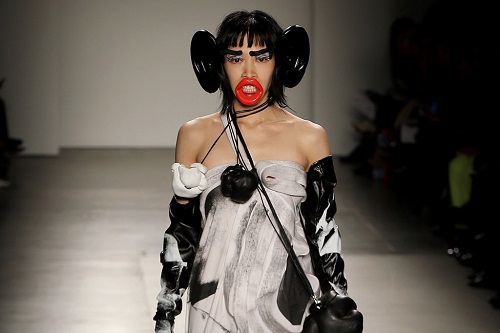
1. From the “When ethics alarms don’t ring” file. Pop Quiz! If you were on the staff of a fashion show about to begin at what the New York Times calls “New York’s famed Fashion Institute of Technology”—which I have never heard of—and several of the models appeared backstage preparing to go out looking like this…

…what would you do?

The answer is that no matter how high or low you were on the metaphorical totem pole, you would be obligated to throw a fit, phone the brass, tell everyone in sight that they are out of their minds, and do everything short of calling in a bomb threat to halt what you know without a shadow of a doubt will result in a public relations disaster.

Incredibly, not a single person raised the obvious objection except an African-American model-who refused to don the giant lips and monkey ears. After the predictable uproar, two F.I.T. administrators were suspended, and  the school’s president, Dr. Joyce Brown (who is African-American) issued a public statement admitting that the Feb. 7 show, intended to demonstrate the work of recent graduates of the school’s M.F.A. program, “failed to recognize or anticipate the racist references and cultural insensitivities that were obvious to almost everybody else.”

Wait—if they were obvious to almost everybody else, why were they not obvious to anyone involved in the show? Continue reading

Morning Ethics Warm-Up,2/25/2020: Remembering “Float Like A Butterfly, Sting Like A Bee” [CORRECTED]

Notice of a correction: in the first version of this post, I mistakenly wrote that the famous photo above was  of the first Liston fight. It was not: this was the dramatic scene that ended the rematch. Thanks to Tim Levier for reminding me.

Good Morning!

1. Cultural literacy thoughts: I wonder…how many Millennial Americans—or among the post-boomer generations—recognize the context of the photo above? On this date in 1964, a brash 22-year-old black boxer named Cassius Clay (1942-2016) pulled off one of the great upsets in sports history, defeating world heavyweight boxing champ Sonny Liston, an 8-to-1 favorite, in a seventh-round technical knockout. The now iconic photo above captured the dramatic finale of the 1965 rematch, ending the speculation that Clay’s victory over the previously frightening Liston had been a fluke.

Indeed, the 1964 fight was just the beginning of a remarkable story.

After his stunning victory, the sudden celebrity attended a victory to a private party at a Miami hotel. In attendance was Malcolm X, the outspoken leader of the rising African American Muslim group known as the Nation of Islam. Two days later, Cassius Clay announced he was joining the Nation of Islam, and renounced his “slave name”  to adopt  the Muslim name, Muhammad Ali. As Ali, he became one of the most influential social and political figures of his era, affecting civil rights, politics, public attitudes, language and culture…and sports, of course, as  professional boxing’s greatest champion. After successfully defending his title nine times, Ali surrendered it in 1967 after he refused induction into the U.S. Army on the grounds that he was a Muslim minister and thus  a conscientious objector. His stand against the Vietnam War galvanized national opposition to the war, especially among students and the young. In 1971,  the U.S. Supreme Court overturned Ali’s draft evasion conviction, and in 1974, he regained his heavyweight title in a match against George Foreman in Zaire, enshrining his phrase “rope-a-dope” in our lexicon. Eventually Ali became  the first boxer to win the heavyweight title three times. His post-retirement diagnosis  of pugilistic Parkinson’s syndrome and the sad spectacle of the once loquacious and witty athlete’s slow decline into near speechlessness and impaired motor functionscontributed to the collapse of boxing’s popularity. Ali was awarded the Presidential Medal of Freedom by Ronald Reagan, and lit the Olympic flame at the opening ceremonies of the1996  Summer Games in Atlanta, Georgia.

My mother, who like virtually everyone in her first generation Greek family was uncomfortable around blacks, once met Ali, who was seated next to her at a Harvard College function when she was Assistant Dean of Housing. She said later that he was the most charming, charismatic, beautiful man she had ever met in her life.

2. You can lead an idiot to child-proof packaging, but you can’t make him think. A study in the Journal of Pediatrics aimed at figuring out why there has been a steep rise in accidental poisonings of U.S. children according to CDC figures has come to a disturbing conclusion. Researchers analyzed nearly 4,500 calls to five U.S. poison centers in Arizona, Florida and Georgia over an eight month period in 2017. They found more than half of the prescription medicine poisonings occurred because parents and grandparents removed  pills and medicines from child-proof packaging to make them more easily accessible, to help the adults remember to take them, or more convenient for travel. Continue reading

Dead Wrong: The Withdrawn Bequest Share

That is, the advice columnist’s answer to an easy ethics question last week was dead wrong.  Once again, the advice-giver in question is Philip Galanes, the Times proprietor of Social Q’s, essentially that paper’s version of “Miss Manners.” Galanes, I now see upon googling him, is a novelist and a lawyer. That explains, perhaps, his unfamiliarity with some of the more nuanced aspects of ethics. Here’s the question he received in its entirety:

My brother died last year and bequeathed his entire (small) estate to me. He had one child, a daughter, to whom he left nothing. Feeling sorry for her, I told my niece I would give her half of the estate. (None of this becomes official until April.) But my circumstances have changed dramatically. My husband was recently diagnosed with pancreatic cancer. He is undergoing treatment, but we face a very uncertain financial future. I would now like to keep the entire estate. My niece is doing well financially, with many earning years ahead of her, unlike me. Is there a way to tell her I’ve changed my mind so she won’t hate me forever?

The Social Q’s verdict: “…Say, ‘I’m sorry if your father’s will hurt you. I promised you half of my inheritance out of love for you and hoping to heal any pain the will caused. But my husband is seriously ill, and I can’t afford to give you the money now. If I can make it up to you later, or in my estate, I will do it.’….For readers worrying about a verbal contract here, let’s assume B’s promise falls into one of several exceptions that requires agreements to be in writing….”

Yeccchh.

Here’s the ethical answer: Continue reading

Lunchtime Ethics Appetizer, 2/12/20: With Just Desserts!

Bon Appetite!

In a perfect example of how avoiding bias can create bias, I am accumulating a backlog of genuine and valuable ethics stories that are triggered by or related to political developments, and deliberately talking myself out of posting them. As regular readers here know, this has been a problem since the beginning of the Trump administration, when the Democrats, the resistance and most of the media  resolved to try to bring him down and cancel the election results with a campaign to delegitimize President’s Trump’s election. I regard this as one of the greatest ethics crises in U.S. history (another, running concurrently, is the near complete abdication of professional ethics by journalists), and I can’t ignore it. But doing my job, as repetitious as it seems, also means that I am reluctant to write about other political stories that I would have included otherwise, and often they involve important issues.

1. Which reminds me: One of the Washington Post’s most reliable anti-Trump columnists, Greg Sargent, issued an opinion piece that would be a strong entrant in a “Hypocrite of the Year” competition. Here’s the line that made my head explode: “Such delegitimization of the opposition strikes at the core of our system. Recognizing the opposition’s legitimacy is a key pillar of accountability in government…”

Astounding! Sargent’s ideologically compatible pals have been working overtime to deny the legitimacy of Trump’s election, from attacking the Electoral College to claiming a Russian conspiracy,  encouraging and cheering “Not my President!” demonstrations, manufacturing impeachable offenses out of thin air, and turning such once-neutral and unifying events as the Inauguration, the Kennedy Center Honors and the White House Correspondents Dinner—and more recently, a State of the Union address where the speaker of the House, on camera, symbolically rejected the legitimacy of the speech by ripping it up on live TV——into opportunities to directly challenge this President’s right to be in office and to be accorded the same respect and civility of his predecessors. If anyone who has been part of this assault, and Sargent definitely has, makes the accusation that Trump is wrong to “delegitimize the opposition,” that critic is either deliberately gaslighting the public, or so devoid of self-knowledge as to be functionally crippled.

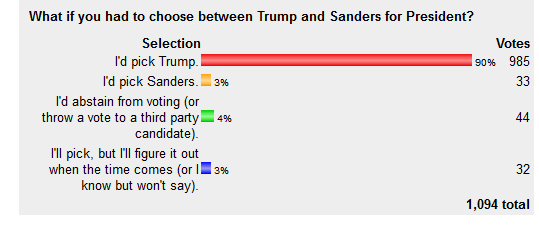
2. Here’s an unscientific poll result that should give Democrats chills. Ann Althouse asked her readers whether they would vote for Bernie Sanders or President Trump if that was the choice in November. Ann readership is Madison, Wisconsin heavy, consisting of many of her former students. She is resolutely politically neutral, laning Left, as she voted for both Hillary and Obama, twice. She has also criticized many of the attacks on Trump, including in the news media, causing her commenters, if not her readership, to see an exodus by the Trump-Deranged, much as what has occurred on Ethics Alarms. Those commenters remaining, I believe, are not uncritical of the President, and I would expect to find them on the “disapprove” side in a Gallup poll. I was very surprised at Ann’s poll results:

In a related development… Continue reading

Ethics Alarms To “The Ethicist”: It’s Called “The Golden Rule”—Why Is That So Hard?

I hadn’t checked in for a while on Kwame Anthony Appiah, the N.Y.U philosophy teacher and author who finally brought ethical consistency to the New York Times magazine’s advice column, “The Ethicist.” I was surprised to find him struggling to answer two family related queries that I would have assumed he could and should have answered  easily with three words: “The Golden Rule.”

The first inquirer asked in part,

Recently a mutual acquaintance who knows my friend’s husband well told me that he has been cheating on my friend on and off for years with someone who once worked with him.I know that if I reveal this information, my friend will take their child and leave her husband. Do I sit on this information and pretend the affair isn’t happening, or do I tell her?

Isn’t that an easy call? Of course she should tell her friend. The Golden Rule applies: would she want to be told if the positions were reversed? Sure she would; anyone would. Not telling her would be a betrayal of the worst kind.

Yet Appiah uses 608 words to reach that conclusion. 608! This makes a slam dunk of an ethics decision appear to be a difficult one. Oh, it’s difficult in the sense that the inquirer has to take sides in a crisis affecting a couple she and her husband are close to, and thus the repercussions as well as the process will be unpleasant, but that’s life. One of the Ethics Alarms rules is that if you can fix a problem, fix it. The Ethicist’s rabbinical musings about the decision just supplies a dangerous volume of rationalizations to temp the questioner into keeping the husband’s secret, and abetting the harm. Continue reading

Morning Ethics Warm-Up, 1/23/2020: You Know, If People Keep Putting Impeachment Ethics Fouls In Front Of Me, I May Have To Comment On Them

Good Morning!

January 23 is a big day in ethics, good and bad. In 1964, poll taxes were finally banned via the 24th Amendment. In 1973, peace was finally declared in the Vietnam War (though it was hardly the “peace with honor” President Nixon called it.)In 1977, “Roots” debuted as a TV mini-series, helping to educate millions of Americans who knew very little about slavery.  In 1988, the Challenger exploded as a result of an engineering ethics breakdown. On this day in 1998, Bill Clinton looked America in the eye and denied having sex with Monica. Of course, he wasn’t lying, because he meant “sexual intercourse.” Sure. And finally, in 1989, Ted Bundy was electrocuted. Good.

1. Impeachment notes. I will not watch the trial, but these kinds of things that come to my attention cannot be ignored:

Instead, we are here today to consider a much more grave matter, and that is an attempt to use the powers of the presidency to cheat in an election. For precisely this reason, the President’s misconduct cannot be decided at the ballot box—for we cannot be assured that the vote will be fairly won. In corruptly using his office to gain a political advantage, in abusing the powers of that office in such a way as to jeopardize our national security and the integrity of our elections, in obstructing the investigation into his own wrongdoing, the President has shown that he believes that he is above the law and scornful of constraint.

Good Lord. Continue reading

Comment Of The Day: “First Open Forum Of 2020!”…Gift Unwrapping Usurpers

In today’s Open Forum, A.M. Golden raised an ethics issue that had never crossed my mind. I had never experienced it, and never heard or read anyone else mentioning it. My recently departed Jack Russell terrier Rugby occasionally opened a Christmas present that wasn’t his, but I don’t think that counts.

Here’s A.M.’s Comment of the Day:

Today’s Miss Manners features a letter regarding one of my pet peeves:

https://www.mercurynews.com/2020/01/10/miss-manners-they-call-cute-i-call-bad-manners/

In a nutshell, the letter writer is tired of bringing presents for her three-year old niece only to watch the child’s six-year old sister open them for her and hand her the opened presents. She believes each child should have the joy of opening her own presents. She has been told the three-year old is now doing the same to her younger sister. The mother of the children doesn’t see anything wrong with it. When the letter writer asked the six-year old to allow her sister to open the present the letter writer brought herself, she was told the child was later upset and crying over why she couldn’t open her sister’s presents for her.

I have been in the letter writer’s shoes more times than I care to have been. It’s frustrating to attend a young relative’s party and watch some random kid plaster himself to the birthday child, getting in every photo and “helping” the child open his presents. Inevitably, the Birthday Mooch, as I’ve dubbed him, will be half-heartedly cautioned by his parent (think, “No…stop…don’t” a la Gene Wilder in “Willy Wonka and the Chocolate Factory”) only to have the Birthday Kid’s Mom jump in to say, “It’s alright!”

No, it’s not. Look at your child’s face and see how excited he is to have his presents opened by someone else, Mom, before you give another kid free reign to usurp the Guest of Honor. Continue reading