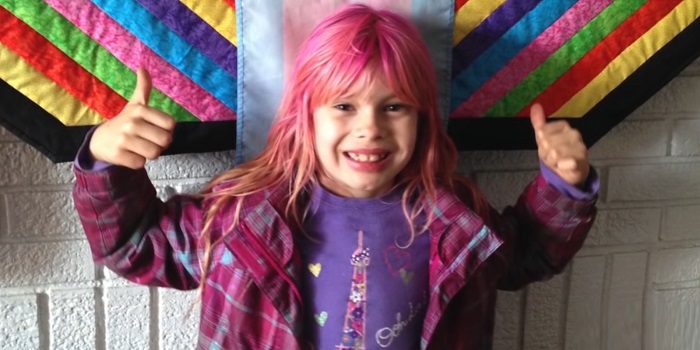
On Twitter/”X,” the advocacy organization “Restore Childhood” documents the horrific case study of a little boy pushed into “gender affirming care” by his woke-lunatic mother, facilitated by unethical medical professionals. Below is the tweet series. You can watch the disturbing videos here.
By the established standards of the news media and the rest of the Axis of Unethical Conduct, it should be, don’t you think? But apparently not.
Huh.
A throbbing example of wildly varying standards in the media depending on whether they are covering Donald Trump or Kamala Harris just raised its warty head. Did you see that Doug Emhoff, Kamala Harris’s husband who was largely invisible until she pushed President Biden off the Democratic ticket, admitted he had an adulterous affair with his nanny and got her pregnant, leading to his divorce? That happened in August, after the slimy Daily Mail broke the scandal and Emhoff came clean to CNN. I missed it entirely, which means that, for example, the New York Times either ignored it or soft-peddled it because, well, you know. But the story burst on the social media scene this week after ex-Obama paid liar Jen Psaki, now a full-time Axis propagandist at MSNBC, interviewed Emhoff and gushed that he had “reshaped the perception of masculinity.” “Has that been an evolution for you and do you think that’s part of the role you might play as first gentleman?” Psaki continued. Yecchh. That was nauseating enough (no Vice-President’s spouse has the power, visibility or status to “reshape” anything), but Emhoff’s answer exploded heads from coast to coast.
Apparently a biological male who “identifies as female” plays on the Plymouth Regional High School girls’ soccer team in New Hampshire. When the team played its regional rival Bow High School, some Bow parents, protesting the presence of the player whom they regarded as a danger to the born-female players on the Bow team, wore wristbands like the ones above as a silent protest. The Bow High athletic director had told concerned parents before the contest that “in the wake of a federal judge’s ruling that the term ‘girl’ includes males who identify as female,” he felt he was powerless. (He’s a weenie. If he agreed with the parents, he could simply have his team refuse to play the Plymouth team, accept the consequences, and raise the issue.)
When the parents’ “XX” bands appeared at the game, school officials stopped the soccer match, ordered the parents to remove the wristbands, and even “issued [a] police-enforced ‘No Trespassing order’” against two parents who refused.
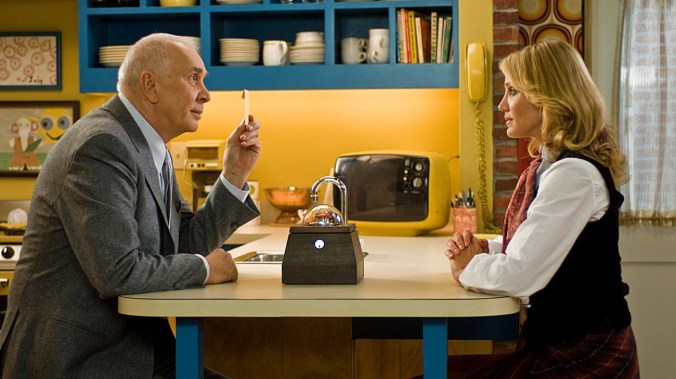
This is very strange. I wrote about the ethics horror movie “The Box” just this year, yet had no memory of writing the post or seeing the whole movie, despite stating in the post that I had. Then I noticed that the post was dated February 28, the day before I found my wife’s body in our living room. Apparently the shock erased some files.
Moreover, it is creepy that I posted on a movie about a couple that pushes a button on a mysterious box after being told that doing so will kill a stranger but also result in their receiving a million tax-free dollars from an anonymous authority, and shortly thereafter discovered that my own wife had died of unknown causes.
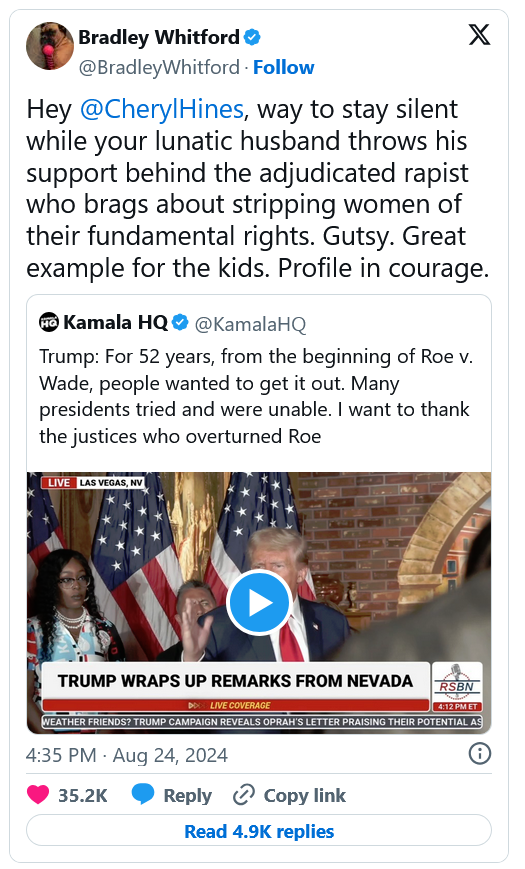
Just remember, the Ethics Alarms position is to strive as much as possible to remain unbiased regarding a performer’s art regardless of his or her demonstrated political orientation or revealed personal character flaws. I enjoy Bradley Whitford as an actor.
But only an unethical, bullying asshole would write a tweet like that.
J.D. Vance’s much maligned “cat ladies” snark , like many furiously slammed comments by conservatives and Republicans are, may have focused attention on to a societal trend seriously threatening the health of American society. (If only he could have articulated it better.)
Lately I have been bombarded with TV ads for Smalls cat food. The promotions and commercials claim that it is “human grade” cat food, and why not, since the TV spots feature disturbed individuals male and female, not just proclaiming these animal companions as their surrogates for children, but literally stating that they are children. “He’s my son,” a young woman says in one ad, speaking of her cat. “She’s literally my baby!” says some guy, also talking about a feline “fur-baby.” Literally!
This would be funny in a mordant way if it were not so ominous. I can’t blame cat food companies for taking advantage of the apocalyptic collision of progressive anti-family attitudes in the U.S. and pet mania: so many people do come to regard a dog or a cat as cheaper, more predictable, less demanding equivalent of a child. What is disturbing about the Smalls commercials is that they represent this mindset as healthy and normal.
Since there is some reason to suspect that Jill Biden has been doing an Edith Wilson impression for at least some of her husband’s ill-starred term as President, a substacker decided to do a deep dive into Dr. Jill Biden’s dissertation to assess exactly how intellectually qualified she is to be shadow-President. What she found was, to understate it, horrifying….and yet, all in all, not surprising.
To summarize, the doctorate of education Jill received from the University of Delaware in January 2007 was based on a “scholarly” dissertation that was objectively crap. It is riddled with typos, mathematical errors, and horrible writing. Holly Mathnerd (not her real name, presumably) writes in part (this is a huge essay),
Waking up this Father’s Day [Thanks, Dad,for 1) being such a terrific, selfless father 2) for continuing to be an inspiration, a role model and a guide during my highs and lows (like now), and everything in-between 3) for loving my wonderful mom and showing it so brilliantly to everyone, especially her, without interruption for almost sixty years; 4) for somehow saving so much money on a modest salary to hand over to my sister, me, and the three grandchildren through sacrifice and smart investing, because without it I would be living in a cardboard box right now, and 5) for surviving the Battle of the Bulge] to the near certainty that my son (who informed me last week that he would like me to refer to him/her/they as my daughter, Samantha. OK! ), is almost certain to ignore this rather contrived holiday (which is fine with me), a mystery in my yard in which someone or something keeps pulling the 15-foot-long heavy plastic, 7″ diameter tubing, installed to send runoff from the gutters into the garden rather than into my home’s foundation, off the down spout and dragging it into my neighbor’s yard, and another fight with a customer service rep, who, I swear, spoke exactly like Andy Kaufmann’s character on “Taxi” but faster than an auctioneer—yes, this IS a long sentence!—I sat down with Spuds to talk myself out of seppuku, drink a cup of coffee, and check what nonsense the various news networks were spouting.
…the main one being that the distress signal is appropriate, because the Axis of Unethical Conduct proved with this fiasco that it is ruthless, shameless, untrustworthy, and will do anything in 2024 to mislead the public if it might mean a few extra votes for Democrats. Or maybe the main one is that your friendly neighborhood ethicist was right about this story from the very start, which is why Fredo asked to make another appearance as my spokesman.
And this, my friends, is why we can’t have nice things.
Or a functioning republic.
Let me not get to far ahead of myself. Right now, the whole, biased, corrupt, anti-Trump, anti-conservative, Biden-protecting propaganda-spewing mainstream news media, the third partner in the Ethics Alarms-dubbed Axis of Unethical Conduct (“the resistance,” and Desperate Democrats completing the troika) is doing a mass Jumbo (“Flags? What flags?”) regarding what was its favorite earth-shattering scandal a week ago. This sudden amnesia was brought on because the Washington Post, perhaps seeking to embarrass its old rival, effectively eviscerated the Times’ “Get Justice Alito!” scoop, which EA first discussed here, and subsequently here, here, and here. (Don’t make me describe it again: I was sick of it days ago.)
Two days ago, the Post revealed that it had known about the first flag episode more than three years ago and had decided that it wasn’t newsworthy (because, as the revealed facts showed clearly, it wasn’t). Now-retired SCOTUS reporter Robert Barnes traveled to the Alito’s home on January 20, 2021, the day of Joe Biden’s inauguration, to follow-up on an anonymous tip he had received from some Alito-hating asshole neighbor about the flag. After investigating, Barnes and the Post concluded there was no story, because the flag-raising appeared to be the work of Martha-Ann Alito, Alito’s wife, not the Justice, as part of her dispute with her neighbors.
Increasingly, Americans no longer agree on what justice and the rule of law mean. This is a very important societal problem, and gee, it would be nice if we had two, or even one, Presidential candidate who could articulate the elements of the crisis well and persuasively enough to make a sufficient proportion of the public aware that this trend must be addressed and reversed.
But we don’t, do we?
The most recent story that brings this into focus comes from Arizona, one of many states with a fracturing, incoherent culture these days. Melody Felicano Johnson, 39, attempted to murder her husband, putting bleach in his coffee at least twice. The woman’s husband, a US airman, began suspecting that something was amiss in March of 2023 when he was stationed in Germany; his wife’s coffee was never very good, but for weeks it had been especially foul.