Be Careful What You Wish For Dept.: “Occupy” May Finally Have a Plan, and Sure Enough, It’s Ethically Bats

Oh, yes,THIS is bound to work out well…

The core of my objection to Occupy Wall Street and its progeny was and is that it never had the discipline, cohesion or communications skills to make it clear what the “movement” really wanted to accomplish, other than generally blaming all the world’s ills on the wealthy and successful. This was the reason for its failure, though Occupy fans like to say that it “succeeded” by starting a national dialogue about corporate executive salaries and the growing disparity in income levels between the richest and the poorest Americans—as if that dialogue hadn’t been ongoing long  before the first sign went up in Zuccotti Park.

Now there are signs that the Occupy bitter-enders are hard at work launching a real, substantive effort with a specific goal, albeit and insane one: to bring down the financial system with a “debt strike.” ( In These Times headlined its story about this “You Are Not A Loan.” Pretty clever!) The idea is to refuse to pay back the interest or principal on outstanding debt, and to insist that all loans and interest  be forgiven, since the debt system is inherently corrupt and rigged to transfer wealth from the poor to the rich.

We shouldn’t have to expend a lot of argument on why this is unethical. People, companies and nations in serious debt reach that point because they spend more money than they have. They borrow money promising to repay, agreeing to pay an additional fee, interest, for the privilege of using money that doesn’t belong to them. The vast majority of debt is not amassed by desperate debtors who have to deal with the equivalent of Loan Shark Larry and risk broken legs or death unless they pay unconscionable fees. Most debt comes from wanting something before you can pay for it. While laws are in place to minimize predatory lending and to provide a safety net (in the form of bankruptcy) so people and companies don’t end up destitute and in debtor’s prison, essentially the system, like society itself, exists on trust, the cornerstone of all ethics.  Lenders give their money to trustworthy loan-seekers, and charge higher interest rates to those who they deem less trustworthy. That is fair. Continue reading

Ethics Quiz: The No-Tolerance Catch 22


Should you trust this guy to be reasonable?

The Des Moines Register reports on a jaw-dropping example of “no-tolerance” management at its saddest, and the astounding fact that it did not, in fact, occur at a an educational institution, but at a bank.

Wells Fargo Home Mortgage  fired 68-year-old Richard Eggers because in 1963, when he was 18, he put a cardboard cutout of a dime in a Laundromat washing machine and was duly convicted of operating a coin-changing machine by false means. Since that time, after spending two days in jail (they were strict in Iowa back then), Eggers has been on the straight and narrow. He is a Vietnam veteran, and tells the press that he can’t remember his last speeding ticket. He has also been a loyal and effective employee of Wells Fargo for seven years. So why fire him over a stupid and trivial crime he committed when Kennedy was President, TV was black and white, Mary Tyler Moore was exciting male viewers in her Capri pants on the brand new “Dick Van Dyke Show,”and people trusted Uncle Sam? Continue reading

Unethical Quote of the Week: Vice-President Biden (No, Not THAT Unethical Quote!)

 “I guarantee you, flat guarantee you, there will be no changes in Social Security. I flat guarantee you.”

—-Vice President Joe Biden, in reply to a supporter at a campaign stop in southern Virgina who told him,  “I’m glad you all are not talking about doing anything with Social Security.”

I know this feels like “Pick on Poor Joe Biden Week” at Ethics Alarms, but everyone has a lot of catching up to do in that regard.

The Washington Post picked up on the above quote by Biden, which it made the subject of an editorial and pronounced “depressing.” It is more than depressing, but then, the Post has to protect Democrats even when they prove themselves irresponsible or dishonest, as Biden does with this “guarantee.” As the Post quite accurately points out, Social Security is going broke, its trustees have called for immediate reforms, and the longer the government waits to do what is needed, the harder it is going to be to do it. Biden, however, and presumably his superior, President Obama, apparently believes that either refusing to take the steps that are essential to prevent a Social Security meltdown or lying to the public about the fact that they will have to take them is preferable to the alternative: responsible fiscal policy and governance and leveling with the public. Critics can scream about the broken system, economists can repeat the math, op-ed writers can warn against constantly “kicking the can down the road” until, like Greece and other profligate and incompetent societies, there is no more road, but if our leaders refuse to show political courage and do their duty, the U.S. has a guarantee, all right—a guarantee of future fiscal catastrophe. That’s okey-dokey with politicians like Biden however. He doesn’t need Social Security, and besides, he’ll be happily drooling in Madam Kluck’s Home for the Bewildered by then. Based on his recent conduct, maybe sooner than he thinks. Continue reading

The Economic Meltdown: Accountability Check

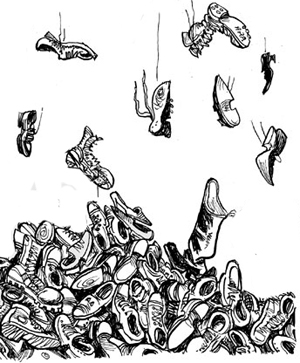
The shoe fits both Parties.

The ethics story of week was the dropping of the missing shoe in the “Friends of Angelo” scandal that helped drive Democratic Senator and party leader Chris Dodd into retirement. (More here.) It fell like this:

WASHINGTON (AP) — The former Countrywide Financial Corp., whose subprime loans helped start the nation’s foreclosure crisis, made hundreds of discount loans to buy influence with members of Congress, congressional staff, top government officials and executives of troubled mortgage giant Fannie Mae, according to a House report.

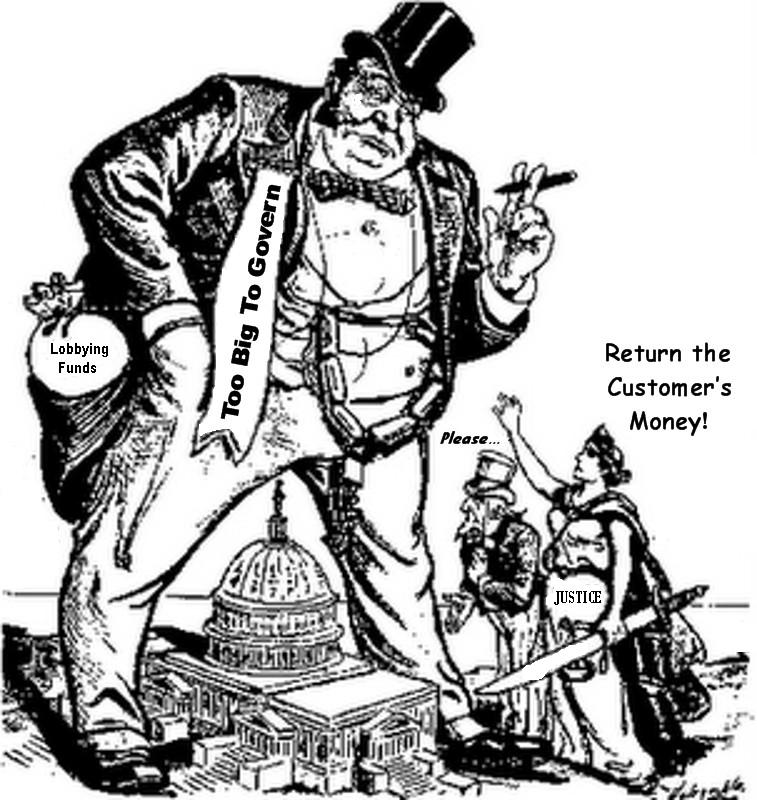
What the report indicates is that the bribery of regulators and members of Congress to allow the sub-prime mortgage con-game to continue was far worse and for more widespread than anyone realized. Countrywide offered special loan deals to dozens of influential government officials to stave off regulations that might have avoided or greatly lessened the mortgage collapse that triggered the current long-term economic crisis: 

“Documents and testimony obtained by the committee show the VIP loan program was a tool used by Countrywide to build goodwill with lawmakers and other individuals positioned to benefit the company,” the report said. “In the years that led up to the 2007 housing market decline, Countrywide VIPs were positioned to affect dozens of pieces of legislation that would have reformed Fannie” and its rival Freddie Mac, the committee said.

More: Continue reading

Ethics Quiz: The Bank, the Addict, and the Broken Egg

There was a little software problem when Bank of America acquired LaSalle Bank and the two were transferring account data. As a result, LaSalle depositor Ronald Page found that he could make unlimited ATM cash overdraft withdrawals, even though he had only $300 in his checking account.  This tempting state of affairs lasted for seventeen days, and then from December 1, 2008 to May 31, 2009, Page gambled like a man on fire.  Unfortunately for Page and Bank of America—but fortunately for several casinos—Page is a gambling addict. He withdrew, and gambled away, $1,543,104.00

Now the U.S. Attorney’s Office in Detroit says he is seeking to send him to jail for 15 months  after he pleaded guilty to charges of theft of bank funds. He is also going to be required to pay back the money, with interest, guaranteeing poverty for life.

Your Ethics Alarms Ethics Quiz question:

Is this fair? Continue reading

University Trustee Investment Conflicts: When the Stumps Start Showing

University boards are great for mutual back-scratching

Deep water hides all stumps, as the saying goes, and while the endowments of rich universities were piling up cash during the investment-friendly period before 2008, nobody questioned the universities’ choices of which companies and funds to invest in. Then came the meltdown, and endowments of over a billion dollars lost an average of 20% or more. That kind of hit has consequences, and among them were that a lot of programs got cut and a lot pf people lost their jobs.

That, in turn, provokes scrutiny: the deep water had receded, and the stumps were out to see in all their ugliness. As an article in Inside Higher Ed explains, among the stumps on display was the fact that many prominent universities invested their funds in places where their trustees had financial interests: Continue reading

Integrity Check For Obama Supporters: Is This Really How You Want The Campaign To Go?

On the heels of Newark Mayor Corey Booker’s criticism of the Obama campaign’s anti-Bain ad and his subsequent simpering recant, an interesting thing happened: some people actually checked the ad for fairness and accuracy…never mind that it was widely interpreted as an anti-capitalist statement in the world’s most successful capitalist nation. Part of the impetus for the check was loyal Democratic consultant and spin-master Lanny Davis announcing on television that the ad was deceptive in more ways than one.

If you have not seen the spot, here it is:

It tells the story of the demise of  GS Industries through interviews with sad-eyed, salt-of-the-earth workers who accuse Bain of buying their town’s small steel company to destroy it. 30-year steelworker Joe Soptic tells the camera,  “They made as much money off it as they could. And they closed it down, they filed for bankruptcy without any concern for the families or the communities.” Jack Cobb, a another steelworker, calls Bain “a vampire. They came in and sucked the life out of us.” Things were going fine, they all say, until Bain Capital, under the leadership of Mitt Romney, bought the company and soon sold them down the river, laying everyone off and pocketing a huge profit. How that would work…how buying a company and its equipment and then quickly shutting it down would be profitable….is never explained, because actual information is irrelevant to the makers of the ad. The point of the Obama campaign is to contrast the intercut video of Mitt Romney saying he created jobs with the weather-beaten faces of hard-working Americans who say he threw them out of work to funnel money to his rich friends.

Deceit, you’ll recall, is when one uses facts to deceive, usually by omitting other facts that make the revealed facts understandable. Deceit is a form of lying, a very effective and insidious form. President Obama’s anti-Bain ad is, beyond question, deceitful, and deceptive, which means that in this instance at least, so is he. For he, Barack Obama, “approved this message.” Continue reading

Estate Tax Ethics

This was not my father. For one thing, he was shorter.

My sister and I finally settled up the estate of our parents after over a year of paper signing, meetings with accountants, and mind-numbing calculations. The estate, as my folks wanted it, was divided 35%-35%-30%, with the last portion going into a trust for the three grandchildren. The amount of money in the estate was a shock to my sister and me, and a very pleasant surprise, though for all the problems the money will solve, we would have forfeited all of it to have Mom and Dad alive today. Still, being able to give over substantial assets to their children and grandchildren was one of their lifelong goals, and they would have been satisfied and proud that they succeeded so spectacularly.

My sister, a good, reliable liberal, asked me whether I felt guilty about the inheritance. I said yes, in the sense that I wish our parents hadn’t been so resolutely frugal in their retirement, and had spent more of the money they earned and saved on more of their own pleasure and enjoyment rather than squirreling it away for us. But did I feel any pangs of conscience because the money wasn’t going to Uncle Sam’s coffers?

Absolutely not. Continue reading

Ethics Dunce: Mirlande Wilson

"Share? Why should I share?"

Mirlande Wilson was part of a lottery pool formed in the Maryland McDonald’s where she works, and claims that she bought one of the three winning tickets that will split the $640 million dollar Mega Millions jackpot. But Wilson told the New York Post that although she did take part in the pool, she bought the winning ticket on her own and has no intention of splitting the winnings. A co-worker who took part in the pool dispute’s Wilson’s story and says Wilson was given additional money late Friday night to buy extra lottery tickets before the Mega Millions drawing.

Why are people like this? Yes, I know, greed…still: does winning a fortune have to turn people into utter, irredeemable jerks? Continue reading

Greg Smith’s Urgent Ethics Alarm

“Today is my last day at Goldman Sachs. After almost 12 years at the firm — first as a summer intern while at Stanford, then in New York for 10 years, and now in London — I believe I have worked here long enough to understand the trajectory of its culture, its people and its identity. And I can honestly say that the environment now is as toxic and destructive as I have ever seen it”

This, says Greg Smith, is how the leadership of Goldman Sachs sees its clients.

With that, Goldman Sach’s executive Greg Smith began his remarkable op-ed in the New York Times, sending his former employers into crisis mode, panicking investors, and setting the financial, political and journalistic worlds buzzing. Obviously, it was an exposé about ethics as much as anything else.  Smith described a corporation-wide breach of trust with clients, a culture in which leadership openly derided those the company pledged to serve as “muppets,” and apparently, sheep to be sheared:

“It makes me ill how callously people talk about ripping their clients off… I don’t know of any illegal behavior, but will people push the envelope and pitch lucrative and complicated products to clients even if they are not the simplest investments or the ones most directly aligned with the client’s goals? Absolutely. Every day, in fact.”

Smith cites a breakdown in leadership, resulting in a corruption of values: Continue reading